
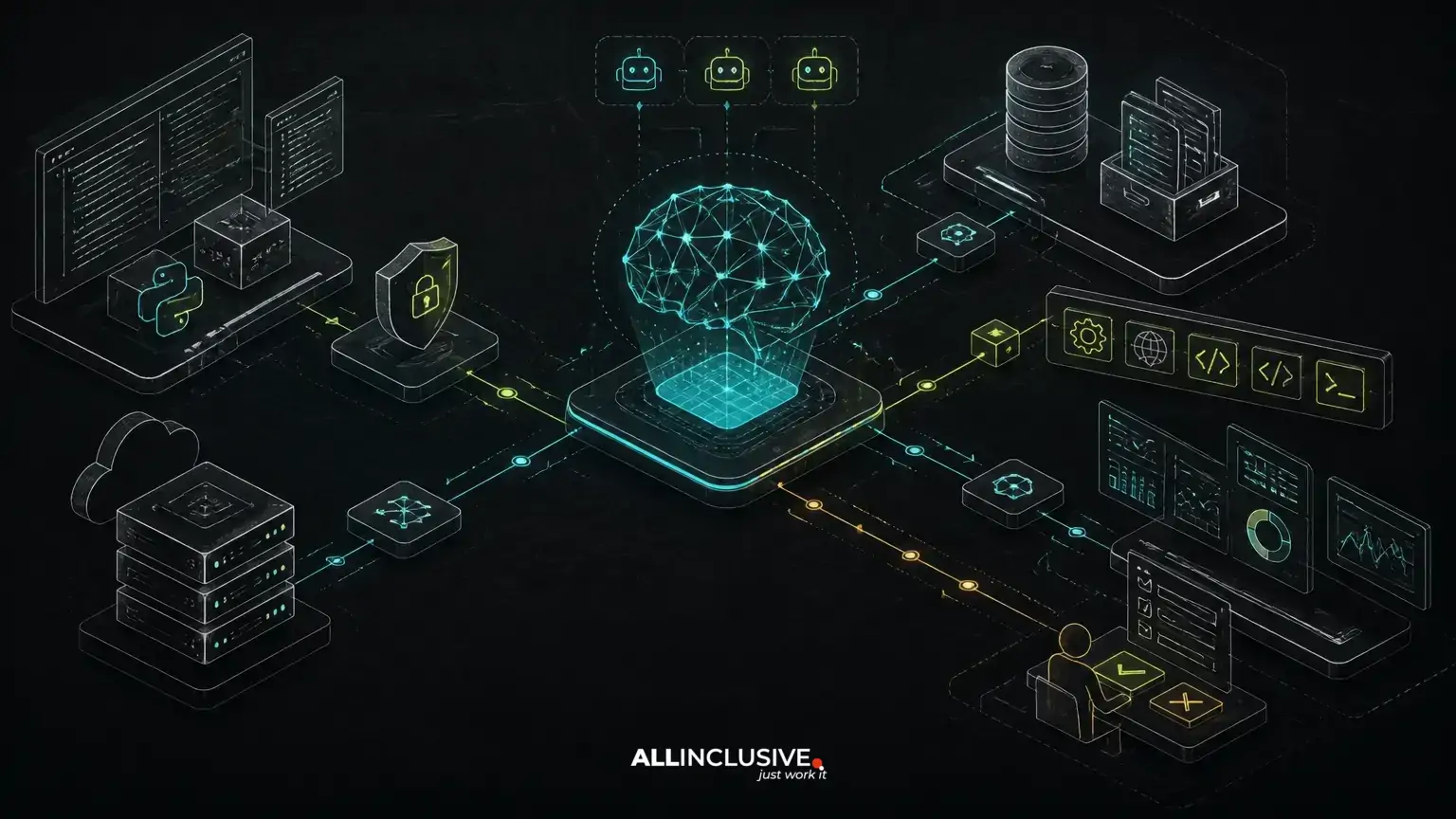
AI agent development becomes a production engineering problem when an agent must do more than generate an answer. A production-ready agent needs controlled access to tools and data, reliable retrieval, explicit permissions, measurable behavior, observability, privacy safeguards, fallbacks and a clear path to human review.
The central design question is not simply which model to use. It is whether the complete system can perform useful work safely, predictably and economically within a real business workflow. That usually means combining an LLM with application services, retrieval infrastructure, business rules and operational controls rather than treating the model as the application.
This article explains the main decisions involved in building production-ready agents and how a Python AI service can work alongside Laravel or another application layer that owns users, workflows and business records. For broader context on building production systems, see AI proof of concept versus production.
What an AI agent does differently from a chatbot
A conventional chatbot usually responds to a message using a prompt, conversation history and possibly a knowledge source. An agent can interpret an objective, decide which actions are needed, call approved tools, inspect results and continue until it reaches a stopping condition or requests assistance.
That distinction introduces both value and risk. An agent may retrieve an account record, draft a response, create a task, update a ticket or call an external API. Each action creates consequences that do not exist in a purely conversational interface.
A useful production definition is therefore:
An AI agent is production-ready when its decisions and actions are constrained, observable, testable and recoverable within the business process it serves.
Autonomy should be treated as a design variable, not a default. Some workflows need only recommendations. Others can permit low-risk actions automatically while requiring approval for irreversible or sensitive operations.
The architecture behind a production-ready agent
Separate the model from the application
The LLM should not be the only place where business logic lives. The surrounding application should enforce authorization, validate inputs, apply state transitions and record audit events. This prevents a prompt or model output from becoming an informal replacement for domain rules.
A common architecture assigns AI-heavy work to a Python service while Laravel or another web application layer owns authentication, product workflows, queues, billing, notifications and persistent business entities. The services can communicate through authenticated APIs or asynchronous jobs. The exact split depends on the team and product, but ownership should be explicit.
This separation improves maintainability. Teams can change prompts, retrieval logic or model providers without rewriting the core application, while application developers can evolve workflow rules without embedding them in agent instructions.
Use a controlled orchestration layer
The orchestration layer manages the agent loop: selecting a model, assembling context, exposing tools, validating tool calls, handling retries and deciding when to stop. It should impose limits such as maximum steps, timeouts, token budgets and permitted tool sequences.
Unbounded loops are a common failure mode. An agent that repeatedly retries a failing API or keeps generating alternative plans can create latency and cost without improving the result. A stopping policy should cover successful completion, validation failure, tool failure, low confidence, policy restriction and escalation to a person.
Retrieval, embeddings and grounding
Many agents need access to company policies, product records or operational documents. Retrieval-augmented generation, or RAG, can supply relevant context without requiring every fact to be placed in a prompt or model training process.
A typical retrieval pipeline may include document parsing, chunking, metadata extraction, embeddings, vector search, keyword search and reranking. The goal is not to retrieve the largest possible context. It is to provide the smallest trustworthy set of evidence needed for the task.
Metadata matters as much as semantic similarity. Access scope, document status, effective date, tenant, department and source type can determine whether a result is appropriate. A semantically relevant document that a user is not allowed to see is still an invalid retrieval result.
Teams should also decide whether retrieval belongs in an existing relational database with vector capabilities, a dedicated search service or a combination of systems. The right choice depends on data volume, filtering requirements, operational ownership and query patterns. The trade-offs are explored in pgvector versus Pinecone, while RAG versus fine-tuning provides a framework for deciding how domain knowledge should be supplied.
Tools need permissions, validation and boundaries
Tool use is where an agent becomes operational software. A tool should have a narrowly defined purpose, a typed input schema, explicit authorization checks and a predictable response format.
Do not rely on the model to decide whether an action is permitted. The application must check the acting user, tenant, resource ownership, role, workflow state and any additional policy requirements. The same rule should apply whether an action was initiated by an agent, a user interface or an integration.
Useful controls include:
- Read and write separation: distinguish information retrieval from actions that change state.
- Least privilege: expose only the records and operations required for the task.
- Idempotency: prevent retries from creating duplicate payments, tickets or messages.
- Confirmation gates: require approval before high-impact or irreversible actions.
- Input and output validation: reject malformed identifiers, unsupported values and incomplete action plans.
- Audit trails: record the user, agent, model, tool, arguments, result and approval path.
A tool should fail safely. If an external service is unavailable, the agent should report a constrained failure or queue a retry rather than inventing a successful result.
Model routing, latency and cost
Production agents rarely need one model for every operation. A routing strategy may use a faster, lower-cost model for classification or extraction and a more capable model for complex planning or synthesis. Routing can also account for language, data sensitivity, context length and required output format.
Model selection should be evaluated against the whole workflow rather than isolated response quality. A slightly weaker model with strong retrieval, clear tool schemas and deterministic validation may outperform a larger model in a narrow business task.
Latency is similarly a systems concern. Agent loops, sequential tool calls, retrieval requests and long contexts can compound response time. Practical mitigations include parallel retrieval where safe, caching stable data, limiting context, moving long-running work to background jobs and streaming progress when the user benefits from immediate feedback.
Cost controls should include token budgets, request limits, model routing, caching and monitoring by workflow or tenant. Without this visibility, an apparently useful feature can become difficult to forecast or operate.
Evaluation is part of development, not a final review
Agent quality cannot be established with a few successful demonstrations. Teams need representative test cases covering normal requests, ambiguous inputs, missing data, malicious instructions, permission boundaries, tool failures and edge conditions.
Evaluation should measure more than whether the final wording sounds plausible. Depending on the use case, relevant checks include:
- Did the agent retrieve authoritative information?
- Did it respect access controls?
- Did it choose an appropriate tool?
- Were tool arguments valid?
- Did it complete the intended workflow?
- Did it avoid unsupported claims?
- Did it escalate when confidence or permissions were insufficient?
- Did it stay within latency and cost limits?
Some checks can be deterministic, such as schema validation, permission outcomes and database state. Others may use rubric-based human review or model-assisted evaluation, but those methods should themselves be tested and monitored. Evaluation sets should evolve as real failures and new business cases are discovered.
Observability and failure handling
Traditional application monitoring is necessary but not sufficient. An agent needs traces that connect the user request, prompt version, retrieved documents, model calls, tool calls, validation results, latency, token usage and final outcome.
Logging must be designed with privacy in mind. Sensitive prompts, retrieved documents and tool arguments may require redaction, restricted access, retention limits or field-level controls. Teams should define what is logged before sending production traffic, not after a sensitive event occurs.
Useful operational signals include tool error rates, escalation frequency, retrieval misses, validation failures, model fallback frequency, response time and cost by workflow. These signals help distinguish a model-quality issue from an integration, data or product-design issue.
Fallbacks should be explicit. Depending on the task, the correct fallback may be a deterministic workflow, a read-only response, a queued job, a different model, a cached result or a human operator. “Try again” is not a complete reliability strategy.
Human review should be designed into the workflow
Human-in-the-loop review is most effective when the reviewer receives the right context and a clear decision. A vague approval button creates friction without adding meaningful control.
Review interfaces can show the proposed action, source evidence, affected records, policy warnings, confidence signals and editable fields. The system should record whether the person approved, rejected or modified the proposal and why when that information is operationally useful.
Not every task requires review. A practical policy classifies actions by risk. Low-impact, reversible actions may be automated. Sensitive communications, financial changes, access decisions and destructive operations may require approval. The classification should reflect the consequences of error, not the apparent simplicity of the request.
Privacy and security considerations
Privacy begins with data minimization. An agent should receive only the information needed for its current task, with tenant and user boundaries enforced before context reaches the model. Sensitive fields may need masking, tokenization or deterministic handling outside the model.
Security review should cover prompt injection, malicious documents, data exfiltration, tool abuse, indirect instructions in retrieved content and compromised integrations. Retrieved text should be treated as data, not as an authority that can override system policies or tool restrictions.
Teams should also document model and data flows: where prompts are processed, what is retained, which providers or services are involved and how deletion or access requests are handled. The appropriate controls depend on the product, jurisdiction and data classification.
A production-readiness checklist
Before releasing an agent beyond a controlled pilot, confirm that the team can answer these questions:
- What business outcome does the agent support, and what is explicitly outside its scope?
- Which actions are read-only, reversible, approval-gated or prohibited?
- Where are authorization and business rules enforced?
- How are retrieval quality, document freshness and access filters tested?
- What happens when the model, tool, database or external service fails?
- Which evaluations represent real user requests and adversarial cases?
- Can operators trace a decision from request through final action?
- How are sensitive data, logs and retention managed?
- What are the latency, cost and usage limits?
- Who owns prompts, tools, evaluations, incidents and ongoing improvements?
These questions expose gaps that a polished demonstration can hide. They also turn an ambiguous AI initiative into an engineering plan with measurable acceptance criteria.
Choosing an implementation approach
Agent development should follow the workflow, not the novelty of the technology. A deterministic service may be better when the process has fixed rules and predictable inputs. A copilot may be preferable when users need suggestions but retain control. An agent is justified when the system must coordinate multiple steps, tools or sources and the expected value exceeds the added operational complexity.
Custom software is often needed when the agent must fit existing permissions, records, approval paths and reporting requirements. A reusable model API alone does not provide those product capabilities. Python can support model orchestration, retrieval and evaluation workloads, while Laravel or another application stack can provide the durable product surface and workflow controls. Teams evaluating the application layer can explore Python development and web development as related architectural capabilities.
The broader AI development discipline connects these choices into a maintainable product strategy, while the development hub provides context on software delivery beyond the model layer.
Production AI agents need operational discipline
Production-ready AI agent development is the disciplined integration of models, retrieval, tools, application rules and operational controls. The strongest systems do not maximize autonomy by default. They define clear boundaries, measure behavior, protect data, handle failure and place people in the workflow where judgment matters.
Starting with a narrow, valuable process makes evaluation and ownership clearer. From there, teams can expand capabilities based on observed performance rather than demo appeal. That approach produces an agent that is easier to maintain, safer to operate and more useful to the business it serves.


