
RAG vs fine-tuning is not a choice between two interchangeable ways to make an AI model smarter. Retrieval-augmented generation (RAG) gives a model access to selected external information at request time. Fine-tuning changes model behavior by training it on additional examples. In production, RAG is usually the better starting point when answers must reflect private, changing or permission-controlled data. Fine-tuning becomes more relevant when you need consistent behavior, formatting, classification or task execution that prompting alone cannot reliably produce.
Many systems use both. A fine-tuned or carefully prompted model can interpret a request, while RAG supplies current source material. The right architecture depends on the problem you are solving, not on which technique is more fashionable.
This comparison focuses on production concerns: retrieval quality, data ownership, privacy, latency, cost, evaluation, observability and integration with application workflows.
What RAG changes in an AI application
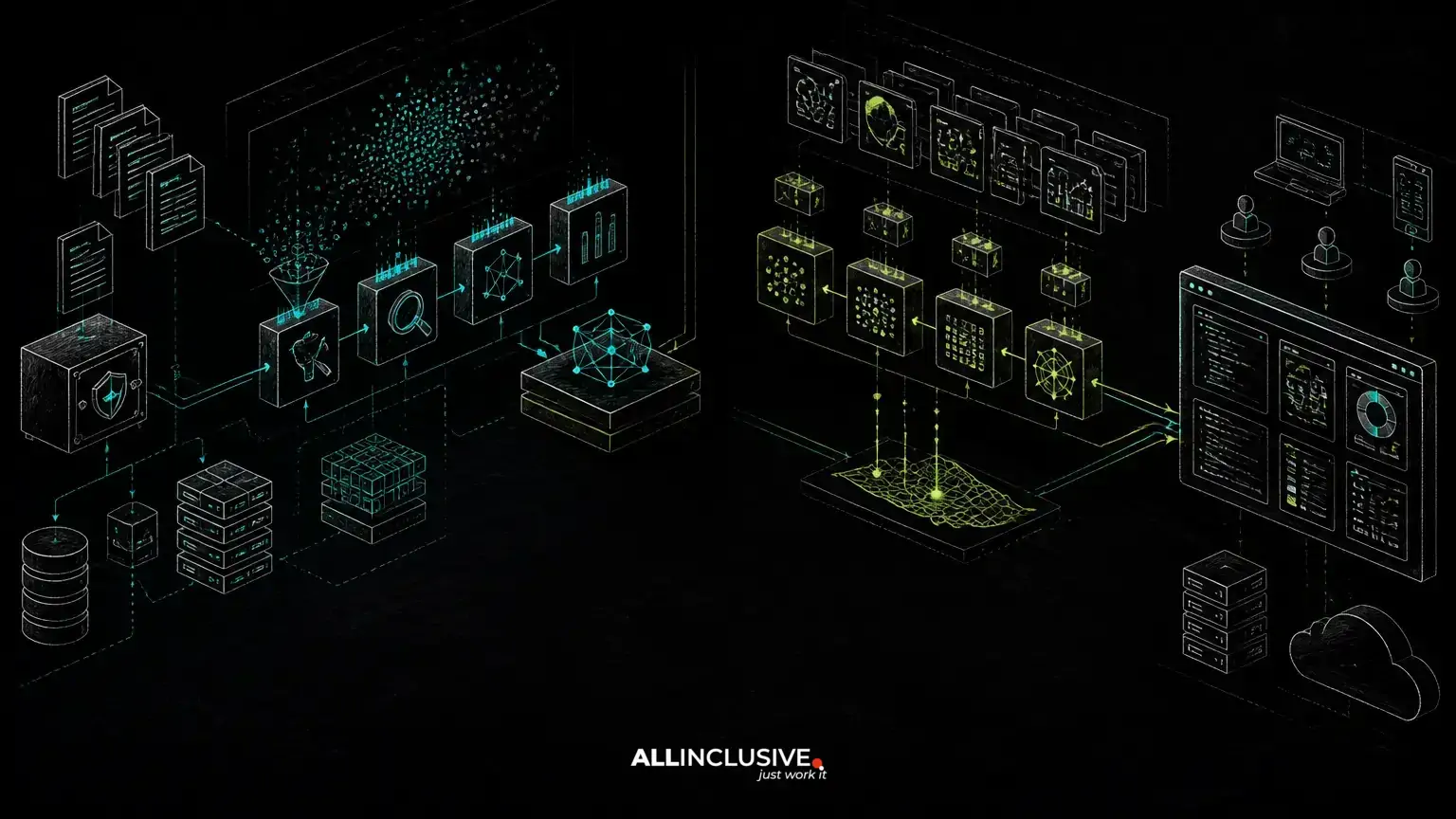
RAG separates the model from a knowledge source. A typical request flows through several stages:
- The application authenticates the user and determines which information the user may access.
- A query is generated or normalized for search.
- The system retrieves relevant document chunks, records or structured data, often using embeddings, keyword search or both.
- A reranker may reorder the candidates using a more precise relevance model.
- The application places the selected context into the model request.
- The model generates an answer, ideally with citations or links back to source records.
The model parameters do not need to change when a policy, product document or customer record is updated. That makes RAG suitable for knowledge that changes frequently or must remain under the control of the application.
RAG is not simply “put documents in a vector database.” Chunking, metadata, access control, query rewriting, reranking, context limits and source attribution all affect the result. A technically correct embedding pipeline can still produce poor answers if it retrieves the wrong document or includes information the user should not see.
For a deeper look at retrieval architecture, see RAG development. Storage choices also deserve separate evaluation; for example, a relational database with vector capabilities may be appropriate in one system, while a dedicated retrieval service may fit another. The rag vs fine tuning workflow also connects to the guidance in pgvector vs Pinecone.
What fine-tuning changes in an AI application
Fine-tuning trains a base model on a curated dataset so it responds in a desired way. Training examples may teach a model to classify support requests, produce a particular structured format, follow domain-specific instructions or use a consistent tone. The process typically involves preparing examples, removing low-quality or contradictory records, running training, evaluating the result and managing the resulting model version.
Fine-tuning does not function as a reliable document database. A model may absorb patterns from training data, but it is not an appropriate substitute for exact retrieval of current policies, account information or transactional records. Updating knowledge through repeated training can also introduce a slower release cycle and a more complex data-governance process.
Fine-tuning can be useful when the desired improvement is behavioral rather than informational. Examples include:
- Returning a stable JSON structure for downstream processing.
- Applying a specialized classification taxonomy.
- Following a consistent response style across many requests.
- Learning terminology or task patterns that are difficult to express through prompts alone.
- Reducing prompt size for a repeated instruction set, where the supported training method and evaluation results justify it.
The exact capabilities, limits and economics of fine-tuning depend on the selected model provider and model family. Those details should be verified against current provider documentation rather than assumed from another model.
RAG vs fine-tuning: the production trade-offs
Freshness and change management
RAG generally has the advantage when source information changes often. A document index or data connector can be updated without retraining the model, although ingestion and indexing still need monitoring. Fine-tuning is less suitable for daily operational facts because new training and validation are required whenever the knowledge changes materially.
If a business rule changes, RAG can make the new source available relatively quickly. However, the application must ensure that old documents are retired, document versions are handled correctly and retrieval does not surface conflicting material.
Accuracy and traceability
RAG can ground responses in source material and provide citations, which helps users verify an answer. It does not eliminate hallucinations: retrieval can miss the relevant source, the source can be ambiguous, or the model can misinterpret the context. Evaluation should measure retrieval recall, ranking quality, groundedness and answer correctness separately.
Fine-tuning may improve consistency for a defined task, but it does not automatically make responses factually current or traceable. If an answer needs evidence, the application still needs a source strategy, such as RAG, structured lookups or links to authoritative records.
Privacy and permissions
RAG can keep sensitive knowledge in systems controlled by the application, with authorization applied before context reaches the model. This is powerful but not automatic. Retrieval filters must respect tenant, role, record-level and document-level permissions. Logs, prompts, traces and cached responses must be treated as potential data stores as well.
Fine-tuning introduces a different governance question: what data enters the training dataset, who can access the resulting model, how versions are managed and how data removal requests are handled? Sensitive data should not be included in training casually. A privacy review should cover provider terms, retention behavior, regional requirements and internal access controls.
Latency and operating cost
RAG adds work to the request path: query processing, retrieval, possible reranking and a larger model context. This can increase latency and token usage. Caching, hybrid search, query planning and selective reranking can help, but they need to be measured against answer quality.
Fine-tuning may reduce the amount of repeated instruction text in a request, but training and model hosting introduce their own costs. A smaller specialized model can sometimes be appropriate, but only after evaluation shows it meets the task requirements. Cost analysis should include ingestion, training, inference, storage, monitoring, retries, human review and engineering maintenance.
Maintenance and ownership
RAG shifts responsibility toward data pipelines and retrieval infrastructure. Teams must own ingestion, parsing, chunking, metadata, indexing, permissions and source versioning. Fine-tuning shifts responsibility toward dataset quality, training runs, model versions, regression testing and release governance.
Neither option removes engineering work. The maintainable choice is the one that matches the organization’s ability to operate the required data and model lifecycle.
When RAG is usually the better first implementation
Start with RAG when the AI feature must answer from:
- Internal policies, manuals, product documentation or knowledge bases.
- Customer-specific records or tenant-isolated data.
- Frequently changing inventory, pricing, procedures or compliance material.
- Support tickets, CRM records or project documents that need source references.
- Content where users or reviewers must inspect the evidence behind an answer.
RAG is also a sensible first step when the team is still learning which questions users ask. Retrieval logs and human feedback can reveal gaps in source content, metadata and workflow design before a training dataset is created.
For example, an AI support assistant might retrieve approved product documentation and a customer’s authorized ticket history. A workflow service can then decide whether the assistant may draft a reply, update a ticket or escalate to a human. The model should not receive unrestricted access merely because the underlying search system can find the data.
When fine-tuning may be justified
Fine-tuning deserves consideration when you have a stable task, a representative dataset and a measurable behavioral problem. Typical signals include:
- The model regularly violates a required output schema despite strong instructions and validation.
- A specialized classification or extraction task has enough reviewed examples for meaningful evaluation.
- Response style or task behavior must be consistent across many contexts.
- The prompt has become large because it repeats stable behavioral instructions.
- A smaller or specialized model could improve operational economics without unacceptable quality loss.
Fine-tuning should follow, not replace, baseline evaluation. First test prompt design, structured outputs, tool use, retrieval and deterministic application logic. If the failure is caused by missing data, fine-tuning is unlikely to solve it. If the failure is caused by an ambiguous workflow, adding training examples may hide the underlying product problem.
Why hybrid architectures often fit real products
A production AI feature can combine the strengths of both approaches:
- RAG supplies current, permission-filtered facts.
- Fine-tuning or model selection supports consistent task behavior.
- Application code enforces business rules, validation and authorization.
- Tools provide controlled access to actions such as searching orders or creating tickets.
- Human review handles high-impact, uncertain or irreversible decisions.
In a web product, Laravel or another application layer may own authentication, billing, tenant boundaries, workflows and user-facing operations. Python services may own ingestion, embedding jobs, retrieval experiments, evaluation pipelines or model orchestration. This split is not mandatory, but it can keep AI workloads separate from transactional business logic while allowing both layers to evolve.
See Laravel and Python AI architecture for a closer look at this application boundary. If the feature connects models to support tickets, CRM data and internal knowledge, AI customer support integration provides a related workflow perspective.
How to evaluate the choice before committing
Use a representative test set rather than a handful of impressive demonstrations. Include normal requests, ambiguous questions, missing information, conflicting documents, permission boundaries, prompt injection attempts and requests that should be refused or escalated.
Measure more than answer fluency:
- Retrieval: Did the system find the authoritative source?
- Grounding: Are claims supported by the supplied context?
- Task success: Did the feature complete the intended user workflow?
- Safety and privacy: Did it avoid exposing unauthorized information or taking an unsafe action?
- Latency and cost: Does performance fit the product’s operational constraints?
- Consistency: Does quality hold across tenants, languages, document types and model versions?
- Escalation quality: Does the system recognize uncertainty instead of confidently guessing?
Production observability should connect model behavior to application outcomes. Log request identifiers, model and prompt versions, retrieval sources, latency, token usage, tool calls, validation failures and escalation events while applying appropriate redaction and retention controls. AI observability and monitoring covers these operational concerns in more detail.
A decision checklist for RAG and fine-tuning
- Is the required knowledge private or frequently changing? Favor RAG or a structured data lookup.
- Is the problem mainly behavior, format or classification? Test prompting and application validation first; then evaluate fine-tuning if the task is stable.
- Must users see evidence? Use retrieval and source attribution.
- Are permissions complex? Keep authorization in application and retrieval logic rather than relying on model instructions.
- Are actions reversible? Add tool boundaries, confirmation steps and human review for consequential operations.
- Can the team maintain the data or training lifecycle? Choose the operating model you can monitor and release safely.
- Have alternatives been measured? Compare a baseline, RAG, fine-tuning and hybrid design on the same evaluation set.
The best implementation may be a conventional application with one carefully bounded model call, not an autonomous agent. Start with the smallest architecture that can satisfy the workflow, then add retrieval, tools, reranking, model routing or fine-tuning when measured evidence supports the complexity.
AI features require decisions across product design, application engineering, data governance and operations. Teams planning that broader work can review AI development and the wider development capabilities available for custom software programs.


