
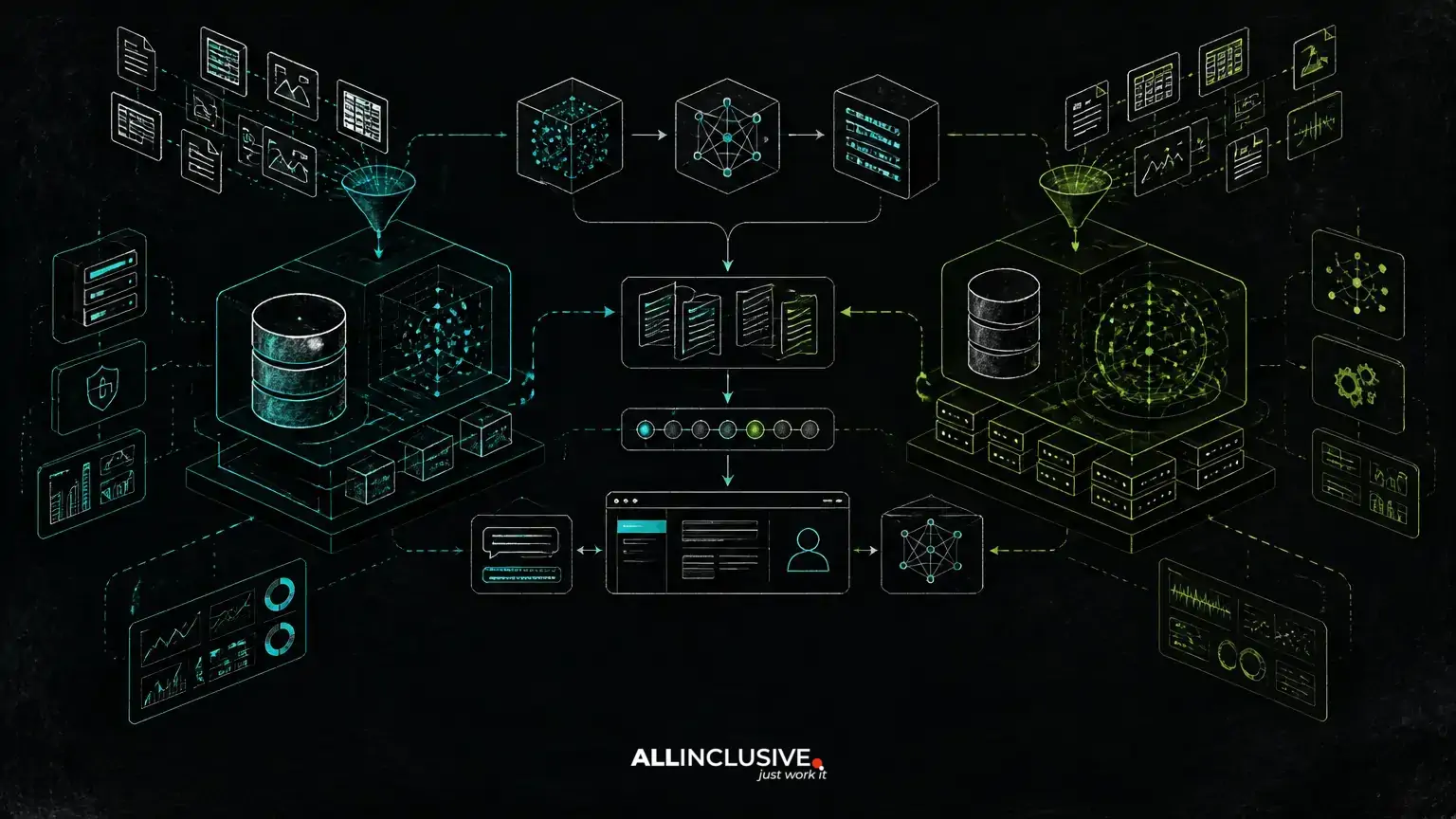
Choosing between pgvector vs Pinecone is not simply a question of which vector database has better search. Both can retrieve embeddings for a retrieval-augmented generation (RAG) system, but they place responsibility in different parts of your architecture. For pgvector vs pinecone, an adjacent technical consideration is explained in python development.
pgvector is usually the better fit when your application already depends on PostgreSQL, your retrieval data belongs beside relational records, and your team wants to operate fewer systems. Pinecone is often a stronger fit when vector retrieval is a distinct platform capability, search traffic must scale independently, or the team prefers a managed vector service over database operations.
The right production decision depends on more than benchmark scores. Data ownership, filtering, tenant isolation, update patterns, latency targets, operational maturity, privacy requirements, observability and failure handling all matter. A prototype can work with either option; a dependable RAG product needs an explicit retrieval architecture.
What pgvector and Pinecone actually provide
pgvector adds vector storage and similarity search capabilities to PostgreSQL. Embeddings can live in tables alongside document identifiers, permissions, tenants, timestamps, product metadata and application relationships. Retrieval can then combine vector similarity with SQL filtering and transactional workflows.
Pinecone is a managed vector database designed around indexed vector retrieval. It separates the vector search service from the application’s primary relational database. Metadata filters, namespaces and index configuration can support multi-tenant or domain-specific retrieval, while the application remains responsible for synchronizing source records and vector records.
Neither product replaces the rest of a RAG pipeline. A production system still needs document ingestion, parsing, chunking, embedding generation, metadata modeling, retrieval filters, optional reranking, prompt construction, model calls, citations, evaluation and monitoring.
Where pgvector is a strong production choice
Relational data and retrieval metadata belong together
Many business search features are not searching text in isolation. They need to enforce conditions such as account ownership, publication status, contract scope, region, role or effective date. If those conditions already live in PostgreSQL, pgvector can reduce synchronization between the source of truth and the retrieval index.
This can simplify permission-aware RAG. An application can resolve the user’s access scope and apply it during retrieval rather than retrieving broadly and attempting to remove unauthorized content later. Authorization still requires careful design, but keeping relevant metadata in the same database can make the data model easier to reason about.
The team wants fewer infrastructure components
Operating PostgreSQL and a separate vector service creates more credentials, deployment concerns, backups, observability surfaces and data synchronization paths. For a moderate workload, using the existing database may be operationally simpler than introducing a specialized service.
That simplicity is valuable when the retrieval workload is closely coupled to application traffic and the team already has strong PostgreSQL practices. It can also shorten delivery for custom software because the ingestion pipeline can use familiar migrations, jobs, transactions and administrative tooling.
Transactions and application workflows matter
Some systems need document status changes, permission updates and retrieval visibility changes to happen consistently with business operations. A relational database can make these relationships easier to model. The application may still generate embeddings asynchronously, but it has a clear source of truth for what content should be searchable.
Where Pinecone may be the better fit
Vector search needs independent operational scaling
A separate vector service can be attractive when retrieval traffic, index size or ingestion activity should scale independently from transactional application workloads. This separation can protect the primary database from workloads with different resource patterns.
It also creates a clearer boundary for teams that treat retrieval as a shared platform used by several products, assistants or search experiences. The trade-off is that the organization now owns an integration between relational or object storage and the vector index.
The team prefers managed vector infrastructure
Pinecone can reduce the amount of database infrastructure the product team must configure and maintain for vector retrieval. Managed services do not eliminate operational responsibility: teams still need to understand index configuration, data lifecycle, access controls, usage limits, regional requirements and failure behavior.
They can, however, be a sensible choice when the engineering organization does not want vector indexing to compete with core database administration or when a dedicated retrieval platform aligns with its operating model.
Retrieval is a central product capability
If semantic search, recommendations or RAG powers multiple high-value workflows, a specialized service may provide a clearer long-term boundary. This is particularly relevant when retrieval teams need independent release cycles, ingestion pipelines and capacity planning.
pgvector vs Pinecone across the decisions that affect production
Data consistency and synchronization
pgvector can minimize synchronization because the vector and business metadata may reside in the same PostgreSQL environment. Embedding generation remains asynchronous, so the design still needs states such as pending, indexed, stale and failed.
With Pinecone, the application must synchronize source content and vector records. Reliable implementations commonly use an outbox or queue-based workflow, idempotent upserts, deletion handling and reconciliation jobs. Without these safeguards, users may receive answers based on deleted, outdated or unauthorized content.
Filtering and authorization
Both approaches can support metadata-aware retrieval, but the important question is where authorization is enforced. A vector similarity result is not automatically an authorized result.
For sensitive systems, define tenant and permission boundaries before selecting the database. Test cross-tenant isolation, revoked access, document deletion and changes to role membership. If filters are applied after retrieval, the system may lose relevant results or expose content during intermediate processing. If filters are applied within retrieval, the metadata model and query path must be tested under realistic access patterns.
Latency and throughput
Latency is shaped by more than vector index speed. Network hops, embedding generation, metadata filters, reranking, LLM time, connection pooling, queue depth and cold or overloaded workers all contribute to user-perceived response time.
pgvector may reduce network boundaries when the application and database are already close together. Pinecone may provide a cleaner retrieval path when the vector workload is isolated and independently provisioned. Neither conclusion should be assumed without testing representative vectors, dimensions, filters, result counts, update rates and concurrency.
Cost and ownership
pgvector concentrates costs in PostgreSQL compute, storage, replicas, backup requirements and engineering operations. Pinecone introduces managed-service spend and may reduce some infrastructure work, while adding data-transfer, synchronization and service-governance considerations.
Compare total cost of ownership rather than a single query price. Include embedding generation, storage growth, reindexing, ingestion failures, observability, on-call effort, backups, disaster recovery and the cost of engineering time spent maintaining synchronization.
Privacy and deployment constraints
Embedding vectors can encode information about source content and should be treated as part of the data protection model. Review retention, deletion, regional hosting, access controls, encryption, vendor terms and incident procedures for the chosen architecture.
Some organizations need retrieval data to remain within an existing controlled environment. Others may accept a managed external service subject to contractual and technical review. The decision should be made with security and compliance stakeholders, not only by the application team.
A production RAG architecture for either choice
A durable architecture separates the retrieval lifecycle from the synchronous answer request. A typical flow includes:
- Ingestion: collect source documents and record their ownership, version, status and provenance.
- Processing: parse content, normalize it, create chunks and attach stable document and chunk identifiers.
- Embedding: generate vectors through a queued, retryable job with model-version tracking.
- Indexing: write vectors and metadata to pgvector or Pinecone using idempotent operations.
- Retrieval: apply tenant and permission filters, retrieve candidates and optionally rerank them.
- Generation: provide the model with bounded context, source identifiers and instructions for grounded responses.
- Evaluation: measure retrieval relevance, citation correctness, refusal behavior, answer quality and latency using representative test cases.
Python is often a practical home for ingestion, embedding, retrieval experiments and evaluation tooling, while Laravel or another application layer can own users, permissions, billing, workflows and review queues. The split should be based on ownership and operational boundaries rather than novelty. See the Laravel and Python AI architecture guide for a broader discussion of that separation.
Failure modes that influence the database decision
Stale or duplicated vectors
Document updates can leave old chunks in an index if identifiers and deletion rules are unclear. Use stable source IDs, version metadata and reconciliation jobs. Test updates, deletions and partial ingestion failures rather than only the happy path.
Retrieval succeeds but the answer is wrong
A fast vector query does not guarantee useful context. Poor chunk boundaries, weak metadata, ambiguous queries and missing reranking can all reduce answer quality. Build evaluation sets before optimizing infrastructure so database changes are judged against product outcomes.
Permission checks are detached from retrieval
Passing a user query to a broad index and filtering content later is risky. Authorization context should be explicit in the retrieval contract, and the system should log which filters and source records contributed to a response.
Operational visibility stops at the model call
RAG observability should connect request IDs to retrieval queries, filters, candidate IDs, reranker decisions, model calls, token usage, latency and user feedback. This makes it possible to distinguish an index problem from an ingestion problem, a prompt problem or a model problem. A related AI observability guide covers these monitoring concerns in more detail.
How to choose between pgvector and Pinecone
Choose pgvector first when most of the following are true:
- PostgreSQL is already a core system of record.
- Retrieval metadata and permissions are relational and frequently updated.
- The expected workload fits comfortably within the database operating model.
- The team values fewer infrastructure dependencies.
- Transactional consistency and straightforward local development are important.
Choose Pinecone first when most of the following are true:
- Vector retrieval needs to scale or operate independently of transactional workloads.
- Search is a shared platform capability across multiple products.
- The team prefers a managed vector service and accepts an integration boundary.
- Retrieval operations require dedicated capacity and ownership.
- The organization has strong processes for synchronization, privacy review and service governance.
For either path, run a focused proof of architecture rather than a superficial benchmark. Use real document types, permission filters, update and deletion events, expected concurrency, representative queries and evaluation criteria. Measure end-to-end answer quality and operational behavior, not only nearest-neighbor latency.
Build the retrieval layer around product accountability
The best choice in the pgvector vs Pinecone comparison is the one your team can operate, secure and improve as the product changes. A specialized service is not automatically more scalable, and an integrated database is not automatically simpler at larger workloads.
Start with data ownership, access rules, freshness requirements and failure recovery. Then select the retrieval infrastructure that supports those constraints without creating avoidable synchronization or operational risk. For teams planning a broader AI feature, RAG development guidance can help connect retrieval choices to chunking, reranking, citations and evaluation.
When retrieval becomes part of a customer-facing workflow, it should be designed as custom software with explicit fallbacks and human review. A response may need to abstain, ask for clarification, route to a support agent or show source evidence instead of presenting uncertain context as fact. Explore AI development services for production-oriented architecture, integration and evaluation planning, and review the broader software development capabilities when retrieval must connect to a larger application platform.


