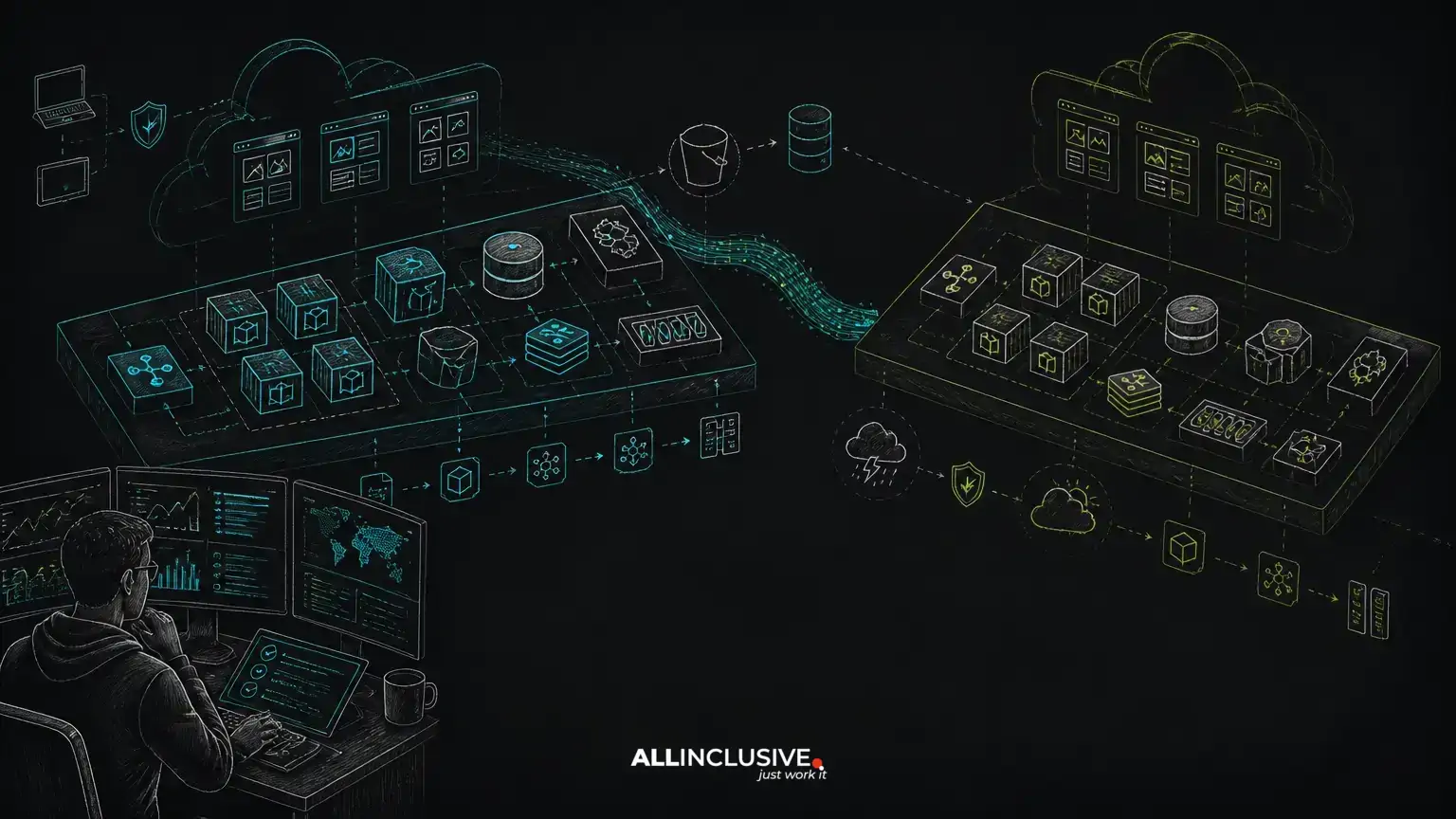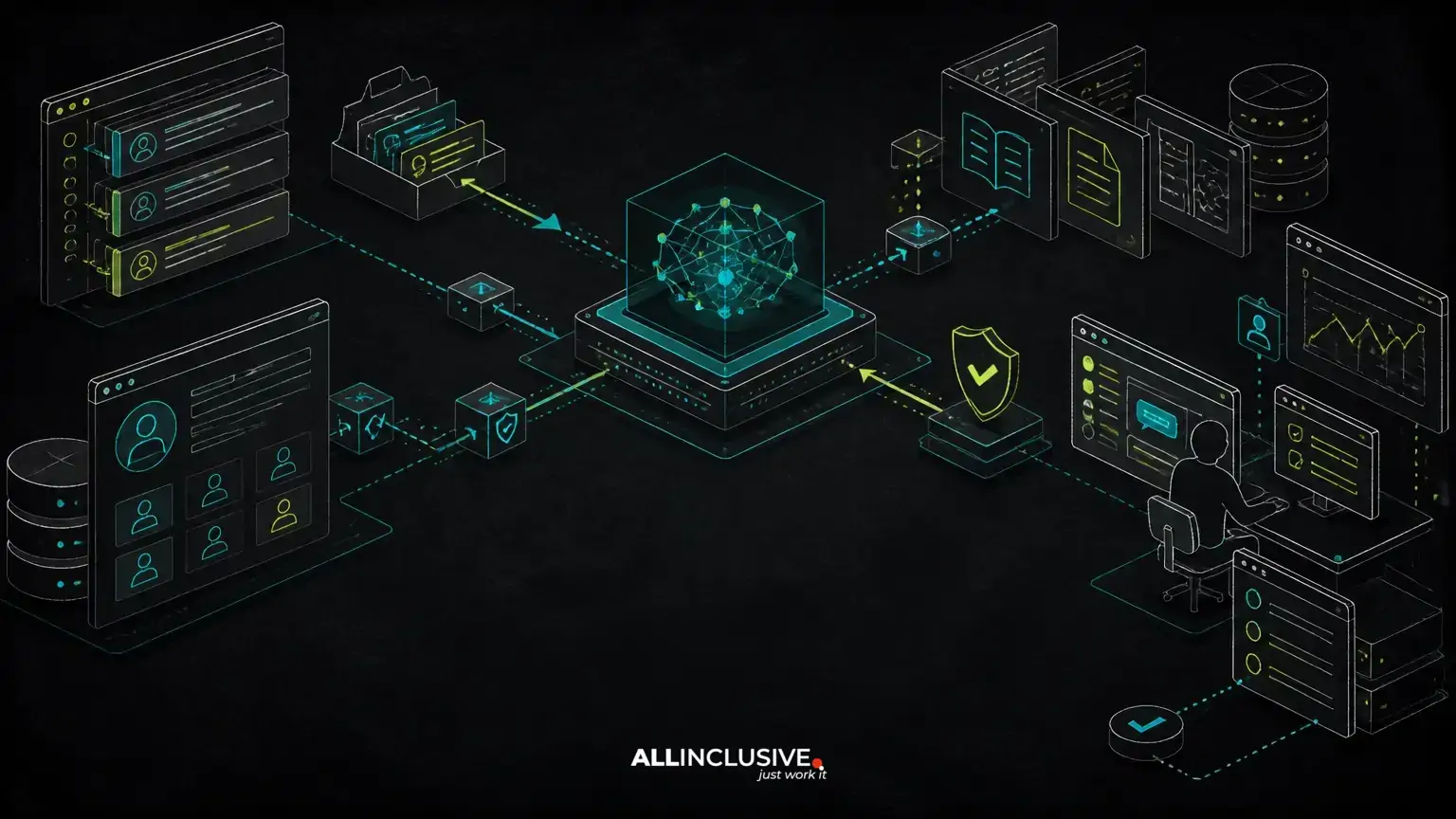
AI customer support integration is the engineering work of connecting language models to the systems that contain customer context: ticketing platforms, knowledge bases, CRM records, product data and internal workflows. A useful implementation does more than generate replies. It retrieves authorized information, applies business rules, records decisions, routes work and gives support staff a clear way to review or correct the result.
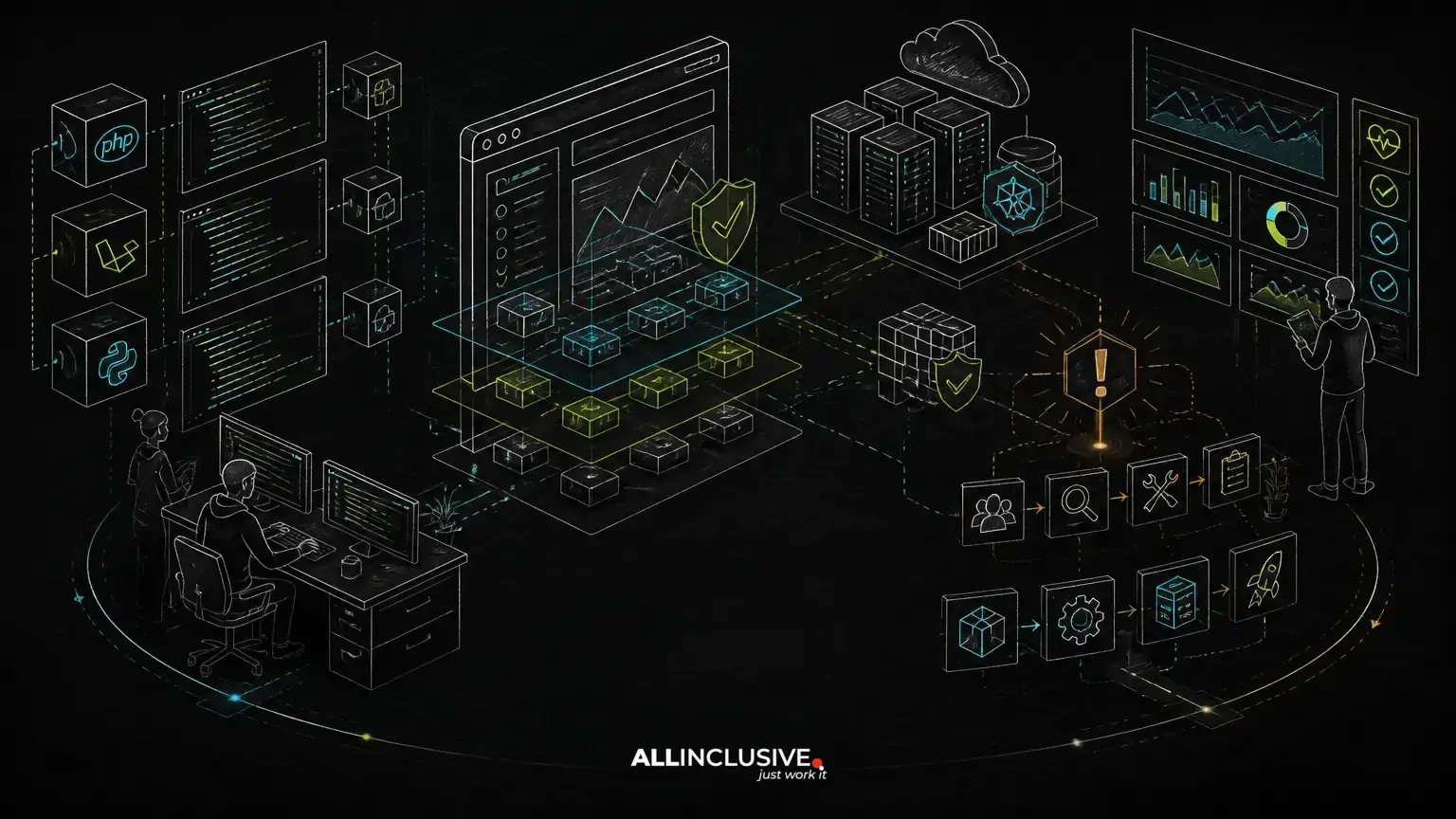
The most reliable architecture separates the customer-facing application from AI workloads. An application layer such as Laravel can own authentication, ticket workflows, queues and administrative interfaces, while Python services handle retrieval, model orchestration, evaluation and other AI-specific operations. This division is not mandatory, but it can make ownership, testing and scaling easier when the integration grows beyond a prototype. See the broader AI development capability overview for context on building production AI systems.
What an AI customer support integration should connect
Support automation usually spans several data and workflow boundaries:
- Conversation channels: web chat, email, messaging platforms or an agent workspace.
- Ticketing data: ticket history, status, priority, assignment, tags and escalation state.
- Knowledge sources: help-center articles, product documentation, policies, troubleshooting procedures and approved response content.
- CRM and account data: customer identity, plan, entitlements, renewal context and relevant account history.
- Operational tools: order lookup, subscription changes, refunds, incident status or other actions exposed through controlled APIs.
- Governance systems: permissions, audit records, feedback, evaluation datasets and monitoring.
These sources should not automatically be treated as one unrestricted context window. Each has different freshness, sensitivity, ownership and authorization requirements. Integration design must define which data the model may read, which actions it may request and which actions require human approval.
A reference architecture for production support AI
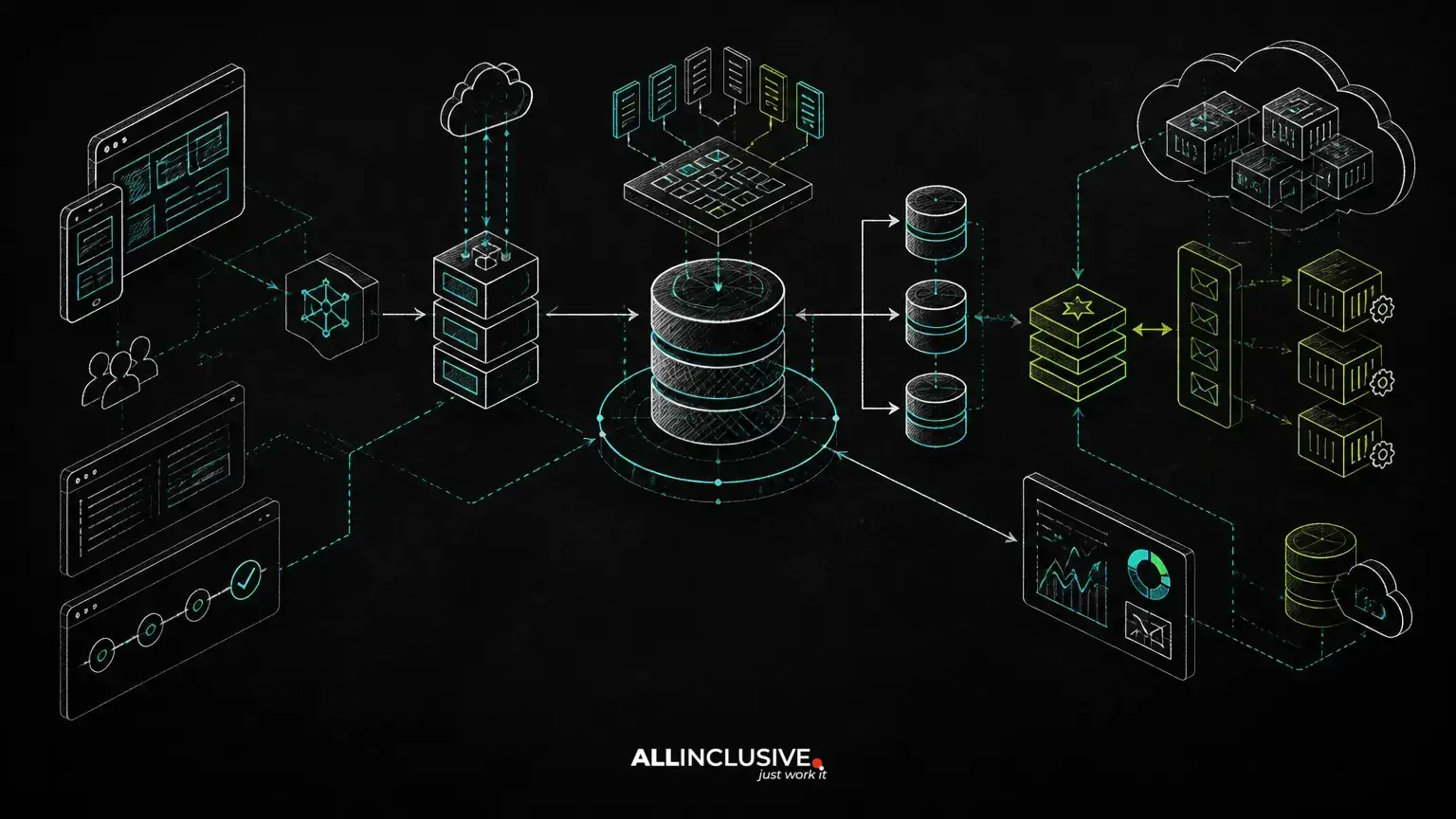
A typical request path includes an application gateway, a support orchestration service, retrieval components, model providers and business-system connectors.
- Authenticate and classify the request. Identify the customer or support agent, channel, ticket, language, intent and risk level before retrieving data.
- Load permitted context. Fetch ticket history and account information through scoped application services rather than passing broad database access to the model.
- Retrieve knowledge. Search indexed documentation using semantic retrieval, keyword signals or a hybrid approach. Reranking can improve relevance when the initial candidate set contains similar but less applicable documents.
- Assemble a constrained prompt or model input. Include source references, instructions, response format and explicit limits on unsupported claims.
- Generate or decide. Use a model for drafting, classification, summarization or tool selection according to the task. Keep deterministic business rules outside the model where possible.
- Validate and route. Check structured output, policy constraints, citations, confidence signals and required approvals before updating a ticket or showing a response.
- Record the trace. Store enough information to investigate the result, including model version, retrieved sources, latency, token usage, tool calls and review outcome, subject to privacy requirements.
Laravel or another application framework can coordinate user-facing workflows, permissions, persistence and queue processing. A Python service can provide model adapters, retrieval pipelines, document processing and evaluation code. Communication between the layers should use explicit contracts, idempotency keys and timeouts rather than tightly coupled internal assumptions. For more detail on this split, see Laravel + Python for AI products.
RAG is the knowledge layer, not the whole integration
Retrieval-augmented generation, or RAG, is useful when answers depend on changing or private documentation. Documents are normalized, chunked, embedded and indexed. At request time, the system retrieves candidate passages and supplies the best authorized evidence to the model.
Support content needs additional controls. Documents should carry metadata such as product area, locale, publication state, effective date and access scope. Retrieval filters should apply those attributes before generation. A model should not receive an outdated troubleshooting procedure simply because its wording is semantically similar to the question.
Embeddings are only one retrieval signal. Keyword search can be valuable for ticket numbers, error codes, product names and exact policy terms. Reranking can compare a larger candidate set using the full query and document text. Citation requirements also help reviewers see whether an answer is grounded in an approved source. The implementation details are covered further in this RAG development architecture guide.
Vector infrastructure is an architectural choice rather than a default. A relational database extension may simplify operations when support data and vectors already belong in the same system. A managed vector service may be preferable when retrieval scale, isolation or operational ownership justifies another platform. The decision should account for filtering, backups, tenancy, latency, observability and team expertise; a universal winner does not exist.
CRM and ticket data require permission-aware orchestration
CRM integration creates practical value because the right response often depends on account state. However, sending an entire customer record to a model is rarely a sound design. Create narrow data-access functions that return only fields required for the task.
For example, an account-context tool might expose entitlement status and recent service events while excluding unrelated contacts, payment details or internal notes. The tool should enforce authorization in application code, validate the customer and ticket relationship, and return structured data. Prompt instructions alone are not an access-control mechanism.
The same principle applies to write operations. A model may propose a refund, change a subscription or update a priority, but the application should validate eligibility, require an approval step when appropriate and write an audit record. Tool calls should be idempotent where possible so retries do not create duplicate actions.
Agents should operate inside bounded workflows
An agent can choose tools and sequence steps, which is useful for multistep support tasks. It also introduces nondeterministic behavior, additional latency and a larger failure surface. A production design should give the agent a limited tool set, strict schemas, maximum iteration counts and clear stopping conditions.
Use deterministic workflow code for rules that must always behave the same way, such as authentication, entitlement checks, required disclaimers and escalation thresholds. Use an agent where the value comes from selecting among well-defined operations or gathering information across systems. In many cases, a workflow with one or two controlled model decisions is easier to test than an open-ended autonomous loop.
Human review is part of the product design
Human review should be designed around risk, not added as an emergency fallback. Low-risk tasks such as summarizing a conversation may be eligible for automatic completion after validation. A response involving legal terms, account changes, security incidents or uncertain identity may require approval before delivery.
The review interface should show the proposed action, relevant ticket history, retrieved sources, tool results and reasons for escalation. Agents need the ability to edit, reject, approve and provide structured feedback. That feedback can improve prompts, retrieval settings, routing rules and evaluation cases without treating every correction as an invitation to retrain a model.
Production controls: privacy, reliability and cost
Support systems handle personal, commercial and sometimes security-sensitive information. Before selecting a model provider, document data flows, retention expectations, regional requirements and contractual constraints. Minimize payloads, redact unnecessary fields and separate sensitive values from prompts when they are not needed for the task.
Reliability requires more than a successful API call. Define timeouts, retries with backoff, circuit breakers and provider fallbacks. If retrieval is unavailable, the system should not confidently invent an answer; it can route the ticket to a human or use a clearly constrained response. Queue-based processing is often appropriate for summaries, classification and indexing, while interactive chat needs a latency budget and graceful degradation.
Cost control starts with routing. Smaller or specialized models may handle classification, extraction and triage, while more capable models are reserved for complex reasoning or sensitive drafting. Limit retrieved context, cache stable results where appropriate and monitor token usage by feature, tenant and workflow. Cost should be evaluated alongside review time and failure remediation, not as an isolated model metric.
Evaluation and observability for support integrations
Traditional software tests cannot fully measure answer quality, so teams need a representative evaluation set. Include real or carefully anonymized support scenarios covering common intents, ambiguous requests, stale documentation, missing permissions, prompt injection attempts and escalation cases.
Evaluate separate dimensions rather than relying on a single quality score:
- Retrieval relevance and source freshness.
- Grounding and citation accuracy.
- Correct intent, routing and priority.
- Structured output validity.
- Policy and permission compliance.
- Appropriate escalation and human-review behavior.
- Latency, failure rate and cost per workflow.
Production observability should connect a user-visible outcome to its underlying trace. Capture request identifiers, retrieval queries, selected sources, model and prompt versions, tool calls, validation failures, latency stages, usage data and reviewer outcomes. Avoid logging raw sensitive content by default. More implementation guidance is available in AI observability and monitoring.
Common integration failures to prevent
- Direct model-to-database access: broad access makes permissions and audits difficult to reason about. Use narrow application services and typed tools.
- Unindexed documentation dumps: placing large manuals in every prompt increases cost and can reduce relevance. Build a maintained retrieval pipeline.
- Unclear source ownership: stale or conflicting articles create inconsistent answers. Assign publication and retirement responsibility for knowledge content.
- Automatic writes without approval boundaries: a plausible model output is not authorization to change customer state.
- Testing only happy paths: evaluate ambiguity, missing data, adversarial content, provider errors and permission boundaries.
- Observability added after launch: without traces and review signals, teams cannot determine whether failures originate in retrieval, orchestration, the model or business data.
Planning an AI customer support integration
Start with a narrow workflow that has a defined owner, measurable acceptance criteria and an accessible source of truth. Map the data needed for that workflow, identify sensitive fields, define the human-review boundary and select the smallest useful set of tools. Then build an evaluation set before expanding automation.
A custom implementation is justified when support workflows span systems, permissions and business rules that off-the-shelf automation cannot represent cleanly. The goal is not to place a chatbot on top of existing software; it is to create a maintainable operational layer that improves response work without weakening control. Teams comparing implementation approaches can also review broader web development services and the development hub for related application architecture considerations.