
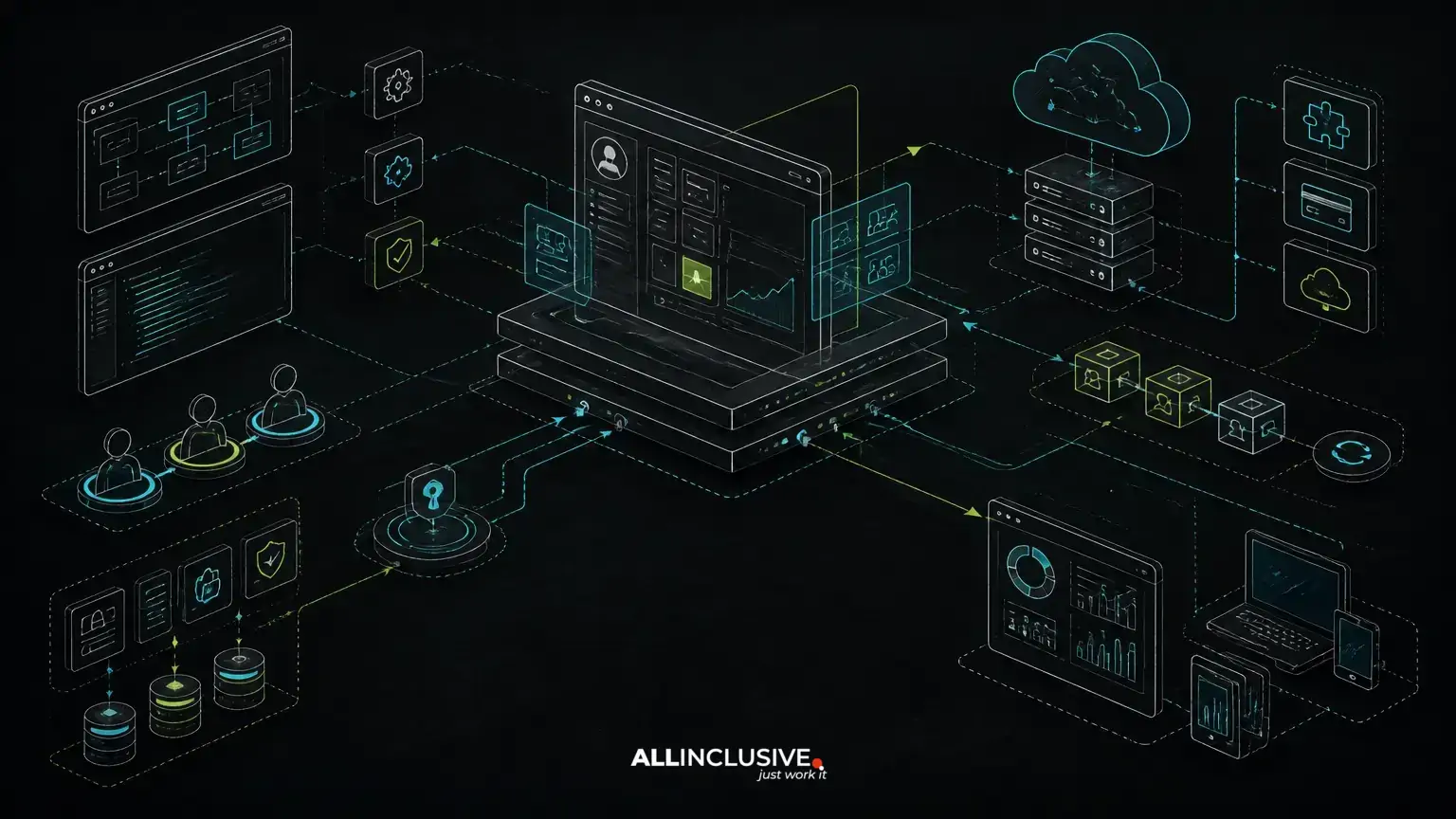
Custom web application development cost is driven by the business system behind the interface—not simply by the number of screens. A customer portal with role-based access, billing, third-party integrations, audit trails, and multi-tenant data isolation requires a different engineering effort from a simple authenticated dashboard.
The most useful way to estimate a budget is to map the workflows, identify the technical risks, and separate essential product capabilities from later enhancements. That approach produces a more reliable plan than choosing a template price based on page count or a list of technologies.
What determines custom web application development cost?
Most budgets are shaped by several connected variables. Changing one often affects the others, so cost should be assessed as a system rather than as isolated features.
1. Workflow complexity
Business rules are usually more expensive than visual screens. A booking application, for example, may need availability rules, cancellations, exceptions, notifications, deposits, refunds, and staff overrides. A marketplace may add seller onboarding, commissions, disputes, moderation, and separate dashboards.
During discovery, the important questions include:
- Which users perform which actions?
- What conditions allow or prevent an action?
- What happens when a process fails or is changed?
- Which events require approval, notification, logging, or escalation?
- Which data must remain isolated between customers, teams, or organizations?
Architecture should follow these workflows. A well-designed custom-made product may reduce future rework even when its initial scope is more carefully defined.
2. User roles and permissions
Basic authentication is relatively different from a full access-control model. Applications with administrators, managers, operators, customers, suppliers, or external partners may require role-based access control, organization-level permissions, delegated administration, approval flows, and audit history.
Permissions must be enforced on the server and reflected consistently in the interface, APIs, background jobs, exports, and integrations. Treating access control as a visual feature creates security and maintenance risk.
3. Integrations and external dependencies
Payment providers, accounting platforms, CRMs, identity systems, shipping services, communications tools, and internal APIs can materially affect delivery effort. The work includes more than connecting endpoints. Engineers must account for authentication, data mapping, retries, rate limits, webhooks, partial failures, version changes, reconciliation, and monitoring.
An integration that appears small in a product brief can become a significant cost variable when the application must remain reliable if an external service is delayed or unavailable.
4. Data model and multi-tenancy
Applications that manage structured business data need a durable model for relationships, history, status changes, and reporting. Multi-tenant SaaS introduces additional decisions: whether tenants share database infrastructure, how tenant boundaries are enforced, how administrators access support data, and how migrations are handled.
These choices influence security, scalability, operations, and the cost of future changes. A data model optimized only for the first release can make reporting, billing, or integrations expensive to add later.
5. Billing and financial operations
Subscriptions, usage-based pricing, invoices, taxes, refunds, credits, payment failures, and account changes introduce business and operational rules. Billing should be designed alongside the product workflow rather than added as an isolated checkout screen.
The required level of financial control depends on the business model. A simple one-time payment is not equivalent to recurring plans with prorations, entitlements, invoices, and reconciliation.
6. Security, compliance, and auditability
Security work is not a single line item. It spans identity, authorization, secrets management, input validation, file handling, logging, backups, dependency maintenance, incident response, and operational access.
Some products also require retention rules, export and deletion workflows, audit records, approval histories, or controls imposed by customers and regulated industries. The applicable requirements should be established before architecture and estimation are finalized.
7. Performance and expected scale
Expected usage affects infrastructure and engineering decisions, but premature scaling can also increase cost unnecessarily. The relevant questions are not only how many users may exist, but when traffic arrives, which operations are expensive, how much data is retained, and which actions require synchronous responses.
A sensible architecture can begin with a clear scaling path: efficient queries, background processing where appropriate, caching when justified, observability, and infrastructure that can be expanded without redesigning the entire product.
How product scope changes the budget
Scope is more useful when organized by user outcome and risk than by a long feature inventory. A first release might focus on one complete workflow, such as creating an account, submitting a request, processing it internally, and reporting its status to the customer.
That does not mean ignoring foundations. Authentication, authorization, data integrity, deployment, backups, testing, and monitoring should be included when they are necessary for the product to operate responsibly. It does mean delaying secondary capabilities that do not validate the core business process.
Common scope expansions include:
- Multiple user types with different dashboards and permissions
- Advanced search, filtering, saved views, and bulk operations
- Real-time updates, chat, or collaborative editing
- Complex reporting and data exports
- Mobile-specific behavior or a progressive web application
- Localization, multiple currencies, and regional rules
- Workflow automation and AI-assisted features
Each item can be reasonable, but combining many of them in the first release increases delivery coordination and testing effort.
Build versus buy decisions affect total cost
A custom web application does not need to recreate every supporting capability. Buying or integrating mature services can reduce initial engineering effort, while custom development may be justified for the workflows that differentiate the business or cannot be represented reliably by an existing product.
Evaluate each capability using criteria such as:
- How closely the product matches the required workflow
- Whether data can be exported and migrated
- How pricing changes with users, transactions, or volume
- Whether the provider supports required permissions and integrations
- What happens if the vendor changes its API or discontinues the service
- Whether the business needs ownership of the source code or data model
A low initial subscription cost can become expensive if staff must maintain manual workarounds. Conversely, custom-building a commodity function can consume budget without improving the customer or operational experience. Our build-vs-buy software decision framework provides a useful way to assess that trade-off.
Technology choices should support the workflow
Technology affects cost, but it should follow the product’s operational needs. PHP and Laravel can be suitable for many data-driven SaaS products, portals, marketplaces, and internal systems because they support structured application development and a broad ecosystem. Python may be appropriate where data processing, automation, or specialized services are central. Other choices may be justified by the product’s runtime, integration, or team requirements.
The important question is not whether a framework is fashionable. It is whether the chosen architecture makes authentication, testing, deployment, observability, integrations, and future change manageable.
For a more detailed view of architectural trade-offs, see how to design scalable web application architecture without overengineering it.
How to create a more reliable estimate
A useful estimate should expose assumptions instead of presenting a single unexplained figure. The planning process should normally include:
- Workflow mapping: document primary users, actions, states, exceptions, and ownership.
- Scope boundaries: identify what belongs in the first release and what is deliberately deferred.
- Technical discovery: examine integrations, data sources, permissions, hosting, security, and migration needs.
- Risk identification: highlight unknowns that could change architecture or delivery effort.
- Delivery decomposition: group work into independently reviewable capabilities rather than vague phases.
- Assumption review: confirm who supplies content, designs, credentials, data, acceptance criteria, and operational decisions.
Estimates should distinguish implementation from continuing costs such as hosting, third-party services, monitoring, support, security updates, and future enhancements.
Ownership and maintenance are part of the cost decision
Initial development is only one part of the product’s financial model. A business-critical application needs a plan for dependency updates, defect resolution, backups, access management, monitoring, incident handling, and incremental improvements.
Source-code ownership, deployment access, documentation, infrastructure credentials, and data portability should be clarified before work begins. Ownership reduces strategic dependency and makes it easier to change teams or evolve the architecture later.
After launch, a defined support model helps separate urgent operational issues from planned product work. See the support and maintenance approach for the types of ongoing responsibilities that should be considered.
Questions to ask before comparing proposals
- Does the proposal describe workflows and acceptance criteria, or only screens and technologies?
- Are authentication, permissions, testing, deployment, backups, and monitoring included?
- Which integrations are assumed, and how are failures handled?
- How are unknowns and change requests managed?
- Who owns the source code, infrastructure configuration, documentation, and data?
- What support is available after launch?
- Does the architecture leave a practical path for additional tenants, roles, integrations, and reporting?
Choosing a partner is also a technical and operational decision. Our guide to choosing a web application development company covers the evaluation criteria in more detail.
Use cost to compare risk, not just implementation effort
The lowest proposal is not automatically the lowest-cost option. A narrow estimate that excludes permissions, integration failure handling, testing, deployment, or maintenance may defer expenses rather than remove them.
A stronger comparison asks whether each proposal provides a credible path from business workflow to maintainable software. It should make scope, assumptions, ownership, technical risk, and ongoing responsibilities visible. For organizations evaluating a custom product, custom web development services can be structured around those decisions rather than around a generic feature package.
The result is a budget based on the product the business actually needs: its users, rules, data, integrations, operational constraints, and path to future change.


