
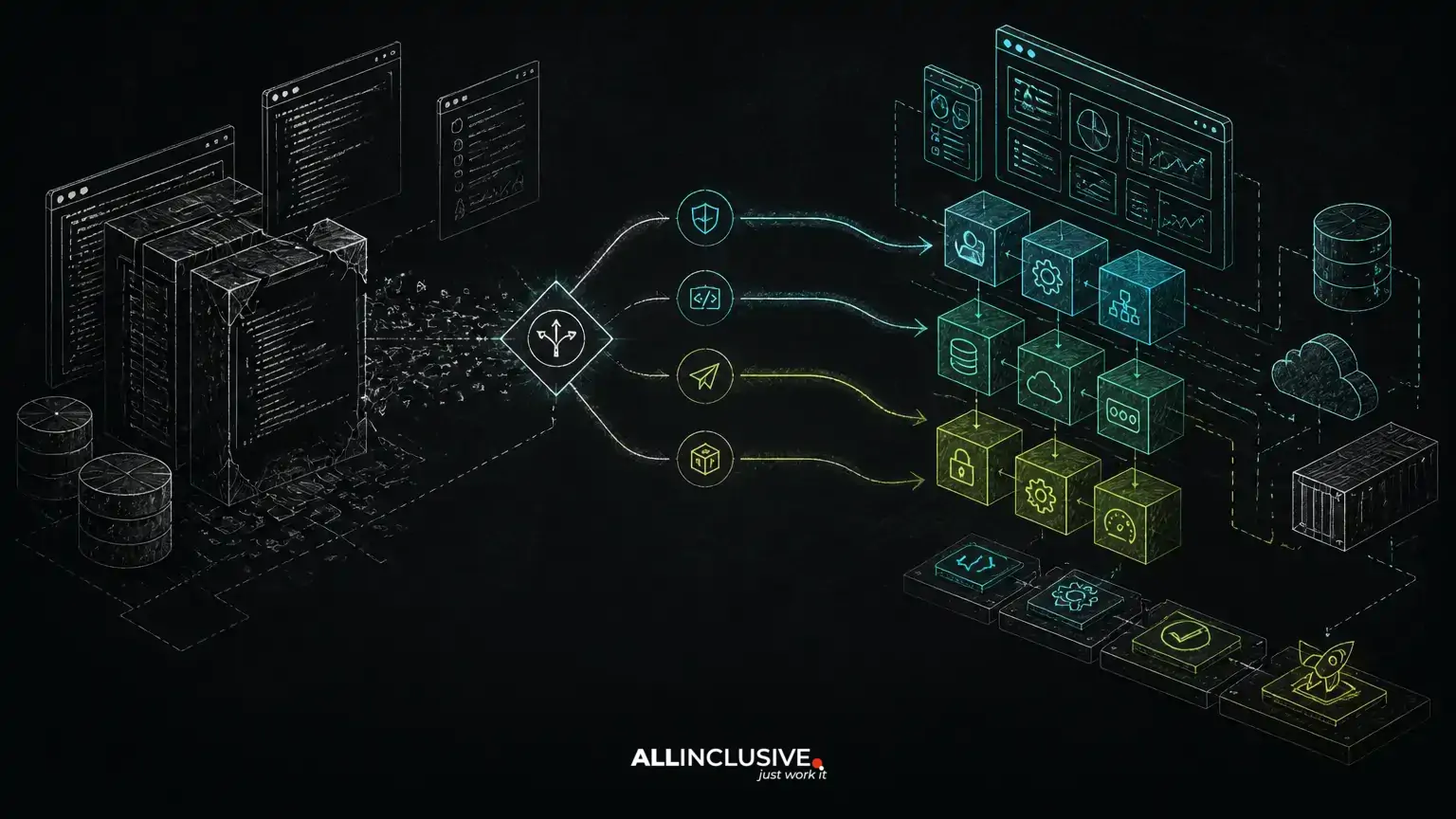
Custom PHP development is usually the right choice when a business application must reflect specialized workflows, preserve valuable existing logic, or integrate with systems that standard products do not support cleanly. It is not automatically the best answer for every project: a configurable platform, a focused API, or a framework-based application may reduce risk and delivery time.
The decision depends on more than whether a team already uses PHP. It should account for the business rules embedded in the current system, dependency and database behavior, security exposure, performance constraints, ownership requirements, and the cost of changing the application later. For companies evaluating PHP development services, the most useful question is not “custom or standard?” but “which level of control does this application actually require?”
When custom PHP development is a strong fit
Custom PHP is often appropriate when the application is part of the company’s operating model rather than a replaceable administrative tool. Common signals include:
- Distinctive business rules: pricing, eligibility, approvals, fulfillment, entitlement, or scheduling logic does not map well to a standard product.
- Complex integrations: the application must coordinate data across ERP, CRM, payment, logistics, identity, or internal systems.
- Specialized workflows: users need a sequence of actions, permissions, exceptions, and audit records designed around how the organization actually works.
- Existing PHP investment: the current application contains reliable domain knowledge that would be expensive or risky to recreate elsewhere.
- Long-term ownership: the business needs control over data structures, deployment, extension points, and release priorities.
A custom-made system can also be justified when the cost of forcing a generic platform to fit is greater than the cost of building a focused application. That comparison should include workarounds, manual reconciliation, integration maintenance, licensing constraints, and the operational risk of an application nobody can change safely.
Custom does not mean starting from an empty repository
For an existing PHP application, “custom development” may mean improving the system already in production rather than replacing it. A useful assessment separates five possible interventions:
- Stabilize: reduce immediate operational risk by addressing outages, insecure configurations, failed jobs, broken deployments, and insufficient monitoring.
- Refactor: improve internal structure while preserving observable behavior, usually in small, testable areas.
- Upgrade: move PHP, libraries, runtime components, or infrastructure to supported versions while managing compatibility.
- Migrate: move the application to a different framework, hosting model, database arrangement, or service boundary while retaining much of its business behavior.
- Rebuild: implement a new system when the existing architecture, dependencies, data model, or testability make controlled change impractical.
These options are not interchangeable. A framework migration may improve structure but still preserve poor business processes. A rewrite may produce cleaner code but lose undocumented rules. Stabilization may be the correct first phase even when a longer-term rebuild is likely.
Preserve business logic before changing implementation
The most valuable part of a mature business application is often not its PHP syntax. It is the set of decisions encoded in validation rules, database constraints, scheduled jobs, exception paths, permissions, and integrations. Some of that logic may exist only in production behavior and staff knowledge.
Before modifying a critical workflow, engineers should identify:
- which inputs are accepted, transformed, rejected, or deferred;
- which records are authoritative when systems disagree;
- which actions are reversible and which create permanent business consequences;
- how permissions differ by role, account, region, or transaction state;
- which background jobs, notifications, exports, or webhooks follow a change;
- what audit history must remain available after a migration.
Characterization tests, representative fixtures, database inspection, production-log analysis, and conversations with domain users can help document current behavior before refactoring. The purpose is not to preserve every defect. It is to distinguish accidental behavior from a rule the business depends on.
When Laravel migration is justified
Laravel can be a sensible destination when a custom PHP application needs a more consistent application structure, clearer conventions, stronger separation of concerns, or a better-supported development workflow. A migration may also make sense when the current codebase has grown into a framework-like system without the shared standards, testing patterns, and extension points that a framework can provide.
However, moving to Laravel is not a substitute for architectural analysis. It is justified when the benefits of the target structure outweigh migration complexity and the team can define boundaries for data, authentication, queues, integrations, and deployment. The migration should answer practical questions:
- Will the existing database remain authoritative during the transition?
- Can old and new components coexist behind stable interfaces?
- How will sessions, permissions, files, scheduled tasks, and third-party callbacks be handled?
- Which business rules will be copied, redesigned, or retired?
- How will data reconciliation and rollback work if a release fails?
A staged migration, such as routing one bounded workflow to the new application while the legacy system continues serving other functions, can reduce risk. It also creates an opportunity to verify behavior before committing the entire business to a new architecture. For a more focused comparison, see Custom PHP vs Laravel.
When a custom PHP application should be stabilized first
Stabilization is the priority when the application is business-critical but its current behavior is poorly understood. Warning signs include recurring production incidents, manual database fixes, untracked cron jobs, expired dependencies, weak deployment controls, and no reliable way to tell whether a release changed important behavior.
A stabilization phase can include dependency inventory, error and access logging, backups and restore testing, environment separation, deployment repeatability, security review, health checks, and monitoring for critical workflows. These activities may not visibly change the product, but they establish the conditions for safer development.
Security deserves particular attention in older PHP systems. Review authentication and authorization boundaries, input handling, file uploads, secrets management, session configuration, dependency exposure, administrative access, and database permissions. Security work should be prioritized by realistic exposure and business impact rather than by replacing every component without a migration plan.
When refactoring is better than rebuilding
Refactoring is often appropriate when the application’s behavior is valuable, the main workflows are understood, and the system can be changed in bounded areas. Candidates include duplicated validation, tightly coupled modules, unclear service boundaries, fragile queries, oversized controllers, and business rules mixed into presentation code.
Effective refactoring changes structure without requiring a simultaneous product redesign. Engineers can introduce tests around high-value behavior, isolate integration clients, centralize validation where appropriate, improve database access patterns, and replace risky code paths incrementally. This approach can preserve delivery continuity while improving maintainability.
Refactoring becomes less attractive when core behavior cannot be tested or observed, dependencies prevent supported runtime upgrades, the data model contradicts current business needs, or every change affects unrelated workflows. In those situations, a bounded migration or rebuild may provide a clearer path.
Database behavior and dependencies can decide the strategy
PHP code is only one layer of an application. Database behavior may include triggers, stored procedures, implicit defaults, denormalized reporting tables, unusual character-set assumptions, or queries that rely on undocumented indexes. A rewrite that reproduces application screens but changes transaction boundaries or locking behavior can create serious operational problems.
Dependency analysis should cover runtime versions, package constraints, extensions, operating-system assumptions, external APIs, payment or identity providers, job workers, and deployment tooling. The goal is to understand what can be upgraded independently and what must move together.
Performance analysis should begin with evidence. Measure slow requests, database queries, queue delays, external calls, memory use, and infrastructure saturation before adding servers or rewriting modules. A narrowly targeted improvement may solve the actual bottleneck more safely than a broad architectural change. See PHP performance optimization for a deeper look at diagnosing bottlenecks.
When custom PHP is not the right choice
Custom development may be the wrong option when the workflow is conventional, the organization has limited capacity to own software, and a mature configurable product meets the requirements without damaging operations. It may also be unnecessary for a small, isolated process that can be handled by an existing platform or a simple integration.
Other warning signs include a project defined only by a vague desire for flexibility, no accountable product owner, no plan for maintenance, and requirements that change faster than the organization can validate them. Custom software creates control, but it also creates responsibility for security updates, observability, backups, incident response, testing, and future changes.
A decision checklist for business application owners
Before selecting custom PHP, modernization, Laravel migration, or a rebuild, document the following:
- Which business outcomes depend on the application?
- Which workflows are truly unique, and which are standard?
- What behavior must remain unchanged during the transition?
- Which security, compliance, availability, or audit requirements are material?
- What are the current performance bottlenecks, supported runtime requirements, and dependency risks?
- Can the system be tested and deployed in small, reversible increments?
- Who will own the codebase, infrastructure, support process, and future roadmap?
- What is the smallest useful phase that can validate the chosen direction?
The strongest plan usually combines technical discovery with business workflow mapping. A team may decide to stabilize and refactor first, migrate one bounded capability to Laravel, or build a new service around an existing PHP application rather than replace everything at once. The right answer is the one that preserves essential business behavior while reducing operational risk and improving the organization’s ability to change the system.
For broader implementation planning, explore custom software development and consider an ongoing support and maintenance approach for releases, security updates, monitoring, and incremental improvements.


