
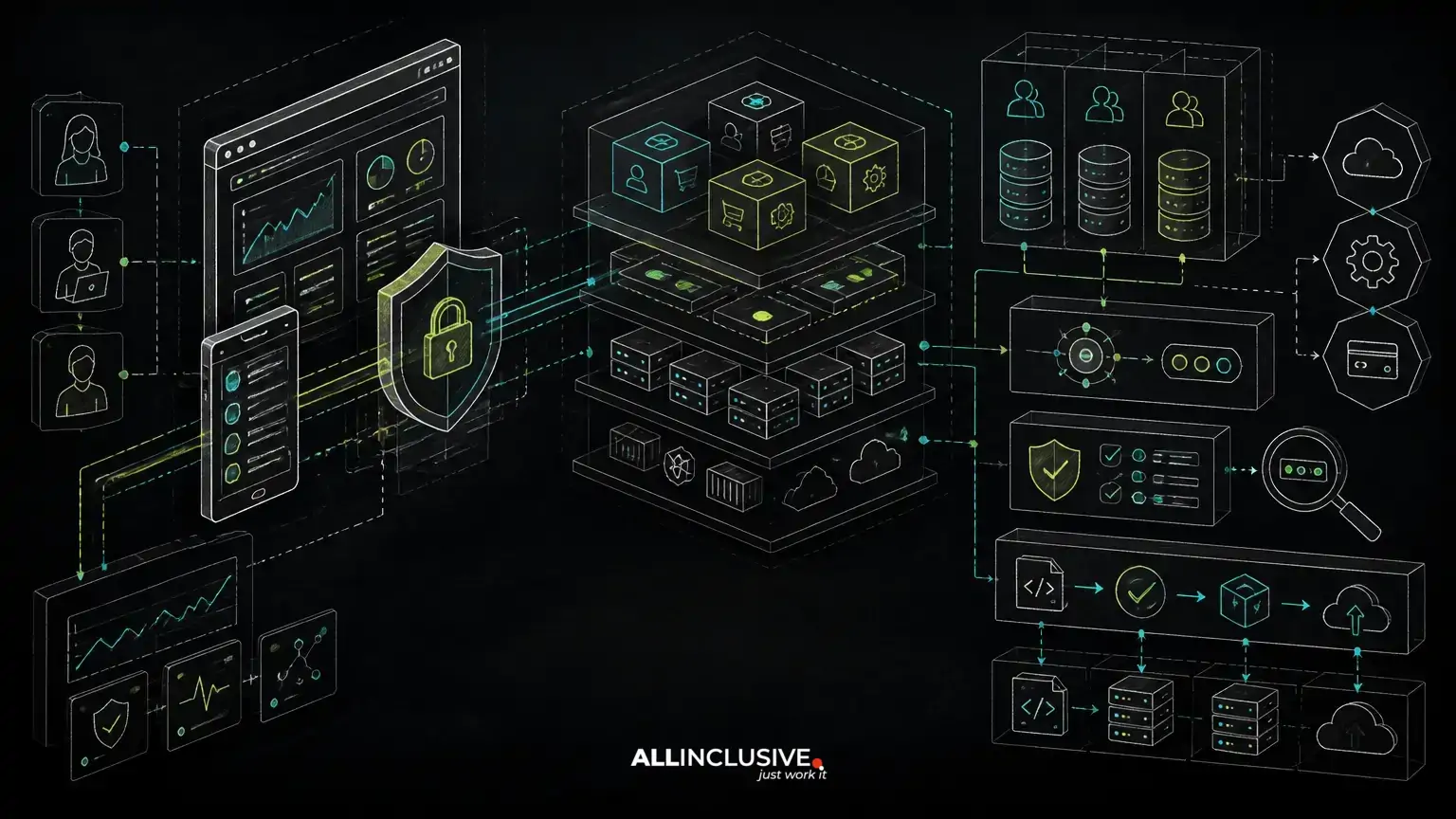
A web application security checklist should do more than confirm that a login screen exists. Custom business software often combines sensitive records, role-based workflows, billing, third-party integrations and administrative tools. Each capability creates security decisions that affect data exposure, operational continuity and the cost of future change.
Use the checklist below during discovery, architecture, development, testing and release review. It is designed for SaaS products, customer portals, internal systems, marketplaces and booking platforms. The objective is not to promise that an application is risk-free; it is to make security requirements explicit and testable before they become production incidents. Another decision connected with web application security checklist is covered in web application modernization strategy.
Start with the business workflow and threat model
Security controls are most effective when they follow the way the business actually operates. Map the important workflows before selecting implementation details:
- Who creates, views, changes and approves each type of record?
- Which actions are reversible, financially significant or legally sensitive?
- What happens when an account is suspended, an employee leaves or a vendor integration fails?
- Which data belongs to one customer, organization, seller, location or business unit?
- What must be logged for investigation, customer support or compliance review?
Then identify likely abuse cases. A threat model might include a user accessing another tenant's records, an employee receiving excessive privileges, a stolen session, manipulated pricing, a malicious file upload or a compromised integration credential. This workflow-first approach prevents teams from treating security as a generic technical layer detached from product behavior.
Web application security checklist for architecture and design
Define data boundaries and ownership
- Classify personal, financial, confidential and operational data.
- Document where data is stored, processed, cached, exported and backed up.
- Decide which records are tenant-owned, user-owned, organization-wide or system-wide.
- Minimize collection of information that the workflow does not require.
- Define retention and deletion behavior for accounts, transactions, files and audit records.
For a multi-tenant SaaS application, tenant isolation must be a deliberate architectural property rather than a convention that developers remember in every query. Application-level filters, database design, service boundaries and authorization tests should reinforce the same ownership model. The appropriate design depends on risk, scale, operational capability and the characteristics of the data.
For a broader discussion of isolation, roles and billing, see multi-tenant SaaS architecture.
Choose dependencies and services deliberately
- Maintain an inventory of frameworks, packages, APIs, infrastructure services and build tools.
- Review dependency updates through a controlled process rather than applying untested changes directly to production.
- Confirm that external services receive only the data and permissions they need.
- Document where authentication, file storage, email, payments, analytics and AI services fit into the trust boundary.
- Plan how a vendor outage, API change or revoked credential affects the workflow.
PHP and Laravel may be suitable for many business applications, while Python or another stack may fit different workloads. Security depends less on a technology label than on sound boundaries, maintained dependencies, careful configuration and a team able to operate the chosen architecture.
Authentication and account security
- Require strong passwords where passwords are used, and store them with an appropriate password-hashing mechanism.
- Support multi-factor authentication for administrators and other high-risk roles where the business risk justifies it.
- Protect login, password-reset and account-recovery flows against enumeration, abuse and unauthorized takeover.
- Use secure session handling, including expiration, rotation after sensitive events and protection against session theft.
- Define account lockout or throttling behavior without creating an easy denial-of-service tool.
- Separate customer, staff, service and administrative identities where their responsibilities differ.
- Record authentication events and make unusual activity available for investigation.
Single sign-on can simplify access management for an internal system, but it does not eliminate authorization work inside the application. A successfully authenticated user still needs permission checks for each relevant action and record.
Authorization, RBAC and tenant isolation
Many serious application vulnerabilities are authorization failures: the system verifies who the user is but not whether that user may perform the requested action. Review authorization at the route, service, record and workflow levels.
- Define roles around actual responsibilities, not only job titles.
- Apply least privilege to users, administrators, support staff and service accounts.
- Check permissions on the server for every sensitive operation; never rely on hidden buttons or client-side state.
- Test both allowed and denied actions for every important role.
- Prevent insecure direct object references, such as changing an identifier in a URL to access another record.
- Verify tenant ownership on reads, updates, deletes, exports, searches and background jobs.
- Control high-risk transitions such as refunds, approval, user impersonation, role changes and payout release.
- Review whether support personnel need temporary, scoped and auditable access rather than permanent administrator privileges.
Role-based access control is useful, but some systems also need organization hierarchies, resource-level rules, approval states or policy-based conditions. A marketplace, for example, may need to distinguish platform administrators, sellers, buyers, finance staff and support agents across different data boundaries.
Input, output and file security
- Validate input on the server using rules appropriate to the field and business operation.
- Use parameterized database access and safe query construction.
- Encode output according to its context, including HTML, JavaScript, URLs and structured data.
- Protect state-changing requests against cross-site request forgery where applicable.
- Set appropriate content and browser security controls for the application's risk profile.
- Restrict file type, size, naming, storage location and access permissions for uploads.
- Scan or inspect uploaded files when the workflow and threat model require it.
- Do not execute user-uploaded files as application code.
- Prevent unsafe redirects, server-side request forgery and injection into command, template or document-processing tools.
Validation should reflect business rules as well as syntax. A booking date may be correctly formatted but still invalid because the resource is unavailable. A discount value may be numeric but unauthorized for the current role. Security and workflow correctness often meet at the same validation boundary.
Protect sensitive data and business transactions
- Encrypt network connections and protect sensitive data at rest using controls appropriate to the environment.
- Keep secrets, API keys and signing credentials outside source code and logs.
- Limit which services and staff can access sensitive fields.
- Mask payment, identity and authentication data in user interfaces and operational logs.
- Use idempotency and replay protection for payment, booking, webhook and other high-impact operations where appropriate.
- Reconcile external transactions instead of assuming that a successful request always represents the final state.
- Make approval, refund, payout and account-change actions traceable.
Billing security is not only a payment-provider concern. The application still controls invoices, entitlements, plan changes, credits, refunds and access after payment events. Those states should be modeled explicitly and updated through controlled, auditable transitions.
Secure integrations, APIs and background processing
- Authenticate APIs with a method suited to the client and risk, and authorize each requested resource and action.
- Apply rate limits, payload limits and abuse monitoring to exposed endpoints.
- Version APIs when changes could affect existing clients or integrations.
- Validate webhook signatures where the provider supports them, and design webhook handling to tolerate retries.
- Use narrow scopes and separate credentials for different integrations.
- Protect queues and scheduled jobs from duplicate execution, unauthorized input and poisoned payloads.
- Ensure background workers apply the same tenant and permission rules as interactive requests.
- Define timeouts, retries, circuit-breaking or fallback behavior for dependent services.
Integrations frequently become hidden security boundaries. A CRM sync, accounting connector or AI feature may move data outside the primary application. Document the data flow, retention behavior, failure mode and revocation process before enabling the integration in production.
Logging, monitoring and incident readiness
- Log security-relevant events such as authentication changes, permission changes, exports, administrative actions and sensitive workflow transitions.
- Include enough context to investigate an event without recording secrets or unnecessary personal data.
- Protect logs from unauthorized alteration and restrict access to them.
- Monitor for repeated failed logins, unusual exports, privilege changes and integration errors.
- Define alert ownership and escalation paths.
- Maintain an incident response process covering containment, investigation, communication, recovery and follow-up.
- Test backups and restoration rather than assuming that a successful backup job proves recoverability.
Observability should support both security and operations. A clear audit trail can help identify abuse, resolve customer disputes and diagnose a workflow defect, but it should be designed with retention and privacy requirements in mind.
Secure development, testing and release controls
- Keep development, staging and production environments separated.
- Do not copy production data into lower environments without a justified, controlled process and appropriate protection.
- Use code review for authentication, authorization, data access, payment and infrastructure changes.
- Automate dependency, secret and static checks where they provide useful signal.
- Write authorization tests for roles, tenants, object ownership and denied actions.
- Test abuse cases, malformed input, replay, concurrency and failure recovery—not only successful user journeys.
- Use migration review and rollback planning for schema or permission changes.
- Restrict production deployment access and keep an auditable release history.
- Perform focused security testing before launch and after substantial architectural or workflow changes.
A custom application should have security acceptance criteria alongside functional acceptance criteria. For example, “a seller can update a listing” is incomplete without specifying which seller, which listing states, which fields and what happens when another seller's identifier is submitted.
Security decisions for build-versus-buy discussions
Buying a service can reduce the amount of code your team owns, but it does not transfer all security responsibility. The application remains responsible for identity, permissions, data mapping, configuration, secrets, error handling and the user workflow around the service.
Build-versus-buy reviews should ask:
- Does the product support the required tenant, role and audit model?
- Can data be exported, deleted and recovered in a usable form?
- What happens if the vendor changes pricing, APIs, access rules or availability?
- Which security controls are configurable, and which are fixed?
- Can the business maintain ownership of its source code, data and critical workflows?
Custom-made product engineering is often justified when generic software forces unsafe workarounds, duplicates sensitive data or cannot represent the business's approval and ownership rules. The right decision balances security, maintainability, delivery speed, operating cost and control—not the number of features in a vendor comparison.
How to keep the checklist useful after launch
Security is a continuing operating responsibility. Revisit the checklist when adding a role, tenant, integration, payment flow, AI capability, file workflow or administrative feature. Also review it after incidents, major dependency changes, infrastructure migrations and business-process changes.
For applications that need ongoing updates, monitoring and controlled maintenance, see support and maintenance for custom software. When planning a new product or internal system, explore custom web development services to connect security requirements with the underlying workflow and architecture.
Use this checklist as a review structure, not as a substitute for risk assessment or qualified security testing. The most reliable result comes from making ownership, permissions, data flows, failure modes and operational responsibilities explicit before the application becomes difficult to change.


