
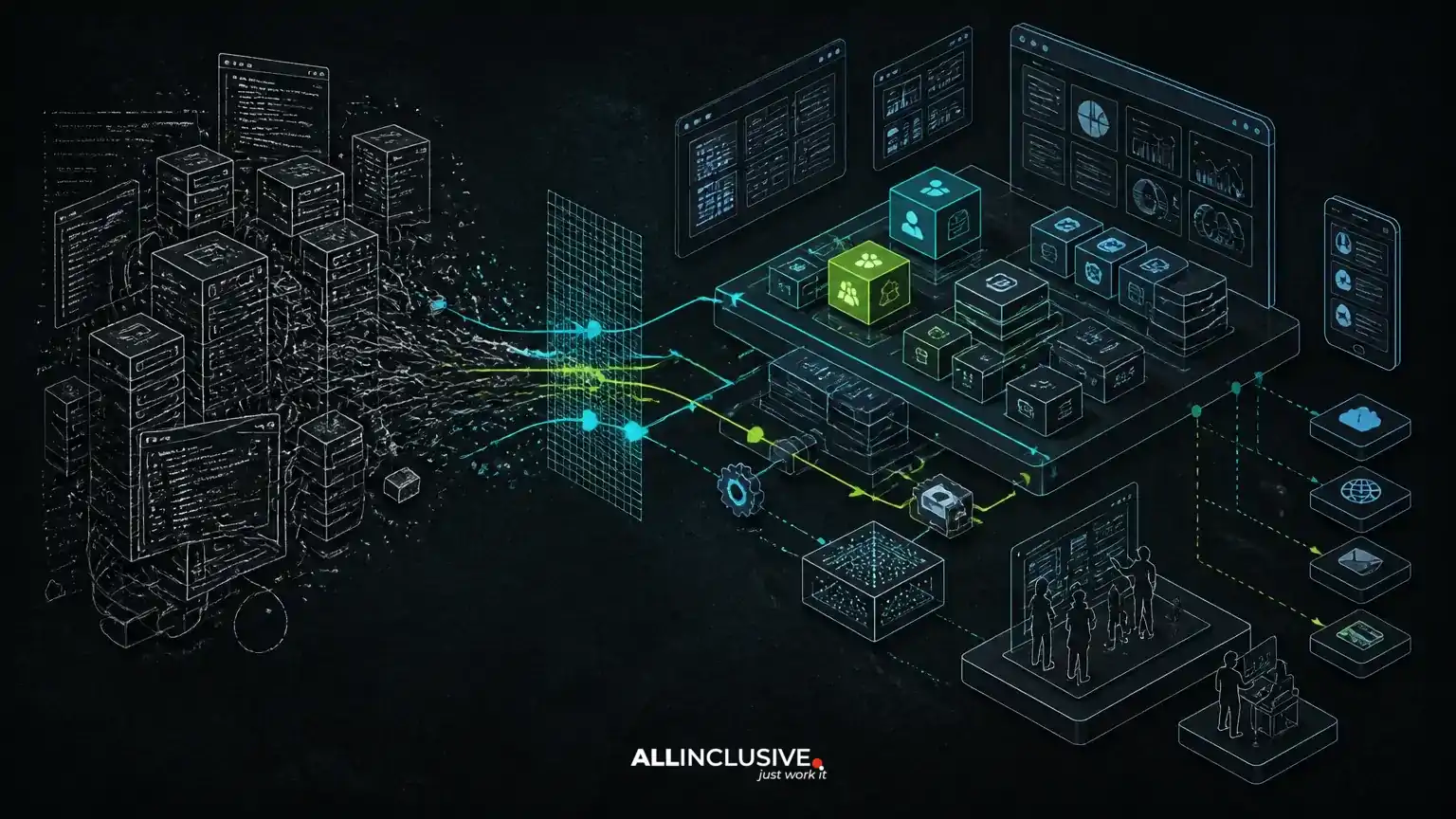
A sound web application modernization strategy does not begin with a preferred framework. It begins with the business workflow the application must support, the risks limiting that workflow and the parts of the system worth preserving.
Some applications need stabilization before any major change. Others can be refactored incrementally. A platform with a fundamentally unsuitable data model, authentication design or operating model may be better rebuilt or replaced. The right decision depends on architecture, operational evidence and the value of continuity—not on whether the code is old.
Start with the workflow, not the technology
Modernization has a business purpose: help people complete work more reliably, serve customers with fewer obstacles or give the company a product it can extend without disproportionate risk. Map the workflows that matter before selecting a technical path.
For a SaaS product, this may include tenant onboarding, role assignment, subscription changes, billing events and account administration. A marketplace may depend on listing approval, search, checkout, payouts and dispute handling. An internal system may center on approvals, document exchange, reporting and integrations with finance or operations tools.
Document each workflow’s users, permissions, data dependencies, external integrations, failure states and audit requirements. This exposes whether the problem is primarily presentation, code structure, data design, infrastructure, process or product fit.
Separate stabilization, refactoring, migration, rebuilding and replacement
These terms describe different levels of intervention. Treating them as interchangeable creates unclear scope and makes success difficult to measure.
Stabilize the existing application
Stabilization reduces immediate operational risk without changing the product’s fundamental design. Typical work includes improving observability, adding backups and recovery procedures, documenting deployment, addressing critical vulnerabilities, removing unsafe credentials from code and creating tests around high-risk workflows.
Stabilization is appropriate when the application is valuable but difficult to operate safely. It creates the evidence and control needed for later modernization. It does not, by itself, resolve an unsuitable data model or an experience that no longer fits the business.
Refactor in place
Refactoring changes internal structure while preserving externally visible behavior. Teams may separate domain logic from controllers, introduce clearer service boundaries, remove duplicated code, improve database access or add automated tests around a legacy module.
Refactoring works well when the core workflows and data model remain sound. It allows a team to modernize incrementally, but it requires discipline. New development must follow the improved structure, or the codebase will accumulate another layer of inconsistency.
Migrate selected components
A migration moves data, workloads or functionality to a new platform while preserving enough behavior to maintain business continuity. Examples include moving from unsupported infrastructure, replacing a fragile file-storage approach, extracting a reporting workload or changing a third-party integration.
Migration risk is often concentrated in data quality and operational dependencies. Before moving, identify ownership, retention rules, duplicate records, reference relationships, historical states and rollback requirements. A technically successful data transfer can still fail if users cannot reconcile records or if downstream systems receive a different meaning.
Rebuild the application
A rebuild creates a new implementation around validated workflows and requirements. It is justified when the old code is too entangled to change safely, the data model blocks essential capabilities or the user experience needs a fundamental redesign.
A rebuild should not be treated as permission to reproduce every legacy behavior. Separate essential business rules from accidental complexity, undocumented workarounds and obsolete features. A workflow-first rebuild may use a modular monolith initially, then introduce separate services only where ownership, scaling or deployment needs justify that complexity.
Replace the application
Replacement means adopting a commercial product, an established platform or another existing system instead of owning a custom implementation. It can be sensible when the workflow is standardized, configuration meets the real requirements and data ownership and integration constraints are acceptable.
Replacement becomes risky when the application encodes a competitive process, requires unusual approval logic, depends on complex multi-tenancy or needs deep integration with proprietary operations. License changes, export limitations, vendor roadmaps and customization boundaries should be evaluated alongside feature lists.
Decision criteria for a modernization path
Use evidence from the current system rather than a single code-quality score. The following questions help distinguish an incremental improvement from a more substantial change.
- Workflow fit: Can the current application support the required customer and internal journeys without persistent workarounds?
- Change safety: Can the team predict the impact of a modification and verify it with tests or other reliable checks?
- Data integrity: Are the entities, relationships, permissions and historical records represented accurately enough for future requirements?
- Operational control: Can the team monitor failures, deploy repeatably, restore data and investigate incidents?
- Integration dependency: Which external systems, webhooks, scheduled jobs and manual exports must remain compatible?
- Ownership: Does the organization control source code, data, deployment access, documentation and the ability to change the system?
- Delivery constraints: Can the business support a gradual transition, parallel operation or temporary duplication of functionality?
If the workflow is sound and change safety is the primary issue, refactoring may be sufficient. If the workflow is blocked by data or architectural constraints, a rebuild may be more appropriate. If the process is standardized and ownership is not strategically important, replacement deserves serious consideration.
Architecture choices that reduce modernization risk
Use a modular monolith when boundaries matter more than distribution
A modular monolith can provide clear domain ownership, shared deployment and relatively simple operations. It is often a practical target for custom SaaS products, portals and internal systems that need stronger structure but do not yet require independently scaled services.
Modules should have explicit responsibilities and controlled access to data. For example, billing, identity, tenant administration and workflow operations may share an application while keeping their domain rules separate. This makes later extraction possible without paying the operational cost of distributed systems prematurely.
Make permissions and tenancy explicit
Modernization often exposes authorization assumptions that were previously hidden in screens or controller conditions. Define users, organizations, roles, resource ownership and action-level permissions as business concepts.
For multi-tenant software, decide how tenant boundaries are enforced, audited and tested. A shared database, separate schemas or separate databases each create different operational and compliance considerations. The important requirement is consistent isolation across queries, background jobs, exports, caches and administrative tools. See the related guide to multi-tenant SaaS architecture for a deeper treatment of these decisions.
Protect integrations with explicit contracts
Legacy applications frequently depend on integrations that no one person fully understands. Inventory inbound and outbound data, authentication methods, retry behavior, idempotency, rate limits and failure handling. Add adapters around unstable or vendor-specific interfaces so the core workflow does not depend on scattered integration code.
For billing, payments and other consequential operations, model state transitions explicitly. A payment event, for example, may be received more than once or arrive after a user-facing request times out. The system should reconcile events safely rather than assuming a single synchronous response.
Plan the transition around business continuity
Modernization is a release and data-management problem as much as a coding problem. Choose a transition pattern that matches the application’s risk.
- Incremental replacement: Replace one bounded workflow while the legacy system remains the system of record for other areas.
- Strangler approach: Route selected capabilities to the new application while gradually reducing the legacy surface.
- Parallel operation: Run old and new paths together for a defined period, with reconciliation rules and an agreed source of truth.
- Big-bang cutover: Move all users and data at once when the system is sufficiently bounded and rollback is credible.
Before implementation, define migration checkpoints, data validation, user training, support ownership, rollback conditions and communication responsibilities. A cutover plan should also cover scheduled tasks, email delivery, webhooks, exports, reporting and administrative access—not just the main user interface.
Common modernization failure modes
Rewriting without preserving business rules
Legacy behavior may include tax handling, approval exceptions, entitlement rules or audit requirements that are not visible in the interface. Interview users, inspect production data and trace integrations before removing behavior. Preserve rules deliberately, not accidentally.
Choosing microservices to solve code organization
Service boundaries do not automatically create maintainability. They add deployment, observability, networking, data consistency and operational responsibilities. Establish domain boundaries first; distribute components only when independent ownership or scaling justifies it.
Starting with a user-interface redesign
A cleaner interface cannot compensate for incorrect permissions, unreliable availability data or inconsistent billing states. Design the workflow and domain model first, then modernize the interface around verified operations.
Ignoring the migration’s end state
Without a defined retirement plan, teams often maintain both systems indefinitely. Assign owners for legacy shutdown, document dependencies, measure remaining usage and set conditions for decommissioning old jobs, credentials and infrastructure.
How to evaluate a modernization proposal
A credible proposal should explain more than the target stack. It should show how the team will learn about the current application, reduce risk and demonstrate progress.
- Request an application and workflow discovery phase with specific outputs.
- Ask for a dependency, data and integration inventory.
- Require a proposed target architecture tied to business capabilities.
- Clarify what will be preserved, changed, migrated or retired.
- Review the testing, observability, security and rollback approach.
- Confirm ownership of source code, infrastructure configuration, documentation and data.
- Define acceptance criteria in terms of workflow outcomes, not only completed tickets.
Security should be assessed throughout the effort, including identity, authorization, secrets, dependency management, audit logging, backups and incident response. The web application security checklist provides a useful companion for reviewing these controls.
Choosing a modernization partner and delivery model
Custom-made product engineering is most valuable when the application contains business-specific workflows that generic software cannot represent cleanly. The implementation may use PHP and Laravel, Python or another suitable technology; the architecture should follow the product’s domain, team capability and operational requirements.
Look for a delivery model that keeps the organization involved in decisions about workflow, data and trade-offs. Source-code ownership, accessible documentation and maintainable deployment processes reduce dependency on any single vendor. Ongoing support should include monitoring, patching, incident response and controlled evolution rather than only emergency fixes. More context is available on support and maintenance for web applications.
For organizations planning a modernization program, custom web development can provide the engineering foundation for a staged rebuild, a workflow-specific SaaS product or an integration-led transition.
A modernization strategy should make the next change safer
The best modernization outcome is not simply a newer codebase. It is a system whose workflows are explicit, whose data and permissions are trustworthy, whose operations are observable and whose owners can change it with confidence.
Stabilize where control is missing, refactor where structure is the constraint, migrate where a bounded component has a better home, rebuild where the existing foundations block the product and replace where a standard capability is genuinely sufficient. That distinction turns modernization from a technology refresh into a managed business decision.


