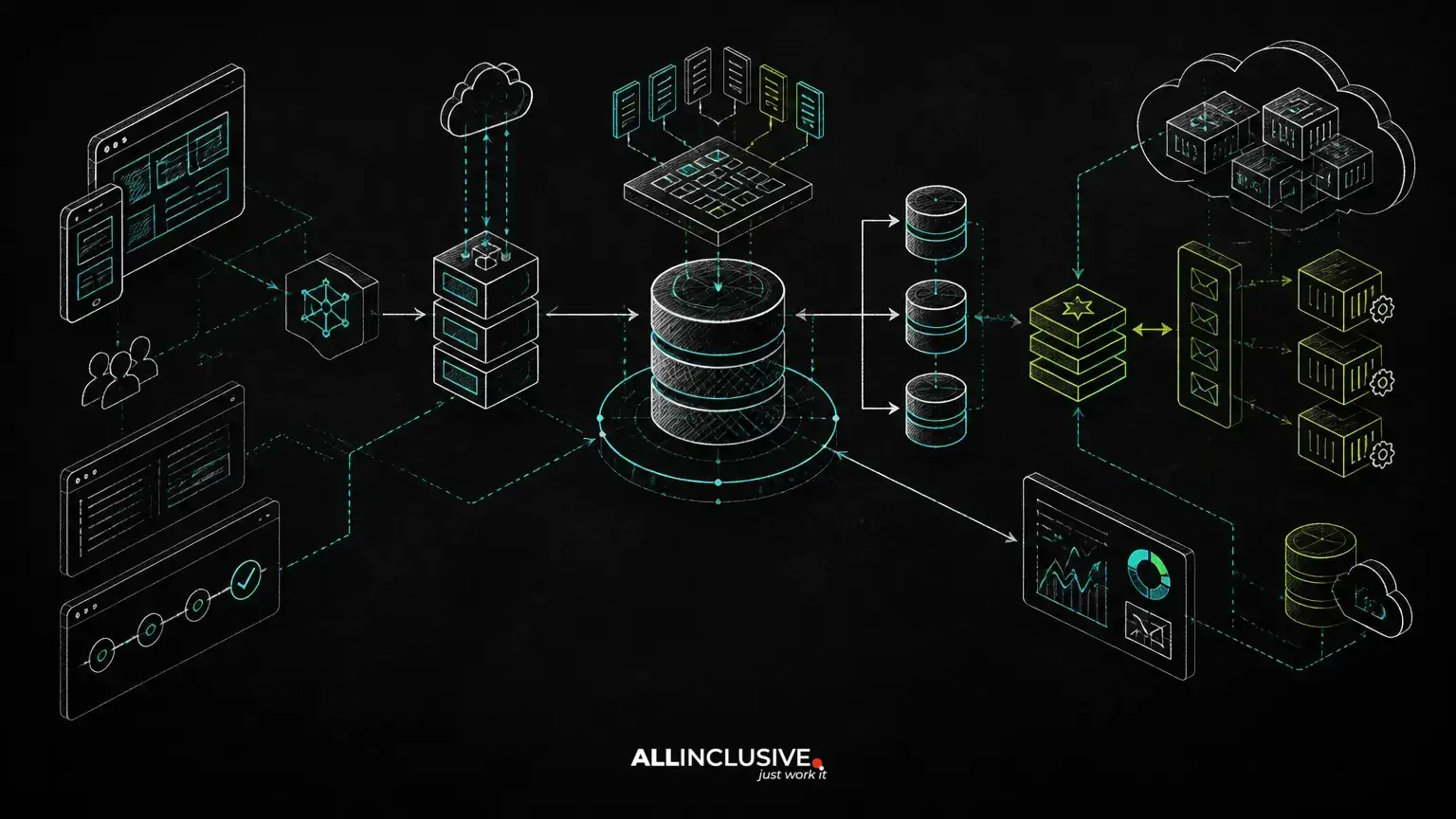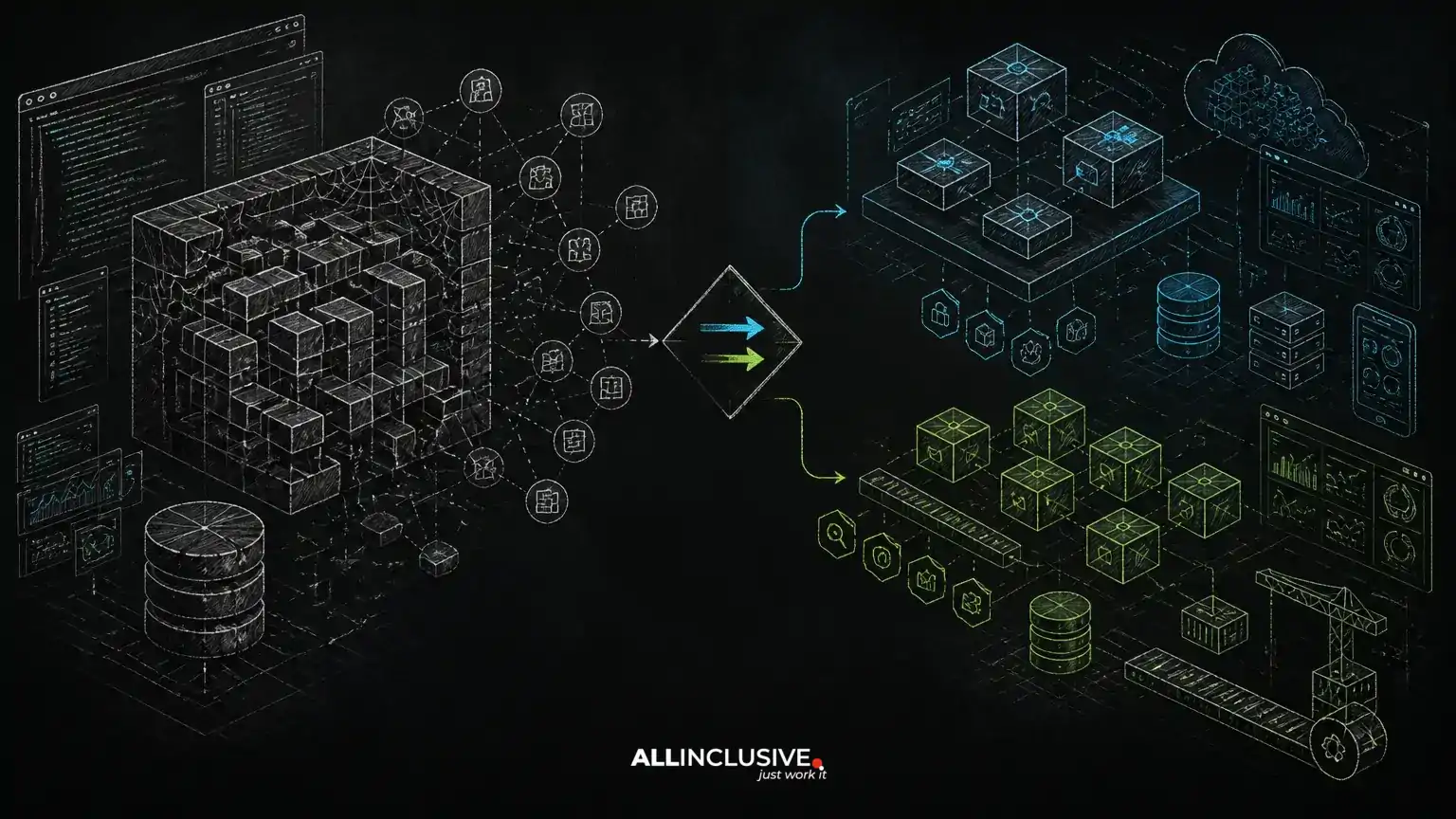
When an aging PHP application becomes difficult to change, the choice is rarely as simple as “keep the old code” or “start over.” The better decision depends on whether the existing system’s business logic is still valuable, whether its dependencies and runtime can be supported, how safely its data can be changed, and how much operational risk the business can absorb.
In practical terms, refactoring improves the internal structure of an application while preserving its externally visible behavior. A rewrite replaces most or all of the implementation, usually behind a carefully planned migration. Between those options are stabilization, targeted upgrades, and migration to a framework such as Laravel when the architecture and team needs justify it.
This guide explains how to choose among those paths without treating a rewrite as a clean slate or refactoring as a universal answer. For broader context on planning and delivering custom systems, see custom software development.
Refactor, rewrite, upgrade, migrate or stabilize?
These terms describe different levels of intervention. Confusing them can produce an inaccurate scope and an unsafe delivery plan.
Stabilize the application
Stabilization addresses immediate operational risk before major modernization begins. Typical work includes securing exposed endpoints, adding monitoring, documenting deployment steps, fixing failing backups, removing unsupported runtime components, and addressing defects that threaten revenue or core workflows.
Stabilization is appropriate when the application is business-critical but poorly understood. It creates enough visibility and control to make later refactoring or migration safer.
Upgrade the runtime and dependencies
An upgrade moves the application toward supported PHP versions, libraries, database drivers, operating systems, or hosting environments. It may require compatibility changes, test coverage and configuration work, but it does not necessarily change the application’s architecture.
Upgrading can reduce security and operational exposure quickly. It may also reveal deeper issues, such as removed language behavior, incompatible extensions, abandoned packages or assumptions about database behavior.
Refactor the existing implementation
Refactoring changes code structure without intentionally changing business outcomes. Examples include separating database access from presentation, replacing duplicated validation, introducing clearer domain services, improving error handling, and adding automated tests around important behavior.
A refactor is usually incremental. The system can continue serving users while engineers improve one area at a time, provided the team can establish reliable boundaries and verify that existing behavior remains intact.
Migrate to a framework or a new architecture
A migration moves selected capabilities into a different technical structure. That may mean introducing Laravel around existing modules, extracting a service, moving from server-rendered pages to an API-backed interface, or replacing a custom authentication layer with a maintained implementation.
Migration is not automatically a rewrite. A team can migrate in slices, retain proven business rules, and replace only the parts that benefit from a new framework or deployment model.
Rewrite the application
A rewrite replaces the implementation substantially enough that existing behavior must be rediscovered, specified and revalidated. The new system may use a modern PHP architecture, Laravel, another platform, or a different application boundary altogether.
Rewriting can be justified when the current code prevents meaningful change, cannot run safely on supported infrastructure, or encodes incompatible assumptions throughout the system. It is also the option with the greatest risk of lost business behavior and extended parallel operation.
When refactoring is the safer PHP modernization path
Refactoring is often the better choice when the application’s business workflows are still correct but its implementation has become difficult to maintain. This is common in custom PHP systems that have accumulated features over years without consistent architectural boundaries.
Indicators that support refactoring include:
- Core workflows are understood by users and subject-matter experts.
- The application can run on a supported PHP version or can reach one through manageable compatibility work.
- Most failures are localized rather than caused by a single pervasive design flaw.
- The database schema remains usable, even if access patterns are inconsistent.
- Business risk favors incremental releases over a long replacement program.
- The team can add characterization tests around high-value behavior.
For example, an order workflow might combine SQL queries, pricing rules, email notifications and inventory updates in one procedural file. A refactor can first capture current behavior, then separate those responsibilities behind explicit interfaces. The goal is not to make the code look modern for its own sake. The goal is to make future changes safer while preserving the rules the business relies on.
Refactoring has limits. If every module depends on global state, database side effects occur during reads, and no reliable environment exists for testing, incremental work may be slower than expected. Those conditions do not automatically require a rewrite, but they increase the value of a discovery and stabilization phase.
When a rewrite may be justified
A rewrite becomes more defensible when the existing implementation is not merely messy but structurally incompatible with the product’s required future.
Common signals include:
- The application cannot be maintained on supported PHP, database or operating-system versions without unacceptable exposure.
- Security controls are distributed inconsistently and cannot be reliably applied across the codebase.
- Small changes repeatedly cause unrelated regressions because responsibilities are inseparable.
- The data model no longer supports required workflows and cannot be evolved without breaking core behavior.
- Deployment is effectively manual, non-repeatable or dependent on unavailable institutional knowledge.
- The product needs a different operating model, such as tenant isolation, independent scaling or clear service boundaries.
- Years of abandoned experiments obscure which behavior is authoritative.
Even then, “rewrite” should not mean rebuilding every feature from memory. The replacement needs a behavior inventory, data migration strategy, acceptance criteria and a plan for running old and new paths safely. A rewrite that ignores undocumented edge cases can reproduce the visible screens while losing the rules that make the system commercially useful.
How business logic and data change the decision
The most important asset in a legacy PHP application is often not its code. It is the business logic embedded in validations, permissions, pricing rules, status transitions, scheduled tasks and exception handling.
Before choosing a path, identify which behaviors are:
- Explicit: documented in requirements, tests or domain specifications.
- Observed: known because users or operators rely on them, even though documentation is limited.
- Accidental: side effects that may be undesirable but could still affect integrations or customer workflows.
- Unknown: behavior that has not yet been traced or tested.
Refactoring can preserve these behaviors while making them more visible. A rewrite requires a deliberate decision about each one. This is why data analysis should begin early. Review foreign keys, nullable fields, duplicate records, historical status values, encoded business states, reporting queries and integrations that write directly to tables.
Database migration is particularly risky when the application has treated its schema as an informal API. A new application may require a cleaner model, but changing it in one step can break exports, background jobs, partner integrations or operational reports. Expand-and-contract migrations, compatibility views, dual reads or carefully controlled backfills may be safer, depending on the system.
Security and performance: repair the cause, not the label
“Legacy” does not automatically mean insecure, and “new” does not automatically mean secure or fast. Assess the actual causes of risk.
For security, examine authentication, authorization, session handling, file uploads, output escaping, SQL construction, secrets management, dependency exposure, administrative interfaces and logging. A targeted fix or dependency upgrade may resolve a specific issue without a rewrite. Conversely, if security decisions are duplicated throughout the application and cannot be audited, deeper restructuring may be warranted.
For performance, measure representative workflows before changing architecture. Slow database queries, missing indexes, excessive remote calls, inefficient queue handling or repeated rendering may be fixable inside the current system. A rewrite should not be used to avoid profiling. It can reproduce the same bottleneck with newer code and a larger delivery risk.
Operational support is part of the technical decision. Monitoring, repeatable deployments, error reporting, backups and incident procedures often deliver more immediate risk reduction than a broad code conversion. Ongoing software support and maintenance can also provide the discipline needed to stabilize a system before larger changes.
When Laravel migration is justified
Laravel can be a strong destination for a PHP modernization effort when the team benefits from a consistent application structure, established conventions, maintained ecosystem components and a development model suited to the product. It may help standardize routing, validation, authentication integration, queues, testing and dependency management.
That does not make Laravel the correct answer for every aging PHP application. A migration should be justified by concrete needs such as:
- Repeatedly rebuilding common application concerns in custom ways.
- Difficulty onboarding engineers because conventions are absent or inconsistent.
- A roadmap that requires clearer modules, testing and deployment practices.
- A need to replace unsupported components with maintainable equivalents.
- A team prepared to operate the framework and manage its upgrade lifecycle.
Laravel migration can be incremental. A strangler-style approach may place new routes or modules in Laravel while the existing application continues to handle untouched functionality. Shared authentication, sessions, database access and deployment need careful design. If those boundaries cannot be established, a phased modular refactor may be more appropriate than forcing a framework around the entire system.
For a focused comparison of architecture choices, read Custom PHP vs Laravel.
A decision process for refactor vs rewrite PHP projects
- Map business-critical workflows. Identify revenue paths, customer-facing operations, staff workflows, integrations and scheduled processes.
- Inventory the technical estate. Record PHP and database versions, extensions, packages, hosting, deployment, queues, scheduled jobs and external services.
- Measure current behavior. Capture error patterns, slow requests, failed jobs, support issues and release-related regressions.
- Trace data ownership. Find direct database consumers, reporting dependencies, imports, exports and records that require historical preservation.
- Establish a safety net. Add logging, backups, repeatable environments, smoke tests and characterization tests for high-risk behavior.
- Separate reversible from irreversible work. Dependency updates and modular refactors may be reversible; data model changes and cutovers require stronger controls.
- Compare delivery slices. Define what can be improved and released independently under refactoring, migration and rewrite scenarios.
- Choose a path per subsystem. One application may need stabilization in its billing area, refactoring in its catalog, a Laravel module for new functionality and eventual replacement of an obsolete reporting component.
This subsystem-level view is often more accurate than assigning one label to the entire PHP application. It also lets product leaders fund risk reduction and user value together rather than waiting for a single large technical program to finish.
Failure modes to avoid during PHP modernization
- Rewriting undocumented behavior: The new system matches the intended requirements but breaks edge cases users depend on.
- Refactoring without boundaries: Engineers improve individual files while global state and shared database side effects remain unchanged.
- Upgrading without testing: Runtime or dependency changes reach production before compatibility issues are visible.
- Migrating data last: The new application is designed without understanding historical records, invalid states or integration ownership.
- Measuring code quality alone: A cleaner codebase is not enough if release speed, reliability or workflow outcomes do not improve.
- Running two systems indefinitely: Parallel applications create duplicated fixes, unclear ownership and synchronization risk unless the cutover plan has explicit milestones.
Choosing a modernization partner for an aging PHP application
The right engineering partner should be able to inspect an existing system without assuming that replacement is the answer. Ask how the team will document business rules, assess dependencies, test database behavior, handle security findings, measure performance and define rollback options.
Look for a plan that separates discovery from implementation, names technical and business risks, and explains how users will be protected during transition. A capable PHP team should be comfortable preserving valuable custom logic, improving the parts that constrain delivery, and recommending Laravel or a different architecture only when the evidence supports it. For additional context on selecting a PHP delivery model, see PHP agency vs freelancer.
The strongest answer to “refactor vs rewrite PHP” is often conditional: stabilize first, refactor where the business logic and architecture are salvageable, upgrade unsupported foundations, migrate selected capabilities when boundaries are clear, and rewrite only the subsystems whose constraints cannot be removed safely. That approach preserves what the business already knows while creating a controlled path toward a more maintainable application.