
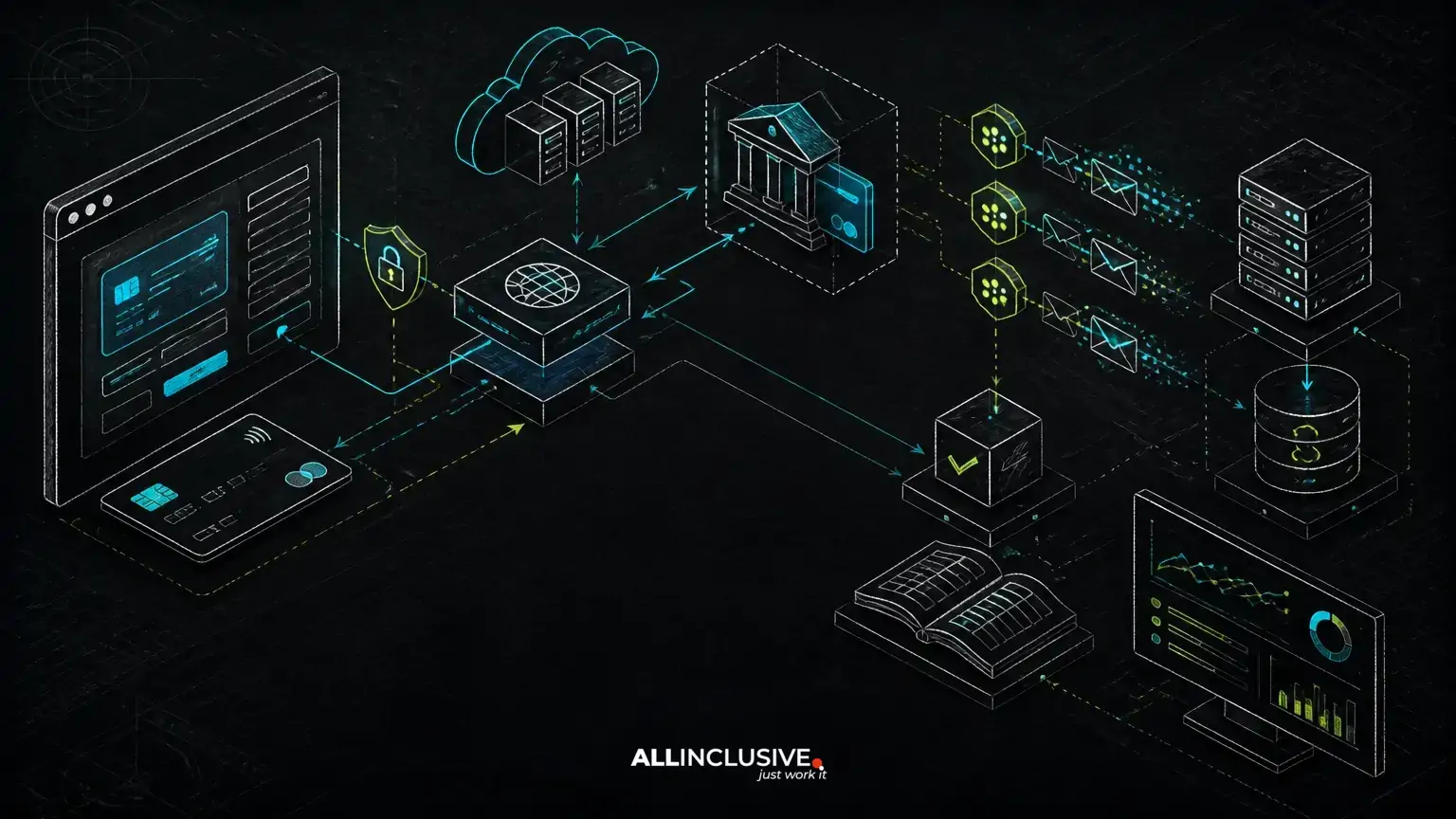
Payment gateway integration should be designed as a distributed transaction workflow, not as a single checkout request. The gateway may authorize a payment asynchronously, send duplicate webhooks, return transient errors, apply rate limits or report a state that differs temporarily from your application. A reliable design accounts for those conditions from the beginning. The payment gateway integration workflow also connects to the guidance in custom software development. Teams using Stripe with Laravel can apply these principles to billing state, webhooks and idempotency.
The core architecture usually includes a payment service, a gateway adapter, durable transaction records, a webhook endpoint, background jobs, reconciliation processes and operational monitoring. The right implementation depends on the product’s payment flows, compliance boundaries, settlement model and operational ownership. A custom integration can be built in Laravel, Python or another backend stack, but the responsibilities should remain explicit regardless of framework.
This article explains the engineering decisions that make a payment gateway integration maintainable: transaction state modeling, authentication, idempotency, webhook processing, retries, queues, reconciliation, versioning and observability.
Model payment transactions as stateful workflows
A payment should not be represented only by a boolean such as paid. Your system needs to distinguish the business order from the gateway transaction and preserve the events that explain how one state became another.
A useful internal model may include:
- Order or invoice: The business obligation for which money is being collected.
- Payment attempt: A specific attempt to authorize or capture funds.
- Gateway reference: The provider’s identifier for the payment, authorization or refund.
- Internal status: A controlled state such as pending, authorized, captured, failed, canceled, refunded or disputed.
- Amounts and currency: Values recorded in the smallest supported currency unit where appropriate, with explicit currency handling.
- Audit data: Timestamps, provider responses, webhook identifiers and relevant failure reasons.
Separating these concepts prevents a retry from accidentally creating a second business payment and makes partial refunds, failed attempts and asynchronous confirmation easier to represent. It also gives support and finance teams a reliable history rather than forcing them to infer what happened from a mutable order record.
Use a gateway adapter instead of spreading provider logic
Provider-specific request formats, response fields and error codes should be isolated behind a gateway adapter. The rest of the application should work with an internal payment contract rather than knowing every detail of a provider’s API.
An adapter can expose operations such as:
- Create or confirm a payment.
- Capture an authorized payment.
- Cancel an authorization.
- Issue a full or partial refund.
- Retrieve a gateway transaction.
- Verify a webhook signature.
This boundary makes provider version changes easier to manage and limits vendor coupling in order, subscription and fulfillment code. It also supports a deliberate multi-provider strategy when geographic coverage, payment methods or business continuity requirements justify it.
The internal contract should define normalized outcomes without hiding important uncertainty. For example, a gateway timeout should not be converted immediately into failed if the request may have reached the provider. A status such as unknown or pending verification can trigger a lookup or reconciliation process instead of an unsafe duplicate attempt.
Teams planning broader integration boundaries may also benefit from the design principles in third-party API integration strategy, particularly the emphasis on failure handling and ownership.
Make idempotency a requirement for payment writes
Network failures create a dangerous ambiguity: your application may not receive the response even though the gateway accepted the request. Retrying without protection can produce duplicate charges or duplicate refunds.
For every operation that changes payment state, generate and persist an idempotency key tied to the business operation. The key should be stable across retries of the same attempt and different for a genuinely new attempt. Store the key with the internal payment record and send it through the gateway’s supported mechanism where available.
Idempotency should exist at more than one boundary:
- Application boundary: Prevent two user requests from creating duplicate payment attempts.
- Job boundary: Ensure a retried queue job repeats the same operation rather than creating a new one.
- Provider boundary: Use the gateway’s idempotency facility when supported.
- Webhook boundary: Record provider event identifiers so duplicate deliveries are harmless.
Database constraints are valuable here. A unique key on the internal operation identifier, combined with a transaction that records the attempt before dispatching work, can prevent race conditions that application checks alone may miss.
Separate checkout requests from webhook confirmation
A checkout request and a webhook serve different purposes. The checkout request starts or confirms an operation and gives the user immediate feedback. The webhook communicates a provider-side event that may arrive later, arrive more than once or arrive out of order.
The webhook endpoint should be intentionally small:
- Authenticate the request by verifying its signature or other provider-specific mechanism.
- Validate the event structure and identify the provider event ID.
- Persist the event or an equivalent processing record.
- Return an appropriate response quickly after durable acceptance.
- Process business effects asynchronously.
Do not fulfill an order merely because a browser was redirected to a success page. Do not trust client-supplied payment status. Fulfillment should follow a verified internal state derived from an authenticated provider response or webhook, according to the product’s risk model.
Webhook processing must be idempotent. A duplicate event should not send another confirmation email, create another shipment or mark an already completed order twice. An event log with a unique provider event ID is a practical foundation, but event ordering also needs attention. A delayed “payment authorized” event should not overwrite a later “refunded” state without transition rules.
Design retry policies around error meaning
Retries are useful for transient network failures, temporary provider errors and selected rate-limit responses. They are harmful when applied to permanent validation failures, declined payments or ambiguous writes without idempotency.
A reliable retry policy classifies errors before deciding what to do:
- Retryable: Timeouts, connection failures and temporary service responses, subject to bounded attempts.
- Rate limited: Delay according to the provider’s guidance when available and reduce request pressure.
- Permanent: Invalid amounts, malformed requests, unsupported currencies or rejected credentials.
- Business decline: A payment decision that should be shown to the user without treating it as an infrastructure failure.
- Unknown: An outcome requiring status retrieval or reconciliation before another write.
Use exponential backoff with jitter, maximum retry counts and a dead-letter or manual-review path. The system should record the reason for each retry and expose jobs that require intervention. A queue is often preferable to keeping a web request open while waiting on a provider, especially for webhook side effects, status checks and reconciliation.
Rate limiting is a shared systems concern rather than only a gateway detail. Your integration should protect both your application and the provider from bursts caused by customer activity, webhook redelivery or a runaway job. The broader API guidance in API rate limiting can help teams define capacity controls without breaking legitimate traffic.
Choose Laravel or Python according to responsibility
Laravel can be a strong fit when payment processing is closely connected to a PHP application that already owns authentication, orders, notifications and administrative workflows. Its application structure, queue support and database tooling can provide a clear home for payment models, webhook routes and asynchronous jobs.
Python can be appropriate when the payment service belongs in a Python backend, when the organization already operates Python integration services or when payment events feed data, risk or automation workflows built in that ecosystem. Framework choice matters less than the quality of the boundaries: typed or validated request models, explicit state transitions, durable job handling and testable gateway adapters.
In either stack, keep provider calls out of templates, controllers and unrelated domain services. A useful structure separates:
- Transport and authentication.
- Provider-specific adapter logic.
- Internal payment domain rules.
- Persistence and state transitions.
- Queue jobs and webhook consumers.
- Reconciliation and reporting.
For teams evaluating a broader custom application architecture, API development provides the relevant context for designing these boundaries as part of a maintainable backend.
Build reconciliation for the cases automation cannot resolve
Webhooks are essential but should not be the only source of operational truth. Events can be delayed, rejected, misconfigured or missed during an outage. Reconciliation compares internal records with provider records and identifies differences.
A reconciliation process may:
- Find payments stuck in pending or unknown states.
- Retrieve current provider status for unresolved attempts.
- Compare captured, refunded and settled amounts.
- Detect missing or duplicate webhook events.
- Flag orders whose fulfillment state does not match payment state.
- Produce an exception queue for finance or support review.
Reconciliation should be safe to run repeatedly. It should not silently rewrite history or issue refunds automatically unless that behavior has been explicitly designed and controlled. Store the comparison result, timestamp, source identifiers and resolution outcome so operational staff can understand what the system checked.
Settlement reconciliation may require a separate model from authorization and capture. The amount a gateway authorizes is not always the same as the amount ultimately settled after refunds, fees, disputes or currency conversion. Finance requirements should be gathered before the schema is finalized.
Protect credentials, sensitive data and operational access
Payment integrations require careful handling of secrets and payment data. Store credentials in a managed secret system or protected environment configuration, restrict access by role and rotate them according to an established operational process. Avoid logging full request payloads when they could contain sensitive payment information.
Log provider reference IDs, internal operation IDs, status transitions and sanitized error details instead. Define retention rules for webhook payloads and audit records. The exact compliance obligations depend on the payment flow, provider, jurisdictions and data handled, so legal and security review should be part of project planning rather than an afterthought.
Authentication is also an integration design issue. Server-to-server credentials, signed webhooks and OAuth-based connections have different lifecycles and failure modes. Do not treat a successful API call as proof that credential management is complete; monitor expiration, rotation and permission changes. Related API authentication considerations are covered in OAuth 2.0 for API integrations.
Instrument the payment lifecycle
When a payment fails, teams need to determine whether the cause was a user decline, application validation, credential failure, provider outage, timeout, webhook problem or reconciliation discrepancy. Observability should make that distinction visible without exposing sensitive data.
Useful signals include:
- Payment attempts by internal status and gateway outcome.
- Webhook receipt, verification and processing failures.
- Queue age, retry counts and dead-letter volume.
- Latency and timeout rates for each provider operation.
- Unknown or pending payments beyond an expected threshold.
- Reconciliation exceptions and unresolved operational cases.
Use correlation IDs across the checkout request, gateway call, webhook event and background jobs. Structured logs and dashboards are more useful than unsearchable text messages. Alerts should focus on actionable conditions, such as a sudden increase in unknown outcomes or a growing backlog of unprocessed webhooks.
Payment gateway integration review checklist
- Are orders, payment attempts, gateway transactions and refunds separate concepts?
- Can every write operation be retried safely?
- Are idempotency keys persisted and enforced?
- Are webhook signatures verified before processing?
- Are duplicate and out-of-order events handled?
- Are provider calls isolated behind an adapter and internal contract?
- Do queues use bounded retries, backoff and a manual-review path?
- Can unknown payment outcomes be checked without charging again?
- Does reconciliation compare internal records with provider data?
- Are secrets, logs, payload retention and access controls reviewed?
- Can support and finance teams see why a transaction reached its current state?
- Are provider API versions and contract changes tested before release?
A dependable payment gateway integration is an operational system as much as a checkout feature. Designing for duplicate events, uncertain responses, retries and reconciliation reduces financial risk and gives product teams a safer foundation for refunds, subscriptions, marketplaces and future payment methods. Ongoing monitoring and maintenance are part of that design; teams can also review support and maintenance services when the integration needs continued operational ownership.


