
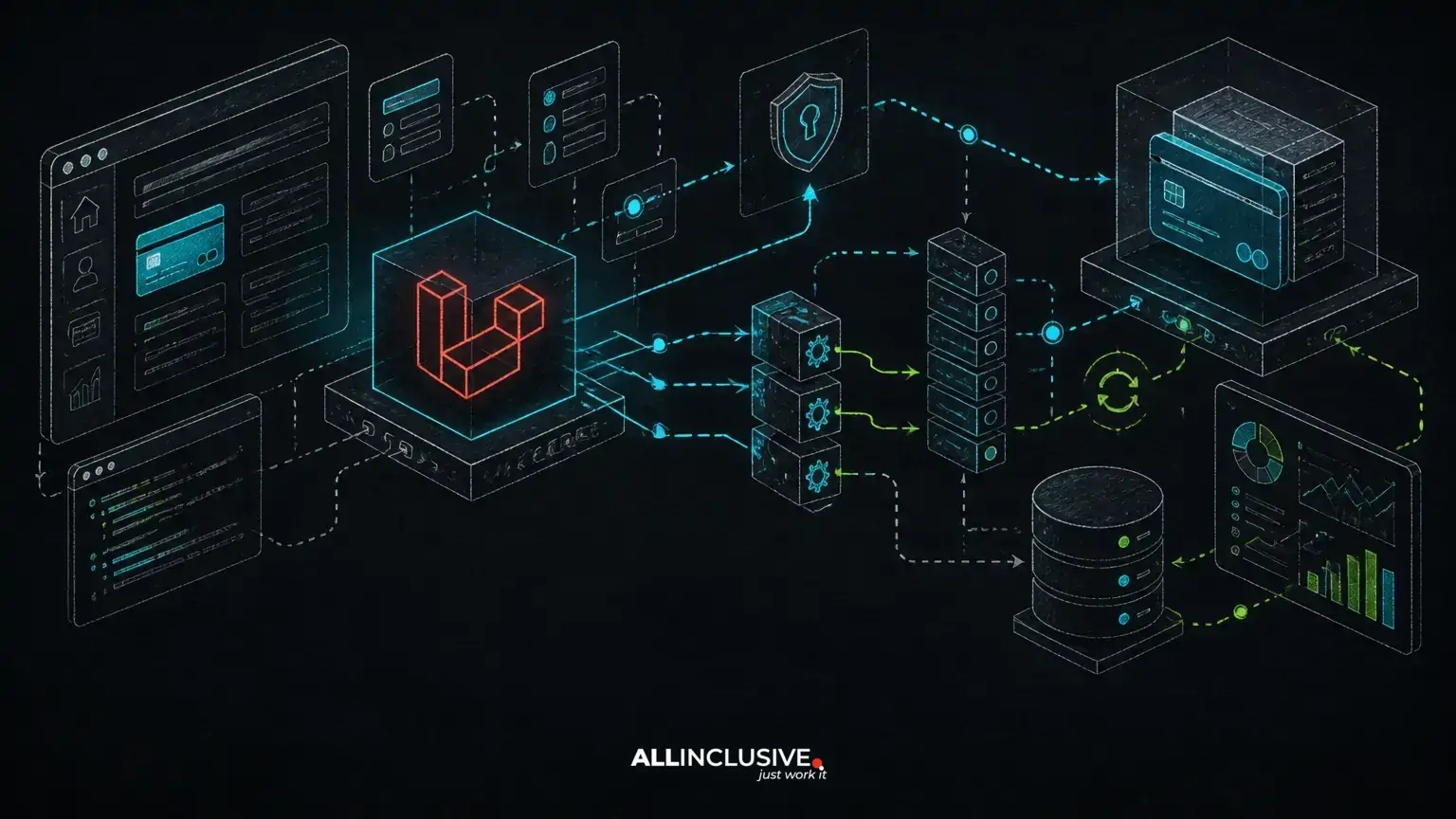
A Stripe integration in Laravel should be designed as a distributed system, not as a small payment form. The application must create Stripe resources safely, verify asynchronous events, represent billing state locally, recover from retries and provide an operational path when records diverge.
The most dependable approach is to treat Stripe as the external system of record for payment objects while Laravel owns the product’s workflow and a deliberate local projection of billing state. That boundary supports clearer responsibilities, safer retries and more maintainable custom software. Another decision connected with stripe integration laravel is covered in rest vs graphql.
Start with a billing state model, not controller calls
Before writing integration code, define the states your product needs to represent. A subscription, for example, may move through trial, active, past due, canceled or incomplete states. A payment may be pending, succeeded, failed or requiring customer action. The precise state names depend on the product and Stripe objects involved, but the principle is consistent: business workflows should not depend on a single synchronous API response.
A Laravel application commonly needs local records such as:
- A customer mapping between the application user or organization and the Stripe customer identifier.
- Subscription and price references, together with the locally relevant status and plan metadata.
- Payment or invoice records used by product workflows, support teams and reporting.
- Webhook event identifiers and processing status for deduplication and diagnostics.
- A reconciliation timestamp or review status for records that require follow-up.
Keep provider identifiers and raw event payloads where they are useful for support and auditing, but avoid making raw provider JSON the only representation of business state. A normalized local model gives the application a stable interface if provider payloads or product requirements change.
Separate customer actions from billing synchronization
Customer-facing actions and webhook processing have different reliability requirements. A checkout or subscription request may need to return an immediate result to the browser. A webhook may arrive later, be delivered more than once, or arrive in an order that differs from the user’s actions.
For a Laravel application, a useful separation is:
- Application service: validates the requested plan or price, checks authorization and coordinates the Stripe operation.
- Stripe client or gateway adapter: contains provider-specific API calls and translates provider errors into application-level outcomes.
- Local billing model: stores the identifiers and state required by the product.
- Webhook endpoint: authenticates and records incoming events without trusting their arrival order.
- Queue jobs: perform work that does not need to block the webhook response.
- Reconciliation process: compares local records with Stripe when events are missed, delayed or ambiguous.
This structure prevents payment logic from spreading across controllers, jobs and models. It also makes it easier to test provider failures without exercising a complete browser workflow.
Use idempotency at every retriable write
Network failures create an important ambiguity: the request may have failed before Stripe processed it, or Stripe may have processed it before the response was lost. Retrying a create operation without protection can produce duplicate customers, subscriptions, payment intents or other resources.
Idempotency keys provide a way to associate retries with the same logical operation. The key should be generated from a stable application operation, not randomly regenerated for every HTTP attempt. For example, an application might create a billing-operation record with its own unique identifier, then use that identifier when retrying the corresponding provider request.
Idempotency design should answer four questions:
- What business action is being protected?
- How long should repeated attempts be considered the same operation?
- What happens when the first attempt has an unknown outcome?
- How will support staff locate the operation in application and provider logs?
Do not assume idempotency removes the need for local safeguards. Use database uniqueness constraints for provider identifiers and application operation keys. Record the request context and final outcome where appropriate. If a retry encounters an existing resource, retrieve and validate it rather than blindly creating another one.
Verify webhooks before changing billing state
Webhook endpoints are part of the security boundary. The endpoint should verify the provider signature using the unmodified request body and the configured signing secret before treating the event as authentic. It should also reject malformed, stale or otherwise invalid requests according to the integration’s security policy.
Verification is only the first step. A robust Laravel webhook flow generally:
- Reads the raw request body and verifies the signature.
- Extracts the event identifier and type.
- Checks whether the event has already been recorded or processed.
- Stores enough information to investigate the event later.
- Returns a successful response promptly when the event has been durably accepted.
- Dispatches suitable processing to a queue when downstream work is not immediate.
Do not perform slow email, entitlement, analytics or complex database workflows directly in the request path unless there is a clear reason to do so. A webhook provider may retry when your endpoint times out or returns an error. Fast acknowledgment reduces unnecessary redelivery, while durable event storage preserves the ability to process the event asynchronously.
Make webhook processing duplicate-safe and order-aware
Webhook delivery is asynchronous. The same event may be delivered more than once, and related events may not arrive in the business order your application expects. An event handler should therefore be safe to run repeatedly and should not assume that the latest local update always came from the latest event.
A practical implementation stores the provider event identifier under a unique constraint. Processing can then distinguish a new event from a duplicate. For state updates, compare event timestamps or retrieve the authoritative provider object when the event does not contain enough context. Avoid allowing an older event to overwrite a newer local state without an explicit rule.
Idempotent handling also applies to side effects. If a successful payment grants access, the entitlement operation should have its own uniqueness rule or state transition guard. Otherwise, a duplicate webhook could create duplicate credits, notifications or fulfillment records even when the billing record itself is protected.
Design retries around error categories
Not every failed request should be retried. Transient network failures, timeouts and some rate-limit or server responses may justify a bounded retry with backoff. Invalid parameters, unauthorized requests, revoked credentials and business-rule failures generally require correction rather than repetition.
Retry policy should specify:
- Which errors are retryable.
- How many attempts are allowed.
- How backoff and jitter are applied.
- When a job moves to a dead-letter or review state.
- How duplicate side effects are prevented.
- What telemetry identifies the failed operation.
Laravel queues can help isolate provider work from customer requests, but queued jobs need the same idempotency and state-transition safeguards as synchronous code. A job retry is an infrastructure behavior; it is not proof that the underlying business operation is safe to repeat.
Keep API contracts, authentication and configuration explicit
Stripe credentials, webhook secrets and environment-specific configuration should be managed through the application’s secret-management process rather than committed to source control. Separate test and live environments carefully, and make the active mode visible in operational diagnostics without exposing secret values.
Use a provider adapter so application code does not depend on SDK details throughout the domain. The adapter can centralize authentication, API version configuration, request metadata, exception translation and logging rules. When the provider or SDK changes, this boundary reduces the number of files that require review.
Record the provider object identifiers needed to trace a local record to Stripe. Correlation identifiers should appear in structured logs, queue jobs and support tooling. Avoid logging payment details or secrets that are not necessary for diagnosis.
For broader API design considerations, see this API security checklist for custom web applications. The same principles—least privilege, controlled secrets, validation and useful audit trails—apply to payment integrations.
Reconcile local records instead of trusting events forever
Webhooks are essential, but they should not be the only recovery mechanism. Configuration mistakes, deployment interruptions, invalid signatures, queue outages and provider-side changes can leave local state incomplete.
A reconciliation process can identify records that are pending too long, have missing provider identifiers, show inconsistent status or have not received expected activity. Depending on the workflow, reconciliation may retrieve a provider object, compare selected fields and either repair the local projection automatically or create a review task.
Reconciliation should be bounded and observable. Do not repeatedly scan every record without a reason. Use timestamps, status filters and explicit repair policies. Record what changed and why, particularly when billing state controls access to a product.
Test the failure paths that affect revenue and access
Integration testing should cover more than a successful checkout. Useful scenarios include:
- A timeout after a create request has reached the provider.
- A repeated request using the same idempotency key.
- A duplicate webhook event.
- An invalid webhook signature.
- Events arriving in an unexpected order.
- A queue job retry after partial local work.
- A provider rate limit or temporary outage.
- A payment requiring customer action.
- A canceled or past-due subscription.
- A reconciliation process finding a mismatch.
Use provider test environments and controlled fixtures where possible, but keep the business-state tests independent of a live external dependency. Contract tests can verify that the adapter sends the expected fields and translates representative responses correctly.
Choose Laravel responsibilities deliberately
Laravel is well suited to the application layer around a Stripe integration: authenticated customer workflows, database-backed state, queue orchestration, validation, notifications and administrative tooling. The framework should not be expected to make distributed payment operations reliable automatically. Reliability comes from explicit contracts, state transitions, idempotency, observability and recovery procedures.
Python may be appropriate when the wider platform already uses Python for billing analytics, data processing or service orchestration. The key decision is ownership: define one authoritative workflow for each billing action and avoid having Laravel and Python independently mutate the same provider resource without coordination.
For teams planning a custom integration, the API development service can be evaluated alongside the product’s data, queue and operational requirements. Broader application implementation context is available through Allinclusive development services.
Operational signals that make support possible
A payment integration is not finished when the API call succeeds. Teams need to know when events fail, jobs accumulate, reconciliation finds drift or a billing state remains unresolved.
Monitor and log signals such as webhook verification failures, processing latency, duplicate-event counts, queue failures, retry exhaustion, provider error categories and records awaiting reconciliation. Include a correlation identifier, local record identifier and provider object identifier where safe and relevant.
Document the response procedure for common incidents: how to replay an accepted event, how to inspect a failed job, how to verify a subscription’s provider state and when a human must approve a correction. Ongoing monitoring and maintenance can be part of the integration’s ownership model; see support and maintenance for custom software for related operational considerations.
Use the integration as a controlled billing boundary
A dependable Stripe integration in Laravel is a boundary between customer intent, provider state and application entitlements. Model the state explicitly, protect writes with idempotency, authenticate and deduplicate webhooks, classify retries, queue slow work and reconcile records that may have drifted.
These practices reduce duplicate charges and duplicate fulfillment, but they also improve maintainability. Product teams gain clearer billing workflows, engineers gain testable integration boundaries and support teams gain the evidence needed to resolve exceptions without guessing.


