
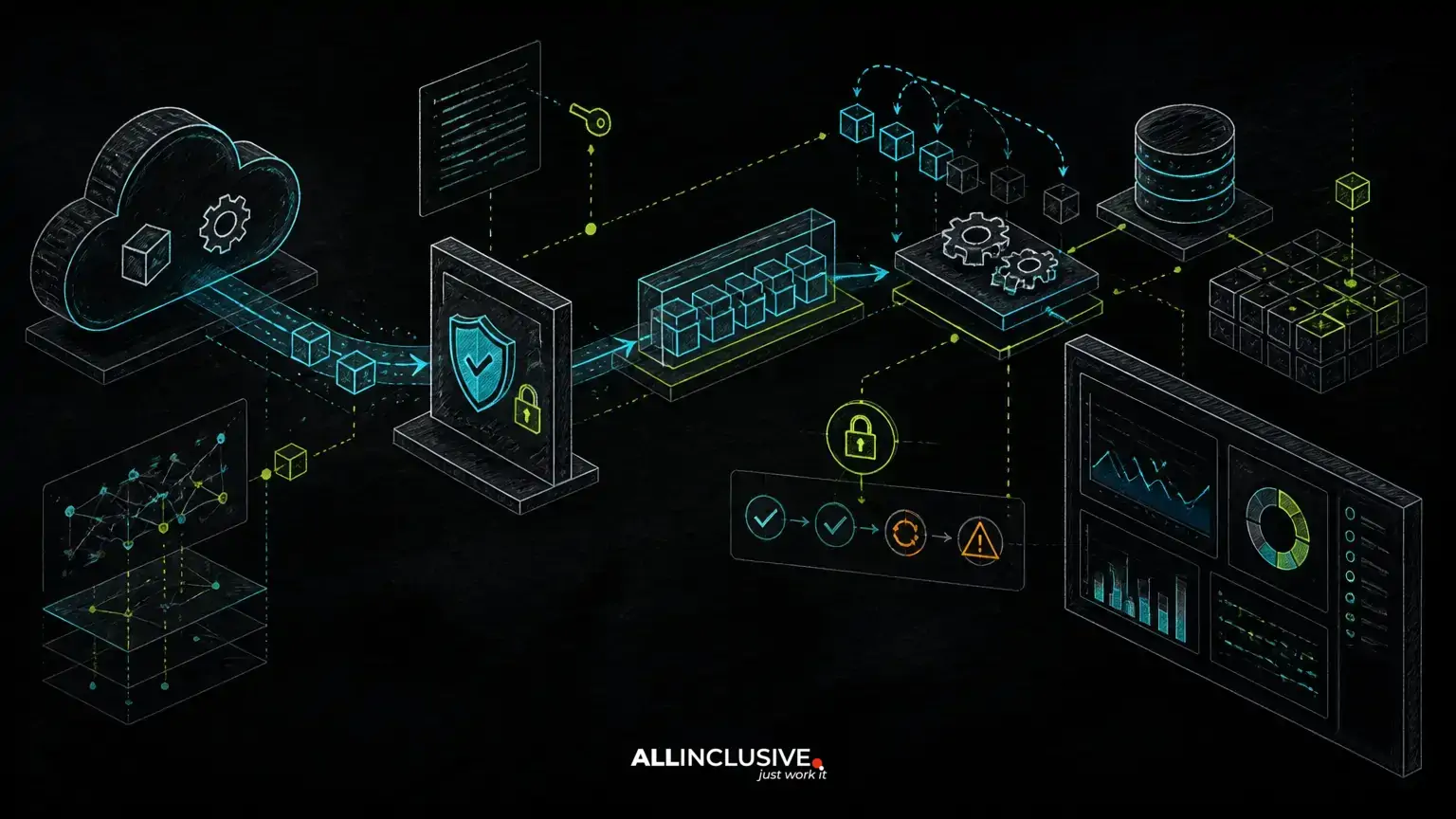
Webhooks are simple to describe: one system sends an HTTP request when an event occurs. Reliable webhook engineering is more demanding. Networks fail, providers retry, consumers process requests slowly, events arrive out of order and an accepted request may still fail later in the application. Teams working on webhooks best practices may also need the implementation guidance in custom software development.
The core webhooks best practices are to authenticate every delivery, verify the complete payload, acknowledge quickly, process asynchronously, make side effects idempotent, retry with controlled backoff, record delivery state and reconcile against the source system. These decisions determine whether an integration is merely connected or dependable enough to support orders, payments, account updates and other business-critical workflows.
Design the webhook contract before writing the handler
A webhook is an integration contract, not just an endpoint. Define the event name, schema, identifier, creation time, delivery metadata and expected response behavior before implementation.
Useful contract fields commonly include:
- Event ID: a stable identifier for the event or delivery, used for deduplication and tracing.
- Event type: a namespaced name such as invoice.paid or customer.updated.
- Occurred-at timestamp: when the source event was created, distinct from when it was delivered.
- Schema version: a way to evolve payloads without silently changing consumer assumptions.
- Resource reference: an identifier that lets the consumer retrieve current state if the payload is incomplete or stale.
Document whether delivery is at-least-once, whether ordering is guaranteed, which status codes trigger retries and how long the provider retains failed deliveries. If those rules are unknown, design defensively: assume duplicates, delays, reordering and eventual delivery failure.
Verify signatures and authenticate the sender
HTTPS protects data in transit, but it does not by itself prove that a request came from the expected provider. Webhook endpoints should use a provider-supported authentication method, such as signed requests, a secret token or mutual TLS where appropriate.
Signature verification should be performed against the raw request body, not a re-serialized JSON object. Whitespace, encoding and property ordering can change during parsing and cause valid signatures to fail. A robust verifier should also:
- Check the signature before performing business processing.
- Validate a timestamp or equivalent freshness value when the scheme supports it.
- Use constant-time comparison for signature values.
- Support secret rotation without creating an unnecessary outage.
- Keep secrets in managed configuration rather than source code or logs.
Authentication and authorization are related but different. A valid provider signature establishes message authenticity; application rules still need to determine whether the referenced account, tenant or resource is allowed to change.
Make every webhook handler idempotent
Most webhook systems provide at-least-once delivery. A provider may send the same event again because the first response timed out, even if the consumer completed the work. The handler must therefore tolerate repeated delivery without creating duplicate orders, charges, emails or background jobs.
The usual pattern is to persist an event or delivery ID in a durable store with a uniqueness constraint. Process the event within a transaction that records the relevant business effect, or use an explicit state machine when processing spans multiple systems. A duplicate should produce a safe outcome: acknowledge it, return its existing result or leave it available for controlled reprocessing.
Do not rely only on an in-memory cache or an application-level “check then insert.” Concurrent deliveries can pass the check at the same time. Database constraints and transactional behavior provide stronger protection.
Idempotency also applies beyond the webhook endpoint. If handling an event dispatches a job, the job needs duplicate protection. If it calls a downstream API, use that API’s idempotency mechanism where available or store an operation key and outcome in your own system. See API idempotency patterns for a broader treatment of duplicate side effects.
Acknowledge quickly and process asynchronously
A webhook request should do only the work required to authenticate, validate, persist enough information for recovery and enqueue processing. Long-running work inside the HTTP request increases timeout risk and causes providers to retry requests that may already be executing.
A common architecture is:
- Receive the request over HTTPS.
- Verify the signature and basic schema.
- Persist the event or delivery record.
- Enqueue an internal job using the event ID.
- Return an appropriate success response.
- Process business logic through a worker with its own retry and failure handling.
This separation gives the integration a clear ownership boundary. The HTTP endpoint manages delivery acceptance; the worker manages business processing. Laravel queue workers, Python task workers or another queue technology can all support this pattern. The right choice depends on the existing application, operational skills, workload and required delivery controls rather than on language preference alone.
Use retries with backoff, limits and failure states
Retries are necessary, but unbounded or immediate retries can amplify an outage. Separate transient failures from permanent failures.
- Transient failures: timeouts, temporary network errors, rate limiting and selected server errors may succeed later.
- Permanent failures: invalid signatures, malformed payloads, unsupported event versions and missing required resources usually require correction rather than immediate repetition.
Use exponential backoff with jitter to avoid synchronized retry bursts. Set a maximum attempt count or delivery window, then move exhausted messages to a dead-letter or review state. Preserve the original payload, headers, error classification and attempt history so an engineer can investigate or replay safely.
Returning a success response merely to stop provider retries can hide a failed business operation. Conversely, returning failure after successfully persisting an event can create duplicate deliveries. The contract should make this distinction explicit: once the event is durably accepted, internal processing should have its own recovery path.
Expect duplicate, delayed and out-of-order events
Event delivery order is often not the same as business state order. A profile update may arrive after a later update, or a deletion event may be processed before an earlier creation event. The handler should not assume that arrival order proves causality.
Use event timestamps, sequence numbers or source-system versions when available. For state synchronization, compare the incoming version with the stored version and ignore stale updates when the contract permits. For financial or workflow events, model transitions explicitly and reject or quarantine impossible transitions rather than applying them silently.
When a webhook contains only a notification, fetch the current resource from the source API before applying state. This reduces dependence on a potentially stale payload, but it introduces rate limits, authentication requirements and another failure point. Cache carefully and retain enough event context to explain why a state changed.
Build reconciliation into the integration
Webhooks should not be treated as the only source of truth for critical data. Deliveries can be disabled, credentials can expire, queues can fail and providers can experience incidents. Reconciliation compares the consumer’s records with the provider’s current state and repairs gaps.
A reconciliation process might periodically identify recently changed resources, compare identifiers and versions, and enqueue missing or inconsistent records for processing. It should be bounded, rate-aware and observable rather than a full uncontrolled import on every run.
This design is especially valuable for payments, subscriptions, inventory and permissions, where a missed event can create an operational or customer-support issue. Webhooks provide timely signals; reconciliation provides recovery confidence.
Make webhook observability useful to operators
Uptime alone does not show whether an integration is healthy. Track the complete delivery and processing lifecycle.
- Accepted requests by event type, tenant and source.
- Signature failures and schema-validation failures.
- Response status and acknowledgement latency.
- Queue delay, processing duration and worker failures.
- Retry counts, dead-letter volume and replay activity.
- Duplicate-event rate and idempotency conflicts.
- Event age: the time between source creation and successful processing.
Use a correlation ID that connects the provider delivery, database record, queue job, downstream request and resulting business transaction. Logs should support diagnosis without exposing credentials, signatures or unnecessary personal data. Alerts should focus on actionable conditions, such as sustained processing lag, a growing failed-delivery state or a sudden increase in authentication failures.
For a wider measurement model, see API monitoring and observability practices.
Choose implementation boundaries in Laravel or Python
Laravel is a natural fit when the surrounding application already uses PHP, relational transactions, framework queues and established authentication or configuration conventions. The important design is not the controller syntax; it is durable event storage, queue behavior, database uniqueness and operational visibility.
Python can be a strong choice when the integration belongs beside Python services, data workflows or asynchronous processing components. Framework selection should follow the service’s concurrency model, deployment environment and team ownership. In either stack, keep provider-specific verification and mapping at the integration boundary. Pass normalized commands or events into domain logic so a provider schema change does not spread throughout the application.
For systems that combine several external services, custom integration architecture can clarify ownership, failure handling and long-term maintenance. Allinclusive’s API development services cover this broader engineering context, including contracts, integrations and operational concerns.
Review this webhook readiness checklist
- Is the event contract versioned and documented?
- Are signatures verified against the raw body with safe secret rotation?
- Can the handler acknowledge quickly without doing long-running work?
- Is there a durable uniqueness constraint for event or operation IDs?
- Are downstream side effects idempotent as well as the HTTP endpoint?
- Do retries use backoff, jitter, attempt limits and failure classification?
- Can the system handle duplicates, stale events and reordering?
- Is there a replay process that does not bypass safety controls?
- Does reconciliation detect missed or inconsistent state?
- Can operators trace an event from delivery through business outcome?
Webhook reliability is an integration architecture responsibility, not a small endpoint detail. Treat delivery as at-least-once, isolate acceptance from processing, protect every side effect, and design recovery before an incident occurs. For ongoing production ownership, support and maintenance can help keep integrations observable and adaptable as contracts and dependencies change.


