PHP third party integrations connect business applications to payment providers, CRMs, shipping platforms, identity services and internal systems. The difficult part is not making the first request succeed. It is preserving business correctness when a provider times out, returns an unexpected response, changes its schema or accepts a request that your application cannot confirm. Teams working on php third party integrations may also need the implementation guidance in custom software development.
A resilient integration treats the external API as an unreliable dependency. It defines ownership of business state, records enough information to investigate failures, retries only when safe and isolates provider-specific behavior from the rest of the application. These principles matter in both new custom PHP systems and legacy applications being modernized without rewriting their business logic.
Start with the business workflow, not the API client
An integration should be designed around the business event it supports. “Create an order,” “capture a payment” and “synchronize a customer” are not equivalent to sending a POST request. Each operation has a business state, an expected outcome and consequences if the provider responds ambiguously.
Before choosing a client library or framework abstraction, document:
- Which system owns the authoritative record.
- Which states are possible, such as pending, confirmed, rejected, cancelled or unknown.
- Whether the operation can be repeated safely.
- What the user or internal team should see when confirmation is unavailable.
- How reconciliation will correct a mismatch later.
This prevents a common design error: treating a transport response as proof that the business operation completed. A timeout after a payment request may mean the payment failed, or it may mean the provider completed the payment before the response was lost. The application needs an “unknown” or “pending confirmation” path rather than guessing.
Separate integration boundaries from business logic
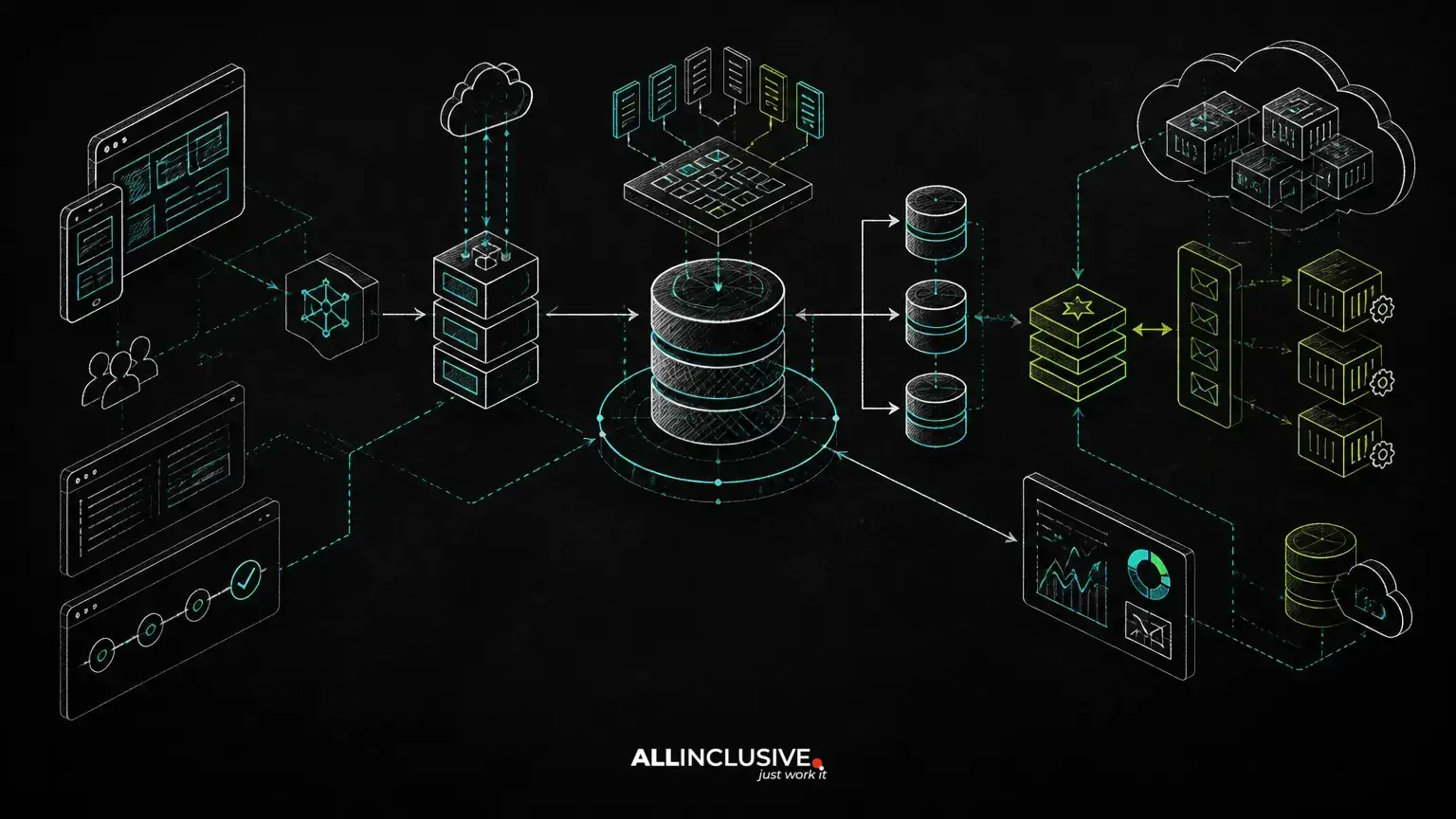
Provider-specific code should be contained behind a small application-facing boundary. The business layer should work with concepts such as a payment intent, shipment, subscription or customer record rather than raw provider payloads.
A useful structure can include:
- Application service: coordinates the business operation and state transition.
- Integration adapter: translates application commands into provider requests and provider responses into internal results.
- Transport client: manages HTTP behavior, authentication, timeouts and response parsing.
- Persistence and audit layer: stores request identifiers, external IDs, status history and failure details.
This boundary makes upgrades safer. A provider SDK can be replaced, a REST endpoint can become a GraphQL operation, or a legacy cURL implementation can be refactored without spreading vendor fields throughout templates, controllers and database queries.
For custom PHP development, the goal is not abstraction for its own sake. The boundary should hide unstable provider details while leaving business rules visible and testable.
Design retries around idempotency and operation type
Retries are appropriate for some failures and dangerous for others. A network timeout, temporary DNS issue or provider-side server error may justify another attempt. A validation error or authentication failure generally does not. Retrying every failure can amplify an outage and create duplicate charges, orders or messages.
Classify operations before implementing retry behavior:
- Read operations: often safe to retry, provided the request is bounded by timeouts and the data can tolerate slight staleness.
- Idempotent writes: can be retried when the same logical request produces the same result, usually with an idempotency key or stable external reference.
- Non-idempotent writes: require stronger safeguards, such as a provider-supported idempotency mechanism, a durable operation record or a reconciliation workflow.
Use a stable idempotency key derived from the application operation, not a new random value for every retry. Store that key with the business record so a later support investigation can connect local activity to provider activity.
Backoff should also be bounded. Exponential backoff with jitter reduces synchronized retry bursts, while a maximum attempt count and overall deadline prevent a worker from retrying indefinitely. The correct values depend on the provider’s documented limits, the business tolerance for delay and whether a queue is available.
Make timeouts explicit at every integration layer
A request without an effective timeout can consume a PHP worker, queue slot or web-server connection longer than the business process can tolerate. Configure separate connection and response time limits where the HTTP client supports them, and define an application-level deadline for the entire operation.
Timeout handling should distinguish between:
- A connection that could not be established.
- A request sent but no response received.
- A response received with a provider error.
- A response received but not understood by the application.
The second case is especially important. The provider may have processed the request even though PHP did not receive the response. Marking the operation as failed immediately can produce duplicate work when a retry follows. Persist the uncertain state and use a status lookup, webhook or reconciliation job where the provider supports one.
Use durable state instead of relying on request memory
Integration state should survive a PHP process ending, a worker restart or a deployment. A database record or durable message should capture the operation before external side effects occur when practical.
Useful fields commonly include:
- Internal entity and operation identifiers.
- Provider name and endpoint or operation type.
- Idempotency key and external reference.
- Current integration status and last attempt time.
- Attempt count and next eligible retry time.
- Sanitized error category and diagnostic correlation ID.
- Provider response identifiers and timestamps.
Do not store access tokens, full payment data or sensitive personal information in logs merely to make debugging easier. Redaction rules should be designed with the integration, not added after a production incident.
For longer-running workflows, a queue can move provider calls out of the user request. This improves user-facing latency and allows controlled retry behavior, but it also requires explicit status communication. A queued operation is not the same as a completed operation. Background processing patterns are covered in PHP background jobs and queues.
Handle webhooks as untrusted, repeatable input
Webhooks reduce the need to poll, but they introduce another asynchronous boundary. A webhook endpoint should authenticate the message according to the provider’s supported method, validate its structure and record the event before applying business changes.
Assume that webhooks can be duplicated, delayed, reordered or delivered after an operation has been cancelled. Store an event ID or equivalent deduplication key where available. If events do not provide a reliable unique identifier, derive a carefully scoped fingerprint and retain enough data to investigate collisions.
Keep acknowledgement separate from complex processing when appropriate. The endpoint can validate and durably enqueue an event, then return a response while a worker applies the business transition. This avoids provider retries caused by slow application processing, but only if the event has been safely persisted first.
Business transitions should be guarded by current state. For example, a late “completed” event should not automatically reopen a record that was legitimately cancelled without a defined policy. These rules belong in the domain layer, not in webhook controller code.
Plan for API changes without spreading provider assumptions
External APIs change in several ways: fields become optional, enum values expand, versions are retired, authentication requirements change or an SDK alters its serialization behavior. A resilient integration assumes that the provider response may contain more, less or different data than expected.
Useful safeguards include:
- Pin compatible SDK or client versions and review upgrade notes before updating them.
- Parse only the fields the business process needs.
- Treat unknown enum values as an explicit compatibility case rather than causing an unsafe default.
- Validate required fields at the integration boundary.
- Keep provider version and request configuration visible in deployment configuration.
- Use contract tests with representative success, error and changed-payload fixtures.
Do not silently map an unrecognized provider state to “successful.” A safe fallback may be “needs review,” “pending” or “not synchronized,” depending on the workflow.
Versioned adapters can be preferable to one adapter filled with conditionals. When two provider API versions have materially different behavior, separate translation code can make the differences explicit and simplify testing. A migration then becomes a controlled change of adapter rather than a risky edit across the application.
Protect security and performance at the integration boundary
Integration credentials should be managed outside source control and rotated according to the provider and organization’s operational requirements. Use least-privilege credentials, verify TLS correctly and restrict administrative integration tools. Avoid exposing raw provider responses to users because they may contain internal identifiers or sensitive fields.
Performance problems often come from integration placement rather than PHP execution itself. A page that makes several sequential provider calls inherits the slowest response and compounds failure risk. Consider caching only data that can tolerate staleness, batching requests where supported and moving nonessential synchronization to a queue.
Caching must respect ownership and invalidation. A cached exchange rate, product catalog entry or shipping estimate has different risk from a cached authorization decision. The guide to Redis caching for PHP applications provides a useful way to evaluate what belongs in a cache and what should remain authoritative.
Modernize legacy integrations in controlled stages
Legacy PHP applications often contain integration behavior inside controllers, templates, scheduled scripts and database triggers. A full rewrite may be unnecessary and can put business logic at risk. Start by mapping the existing workflow and observing current behavior, including undocumented provider fields and manual recovery steps.
Then distinguish the modernization path:
- Stabilize: add timeouts, logging, credential controls, error classification and basic operational visibility without changing the workflow.
- Refactor: extract provider calls behind an adapter and add tests around existing business behavior.
- Upgrade: update PHP, libraries or API versions with compatibility checks and rollback planning.
- Migrate: move to Laravel or another architecture when its routing, queues, dependency management, testing or application structure solves a demonstrated problem.
- Rebuild: replace the application only when its data model, workflow assumptions or operational constraints make incremental change impractical.
Laravel can be a strong choice for a modern PHP integration layer, but migration should be justified by maintainability, delivery and operational needs—not treated as a requirement for every integration. Preserve business rules explicitly before changing framework structure. The article on legacy PHP modernization explores why stabilization often belongs before migration.
Test failure paths as first-class behavior
Happy-path tests do not demonstrate integration reliability. Test connection failures, timeouts after submission, malformed responses, expired credentials, rate limits, duplicate webhooks and provider state changes. Verify both the application state and the external operation record after each scenario.
Contract tests should validate the assumptions at the boundary, while unit tests cover business decisions without requiring a live provider. Controlled integration tests can then verify authentication, serialization and representative provider behavior. Never make production recovery depend on a test environment that cannot reproduce ambiguous outcomes.
Operational readiness also requires alerts that distinguish transient failures from persistent configuration or contract failures. An increasing retry count, growing pending queue or rise in unknown states can be more actionable than a generic server-error alert.
Use a written integration checklist before release
- Is the authoritative system and business state model documented?
- Are timeouts, retryable errors and maximum attempts defined?
- Can a repeated request create a duplicate side effect?
- Are idempotency keys stable and persisted?
- What happens when the response is lost after the provider processes the request?
- Are webhooks authenticated, deduplicated and safely ordered?
- Are credentials, personal data and provider responses protected in logs?
- Can an API version or SDK be upgraded without changing unrelated business code?
- Is there a reconciliation or manual-review path for unresolved records?
- Can the team observe, pause and replay integration work safely?
Reliable PHP third party integrations are an architecture and operations concern, not merely an HTTP-client task. Whether the application is new or being modernized, the safest design preserves business intent across uncertainty: external calls can fail, responses can disappear and contracts can change. Clear boundaries, durable state, controlled retries and deliberate migration choices reduce that uncertainty without forcing a wholesale rewrite.
For broader planning around custom systems and modernization, see PHP development, and review custom web development when the integration is part of a larger application architecture. Ongoing monitoring, upgrades and incident response are also addressed through support and maintenance.