
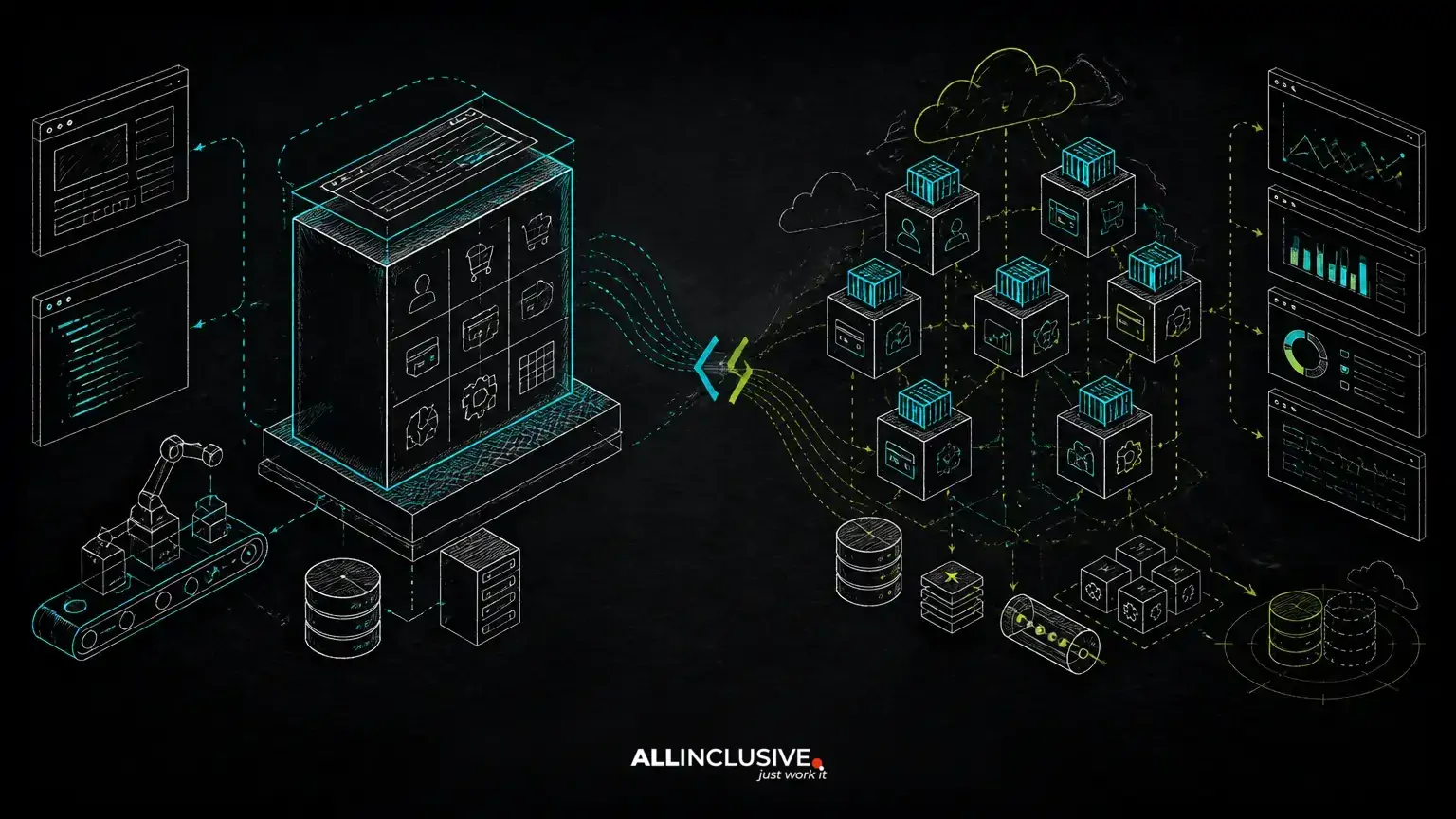
Monolith vs microservices is not a contest between an outdated model and a modern one. It is a decision about how your team wants to build, deploy, scale, observe and recover a custom web application. A well-structured monolith can be easier to operate, faster to change and less expensive to run than a distributed system. Microservices can be the better choice when independent scaling, team ownership or fault isolation justify the additional complexity. The monolith vs microservices workflow also connects to the guidance in custom software development. For Python teams, guidance on Python microservices explains when independent services justify the added complexity over a modular monolith.
The practical question is not which architecture is more fashionable. It is which architecture your organization can operate reliably with its current team, delivery process, cloud maturity and product requirements.
What the monolith versus microservices decision actually changes
A monolith packages most or all application capabilities into one deployable unit. The codebase may contain clear modules for accounts, billing, reporting or content, but those modules typically share a runtime, deployment process and often a primary database.
Microservices divide the application into independently deployable services. Each service owns a narrower business capability and communicates with other services through APIs, messages or events. That separation can create useful autonomy, but it also introduces network calls, distributed failure modes, service discovery, deployment coordination and more operational surfaces.
The architecture affects several business outcomes:
- Delivery speed: A monolith can make cross-feature changes straightforward, while a service-based system may require coordinated API, schema and contract changes.
- Scaling cost: A monolith may scale the whole application when only one capability needs more capacity. Microservices can scale selected workloads, but each additional service adds infrastructure and monitoring needs.
- Reliability: A single deployment unit has fewer network boundaries. Microservices can isolate some failures, but only when timeouts, retries, queues and fallback behavior are designed carefully.
- Ownership: Service boundaries can support team autonomy, but unclear boundaries create duplicated logic, dependency friction and unclear responsibility.
- Operations: Both architectures require secure deployment, backups, observability and recovery planning. Microservices generally require more of each.
When a monolith is the stronger starting point
A monolith is often appropriate for a new product, a small engineering team or a workflow whose features change together. It is especially effective when the application has one primary release cadence, a shared transactional data model and no proven need to scale individual capabilities independently.
A modular monolith provides a useful middle path. The application remains one deployable unit, but business capabilities are separated through explicit modules, interfaces and ownership rules. A Laravel, Python or PHP application can use this approach without prematurely introducing a network boundary between every component.
For example, an order management system might keep catalog, order, payment and notification modules in one application. Orders and payments can use transactional database operations where appropriate, while notifications are dispatched to a queue. The application remains simple to deploy, but expensive or asynchronous work does not block web requests.
A monolith is not automatically easy to operate. It still needs structured logging, metrics, error tracking, database maintenance, capacity planning and a tested deployment process. A poorly organized monolith can become difficult to change even when its infrastructure is simple.
When microservices can justify their operational cost
Microservices become more compelling when the application contains capabilities with materially different scaling, availability or release requirements. A high-volume event ingestion service may need different compute and queue behavior from an administrative interface. A media-processing service may require worker nodes and specialized runtime dependencies that do not belong in the main web application.
They can also be appropriate when multiple teams need to own and deploy capabilities independently, provided the organization has the engineering discipline to manage contracts, observability and on-call responsibility.
Useful signals include:
- A bounded business capability has a clearly defined owner and stable interface.
- One workload needs to scale independently from the rest of the application.
- Different components require materially different deployment schedules or runtime environments.
- Failure isolation is a genuine product requirement, not only an architectural preference.
- The team already operates automated deployments, centralized logs, metrics, traces, alerts and tested recovery procedures.
Microservices should not be selected merely because an organization expects future scale. Future requirements are better handled by preserving clear boundaries in a monolith until independent deployment or scaling becomes a demonstrated need.
Compare architectures by operability, not diagrams
Deployment and release management
With a monolith, a release usually packages one application version. A CI/CD pipeline can run tests, build a Docker image, apply controlled database changes and deploy behind a load balancer with a rollback path. Zero-downtime deployment still requires care: schema changes must be compatible with both the previous and new application versions, background workers must be coordinated, and health checks must represent real readiness.
Microservices multiply these concerns. Each service may have its own image, pipeline, environment variables, deployment strategy and rollback decision. Independent releases are valuable only when services have stable contracts and the team can determine which version combinations are compatible.
Data ownership and consistency
A monolith often benefits from a shared relational database and straightforward transactions. That can simplify workflows involving several related records. The trade-off is stronger coupling between modules and the risk that any component can bypass intended ownership boundaries.
Microservices typically work best when each service owns its data rather than allowing unrestricted cross-service database access. But separate data stores make cross-service transactions harder. Teams may need idempotent commands, domain events, queues, reconciliation jobs and explicit handling for partial failure.
Do not split a database simply to make an architecture diagram look distributed. Define the business ownership boundary first, then select storage and integration patterns that support it.
Queues, caching and asynchronous work
Queues are useful in either architecture. They can move email, report generation, imports, image processing and AI-related workloads out of the request path. Redis may support caching, rate limiting or queue-related workloads, but it should not become an accidental source of truth for critical data without an explicit durability and recovery design.
Microservices often rely more heavily on queues and events because services need to communicate without synchronous chains. That increases the importance of retry limits, dead-letter handling, idempotency keys, message visibility and operational dashboards. A queue that silently accumulates failed work can turn a small integration problem into a customer-facing incident.
Observability and incident response
A monolith needs logs, metrics and traces that explain request behavior, database performance, queue latency and external service failures. Microservices need the same signals across service boundaries, with correlation identifiers that connect one user action to multiple requests and messages.
Distributed tracing is particularly valuable when a request crosses an API gateway, application service, queue worker and database. Without it, teams may see symptoms in several services but struggle to identify the original failure. Alerting should focus on user impact and actionable conditions rather than producing a large volume of disconnected warnings.
A cloud architecture does not require microservices
A scalable AWS or other cloud deployment can run a monolith effectively. Common building blocks include containerized application processes, a managed relational database, object storage, a cache, queue workers, a load balancer and centralized observability. The right arrangement depends on traffic patterns, data sensitivity, operational skills and recovery objectives.
Docker can make environments more consistent without forcing the application into many services. A single application may have separate web, worker and scheduler processes, each using the same codebase but different runtime responsibilities. CI/CD can build and test these components together while still allowing independent capacity settings.
Microservices may use the same cloud primitives, but they add service-level configuration, networking, secrets management, deployment coordination and cost allocation. Cloud flexibility does not remove the need to understand those operational dependencies.
For a deeper infrastructure view, see AWS Architecture for Laravel: Compute, Database, Cache, Queues and Storage and Docker for Laravel and Python: A Practical Multi-Service Development Setup.
Test the architecture before traffic makes the decision
Architecture should be validated against realistic workflows rather than only theoretical throughput. Load testing can expose database contention, slow queries, cache pressure, queue backlogs and connection-pool limits in a monolith or a distributed system.
Test more than the successful path:
- What happens when the database is slow?
- What happens when Redis is unavailable or contains stale data?
- What happens when a downstream API times out?
- Can workers retry safely without duplicating charges or records?
- Can the system deploy while users continue working?
- Can the team identify and isolate a failing component from logs and metrics?
Recovery testing is equally important. Backups are not a recovery strategy until restoration has been tested. Define recovery point and recovery time objectives appropriate to the application, document the process and verify that credentials, infrastructure configuration and required data are available during an incident.
Teams planning a migration should also review Cloud Migration for Web Applications: A Phased Plan That Avoids Big-Bang Risk. Incremental extraction from a modular monolith is usually safer than attempting to redesign every boundary during a single migration.
A decision checklist for custom web applications
Choose a monolith or modular monolith when most of these statements are true:
- The product is still validating its workflows or business model.
- One team owns most of the application and releases together.
- Features share transactional data and change at a similar pace.
- The team wants fewer deployment and monitoring surfaces.
- Independent scaling has not been demonstrated as a real requirement.
Consider microservices when several of these statements are true:
- Business capabilities have clear owners and stable contracts.
- Specific workloads require independent scaling or deployment.
- Service isolation provides measurable reliability or security value.
- The team can support distributed tracing, contract testing and incident response.
- Data ownership and cross-service consistency rules are explicit.
Regardless of the choice, establish automated testing, repeatable environments, secure secrets handling, database migration discipline, deployment health checks, centralized observability, backups and a recovery runbook. These capabilities usually contribute more to operational maturity than the number of services in a diagram.
Choose the simplest architecture that preserves future options
For many custom web applications, the best path is a well-modularized monolith with containers, queues, caching, a managed database and an automated deployment pipeline. It can scale vertically and horizontally, support background processing and provide a clean foundation for later extraction.
Microservices are valuable when their boundaries solve a specific organizational or technical problem. They are not a substitute for clear domain modeling, performance testing or operational ownership. Start with the architecture your team can observe and recover, then introduce service boundaries when evidence shows that the separation will pay for its complexity.
Allinclusive helps product and engineering teams plan, build and improve custom software through web development services, with architecture decisions tied to delivery workflows, infrastructure and long-term maintainability. For ongoing operational needs, see support and maintenance for web applications.


