
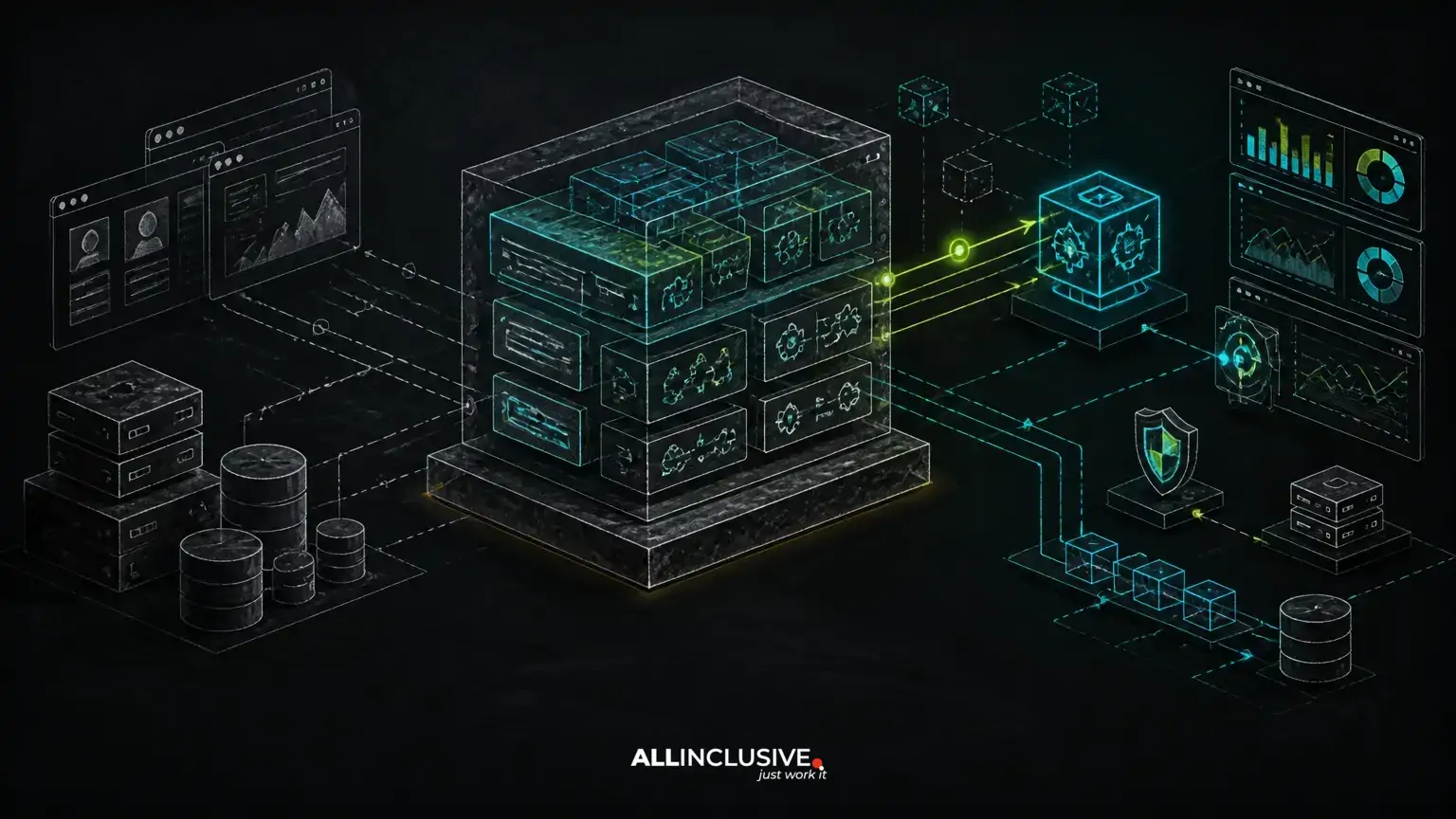
PHP monolith modernization is often framed as a choice between leaving an aging application alone and replacing it with microservices. That framing creates unnecessary risk. A well-planned modernization can preserve valuable business logic, improve security and performance, and make delivery more predictable without forcing a wholesale architectural rewrite. The php monolith modernization workflow also connects to the guidance in custom software development.
The right sequence depends on what is actually wrong. Some systems need stabilization and dependency upgrades. Others need targeted refactoring, database work, a Laravel migration or a carefully bounded rebuild. Microservices may eventually be appropriate, but they should solve a demonstrated ownership, scaling or deployment problem—not serve as the default definition of modernization.
This article explains how to assess a custom PHP monolith, separate modernization paths, and choose changes that improve the business without disrupting critical workflows.
Start by defining what modernization must improve
A monolith is not automatically a technical failure. A single deployable application can be easier to test, operate and understand than a distributed system. The more important question is whether the current system prevents the organization from changing safely or serving users reliably.
Before selecting an architecture, document the business outcomes that justify the work. Common drivers include:
- Security exposure from unsupported PHP versions, outdated packages or weak authentication and authorization controls.
- Slow delivery because a small change requires navigating tightly coupled code.
- Performance problems caused by inefficient queries, excessive application work or fragile background processing.
- Operational risk from undocumented deployment steps, shared server state or limited observability.
- Inability to support new products, workflows or integrations without breaking existing behavior.
- Difficulty hiring, onboarding or transferring ownership because critical rules exist only in the codebase.
These problems require different interventions. A PHP version upgrade does not automatically improve domain boundaries. Splitting an application into services does not automatically fix a slow query. Modernization should therefore begin with evidence, not an architectural preference.
Separate stabilization, refactoring, upgrading, migration and rebuilding
Teams often use “modernize” to describe several different activities. Distinguishing them keeps scope and risk under control.
Stabilize the existing system
Stabilization reduces immediate operational risk before larger changes begin. It may include adding deployment repeatability, backups and restore testing, error monitoring, dependency inventory, automated smoke tests, access reviews and documented recovery procedures.
This work can feel less ambitious than a rewrite, but it creates the feedback needed for safe change. If the team cannot tell whether a release broke checkout, reporting or an integration, architectural work will be difficult to evaluate.
Refactor the monolith in place
Refactoring changes internal structure while preserving the existing deployment model and user-facing behavior. Examples include isolating domain services, removing duplicated validation, introducing clearer interfaces around integrations, separating read and write responsibilities where useful, and replacing global state with explicit dependencies.
Incremental refactoring is often the lowest-risk path when the business logic is valuable but the code is difficult to change. It can improve ownership and testability without introducing network calls, service discovery or distributed data consistency problems.
Upgrade the PHP runtime and dependencies
A runtime upgrade can improve supportability and address security concerns, but it should be treated as an engineering project rather than a package installation. Legacy applications may depend on removed language behavior, incompatible extensions, old database drivers or libraries that no longer receive maintenance.
Use a dependency inventory, compatibility analysis and representative test workflows. Pay particular attention to date handling, string encoding, serialization, error handling, authentication, file uploads and third-party API clients. A successful upgrade should be validated against production-like data shapes and business scenarios, not only a clean application boot.
Migrate selected capabilities
Migration moves a bounded part of the system to a different framework, runtime or deployment model. A Laravel migration may be justified when the current PHP structure limits maintainability, the team has strong Laravel expertise, or a new module needs a consistent application foundation.
Migration should have a clear boundary. Recreating the whole system in Laravel without understanding its existing rules can preserve the old complexity in a new codebase while adding cutover risk. A modular migration, strangler-style replacement or new capability built alongside the existing system may provide better control.
Rebuild only when the existing foundation cannot carry the business forward
A rebuild replaces substantial behavior and infrastructure. It may be appropriate when the system has irreconcilable security or operational constraints, the domain has materially changed, or the cost of proving and maintaining the old behavior exceeds the value of preserving it.
Rebuilds are not blank slates. They still require discovery of workflows, data relationships, permissions, edge cases, integrations and operational responsibilities. If those details are not captured, a rewrite can reproduce visible features while losing the business rules that made the original system useful.
Preserve business logic before changing application structure
The hardest part of a legacy PHP system is often not its controllers or templates. It is the implicit business logic distributed across database queries, scheduled jobs, authorization checks, import scripts and integration handlers.
Before restructuring code, identify:
- Core entities and their lifecycle states.
- Rules that determine eligibility, pricing, approvals, notifications or access.
- Side effects triggered by a user action, including emails, payments, exports and external updates.
- Scheduled tasks and manual operational procedures.
- Data fields that appear unused but support reporting, reconciliation or downstream integrations.
- Role-specific workflows and exception paths.
Characterization tests can help capture current behavior before refactoring. These tests do not claim that every existing behavior is ideal; they record what the system currently does so the team can decide deliberately whether to preserve or change it. For critical workflows, pair automated tests with business-owner review and representative fixtures.
Preservation also requires distinguishing accidental behavior from contractual behavior. A strange validation rule may be a defect, or it may encode a regulatory, financial or operational requirement that was never documented. Technical teams should not remove it without confirming its business meaning.
Inspect dependencies, database behavior and integration boundaries
Modernization plans often underestimate the database. A PHP application may rely on implicit column defaults, permissive data types, stored procedures, triggers, transaction behavior or query ordering that is not documented in the application layer.
Review schema relationships, indexes, migrations, data volume, locking patterns and historical records. Validate changes against production-like data, especially when introducing stricter constraints or changing character sets. Database behavior should be treated as part of the application contract.
Dependencies require the same discipline. Build an inventory of PHP packages, extensions, operating-system assumptions, JavaScript assets, queues, caches, file storage and external services. Identify packages that are abandoned, pinned to incompatible versions or used in security-sensitive paths.
Integrations deserve explicit boundaries. A modernization can expose previously hidden assumptions about retries, timeouts, idempotency, authentication and webhook ordering. Encapsulating each external dependency behind a small interface makes replacement and testing easier, while durable logging helps operators distinguish application failures from partner failures.
For a deeper assessment of an inherited system, see this PHP codebase audit guide. If database performance is the primary constraint, PHP and MySQL query optimization is a more focused starting point.
Improve security and performance without confusing symptoms with causes
Security work should be integrated into modernization rather than postponed until after architectural changes. Review authentication, authorization, session handling, secrets management, input validation, output encoding, file handling, dependency exposure and administrative access. Establish logging and alerting for security-relevant events while avoiding sensitive data in logs.
Performance work should begin with measurement. Profile representative requests and background jobs, inspect database query plans, review cache behavior and examine slow external calls. A new framework or service boundary will not compensate for an inefficient query, unbounded result set or repeated remote request.
Performance improvements should also respect workflow correctness. Caching a value with unclear invalidation rules can create stale decisions. Moving work to a queue can improve response times but introduces delivery, retry and visibility concerns. Every optimization changes operational behavior and should be tested accordingly.
Use microservices only when the boundary is real
Microservices can be useful when an independently owned capability has distinct scaling needs, release cadence, reliability requirements or technology constraints. They can also isolate a genuinely separate domain or provide a controlled boundary around a high-risk integration.
They introduce costs that a monolith avoids: network failure, distributed tracing, service deployment, versioned contracts, duplicated infrastructure, cross-service authorization and more complicated data consistency. A team should be able to explain which of these costs is justified by a specific problem.
A modular monolith is often a strong intermediate architecture. It can organize code around business capabilities, enforce interfaces between modules and establish ownership boundaries while retaining a single deployment and transaction context. Later extraction becomes more informed if a module demonstrates a genuine need for independent operation.
Build a modernization sequence that protects delivery
A practical sequence for a custom PHP system may look like this:
- Discover. Map users, workflows, data, dependencies, deployment, integrations and operational risks.
- Stabilize. Establish backups, monitoring, repeatable environments, access controls and smoke tests.
- Prioritize. Rank work by business impact, security exposure, technical risk and dependency order.
- Protect critical behavior. Add characterization and integration tests around revenue, compliance, permissions and high-volume workflows.
- Upgrade foundations. Address PHP, package, operating-system and infrastructure constraints where they block safe progress.
- Refactor by capability. Create clearer boundaries around domain logic, persistence and integrations.
- Measure results. Track release risk, incident patterns, change lead time, response behavior and support effort.
- Reassess architecture. Extract a service or migrate a module only when evidence shows that the monolith is the limiting factor.
Run this work in slices that can be released and observed. Feature flags, parallel reads, staged migrations and reversible database changes can reduce cutover risk when they fit the system. Avoid promising reversibility where data transformations or external side effects make rollback inherently difficult.
Choose a modernization partner that can work with the existing system
Modernization requires more than selecting a current framework. The engineering team must be able to read unfamiliar PHP, investigate production behavior, protect data, communicate trade-offs and work with business owners who understand the workflows better than the code does.
For organizations evaluating custom engineering support, the PHP development practice should be able to address legacy code, security, performance, integrations and incremental delivery—not only greenfield application development. Ongoing operational ownership also matters; support and maintenance can provide the monitoring, patching and incident response needed after the initial modernization work.
Modernization succeeds when the system becomes safer to change without losing the capabilities the business depends on. That may mean a cleaner monolith, a Laravel module, a selectively extracted service or, in limited cases, a rebuild. The architecture is the result of the diagnosis—not the starting assumption.


