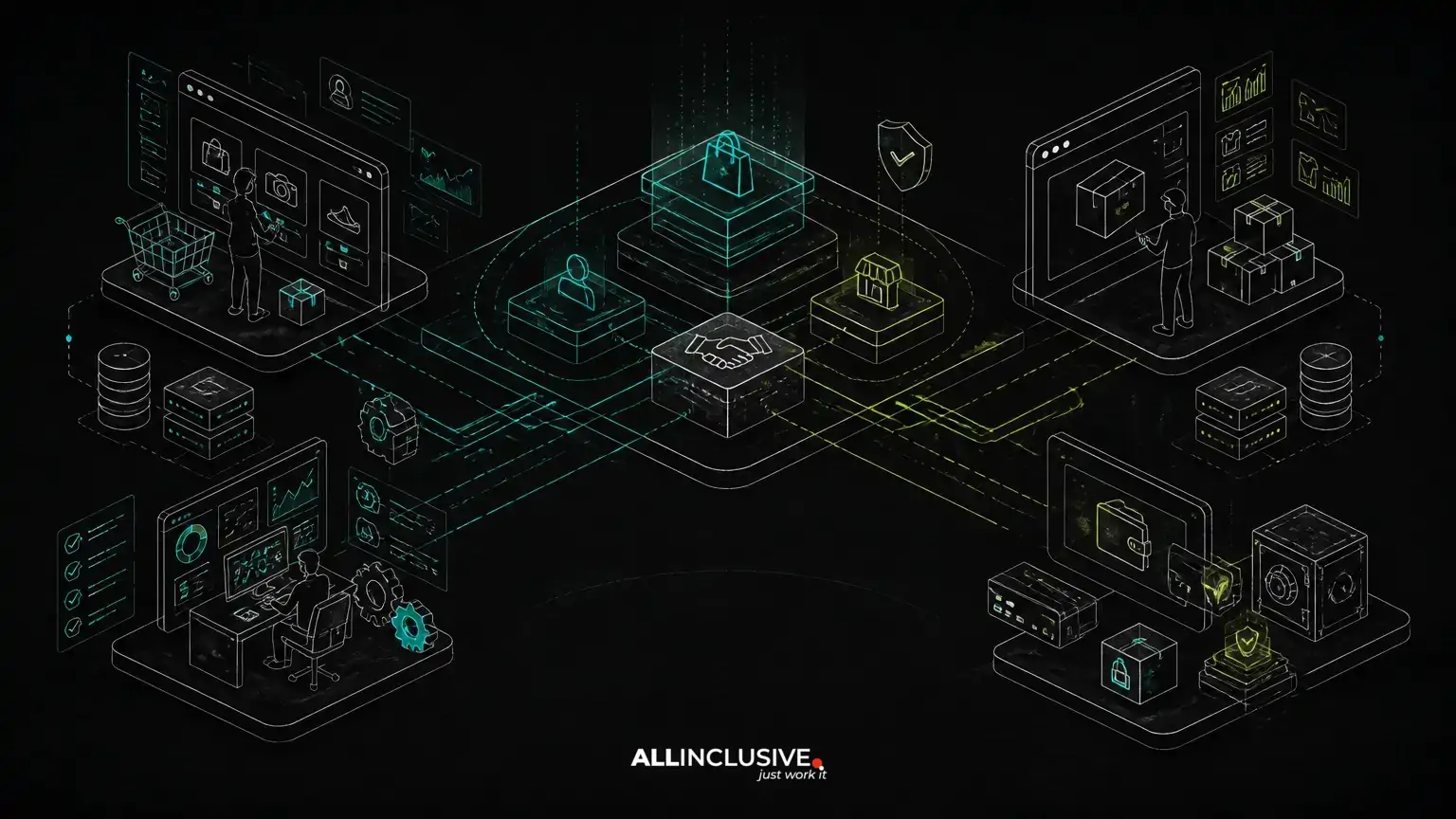
Marketplace platform development is the design of a multi-sided product that coordinates buyers, sellers, operators and payment providers in one controlled workflow. The difficult part is not simply listing products or adding checkout. A production marketplace must manage identity, inventory or availability, orders, commissions, disputes, notifications, permissions and operational exceptions without creating ambiguity about who is responsible for each step.
The strongest implementations begin with the business workflow rather than a fixed feature list. Before selecting a framework or payment provider, define how a buyer discovers an offer, how a seller accepts or fulfills it, when money is authorized or released, and how the platform handles cancellation, refunds and disputes. That workflow becomes the basis for the data model, APIs, user interfaces and administrative controls.
For organizations evaluating a custom build, the objective is usually ownership of a product-specific operating model—not merely a branded version of generic marketplace software. A custom web application can encode the rules that differentiate the business while leaving room for new seller types, regions, payment methods and service models.
Start with the transaction and fulfillment workflow
A marketplace transaction should be described as a stateful process. Typical states might include draft, submitted, accepted, paid, in fulfillment, completed, canceled, refunded or disputed. The exact names depend on the business, but each transition should have a clear actor, authorization rule and side effect.
For example, a service marketplace may need seller approval before a booking is confirmed, while a product marketplace may reserve inventory at checkout. A B2B marketplace may require purchase orders, tax documentation or buyer approval before payment. Treating all of these cases as a simple “order” creates fragile exceptions later.
Questions to settle before implementation
- Which party creates the transaction, and which party can modify it?
- When is inventory, capacity or seller availability reserved?
- What conditions move an order from pending to confirmed?
- Who can cancel, refund or dispute a transaction?
- When is the seller entitled to funds?
- Which events must be visible to buyers, sellers and operators?
These decisions also determine whether the product needs a reservation model, an approval workflow, a quote process, an asynchronous fulfillment process or several transaction types. Architecture should follow those distinctions rather than forcing different business models into one generic record.
Core architecture for buyers, sellers and operators
A marketplace commonly contains four product surfaces: the buyer experience, the seller workspace, the platform administration area and the integration layer. Each surface should share authoritative business data while exposing only the actions appropriate to its role.
Buyer experience
Buyers typically need discovery, search and filtering, comparison, account management, checkout, order history, messaging and support. Search may begin with a relational database and carefully designed indexes. A separate search engine can be introduced when relevance, faceting, geographic queries or catalog size justify the additional operational complexity.
Seller workspace
Sellers need more than a profile page. They may manage listings, pricing, availability, fulfillment, documents, payouts, staff accounts and customer communication. Seller workflows should make the current state of each transaction obvious and should prevent actions that conflict with platform rules.
Operations and administration
Operators need tools to review sellers, moderate listings, inspect payment events, resolve disputes, issue approved refunds and correct exceptional records. An administrative dashboard is not an afterthought; it is the control plane for a product whose participants will eventually encounter cases that automated flows cannot resolve.
For a deeper look at this operational layer, see admin dashboard development. Marketplace teams can also benefit from patterns described in customer portal development when designing role-specific account areas.
Data modeling: separate marketplace concepts that change independently
A maintainable marketplace data model should avoid treating users, organizations, listings, orders and payments as interchangeable concepts. A person may belong to several organizations, a seller may publish multiple listings, and one order may contain items from several sellers. These relationships affect permissions, tax handling, fulfillment and reporting.
Common domain entities include:
- Accounts and organizations: buyers, sellers, staff members and platform operators.
- Roles and permissions: actions granted by platform role, organization role or transaction context.
- Listings or offers: products, services, packages, pricing rules and publication status.
- Availability or inventory: quantities, schedules, reservations and adjustments.
- Orders and order items: the commercial agreement and its seller-specific components.
- Payments and ledger entries: payment attempts, fees, refunds, transfers and reconciliation records.
- Messages and events: communication, audit history and notifications.
The accounting model deserves particular care. A payment provider’s status is not the same thing as the platform’s internal financial record. Maintaining an internal ledger or transaction record can help the business reconcile charges, commissions, refunds and seller payouts, while provider webhooks update the system when external events occur. This does not replace formal accounting advice, but it does reduce reliance on scattered payment callbacks.
Payments, commissions and financial failure modes
Marketplace payments involve more decisions than selecting a checkout form. The product must define who is charged, who receives funds, how the platform earns revenue and what happens when a transaction changes after payment.
Important design choices include:
- Whether the platform collects payment before fulfillment or after approval.
- Whether funds are split, held, transferred or paid out through a provider-supported marketplace model.
- How commissions, service fees, taxes and seller adjustments are represented.
- How partial refunds work when an order contains multiple sellers or line items.
- How failed payments, duplicate callbacks and delayed provider events are handled.
- How seller onboarding and payout eligibility are reviewed.
Payment webhooks should be treated as repeatable, verifiable events rather than one-time instructions. Network failures and retries are normal, so handlers need idempotency and clear reconciliation behavior. The application should also distinguish a user-facing payment status from an internal processing state when provider updates arrive asynchronously.
Payment, tax and marketplace compliance requirements vary by jurisdiction and business model. Engineering decisions should therefore be reviewed with the relevant legal, tax and payment specialists rather than treated as purely technical configuration.
Identity, RBAC and trust controls
Role-based access control, or RBAC, should reflect the marketplace’s responsibility boundaries. A seller administrator may manage a company’s listings, while a fulfillment employee may see orders but not payout settings. A support agent may inspect transactions without changing financial records. Platform administrators may have broader access, but sensitive actions should still be restricted and audited.
Useful controls include:
- Organization-level membership and invitations.
- Separate permissions for viewing, editing, approving and exporting data.
- Audit records for high-impact actions such as refunds, seller approval and payout changes.
- Verification states for sellers, listings and regulated documents.
- Rate limits, abuse detection and moderation queues where appropriate.
- Secure account recovery and strong session management.
Trust is also a product workflow. Reviews, seller verification, reporting, dispute handling and content moderation should have defined states and ownership. Adding a rating field without an operational response to abuse or contested reviews does not create a reliable trust system.
Architecture choices for a custom marketplace
Many marketplaces can begin as a modular monolith: one deployable application with clear domain boundaries, background jobs and a well-defined integration layer. This approach can reduce coordination overhead while the transaction model is still changing. Modules might separate identity, catalog, orders, payments, messaging, notifications and administration even when they share a deployment.
Service decomposition may become useful when a domain has distinct scaling, ownership or reliability requirements. However, separate services also introduce distributed transactions, deployment coordination, observability needs and more complex local development. Splitting an application by organizational fashion rather than workflow can slow delivery and make financial or order consistency harder to reason about.
PHP and Laravel can be suitable for a marketplace when the team values rapid product iteration, strong conventions and a mature web application ecosystem. Python may be appropriate for particular services, data workflows or integrations where the team already has relevant expertise. The right choice depends on the domain model, delivery constraints, team capability, hosting environment and long-term ownership—not on a universal framework ranking.
For broader guidance on custom product engineering, visit custom web development services. The implementation should preserve source-code ownership and make the main business rules understandable to the team that will operate the product.
Integrations and asynchronous processing
Marketplaces commonly integrate with payment providers, email and messaging services, search systems, shipping or scheduling tools, tax services, analytics platforms and identity providers. Integrations should be isolated behind clear adapters so a provider change does not spread vendor-specific assumptions throughout the domain model.
Background jobs are useful for tasks such as sending notifications, importing catalogs, processing documents, synchronizing external statuses and generating reports. Jobs should be retryable, observable and safe to run more than once. A failed email should not invalidate a completed order, while a failed inventory synchronization may require an operator alert and a defined recovery path.
Event-driven patterns can help decouple notifications and reporting from core transactions. They should not obscure the source of truth. The order or payment module should remain responsible for its state, while downstream consumers react to documented events.
Common marketplace development failure modes
- Building the catalog before defining fulfillment: Attractive listings cannot compensate for unclear acceptance, reservation or delivery rules.
- Using one status for several actors: Buyer, seller and platform states may differ and should not be collapsed into an ambiguous label.
- Leaving administration until launch: Without review and correction tools, routine exceptions become engineering tickets.
- Trusting provider callbacks blindly: Duplicate, delayed or out-of-order events can corrupt payment and order states without idempotent handling.
- Overusing microservices early: Distributed architecture can add operational cost before the domain boundaries are understood.
- Treating permissions as interface logic: Hiding a button is not authorization; access rules must be enforced on the server and represented in the domain.
- Optimizing for feature count: More filters, dashboards or automation do not help if the core transaction cannot be completed reliably.
Build-versus-buy decisions for marketplace capabilities
Buying a capability can make sense when the requirement is standardized, the provider supports the required workflow and the business accepts its data, pricing and integration constraints. Payments, email delivery and some search capabilities are often evaluated this way.
Custom development becomes more compelling when the marketplace’s differentiation depends on workflow, pricing, approval, fulfillment, permissions or operational data that generic products cannot represent cleanly. A hybrid approach is common: use established providers for commodity infrastructure while custom-building the domain logic that creates business value.
Evaluate each candidate product or service against the following criteria:
- Does it support the complete workflow, including exceptions?
- Can the business export its data and retain control of source code where required?
- Are permissions, auditability and regional requirements adequate?
- What happens when pricing, payout, catalog or fulfillment rules change?
- Can the integration be replaced without rewriting the core domain?
Marketplace platform development should produce a system that can be understood, operated and changed. When architecture follows the real relationship between buyers, sellers, operators and payments, custom software becomes a way to reduce workflow ambiguity and preserve product ownership—not just another interface layered over disconnected tools.
After launch, ongoing monitoring, dependency updates, security review and operational support are part of the product lifecycle. See support and maintenance for custom software for the operational side of keeping a marketplace dependable as its workflows evolve.