Laravel and Node.js are both credible choices for a SaaS product or custom business platform, but they encourage different engineering trade-offs. Laravel provides a structured PHP application framework with mature conventions for domain logic, database work, authentication, queues, testing and deployment. Node.js provides a JavaScript or TypeScript runtime suited to event-driven services, real-time workloads and teams that want one language across the stack.
Neither is automatically faster, cheaper or more scalable. The right decision depends on the product’s business logic, workload profile, team, integration requirements and expected ownership horizon. For many workflow-heavy SaaS products, Laravel offers a productive and maintainable foundation. For real-time collaboration, streaming, high-concurrency I/O or a predominantly JavaScript team, Node.js may be the stronger fit.
This comparison focuses on production application engineering rather than template-driven website development. If you are evaluating a broader custom product architecture, review Allinclusive’s development services alongside the criteria below.
Laravel vs Node.js: the short answer
- Choose Laravel when the product centers on structured business workflows, relational data, permissions, billing, reporting, administration and conventional APIs.
- Choose Node.js when the system depends heavily on real-time events, long-lived connections, high volumes of concurrent I/O or an existing JavaScript and TypeScript platform team.
- Choose a hybrid architecture when different workloads have genuinely different requirements and the additional operational complexity is justified.
Both platforms can expose APIs, connect to queues and external services, support automated testing and run in containerized or managed environments. The decision should be made against the product’s risks, not framework popularity.
Core architectural difference
Laravel: a structured application framework
Laravel is designed to organize a complete web application. Its conventions help teams implement routing, controllers, validation, authentication, authorization, database access, jobs, notifications, scheduled tasks and automated tests within a coherent structure.
That structure is valuable when a platform contains substantial domain logic. A subscription product, operations portal or multi-tenant business system may need account boundaries, role rules, approval flows, invoices, audit records, imports, reports and integrations. Laravel does not remove the need for sound architecture, but it gives engineers established patterns for turning those requirements into maintainable application code.
Node.js: a runtime for event-driven services
Node.js is a JavaScript runtime rather than a single full-stack framework. Teams select additional tools for routing, validation, database access, dependency injection, authentication, testing and application structure. Frameworks such as Express, Fastify or NestJS can provide different levels of convention and organization, but the final architecture depends more heavily on team choices.
This flexibility can be an advantage. A Node.js system can be shaped around lightweight services, TypeScript contracts, event processing or real-time communication. It can also become inconsistent if foundational decisions are made piecemeal or if different teams adopt incompatible patterns.
Business logic and data modeling
Most SaaS products are not difficult because they can return JSON. They are difficult because rules accumulate: who can see a record, which state transitions are valid, when a charge is allowed, how an adjustment is audited and what happens when an external system fails.
Laravel’s PHP ecosystem and Eloquent ORM can make common relational data operations approachable while leaving room for explicit domain services, policies, value objects and query boundaries. The convenience is useful, but teams should avoid placing all business rules in controllers or relying on implicit ORM behavior for critical workflows.
Node.js can model the same domains effectively, especially with TypeScript and a disciplined data-access layer. Its flexibility supports different persistence technologies and service boundaries. However, the team must deliberately define conventions for transactions, schemas, validation, error handling and domain ownership. That planning is an engineering requirement, not a drawback unique to Node.js.
APIs and integrations
Both platforms can support REST APIs, webhooks, background processing and integrations with billing, CRM, identity, messaging and analytics systems. The important distinction is how much of the surrounding application structure the team wants the framework to provide.
Laravel is often a strong choice when an API is part of a larger business application with a relational core and an administrative interface. Validation, authorization, queues and scheduled work can remain close to the domain model. Read Laravel API development principles for a deeper discussion of reliable API boundaries.
Node.js is attractive when the API layer must coordinate many network-bound services, consume event streams or serve browser and server code written in the same language. It can also be a good fit for gateway services and specialized integration workers. In either stack, API quality depends on versioning, idempotency, observability, rate controls and clear failure behavior—not simply on the runtime.
Performance, concurrency and real-time workloads
Node.js uses an event-driven model that is well suited to many concurrent I/O operations, such as WebSocket connections, notifications, collaborative updates and service orchestration. It is not automatically the best option for every high-traffic system, and CPU-intensive work can block the event loop unless it is moved to workers or separate services.
Laravel applications commonly use PHP’s request-oriented execution model and can scale horizontally behind a load balancer. Queues, caching, database design, asynchronous workers and infrastructure configuration often matter more than the framework label. For compute-heavy or long-running work, Laravel systems also need appropriate worker or service boundaries.
For a conventional SaaS platform, the relevant question is usually not “Which framework is fastest?” Ask instead:
- Are requests mostly relational database operations and business rules?
- Are users maintaining persistent real-time connections?
- Which tasks can be queued or processed asynchronously?
- Where are the likely bottlenecks: database queries, external APIs, serialization, computation or network latency?
- Can the team measure these bottlenecks in production?
Authentication, authorization and security
Security is an application-wide discipline in both ecosystems. The team must design session or token handling, password policies, multi-factor authentication where appropriate, authorization boundaries, secret management, dependency updates, logging and abuse controls.
Laravel provides conventions and first-party ecosystem options that can simplify common authentication and authorization flows. Its policies, gates, validation mechanisms and middleware can help keep access rules visible, provided engineers apply them consistently and test sensitive paths.
Node.js teams have many mature security libraries and framework options, but they must assemble and maintain more of the security posture themselves. This is manageable with experienced engineering ownership, secure defaults and dependency governance. It becomes risky when authentication is treated as a package installation rather than a product-level threat-modeling exercise.
In both stacks, authorization should be tested against tenant boundaries, role changes, object ownership and administrative actions. A login screen is not a security architecture.
Testing and maintainability
Laravel’s conventions can make it straightforward to establish unit, feature and integration testing around application behavior. The most valuable tests usually protect business outcomes: subscription changes, permission rules, import reconciliation, invoice states and failure recovery. Framework convenience should support, not replace, deliberate domain design.
Node.js also supports strong testing practices with unit, integration, contract and end-to-end tests. TypeScript can improve feedback around interfaces, but static types do not verify authorization, database behavior or external-service failure modes. Those still require runtime tests.
Maintainability in either stack depends on boundaries. Keep domain decisions separate from transport concerns, define ownership for shared modules, document integration contracts and monitor background jobs. A familiar framework cannot compensate for tightly coupled code or missing operational discipline.
Delivery speed and team fit
Laravel may reduce delivery friction for teams experienced with PHP because common application concerns have recognizable conventions. This can be particularly useful for a small product team building a business platform with many CRUD-adjacent workflows, though serious products still need careful domain modeling and review.
Node.js can reduce context switching when the organization already uses JavaScript or TypeScript throughout the frontend, backend and tooling. Shared types and language knowledge may simplify collaboration, but they do not guarantee a simpler architecture. Teams should assess their ability to define and enforce backend conventions.
Hiring and ownership matter as much as initial development speed. A system built in a language the team can confidently test, secure, upgrade and operate is usually a better investment than one selected solely for a theoretical performance advantage.
When a hybrid architecture makes sense
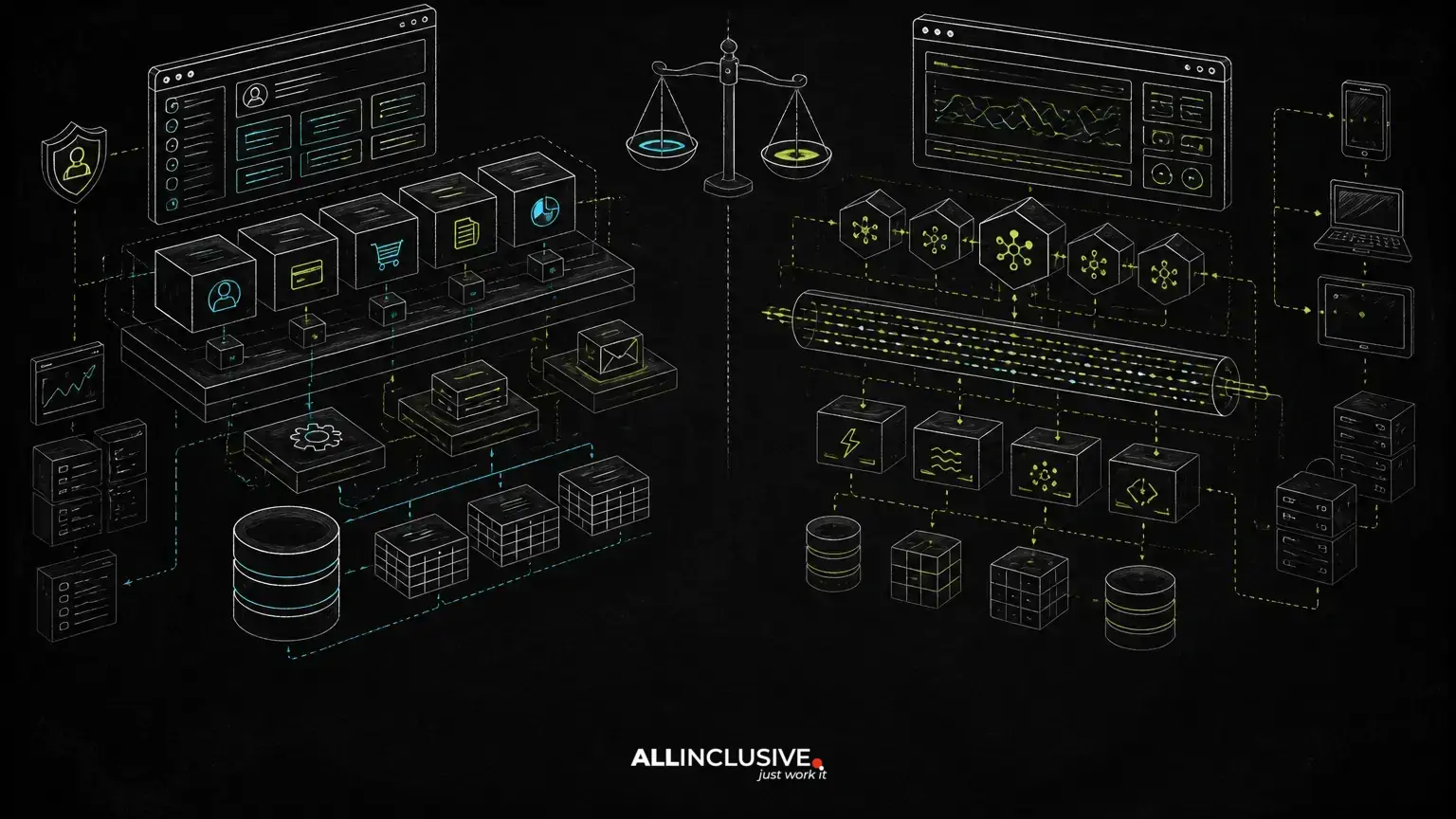
A hybrid approach can be appropriate when responsibilities are clearly separated. For example, a Laravel core may manage accounts, billing, permissions and relational business records, while a Node.js service handles real-time presence, WebSocket connections or a specialized event pipeline.
Do not introduce two runtimes simply to follow architectural fashion. A hybrid system adds deployment pipelines, observability, security reviews, on-call knowledge and duplicated platform concerns. It is justified when the workload difference is real and the boundary is stable. Otherwise, a well-structured monolith is often easier to operate and evolve.
Common selection mistakes
- Choosing by benchmark alone: synthetic runtime results rarely represent database contention, external services, authorization and real product workflows.
- Confusing framework flexibility with low cost: Node.js can be lightweight, but assembling and governing the platform still requires engineering time.
- Assuming Laravel means simple applications: Laravel can support complex domains, but teams must design explicit boundaries rather than overusing convenient abstractions.
- Using real-time requirements as a vague justification: identify which features need persistent connections and whether a focused service is enough.
- Ignoring operational ownership: upgrades, logging, queues, backups, dependency review and incident response affect total cost over time.
A practical decision checklist
- Map the core domain: tenants, users, permissions, transactions, workflows and reporting.
- Classify workloads as request-response, background, real-time, scheduled or compute-intensive.
- Identify the team’s strongest production experience, including testing and operations.
- Define data ownership, consistency requirements and integration failure behavior.
- Estimate the cost of supporting one runtime versus multiple runtimes.
- Prototype the riskiest workflow, not just a visually impressive endpoint.
- Document upgrade, security, monitoring and deployment responsibilities before committing.
Choose around workload, team and operating model
Laravel and Node.js can both serve as foundations for a reliable SaaS or business platform. Laravel is often compelling for structured, relational, workflow-heavy products where maintainable application conventions and integrated backend capabilities matter. Node.js is often compelling for event-driven systems, real-time interactions and organizations with established JavaScript or TypeScript backend practices.
The best choice is the one your team can evolve safely as requirements become more specific. That means evaluating domain complexity, workload behavior, security, testing, operations and ownership together. If the existing system needs stabilization, refactoring, migration or a carefully scoped rebuild, ongoing software support and maintenance should be part of the architecture conversation from the start.
For adjacent PHP framework decisions, see Laravel vs Symfony and Laravel vs Django.