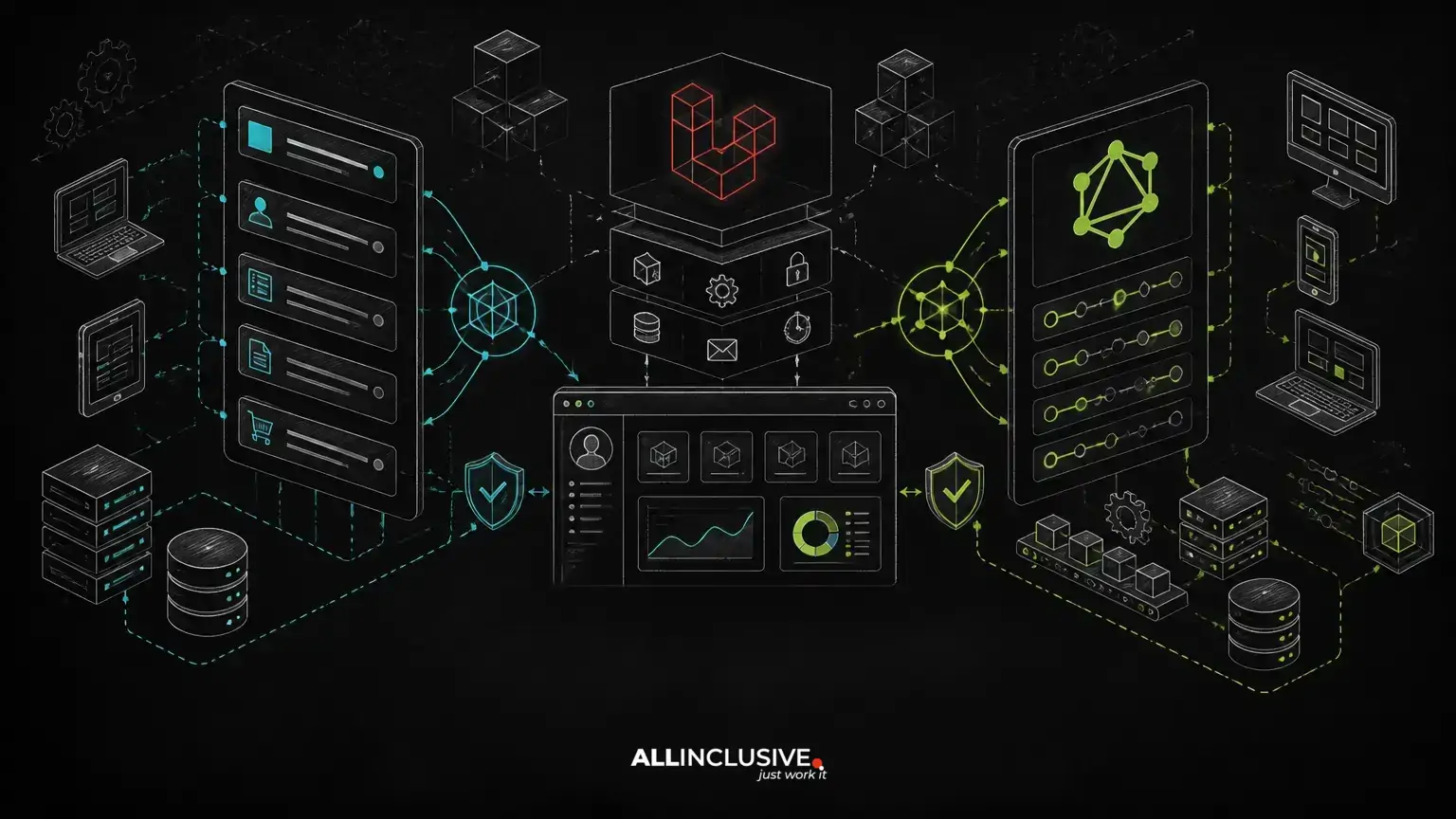
GraphQL with Laravel can be a strong choice when clients need different views of the same domain data, but it is not automatically a better API design than REST. The right decision depends on client diversity, data relationships, authorization rules, caching needs, team experience and operational maturity.
For a single web application with predictable resources and conventional create, read, update and delete workflows, a well-designed Laravel REST API is often simpler to document, test, cache and operate. GraphQL becomes more compelling when several clients need different combinations of data, when network round trips are costly, or when a product team needs a client-driven query layer over a complex domain. Teams working on laravel graphql may also need the implementation guidance in laravel rest api best practices.
This distinction matters in production Laravel engineering. GraphQL changes how data access, performance controls, errors, security and ownership are designed. It should be treated as an architectural decision, not merely an alternative route format.
What Laravel GraphQL changes in an application
A REST API generally exposes resources through routes and HTTP methods. A GraphQL API exposes a schema containing types, fields, queries and mutations. Clients select the fields they need in a query, while the server resolves those fields from application services, Eloquent models or other data sources.
Laravel can provide the surrounding application foundation: authentication, authorization, validation, queues, billing workflows, notifications, database access and testing. A GraphQL integration then adds a schema and execution layer. The exact package and implementation approach should be selected based on its maintenance status, Laravel compatibility, team familiarity and required features rather than assumed from a tutorial.
The most important architectural rule is to keep business logic outside individual GraphQL resolvers. Resolvers should coordinate input and output. Domain services, policies, application actions and query objects should enforce business rules consistently across GraphQL, REST, jobs and command-line processes.
When GraphQL is a good fit for Laravel
Several clients need different data shapes
GraphQL can reduce the need to create a separate endpoint for every screen when a product serves a web application, mobile clients, partner integrations or embedded experiences. Each client can request an appropriate selection of fields while using the same schema.
This is especially useful when a screen combines related data such as an account, subscription, recent invoices, team members and permissions. A REST design can serve this efficiently too, but it may require carefully composed endpoints or multiple requests. GraphQL provides a consistent query language for requesting the required shape.
The domain contains connected resources
Products with nested relationships can benefit from a schema that makes those relationships explicit. For example, a project-management application may expose organizations, projects, memberships, tasks and activity entries. A well-designed GraphQL schema can describe these connections without forcing every client to understand internal table structure.
That benefit depends on disciplined schema design. Exposing every Eloquent relationship directly can create excessive coupling, reveal fields that should remain internal or produce expensive queries. GraphQL types should represent product concepts and access rules, not simply mirror database tables.
Client teams need controlled query flexibility
GraphQL can give frontend teams more autonomy when the server can safely support a range of presentation needs. This may reduce repeated API changes for minor user-interface variations. It does not remove the need for backend governance: field ownership, deprecation rules, query limits and authorization still belong to the API team.
The organization can operate a query-based API
GraphQL is more suitable when the engineering team is prepared to inspect query behavior, control complexity and maintain a schema over time. Production readiness may require depth limits, cost controls, pagination rules, persisted operations, structured logging and monitoring of resolver performance.
When Laravel REST is simpler and safer
The workflows map cleanly to resources
REST is often the clearer option for conventional business APIs: create an invoice, retrieve an order, update a profile, list transactions or cancel a subscription. HTTP methods, status codes and resource-oriented URLs make the contract familiar to developers, infrastructure teams and external integrators.
For APIs consumed by a small number of known clients, GraphQL flexibility may not justify the additional schema and operational work. A focused REST API can be easier to explain, version and support.
HTTP caching and infrastructure behavior are priorities
REST requests commonly communicate intent through URLs and HTTP methods, which can fit existing gateway, proxy and browser caching patterns. GraphQL commonly concentrates many operations behind one endpoint and places the requested fields in the request body, so caching usually requires more deliberate application or edge-level design.
This does not make GraphQL uncachable. It means caching strategy must be designed around operation identity, variables, authorization context and data invalidation. If the product depends heavily on straightforward HTTP caching, REST may reduce complexity.
External consumers need a conventional contract
Partners and customers may prefer REST because their tooling, documentation standards and integration processes already assume resource endpoints. GraphQL can be an excellent partner API, but it requires clear schema documentation, compatibility policies, query governance and support for client mistakes that may be less obvious than an invalid REST route.
The team needs a small operational surface
A REST API can still have serious security and performance concerns, but its failure modes are often easier to isolate. With GraphQL, one request can traverse many types and relationships. A seemingly reasonable query can trigger excessive database work, large response payloads or authorization checks across a broad graph.
Laravel-specific design concerns for GraphQL
Prevent N+1 database queries
GraphQL's nested selection model can expose inefficient resolver behavior. If a list of projects independently loads its owner, team or tasks, the application may issue repeated queries rather than using eager loading, batching or a data-loader pattern.
Performance work should begin with domain-specific query planning. Define which relationships can be selected, establish pagination requirements and inspect actual SQL and resolver timings. Eloquent's relationships remain useful, but they should not be treated as an automatic solution for every GraphQL query shape.
Design authorization at field and action boundaries
Authentication identifies the caller; authorization determines which records, fields and actions that caller may use. Laravel policies and gates can support these decisions, but a GraphQL schema must apply them consistently to nested objects, mutations and sensitive fields.
For example, a user may be allowed to view an invoice summary but not payment-provider identifiers. A manager may update a team's membership but not transfer account ownership. These rules belong in explicit application and authorization layers, not in assumptions made by a resolver.
Control query depth, breadth and cost
GraphQL does not automatically protect an application from expensive queries. Establish limits for nesting, list sizes, aliases, batching and execution time where appropriate. Pagination should be mandatory for potentially large collections, with limits enforced server-side.
Complexity controls should reflect the domain. A query that reads a few scalar fields is not equivalent to one that traverses organizations, projects, tasks, comments and audit entries. Monitoring should identify expensive operations by name, client and variables without logging sensitive data.
Keep mutations aligned with business actions
Mutations should represent valid application operations rather than expose arbitrary model updates. A mutation such as approveExpense can express validation, authorization, state transitions and audit requirements more clearly than a generic update operation.
This approach also protects maintainability. Billing, fulfillment, approval and account-management workflows often contain rules that should remain consistent whether invoked by GraphQL, REST, a queued job or an internal command.
Plan error behavior deliberately
GraphQL responses can contain both data and errors, including partial results. That behavior may be useful for some read operations, but clients need a documented approach to validation failures, authorization errors, missing records and domain conflicts.
Do not expose database exceptions or internal implementation details. Map failures to stable, meaningful error categories and log the diagnostic context privately. REST APIs have their own error-design decisions, but their HTTP status conventions may be more familiar to consumers.
Security and maintainability trade-offs
GraphQL's single endpoint does not simplify security by itself. The application still needs strong authentication, authorization, input validation, rate limiting and protection against abusive query patterns. Introspection and schema exposure should be considered in the context of the environment and API audience, not handled through a blanket assumption that hiding a schema provides meaningful access control.
Schema evolution also requires discipline. Removing a REST endpoint and removing a GraphQL field are both compatibility events. GraphQL often favors deprecating fields and tracking client usage before removal. That can support gradual change, but it also means unused fields and old types can accumulate unless ownership and cleanup are explicit.
Testing should cover authorization, resolver behavior, domain rules, pagination, query limits, error contracts and representative query shapes. Integration tests that execute real GraphQL operations are valuable, while unit tests should continue to protect application services and policies independently from the transport layer. Teams establishing a broader release process can also review Laravel testing and CI/CD practices.
How GraphQL and REST can coexist in Laravel
Choosing GraphQL does not require converting every existing endpoint. A Laravel application may keep REST for public integrations, webhooks and operational resources while introducing GraphQL for a product interface that needs flexible reads. Conversely, a team may use GraphQL for selected read models and REST for command-oriented workflows.
Coexistence works best when both interfaces call shared application services rather than duplicating business rules. Authentication, policies, billing actions, audit logging and transactional boundaries should remain consistent. The transport layer can differ while the domain behavior stays centralized.
A migration should begin with a bounded use case. Select a workflow with clear client needs, define a schema that does not expose persistence details, measure query behavior and document ownership. Avoid introducing GraphQL as a broad rewrite before the team understands its operational cost.
A decision checklist for Laravel GraphQL
- Client diversity: Do multiple clients need materially different selections of the same domain data?
- Relationship complexity: Would a graph of related resources improve the product experience without exposing unsafe or unbounded traversal?
- API ownership: Can the team maintain schema documentation, deprecations and compatibility policies?
- Performance controls: Are pagination, batching, query-cost limits and resolver monitoring part of the design?
- Security: Are authorization rules defined for records, fields and mutations rather than only at the endpoint level?
- Infrastructure: Does the caching, observability and gateway environment support the chosen request model?
- Integration needs: Will partners benefit from GraphQL flexibility, or would conventional REST contracts reduce adoption friction?
- Business logic: Are domain actions centralized so GraphQL does not become a second implementation of application rules?
If most answers point toward predictable resource operations, REST is likely the more maintainable starting point. If clients genuinely need flexible, connected data and the team can operate the additional controls, GraphQL may provide meaningful value.
Choosing the API approach as part of Laravel application engineering
The choice between GraphQL and REST should follow product workflows and operational constraints, not API fashion. A carefully designed REST API can support sophisticated SaaS products, billing systems and internal platforms. GraphQL can be appropriate when it reduces client coordination and presents a governed view of a complex domain.
For teams planning a custom application, the API decision should sit alongside data modeling, authentication, queues, testing, deployment and upgrade planning. Our Laravel development work focuses on maintainable application architecture rather than template-first delivery. Broader software engineering considerations are covered in our development services overview.
Whichever interface you choose, document the contract, test business-critical behavior, monitor real workloads and keep domain logic independent from the transport layer. Those practices preserve the option to add or change an API style later without rebuilding the product around its first interface.
Long-term API quality also depends on upgrades, security review, performance investigation and operational ownership after launch. Teams that need ongoing help can review support and maintenance for custom software.