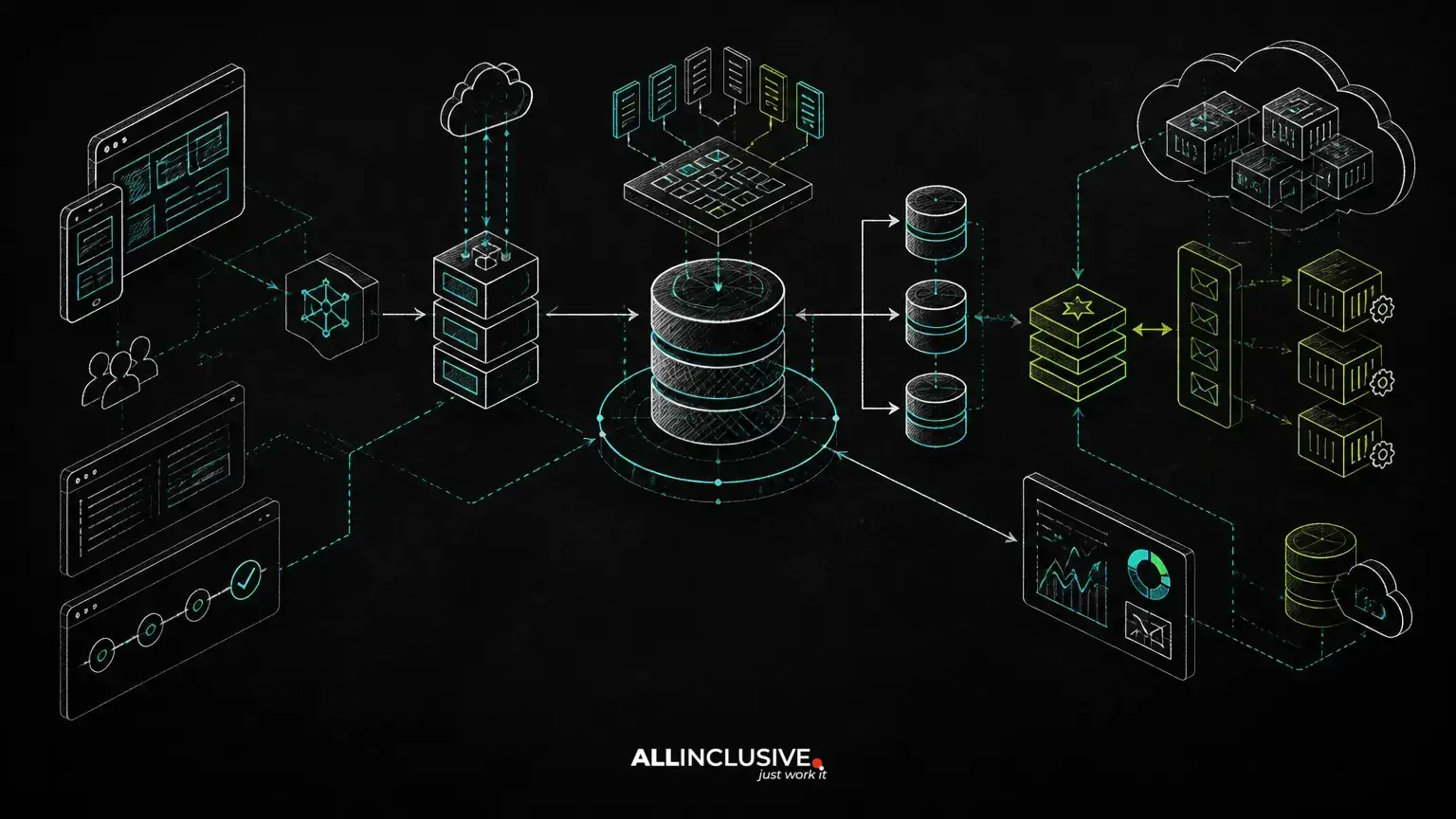
FastAPI API development is a strong fit when a Python backend needs explicit request and response contracts, automatic API documentation and an efficient path to asynchronous I/O. The framework is not a substitute for architecture: production results still depend on boundaries, database design, background processing, testing, observability and deployment discipline. When planning fastapi api development, the implementation context in ai development is also relevant.
FastAPI is particularly useful for custom APIs, data services, automation platforms and AI-enabled products. It can serve a focused service alongside a Laravel or PHP application, or act as the primary backend for a new product. The right choice depends on workload, team ownership and the surrounding system—not on framework popularity alone.
Why FastAPI fits typed Python API development
FastAPI builds on Python type annotations and commonly uses Pydantic-based models to validate and serialize data. That gives teams a shared contract for incoming requests and outgoing responses. The contract can support generated OpenAPI documentation, client generation and clearer collaboration between frontend, backend and integration teams.
Type declarations do not make an API correct by themselves. They should be paired with explicit domain rules, database constraints and tests. A model can confirm that a field is an integer or a value matches an expected shape, but business logic must still decide whether the operation is permitted.
FastAPI also supports asynchronous endpoint functions, which can help when an operation spends time waiting on network services, databases or other I/O components. Async code is not automatically faster. Blocking libraries inside an asynchronous execution path can reduce its value, while CPU-heavy work may need a separate worker process or job system.
Separate the API contract from the application domain
A maintainable FastAPI service should avoid placing all behavior in route handlers. Routes are an entry point, not the complete application layer. A practical structure separates transport concerns from business rules and infrastructure.
- Route layer: authenticates the request, validates inputs and selects the application operation.
- Application layer: coordinates a use case such as creating an order, starting an import or generating an AI response.
- Domain layer: contains business rules that should remain understandable outside HTTP.
- Infrastructure layer: manages persistence, external APIs, queues, storage and observability integrations.
This separation makes the service easier to test and gives the team more options later. A scheduled job or message consumer may be able to reuse an application service without pretending to be an HTTP request. It also reduces the risk that database details become embedded throughout the API surface.
Design response models deliberately
Response schemas should represent what a consumer is allowed to receive, not simply mirror database tables. Returning an internal record directly can expose fields that were never intended for clients and can make future database changes into accidental API changes.
Use separate models where the lifecycle requires them: an input model for creation, an update model for partial changes and a response model for published data. Decide how the API represents null values, pagination, validation failures and resource identifiers. Consistency across endpoints lowers integration effort and reduces support work.
Use asynchronous execution for the right workload
FastAPI can handle asynchronous endpoints, but the choice should follow the dependencies used by the operation. An endpoint that calls an async-capable database driver and several network services may benefit from non-blocking execution. An endpoint that performs CPU-intensive document processing, image transformation or model inference may need a worker queue instead.
Background tasks are useful for small, non-critical work that can occur after a response is prepared. They are not a universal replacement for durable job processing. If a task must survive a process restart, expose retries, report progress or avoid duplicate execution, use a queue and a worker design with explicit job state.
Plan long-running work as a workflow
For imports, report generation, media processing and AI pipelines, a synchronous request can create poor user experience and unreliable infrastructure behavior. A more durable pattern is:
- Validate the request and create a job record.
- Return an identifier that the client can use to inspect status.
- Publish work to a queue or durable task mechanism.
- Process the job with retry and failure rules.
- Store progress, output and an actionable error state.
This design changes the product workflow, not just the backend implementation. The interface must explain pending, completed and failed states. Operators need a way to inspect stuck jobs and replay work safely. Idempotency keys or deterministic job identifiers can help prevent duplicate effects when clients retry requests.
Build persistence and integration boundaries before adding endpoints
API performance is often constrained by data access rather than routing overhead. Define how transactions begin and end, how sessions are managed and how related records are loaded. Avoid allowing each route to invent its own persistence pattern.
For external services, isolate client code behind an integration boundary. Set connection and response timeouts, classify failures and record correlation information without logging credentials or sensitive payloads. A service that calls payment, identity, messaging or AI providers should make those dependencies visible in its operational model.
When FastAPI is introduced beside an existing Laravel or PHP system, establish ownership at the boundary. Decide which service owns each record, how authentication is shared, how events are published and which system is authoritative during a transition. A small Python service can be a sensible extension to a mature application, but two systems without clear ownership create reconciliation work.
Test the contract, behavior and failure paths
FastAPI’s generated schema and validation make contract testing more approachable, but production confidence requires multiple test layers.
- Unit tests cover domain rules and application services without requiring a running web server.
- API tests verify status codes, response shapes, validation behavior and authentication boundaries.
- Integration tests exercise real database behavior, queues or external-service adapters in controlled environments.
- Contract tests help confirm that consumers and providers agree on fields, error formats and compatibility expectations.
- Workflow tests cover retries, duplicate messages, partial failures and job recovery.
Do not focus only on successful requests. Test malformed input, expired credentials, missing resources, dependency timeouts, transaction rollbacks and repeated submissions. These cases are where operational and user-facing defects commonly appear.
For a broader view of API and service-layer controls, use a dedicated Python web application security checklist alongside framework-level tests.
Make observability part of the API design
Logs, metrics and traces should answer practical questions: Which request failed? Which dependency was slow? How many jobs are waiting? Is a timeout isolated or systemic? What did the user experience?
Use structured logs with request or correlation identifiers. Capture method, route, outcome and duration while excluding secrets and unnecessary personal data. Metrics should distinguish request volume, latency, error categories, queue depth and worker failures. Distributed tracing can be valuable when one user action crosses an API, database, queue and external provider.
Health endpoints should distinguish basic process availability from dependency readiness where the deployment platform needs that distinction. A service that is running but cannot reach its required database is not necessarily ready to accept traffic.
Secure FastAPI endpoints beyond input validation
Validation reduces malformed data; it does not establish authorization. Each protected operation should verify that the caller can perform the requested action on the specific resource. Avoid relying on a client-provided account or organization identifier without checking it against authenticated context.
Define authentication, authorization, rate limiting and audit requirements early. Consider how tokens are issued and rotated, how service-to-service credentials are stored, and how sensitive fields are redacted from logs. Apply limits to file uploads, request sizes and expensive operations. For AI endpoints, also consider prompt and document handling, provider data policies and abuse controls.
Deploy FastAPI as an owned production service
Deployment decisions should reflect the service’s workload. A stateless HTTP API may scale independently from workers, while a queue consumer may need different CPU, memory and concurrency settings. Configuration should come from the deployment environment, with secrets managed outside source control.
Use repeatable builds, automated checks and a release process that can identify the deployed version. Database migrations need an ownership and rollback strategy. Graceful shutdown matters when instances are replaced: the service should stop accepting new work appropriately and allow in-flight operations or worker acknowledgements to complete within an intentional window.
Capacity planning should examine database connections, downstream limits, queue throughput and concurrency—not just the number of web processes. More workers can increase pressure on a database or third-party API. Measure the complete path before changing concurrency settings.
When FastAPI should share a system with Django or Laravel
FastAPI is often selected for focused APIs, high-concurrency I/O, data services and AI orchestration. Django may be more suitable when a product needs a broad batteries-included web platform, administrative workflows and established conventions around models and application structure. Laravel can remain the right owner of a PHP product while FastAPI handles a specialized Python workload.
The decision should account for team expertise, existing data ownership, deployment maturity and the cost of operating another service. A separate FastAPI service is justified when it creates a clear boundary or solves a workload mismatch. It is less attractive when it merely divides one small application into components with duplicated authentication, deployment and monitoring.
For a fuller comparison of framework trade-offs, see FastAPI vs. Django. If the broader requirement is Python backend selection rather than one framework, the Python backend development guide provides additional context.
A production readiness checklist for FastAPI API development
- Are request and response contracts explicit, versioned where necessary and reviewed with consumers?
- Are route handlers thin enough that business rules can be tested without HTTP?
- Are asynchronous, synchronous and CPU-heavy workloads separated appropriately?
- Do long-running operations use durable job state, retry rules and idempotency controls?
- Are database transactions, connection limits and migration ownership defined?
- Do tests cover authorization, dependency failures and repeated requests?
- Can operators identify slow dependencies, failed jobs and affected request paths?
- Are secrets, personal data and provider payloads handled according to the product’s risk?
- Can the service be deployed, upgraded and shut down without ambiguous ownership?
FastAPI is most valuable when it forms part of a disciplined Python backend rather than a thin collection of endpoints. With typed contracts, clear application boundaries, durable background processing and observable deployment, it can support APIs that remain understandable as automation, data workflows and AI capabilities expand. For broader guidance on selecting and delivering custom systems, explore Python development and the wider development practice.