
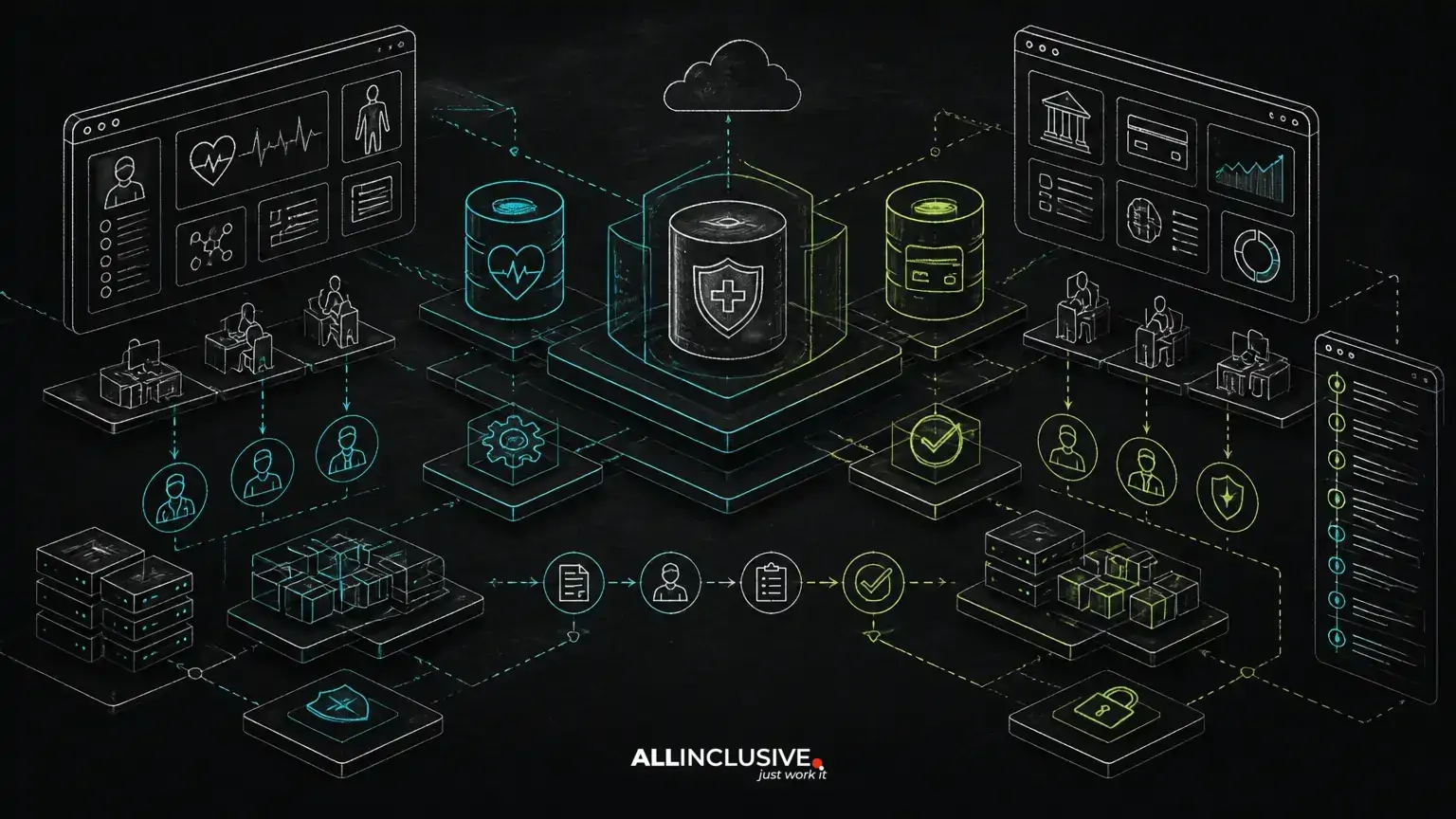
A custom web application for regulated industries cannot be designed as an ordinary SaaS product with compliance features added near launch. Healthcare and FinTech applications must make sensitive workflows explicit, restrict access at multiple levels, preserve an audit trail, manage integrations carefully and support operational decisions that may be reviewed months or years later.
The architectural difference is not simply that these systems need stronger security. Their business rules, data boundaries, failure handling and ownership model must be designed around regulated workflows from the beginning. A custom-built portal, internal operations system, billing platform or multi-tenant product should reflect how the organization actually handles consent, approvals, exceptions, records and accountability.
This article explains what changes in the architecture, where healthcare and FinTech systems share patterns, and where their requirements diverge.
Start with the regulated workflow, not the feature list
Feature lists often hide the decisions that create the most technical risk. “User management,” “payments,” “reporting” and “document storage” describe capabilities, but not the rules governing them.
A workflow-first discovery process asks more precise questions:
- Which roles can create, view, approve, correct or export a record?
- Which actions require separation of duties or a second approval?
- What happens when an external integration is delayed, unavailable or returns conflicting data?
- Which records are immutable, and which can be amended through a controlled correction process?
- What evidence must be retained to explain who did what, when and under which business rule?
- Which users, organizations, products or accounts must be isolated from one another?
These answers influence the domain model, authorization layer, database design, background jobs, notification system and administrative tools. They also determine whether an off-the-shelf product can be configured safely or whether custom-made product engineering is justified.
Healthcare and FinTech share control patterns, but not identical domains
Both industries handle sensitive data and consequential decisions. That creates common architectural requirements: strong identity controls, least-privilege access, auditability, data minimization, careful integrations, controlled changes and documented operational procedures.
The domains still differ significantly. Healthcare applications may coordinate patients, providers, clinical or administrative records, appointments, referrals, claims and consent. FinTech applications may manage customers, accounts, transactions, payment instructions, risk decisions, reconciliations and financial reporting.
The distinction matters because the same generic “compliance-ready” architecture can fail to represent the actual business process. A healthcare portal may need to distinguish a patient’s ability to view a record from a clinician’s ability to edit a note. A FinTech platform may need to separate the person initiating a payment from the person approving it, while also handling idempotency and reconciliation.
Identity and authorization need more than a user role
Basic role-based access control is a starting point, not a complete authorization model. Regulated applications commonly need several dimensions of access:
- Role: what a user is generally allowed to do.
- Organization or tenant: which business, practice, department or account the user belongs to.
- Resource relationship: whether the user is associated with a patient, account, case, transaction or workflow.
- Action state: whether an object is draft, submitted, approved, settled, archived or under review.
- Context: whether access is permitted for a specific operational reason, region, channel or time period.
Permissions should be modeled as business rules rather than scattered checks in controllers and front-end components. The interface can hide unavailable actions, but the server must enforce authorization independently on every sensitive operation.
For a deeper treatment of permission design, see role-based access control for web apps. The important architectural principle is to define permission semantics early, before roles become an unmaintainable collection of exceptions.
Data architecture must support traceability and controlled change
Regulated systems need to distinguish current state from historical evidence. Overwriting a record may make the interface simple, but it can remove information needed to understand how the record changed.
A more suitable design may combine ordinary transactional tables with version history, event records or dedicated audit entries. The right approach depends on the workflow. Not every field requires event sourcing, and imposing a complex pattern everywhere can make the system harder to maintain. The design should answer specific questions:
- Can a record be corrected, and how is the original value preserved?
- Does an audit entry capture the actor, timestamp, action, resource and relevant context?
- Are automated actions distinguishable from human actions?
- Can administrators investigate an incident without granting broad access to production data?
- What retention and deletion rules apply to each data category?
Healthcare applications often need carefully separated clinical, administrative and identity data. FinTech systems often need a clear distinction between transaction intent, processing status, ledger effects and external settlement. Treating these as one mutable status field can create reconciliation and reporting problems later.
Transaction integrity changes the design of payments and financial workflows
FinTech architecture must account for the fact that a request can succeed locally while its external effect remains uncertain. A payment provider, bank, identity service or risk engine may time out after accepting a request. Retrying without safeguards can create duplicate actions.
Common design responses include idempotency keys, explicit state machines, durable job processing, provider reference storage and reconciliation workflows. These mechanisms do not eliminate every failure, but they make ambiguous outcomes visible and recoverable.
For example, a payment workflow may move through states such as initiated, authorized, submitted, confirmed, failed, reversed or requiring review. The exact states depend on the business and provider, but representing them explicitly is safer than treating a request as a single synchronous operation.
Healthcare systems also need reliable asynchronous processing for tasks such as eligibility checks, document imports, notifications and external record exchanges. The consequence of failure may differ, but the architectural need is similar: queue work, record outcomes, retry safely and expose exceptions to authorized staff.
Integrations become part of the product architecture
In regulated industries, integrations are not peripheral utilities. They often carry the system’s most sensitive and consequential workflows.
An integration boundary should define:
- What data is sent and received.
- Which system is authoritative for each field.
- How identity matching is performed.
- How authentication credentials are stored and rotated.
- How timeouts, rate limits and provider errors are handled.
- How duplicate messages and out-of-order events are detected.
- How changes to the external contract are tested and monitored.
Use an internal domain model rather than allowing every provider’s terminology to spread through the application. An adapter can translate external formats into stable internal concepts. This reduces vendor coupling and makes future replacement more practical.
It is also important to distinguish integration failure from business failure. A rejected payment, an unavailable eligibility service and a malformed inbound document require different operational responses. The application should preserve enough detail for support and compliance teams to understand the difference.
Multi-tenancy and data isolation need explicit boundaries
Many healthcare and FinTech products serve multiple organizations, practices, employers or business accounts. Multi-tenancy then becomes a central architectural decision rather than a deployment detail.
Possible models include shared tables with tenant identifiers, separate schemas or separate databases. Each has trade-offs involving isolation, operational complexity, reporting, migrations, cost and recovery. The correct choice depends on the sensitivity of the data, tenant requirements, expected scale and operational capability.
Regardless of the model, tenant context must be enforced consistently. It should not depend only on a hidden form field or a front-end route. Queries, background jobs, exports, administrative tools and support workflows all need clear rules for tenant scope.
Billing introduces another boundary. Subscription plans, usage records, invoices, credits and payment status should be modeled independently from authorization. A user may have permission to administer an organization without being the person whose payment method is charged, and a suspended billing state may restrict some actions without making historical records disappear.
See multi-tenant SaaS architecture for a broader discussion of isolation, roles, billing and scale.
Privacy, security and compliance are engineering concerns
Compliance cannot be reduced to a checklist or a policy document. It affects system behavior and operational design.
A regulated application should consider data minimization, encryption in transit and at rest where appropriate, secret management, secure session handling, access reviews, dependency management, vulnerability response, backup protection and incident investigation. Sensitive data should not appear casually in logs, analytics payloads, error messages or support screenshots.
Security controls also need usable operational paths. If staff cannot resolve a failed workflow without requesting excessive privileges, they may create unsafe workarounds. A well-designed system provides controlled escalation, approval, temporary access where appropriate and clear records of administrative actions.
Specific obligations vary by jurisdiction, business model, data type and contractual context. Architecture should support the organization’s compliance program, but technical implementation should be reviewed with qualified legal, security and compliance professionals rather than treated as a substitute for that advice.
Custom architecture supports ownership and long-term change
Off-the-shelf products can be appropriate when their workflows, integration model, data controls and contract terms match the business. Problems arise when configuration is used to force a product into processes it was not designed to represent.
A custom application may be a better fit when the organization needs distinctive workflow logic, a controlled data model, specialized integrations, tenant-specific behavior or ownership of the source code and deployment process. The trade-off is responsibility: the organization must fund maintenance, security updates, monitoring, documentation and continued product decisions.
PHP and Laravel can be suitable for many workflow-heavy portals, administrative systems and SaaS products when the team values a structured web framework, conventional application patterns and maintainable delivery. Python may be appropriate where the domain includes substantial data processing, automation or machine-learning services. Neither choice removes the need for sound boundaries, testing and operational discipline.
The technology should follow the workflow and team capability—not the other way around. Source-code ownership is valuable only when the codebase is understandable, deployable and supported over time.
Architecture decisions should be tested against failure and change
A credible design review should examine more than the successful user journey. Walk through scenarios such as:
- A user loses access while an approval is pending.
- An external provider accepts a request but does not return a response.
- A record must be corrected after downstream systems received the original value.
- A tenant administrator attempts to export data outside their permitted scope.
- A scheduled job runs twice or processes messages out of order.
- A staff member needs to investigate an incident without seeing unrelated sensitive records.
- A vendor changes an API contract or becomes temporarily unavailable.
These exercises reveal whether the architecture has explicit states, reliable audit records, safe retries, appropriate permissions and practical recovery paths. They also expose where a proposed feature depends on undocumented manual work.
A delivery plan for regulated custom web applications
A disciplined delivery sequence reduces the risk of discovering architectural constraints after the interface is complete.
- Map the workflow: identify actors, decisions, records, approvals, exceptions and external dependencies.
- Classify data: define sensitivity, retention, ownership, access scope and reporting needs.
- Model authorization: document roles, tenant boundaries, resource relationships and administrative escalation.
- Define state transitions: make approval, payment, review, correction and failure states explicit.
- Design integration contracts: specify authoritative systems, retries, idempotency, monitoring and reconciliation.
- Build a narrow vertical slice: test one complete workflow from user action through persistence, audit and exception handling.
- Validate operations: test deployment, backups, logging, alerts, support access and recovery procedures before broad rollout.
For organizations evaluating scope and sequencing, a focused web application discovery phase can turn ambiguous requirements into a more testable product and architecture plan.
Custom web applications for healthcare and FinTech succeed when architecture reflects accountability as clearly as it reflects functionality. The strongest designs make permissions explicit, preserve trustworthy history, isolate data deliberately, handle integration uncertainty and give operators safe ways to resolve exceptions.
That is the practical role of custom web development: translating a business workflow into software the organization can control, extend and maintain. Long-term reliability also depends on post-launch practices such as monitoring, security updates and controlled changes; these responsibilities should be planned rather than assumed, as outlined in software support and maintenance.


