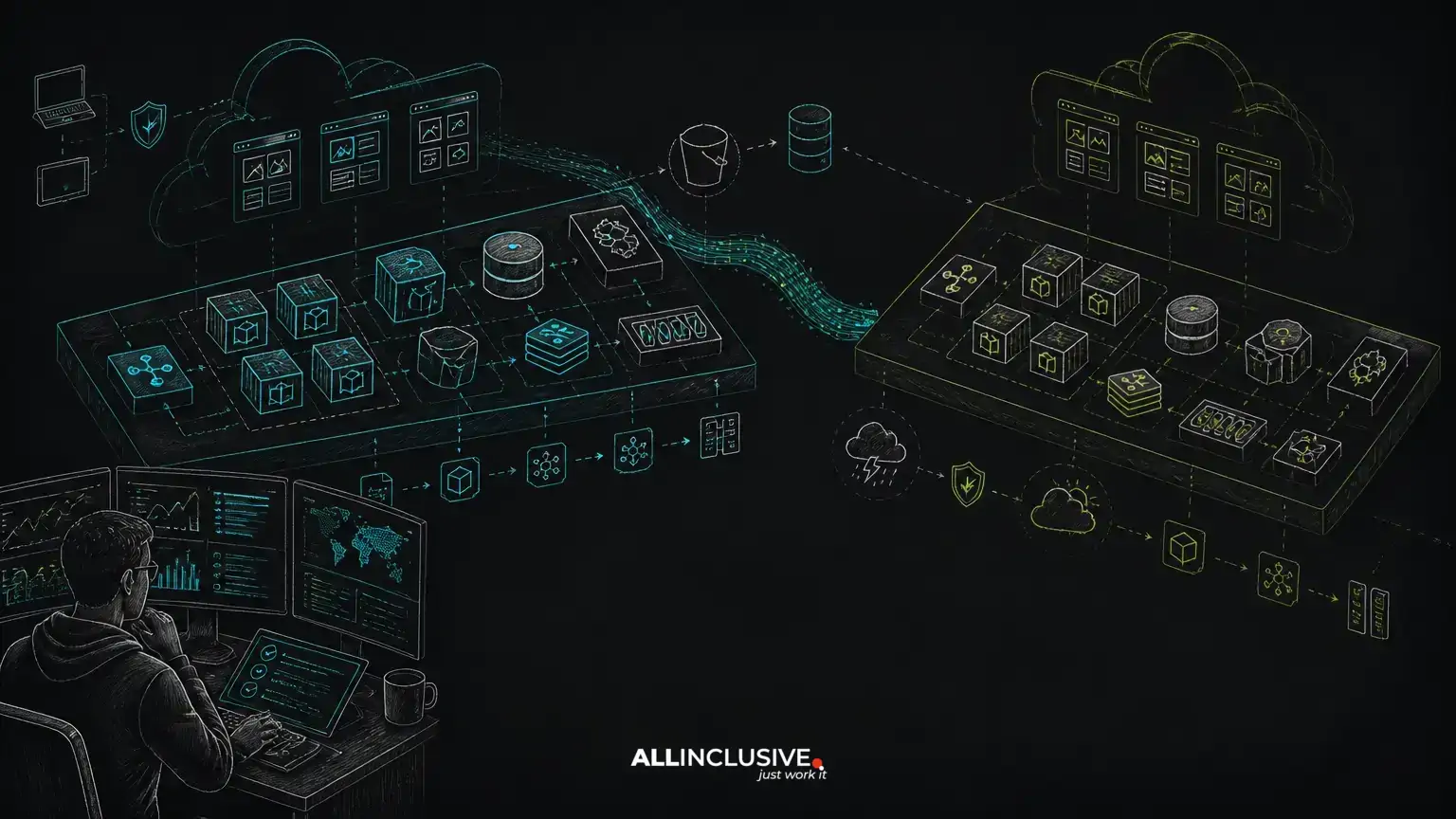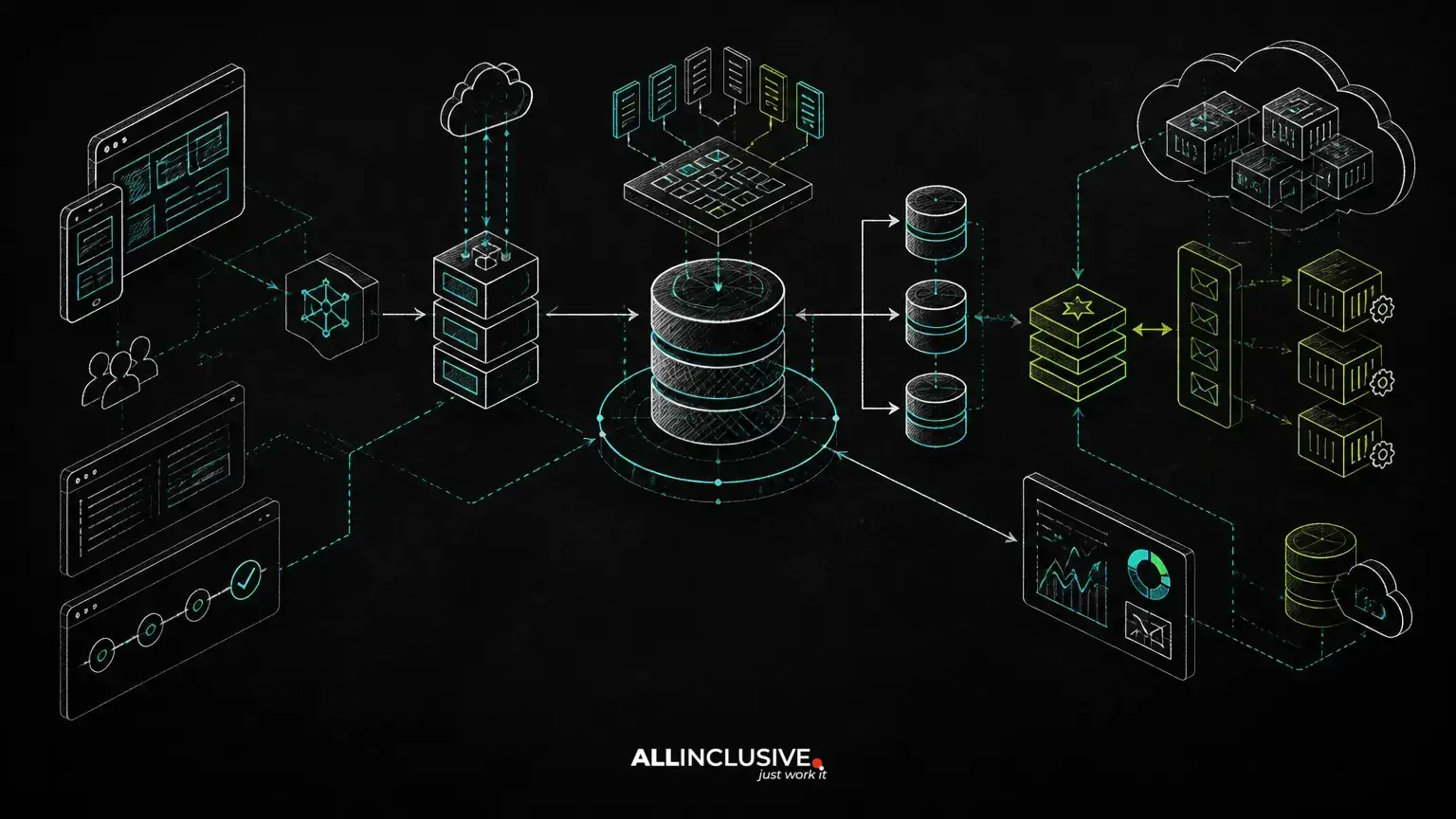
A web app discovery phase should establish what the product must accomplish, who will use it, how work moves through it and which technical decisions could create risk later. Before anyone starts coding, the team should align on workflows, requirements, data ownership, integrations, permissions, operational constraints and a realistic first release.
Discovery is not a long requirements document written in isolation. It is a structured decision-making process for turning a business problem into a buildable product. For a custom SaaS platform, internal system, marketplace, booking product or customer portal, the quality of this phase often determines whether development stays focused or becomes a sequence of expensive corrections.
What a web app discovery phase is meant to resolve
Discovery should remove ambiguity that would otherwise surface during design, development or launch. The most important questions are usually business and workflow questions, not framework questions:
- Which users need the product, and what decisions or actions must each user perform?
- What is the primary workflow from the first trigger to the final outcome?
- What belongs in the first release, and what can wait?
- Which rules, approvals, exceptions and handoffs must the system enforce?
- What data does the business own, and where does external data come from?
- How should permissions, billing, tenancy and auditability work?
- Which existing tools must integrate with the application?
- What risks could affect delivery, compliance, reliability or future maintenance?
The output should be enough clarity for a product owner and engineering team to make informed trade-offs. It should not pretend that every future detail can be known before users interact with the product.
Start with the business workflow, not a feature inventory
Feature lists are useful, but they rarely explain how a product creates value. A discovery team should first map the business workflow that the web application is expected to improve.
For example, a booking platform may need more than calendars and payment screens. Its core workflow could include availability rules, customer requests, staff approval, payment authorization, reminders, cancellations and reconciliation. Each step introduces states, permissions, notifications and failure cases. Those relationships matter more to the architecture than the label “booking system.”
Workflow mapping should identify:
- Actors: customers, employees, managers, administrators, partners or automated services.
- Triggers: a submitted form, imported record, payment event, scheduled task or manual approval.
- States: draft, pending, approved, rejected, paid, cancelled or archived.
- Rules: conditions that determine what can happen next.
- Exceptions: missing information, failed payments, duplicate records, conflicts or reversals.
- Outputs: notifications, reports, invoices, records sent to another system or operational tasks.
This approach prevents a common failure mode: building screens that look complete while leaving the underlying process undefined.
Validate users, roles and permissions before designing screens
Role design should happen early because permissions affect navigation, data models, workflows and testing. A simple “admin versus user” model may be sufficient for a small application, but many products need more precise distinctions.
Discovery should clarify whether access is based on role, organization, project, ownership, geography, subscription tier or a combination of these conditions. A manager may be allowed to approve records for one department but not another. A customer may see only their own account data. A platform operator may need support access without being allowed to change billing information.
These decisions should be documented as permission rules rather than inferred from interface elements. A useful permission definition states who can perform an action, on which resource, under what conditions and with what audit requirements. Teams working on web app discovery phase may also need the implementation guidance in role-based access control for web apps.
Define the first release around a usable outcome
Discovery should produce a prioritized release scope, not an exhaustive wish list. The first release needs to support a complete, meaningful workflow for its intended users.
A practical way to structure scope is to separate:
- Core workflow: the smallest end-to-end process that delivers the product’s primary value.
- Operational necessities: authentication, permissions, error handling, notifications, support tools and basic reporting required to run that workflow.
- Deferred capabilities: enhancements that may be valuable but do not determine whether the initial product works.
- Unknowns: assumptions that require user validation, technical investigation or a proof of concept.
Prioritization should account for dependencies. A sophisticated analytics dashboard may need stable event definitions and historical data first. Automated billing may require decisions about plans, proration, refunds and account ownership before it can be safely added. Treating every feature as independent creates misleading estimates and weak sequencing.
Turn requirements into testable product behavior
Discovery should translate stakeholder goals into behavior that can be reviewed and tested. Statements such as “the system should be easy to use” or “the platform needs flexible reporting” are directionally useful but not implementation-ready.
Instead, define the expected behavior in observable terms. For example:
- A manager can approve a submitted request only when required fields are complete.
- A customer can download invoices belonging to their organization but cannot view another organization’s invoices.
- A failed payment leaves the subscription in a defined state and creates a follow-up action.
- An imported record is rejected or flagged when it conflicts with an existing unique identifier.
Acceptance criteria should also cover negative paths. What happens when a user lacks permission, an integration is unavailable, a record is deleted, or two users update the same item? These cases influence database constraints, transaction handling, user messaging and support procedures.
Make architecture decisions based on product constraints
Architecture should follow the workflow and operating context rather than being selected because a technology is popular. During discovery, the team should evaluate the application’s data boundaries, deployment needs, integration patterns, expected usage, security requirements and maintenance model.
A conventional web application may be a suitable starting point for a workflow-heavy product with authenticated users, relational data and administrative operations. PHP with Laravel can be a practical choice where the team benefits from a structured application framework, mature web patterns and clear conventions. Python may be appropriate where the product has substantial data processing or domain-specific services. The decision should follow the product’s constraints and the team’s ability to operate the system over time.
Discovery should clarify architectural questions such as:
- Is the first release best served by a modular monolith, separate services or a managed platform component?
- Which data must be transactional, and which data can be processed asynchronously?
- Where should files, events, search indexes or analytical data be stored?
- What must happen synchronously during a user action?
- Which boundaries may need to evolve if the product becomes multi-tenant?
- What operational visibility will be needed to diagnose failures?
Starting with a modular structure can preserve speed while keeping domain boundaries clear. Splitting a system into services too early can add deployment, monitoring and data-consistency overhead without solving a real problem.
Investigate integrations before treating them as simple tasks
Integrations frequently change scope because external systems have their own authentication models, data formats, rate limits, webhooks, failure states and ownership rules. Discovery should inspect the actual integration requirements rather than recording “connect to CRM” or “add payments” as single features.
For each integration, document:
- Which system is authoritative for each important data field.
- Whether data moves through an API, file exchange, webhook, scheduled job or manual process.
- How records are matched and how duplicates are handled.
- What happens when an external request fails or arrives more than once.
- How credentials, access scopes and environment separation will be managed.
- Who owns the relationship and can resolve data discrepancies.
Payment, identity, communications and accounting integrations deserve particular care because failures can affect revenue, access, compliance or customer trust. The application should not assume that an external event is always immediate, unique or successful.
Address tenancy, billing and data ownership early
For SaaS products, multi-tenancy is not only a database decision. It affects onboarding, authorization, billing, support access, reporting, exports, backups and deletion policies.
Discovery should establish whether tenants share application infrastructure, how records are associated with a tenant, whether users can belong to multiple organizations and how administrators access tenant data. It should also define subscription states, plan limits, trial behavior, invoices, refunds, cancellations and entitlement changes.
These decisions can be designed in different ways, including shared tables with tenant identifiers, separate schemas or isolated databases. There is no universal answer. The appropriate model depends on risk, operational complexity, data sensitivity, expected growth and the team’s ability to maintain it. A focused analysis of these trade-offs is provided in multi-tenant SaaS architecture.
Use technical spikes to test the riskiest assumptions
Not every uncertainty requires a full prototype. A technical spike is a small, bounded investigation used to answer a specific question before committing to a broader design.
Useful spike topics might include:
- Whether a required external API supports the needed operation and data volume.
- Whether a complex permission rule can be represented clearly and enforced consistently.
- Whether a document, search or reporting requirement needs a separate storage or processing approach.
- Whether a legacy system can provide reliable identifiers and change notifications.
- Whether an AI-assisted workflow can produce results that are sufficiently reviewable for the intended use.
A spike should have a defined question, boundary and decision outcome. It is not a disguised attempt to build the entire product without a plan.
Produce discovery deliverables that guide development
A useful discovery phase leaves behind artifacts that the product and engineering teams can continue to use. Depending on the product, these may include:
- Business goals and measurable product outcomes.
- User roles, permissions and key user journeys.
- Workflow diagrams and state transitions.
- Prioritized release scope and deferred backlog.
- Acceptance criteria for core behaviors and failure paths.
- Domain model, data ownership notes and integration map.
- Architecture recommendation with explicit trade-offs.
- Risk register and technical spike findings.
- Delivery plan organized by dependency and product value.
- Open questions, assumptions and decisions requiring owner approval.
The deliverables do not need to be elaborate to be valuable. They need to be specific enough that different people interpret the product in the same way.
Warning signs that discovery is too shallow
A project may not be ready for coding when stakeholders disagree about the primary user, the first usable outcome or who owns the data. Other warning signs include an undefined permission model, integrations described only by vendor names, no treatment of failed workflows, an unprioritized feature backlog or estimates produced before dependencies are understood.
Another warning sign is an architecture discussion detached from business behavior. Choosing a framework, database or hosting model before understanding the workflow can make a project appear decisive while leaving the most important product questions unanswered.
How discovery supports long-term ownership
Discovery is also where a business protects its future options. A custom-made application should be designed around the organization’s actual workflow, with clear ownership of source code, data and operational decisions. That does not mean building every capability from scratch. It means making deliberate build-versus-buy decisions and understanding the consequences of each dependency.
The team should record what is proprietary to the business, what is provided by an external service, how data can be exported and which components could be replaced later. This reduces avoidable vendor dependence and makes future modernization, maintenance or team transitions more manageable.
For organizations evaluating custom product engineering, the web development service overview provides broader context on application types and delivery considerations. Once a product is live, planned support and maintenance helps address defects, dependency changes, security updates and evolving operational needs.
When the discovery phase is complete
Discovery is complete when the team can explain the first release as a coherent business workflow, identify the users and permissions involved, describe the important data and integrations, state the major architectural trade-offs and name the assumptions that remain open.
It should also be possible to explain what will not be built yet. That boundary is as important as the feature list because it protects delivery focus and gives future decisions a clear place in the product roadmap.
Starting with this level of clarity does not eliminate uncertainty. It makes uncertainty visible, assignable and manageable. That is the purpose of a web app discovery phase: to ensure that coding begins with a shared model of the product rather than a collection of untested assumptions.