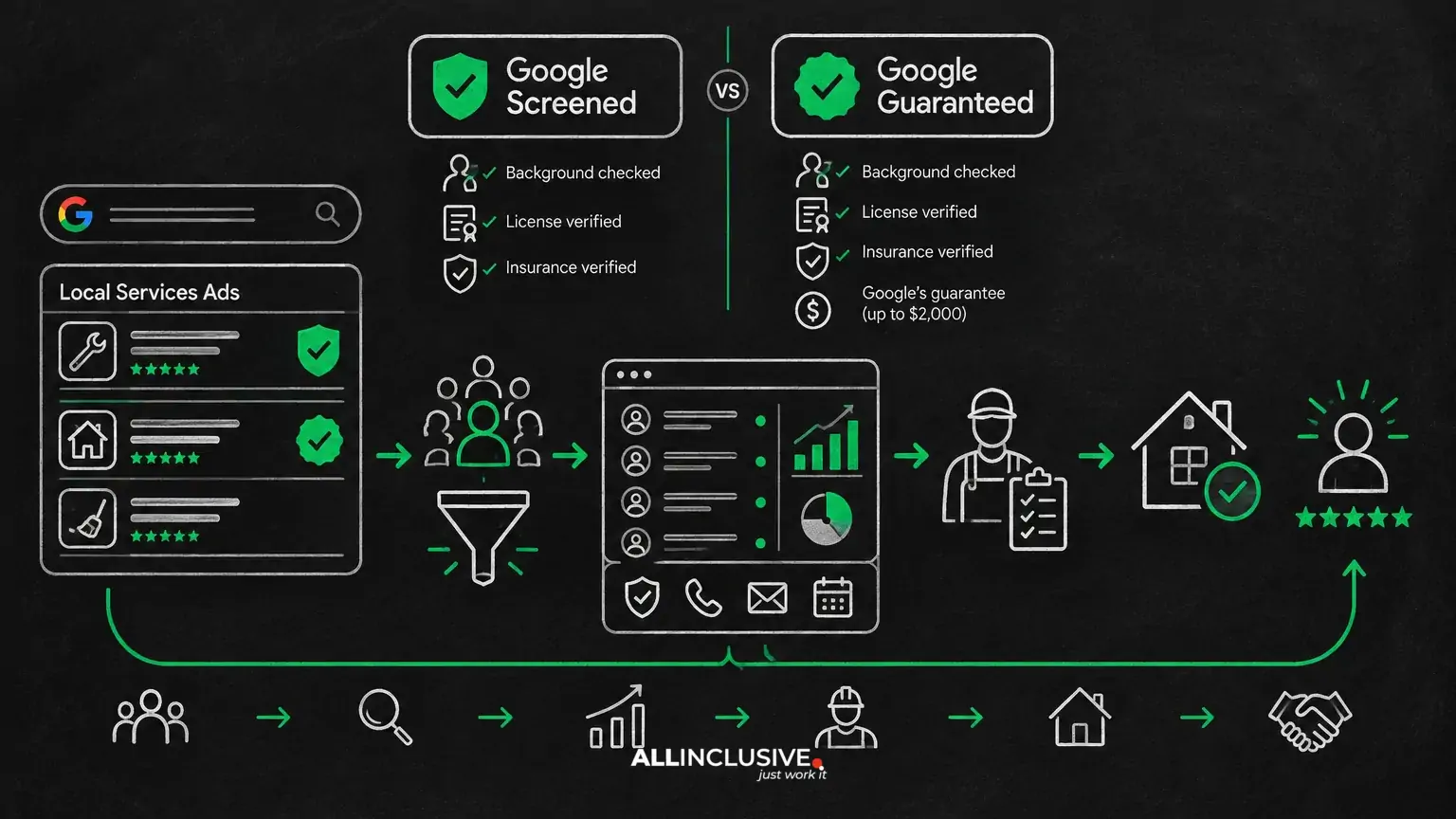
Local Services Ads (LSAs) are a Google advertising format designed to connect eligible local businesses with people searching for nearby services. Instead of sending every prospect to a conventional search-ad landing page, LSAs can display a business profile with service details, location information, reviews, and a way to contact the business directly.
For businesses that qualify, LSAs can be a useful demand-capture channel when customers are actively looking for help. However, visibility is not the same as profitable lead generation. Results depend on eligibility, service coverage, profile quality, response speed, budget controls, lead screening, and the business’s ability to turn inquiries into booked work.
This guide explains what are local service ads, how the format generally works, what businesses should prepare before launching, and how LSAs differ from other forms of paid and organic local marketing.
What are Local Services Ads?
Local Services Ads are pay-per-lead advertisements that appear for relevant local-service searches on Google, subject to market, category, and account eligibility. They are intended for businesses that serve defined geographic areas and offer services included in Google’s supported categories.
An LSA typically emphasizes:
- The business name and service category
- Service areas or locations served
- Customer reviews and profile information
- Trust or verification signals where applicable
- Contact actions such as calls or message requests, where available
The exact layout, features, qualification requirements, and availability can vary by country, service category, and account. Businesses should treat Google’s current account interface and policy documentation as the final authority for their market.
How do Google Local Services Ads work?
1. The business creates and verifies a profile
A business starts by providing information such as its category, operating details, service area, contact information, and business credentials. Google may require verification steps, documentation, background checks, insurance details, or other trust and eligibility information depending on the market and service type.
Verification is not a substitute for operational readiness. The profile still needs accurate services, service areas, business hours, images, review history, and contact processes. Inaccurate information can create poor customer experiences and make lead evaluation more difficult.
2. Google matches the profile to relevant searches
When a person searches for a supported local service, Google may show eligible businesses that appear relevant to the query and location. Matching can depend on factors such as service category, proximity or service-area coverage, profile completeness, responsiveness, reviews, budget availability, and other platform signals.
There is no reliable universal formula for placement. A business should avoid assuming that increasing spend alone will guarantee better visibility. Strong performance requires alignment between the search demand, the profile, the operational territory, and the business’s ability to respond.
3. The customer contacts the business
Depending on the market and available features, a prospect may call or send a message through the LSA experience. The inquiry is then delivered to the business for follow-up and qualification.
This makes response operations part of paid-media performance. Missed calls, delayed replies, unclear service boundaries, and weak intake questions can reduce the value of otherwise relevant inquiries.
4. The business reviews and manages leads
Businesses should record each inquiry, including its source, service requested, location, contact outcome, qualification status, appointment status, and eventual revenue when available. Google may provide mechanisms for reviewing or disputing leads under its current policies, but the account owner remains responsible for maintaining accurate internal records.
How are Local Services Ads charged?
Unlike many traditional search campaigns, LSAs are generally structured around leads rather than clicks. The business sets a budget or spending preference within the available account controls, and charges may be associated with eligible customer inquiries rather than every visit to a website.
That distinction changes how performance should be measured. A low cost per inquiry is not automatically efficient if the leads are outside the service area, request an unsupported service, cannot be reached, or never become profitable jobs. Likewise, a higher inquiry cost may be acceptable when the resulting work has sufficient margin and close rate.
Before launching, define:
- The maximum weekly or monthly spend the business can support
- The target number of qualified inquiries
- The services and locations worth accepting
- The minimum economic value of a booked job
- The process for reviewing questionable or invalid leads
For a deeper planning framework, see Local Services Ads Budget: How to Set Weekly Spend and Lead Targets.
Who can benefit from Local Services Ads?
LSAs are usually most relevant to local businesses whose customers search with clear service intent and whose teams can respond quickly. Common examples may include selected home services, professional services, health-related services, and other eligible local categories. Availability should always be checked for the specific market and category.
LSAs may be a strong fit when:
- The business serves a defined geographic area
- Customers commonly search for the service by category or need
- The business can answer calls or respond to messages reliably
- The average job or customer value supports paid lead acquisition
- The team can qualify demand and schedule work promptly
They may be a weaker fit when the offering is highly specialized, the service area is unclear, demand is mostly referral-driven, or the business cannot handle new inquiries consistently. A profile can generate attention that the operation is not prepared to convert.
What affects LSA visibility and lead quality?
Category and service relevance
The selected category and listed services should reflect what the business actually provides. Overly broad or inaccurate positioning can attract mismatched requests, while overly narrow positioning may limit relevant demand.
Geographic coverage
Service areas should match the places the team can realistically serve. Travel time, dispatch economics, licensing boundaries, and minimum job value should inform coverage decisions. Expanding into every nearby area may increase inquiry volume while lowering profitability and operational reliability.
Reviews and profile trust
Reviews help prospects assess whether a business appears credible. The objective is not to manufacture social proof but to deliver good work, request feedback through compliant processes, and keep business information consistent.
Responsiveness and availability
Customers contacting a local provider often compare several options. Calls that go unanswered or messages that receive delayed replies can be lost even when the original inquiry was relevant. Establish a clear ownership model for calls, after-hours inquiries, and overflow periods.
Budget and demand conditions
Budget influences how much demand the account can capture, but it does not create demand where search volume is limited. Seasonal demand, competition, service urgency, and market coverage all affect the number and type of opportunities available.
How should businesses evaluate LSA performance?
Use a funnel that separates platform activity from business outcomes. A practical scorecard includes:
- Inquiry volume: How many calls or messages were received?
- Validity: How many were genuine prospects rather than spam, duplicates, job seekers, vendors, or wrong numbers?
- Qualification: How many matched the service, location, timing, and customer requirements?
- Contact rate: How often did the business reach and speak with the prospect?
- Appointment rate: How many qualified inquiries became estimates, consultations, or scheduled visits?
- Close rate: How many appointments became paying work?
- Economics: What revenue and contribution margin were generated relative to advertising and operating costs?
Do not rely on lead volume alone. A simple tracking sheet or CRM workflow can expose whether the main constraint is ad visibility, lead quality, response speed, sales execution, or service capacity.
Local Services Ads versus traditional Google Ads
LSAs and conventional Google Search campaigns can both capture active demand, but they work differently. Traditional search ads typically send users to a selected landing page and can provide more control over keywords, ad copy, bidding structures, audiences, and conversion paths. LSAs emphasize a local business profile and direct contact actions, with eligibility and lead-handling rules that differ from standard search advertising.
The right choice depends on the customer journey. A business may prefer LSAs when direct calls are valuable and the category is eligible. Search campaigns may be more useful when the business needs detailed message control, broader funnel coverage, specialized landing pages, or traffic to an online booking or ecommerce experience. Some businesses can use both, provided measurement separates their roles.
Read the detailed comparison in Local Services Ads vs. Google Ads: When to Use Each Channel.
Local Services Ads versus local SEO
LSAs are a paid demand-capture mechanism. Local SEO is an organic visibility strategy involving business information, relevant content, local authority, technical quality, and customer experience signals. LSAs can create opportunities sooner when the account is eligible and demand exists, while SEO generally requires sustained work and time to build durable visibility.
They should not be treated as interchangeable. Paid visibility can support short-term lead generation, while local SEO can strengthen unpaid discovery and brand credibility over the longer term. The appropriate mix depends on market demand, competition, capacity, budget, and growth objectives.
How to prepare before launching an LSA campaign
- Confirm eligibility: Check the current supported category, location, verification, and policy requirements for the target market.
- Define profitable service boundaries: List the jobs, customer types, and locations the business can serve profitably.
- Complete the profile accurately: Use consistent business details, service information, hours, images, and credentials.
- Set a controlled starting budget: Choose a level that allows learning without exposing the business to unmanaged demand.
- Build a lead intake process: Decide who answers calls, who handles messages, what qualifies a lead, and how follow-up is recorded.
- Install outcome tracking: Connect inquiry records to appointments, jobs, revenue, and lead-quality decisions.
- Review performance on a schedule: Look for patterns by service, geography, time, lead type, and sales outcome before making major changes.
Common mistakes with Local Services Ads
- Launching before confirming category and market eligibility
- Accepting every location without checking travel time or profitability
- Judging success by inquiry volume instead of qualified jobs
- Allowing calls to go unanswered during peak demand
- Failing to distinguish invalid leads from merely unsuccessful sales conversations
- Changing multiple profile or budget variables at once, making results difficult to interpret
- Using LSAs without a process for review, dispute, or internal lead-quality feedback
Operational discipline matters as much as account setup. A business that consistently answers, qualifies, schedules, and follows up can extract more value from the same level of demand than one that treats LSAs as a passive listing.
Where to go next
Local Services Ads can be a practical part of a broader local paid acquisition strategy, but the channel should be evaluated against business economics rather than visibility alone. Start with eligibility, profitable service coverage, budget limits, and a reliable lead-response process. Then use qualified-lead and booked-job data to decide whether to expand, refine, or reduce investment.
For ongoing channel planning and measurement, explore the broader paid media resources. If the account is already active, the Local Services Ads Management: Weekly Operating Checklist provides a practical framework for recurring reviews.