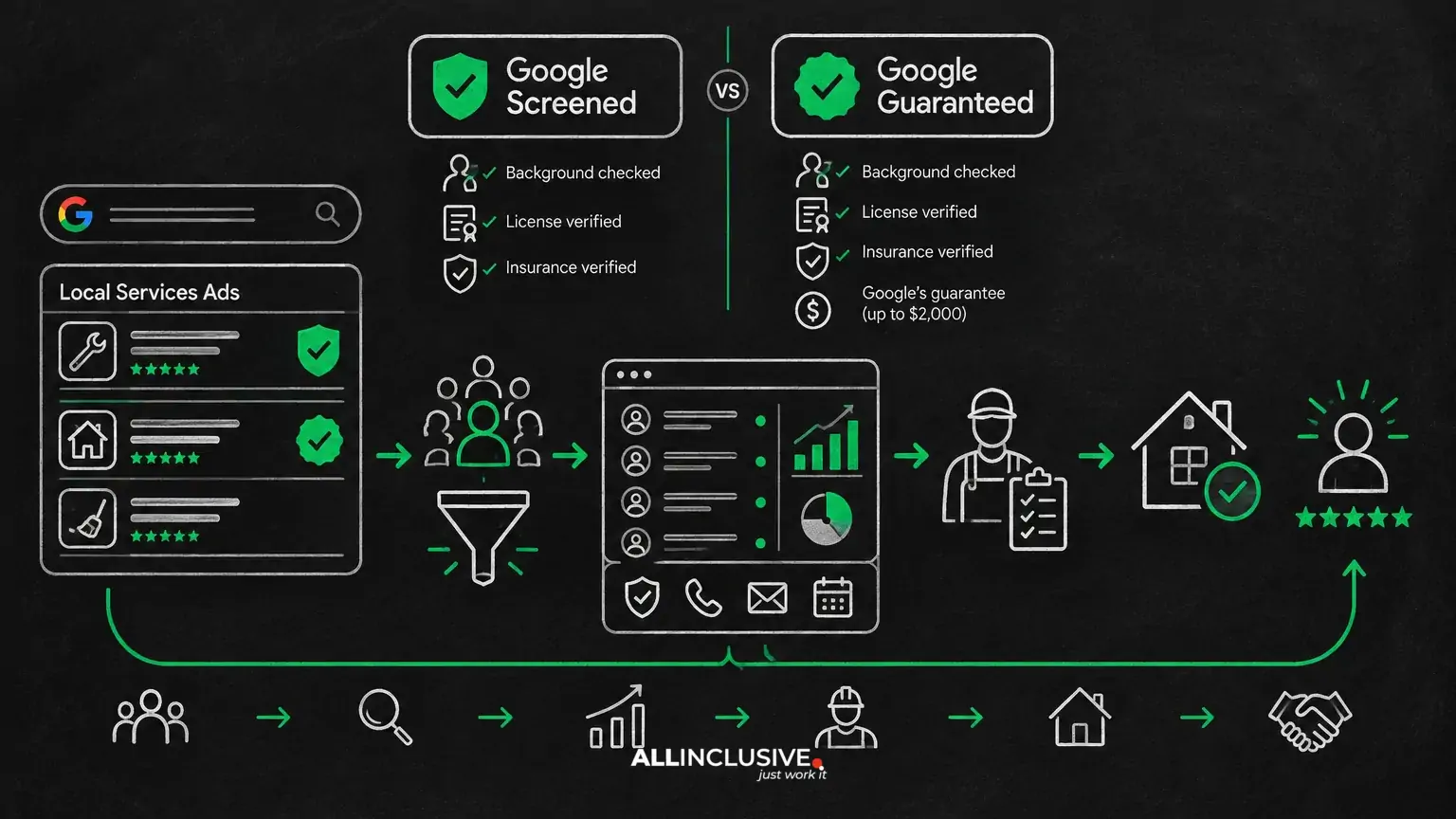
Google Local Services Ads are designed for customers looking for nearby providers, but eligibility is not universal. Available categories can vary by country, service area, business type, and Google’s current program requirements. A business may operate locally and still be unable to participate if its service category is not supported in its market or it cannot complete the required checks.
The practical answer is this: eligible businesses are generally local, service-based providers that can serve customers in a defined area and meet Google’s verification and policy requirements. Common examples include home services, professional services, health-related providers, wellness businesses, and certain automotive or care services. The exact list should always be confirmed through the current Local Services Ads sign-up flow for the business’s location.
What are Local Services Ads categories?
Local Services Ads categories are the business and service classifications Google uses to determine whether a provider can advertise through the Local Services Ads program. A category helps Google match a business with relevant searches, establish which verification steps apply, and determine where the provider may be eligible to receive leads.
Categories are more specific than a broad label such as “local business.” Two companies serving the same geographic area may have different eligibility outcomes because they provide different services, operate under different professional requirements, or fall into different program classifications.
Category availability is also market-dependent. A category shown in one country, state, or metropolitan area may not be available in another. Businesses should therefore treat general category lists as starting points, not as a guarantee of eligibility.
Common business groups found in Local Services Ads
Although the available options change over time and by market, Local Services Ads commonly support service businesses in several broad groups.
Home and property services
- Plumbing and water-related services
- Heating, ventilation, and air-conditioning services
- Electrical work
- Roofing and exterior services
- General contracting and remodeling
- Carpentry and handyman services
- Painting and certain finishing services
- Pest control
- Cleaning services
- Landscaping and lawn care
- Garage door and other property maintenance services
Home-service categories often require a clear service area and evidence that the provider can perform the advertised work. Depending on the category and market, that may include business documentation, trade licensing, insurance information, or other verification.
Professional services
- Legal services
- Accounting and tax services
- Real estate services
- Financial planning or related advisory services
- Business and professional consulting in supported markets
Professional-service advertisers should pay close attention to the relationship between the business name, practitioner credentials, office details, and advertising claims. A category selection that is too broad or does not match the provider’s actual qualifications can create approval or lead-quality problems.
Health, wellness, and care services
- Dental services
- Primary care and selected medical services
- Mental health services
- Physical therapy and rehabilitation
- Chiropractic services
- Optical and hearing-related services
- Senior care and certain home-care services
Health-related categories can involve more sensitive policy and verification considerations. Providers should ensure that the advertised service, practitioner information, location, and claims are consistent across their business profile and supporting documentation.
Automotive services
- Auto repair
- Auto body services
- Towing and roadside assistance
- Vehicle glass services
- Selected mobile automotive services
Automotive eligibility may depend on whether the business operates from a customer-facing location, travels to customers, or provides emergency services. The operating model should be represented accurately during setup.
Other local and personal services
Depending on the market, supported categories may also include moving services, locksmiths, pet-related services, beauty and wellness providers, fitness services, and other appointment-based businesses. These categories are not interchangeable, and a business should not select the nearest-sounding option simply to enter the program.
How eligibility is determined
Category availability is only one part of eligibility. Before investing time in setup, evaluate the following factors.
1. Supported category and market
Start with the official Local Services Ads enrollment experience for the business’s country, region, and service area. Enter the most accurate business category available rather than forcing the business into a broader classification.
If the category is not listed, that usually means the provider should not assume it can participate under a neighboring category. Monitor the program periodically if the business is a strong fit, because platform coverage can change, but do not build forecasts around unconfirmed availability.
2. Local operating model
Local Services Ads generally suit businesses that serve customers in a defined geography. A provider may operate from a storefront, visit customer locations, or use a service-area model. The business must be able to explain where and how it serves customers.
National providers, online-only companies, lead resellers, and businesses without a genuine local fulfillment capability may be poor fits even if their website targets local keywords. The important distinction is the delivery model, not merely the presence of a local landing page.
3. Business identity
The business name, phone number, website, address, service area, and primary category should describe the same operating entity. Inconsistencies can delay verification and make it harder for prospective customers to assess the provider.
For multi-location businesses, assess each location’s eligibility and operating details separately. Avoid presenting a shared call center, virtual office, or unrelated branch as if it were a local service location.
4. Licensing, insurance, and professional requirements
Some categories require licenses, insurance, background checks, or other documentation. Requirements can depend on the service, jurisdiction, and business structure. A business should identify who is responsible for the work and whether that person or entity holds the credentials needed to provide it legally.
Verification is not a one-time reason to relax documentation standards. Keep licenses and business information current, and review the provider’s status whenever the company changes ownership, service scope, location, or personnel.
5. Customer experience and policy compliance
Eligibility does not guarantee sustained visibility or lead volume. Providers must also meet applicable advertising and customer-service expectations. Misleading claims, unclear pricing practices, poor responsiveness, or services that do not match the selected category can create operational and advertising risk.
Review Local Services Ads verification before applying if you need a clearer view of the business, license, and background-check process.
How to choose the right category
Category selection should reflect the service customers can actually book or request, not every capability the company has ever offered. Use these decision criteria:
- Lead with the highest-value core service. Choose the category that best represents the work the business wants to sell and can fulfill reliably.
- Match the customer’s language. Use the closest supported classification to how prospects describe the service, while remaining accurate.
- Separate materially different services. A roofing contractor, general remodeler, and handyman may overlap operationally but can attract different expectations and lead types.
- Check credential alignment. Confirm that the selected category does not imply a license or qualification the business does not hold.
- Review lead quality after launch. Track whether inquiries match the chosen service, geography, urgency, and customer value.
Do not treat category selection as a keyword-targeting exercise. Local Services Ads are intended to connect customers with providers, so the category must be defensible when a customer asks what the business does and who will perform the work.
Examples of category decisions
Example: a remodeling company
A company that primarily completes kitchen and bathroom renovations should avoid presenting itself only as a general handyman if that classification attracts small repair requests it cannot serve profitably. It should select the closest supported remodeling or contractor category and make the service scope clear in its profile and intake process.
Example: a mobile locksmith
A locksmith that travels to customers should represent its mobile operating model accurately. It should not imply that customers can visit an office if no genuine customer-facing location exists. Service coverage, response expectations, and business identity should be consistent across the profile and website.
Example: a multi-specialty healthcare practice
A practice offering several specialties should determine whether each service is supported under one category or whether separate practitioner or location structures are appropriate. The business should avoid using a broad health label that obscures the actual provider and appointment type.
Category eligibility versus ad performance
Being eligible is the entry condition, not a performance strategy. Once approved, results can be affected by factors such as service-area coverage, responsiveness, profile completeness, reviews, budget controls, lead relevance, and competitive conditions.
For a broader view of the channel and how it fits into a paid acquisition plan, see Allinclusive’s paid media resources. For ongoing account management, category fit should be reviewed alongside the factors covered in Local Services Ads ranking factors.
Businesses should also establish a lead-quality feedback loop. Record the selected category, service requested, location, caller intent, qualification outcome, booked appointment, and revenue potential. This helps distinguish a category problem from a targeting, intake, or sales-follow-up problem.
Pre-application checklist
- Confirm that the category is available in the relevant market.
- Verify that the business genuinely serves customers locally.
- Document the business name, address, phone number, website, and service area.
- Gather current licenses, insurance details, and other requested documentation.
- Confirm that the selected category matches the work customers can request.
- Review whether practitioner, location, or ownership details need separate treatment.
- Prepare a process for answering calls and following up on leads promptly.
- Define which inquiries are qualified, unqualified, outside the service area, or unsuitable.
- Establish a process for reviewing disputed or invalid leads where applicable.
Local Services Ads Categories: Key Decision Point
The right Local Services Ads category is the most accurate supported classification for the business’s core local service in its market. Eligibility depends on more than choosing a label: the provider must have a credible local operating model, consistent business information, appropriate credentials, and the ability to deliver what the ad promises.
Because categories and requirements can change by market, confirm availability through the current enrollment process before making budget or staffing decisions. Once approved, treat category selection as part of a wider operating system that connects advertising, lead handling, customer experience, and revenue measurement.
For broader strategic context, see our Local Services Ads resource.