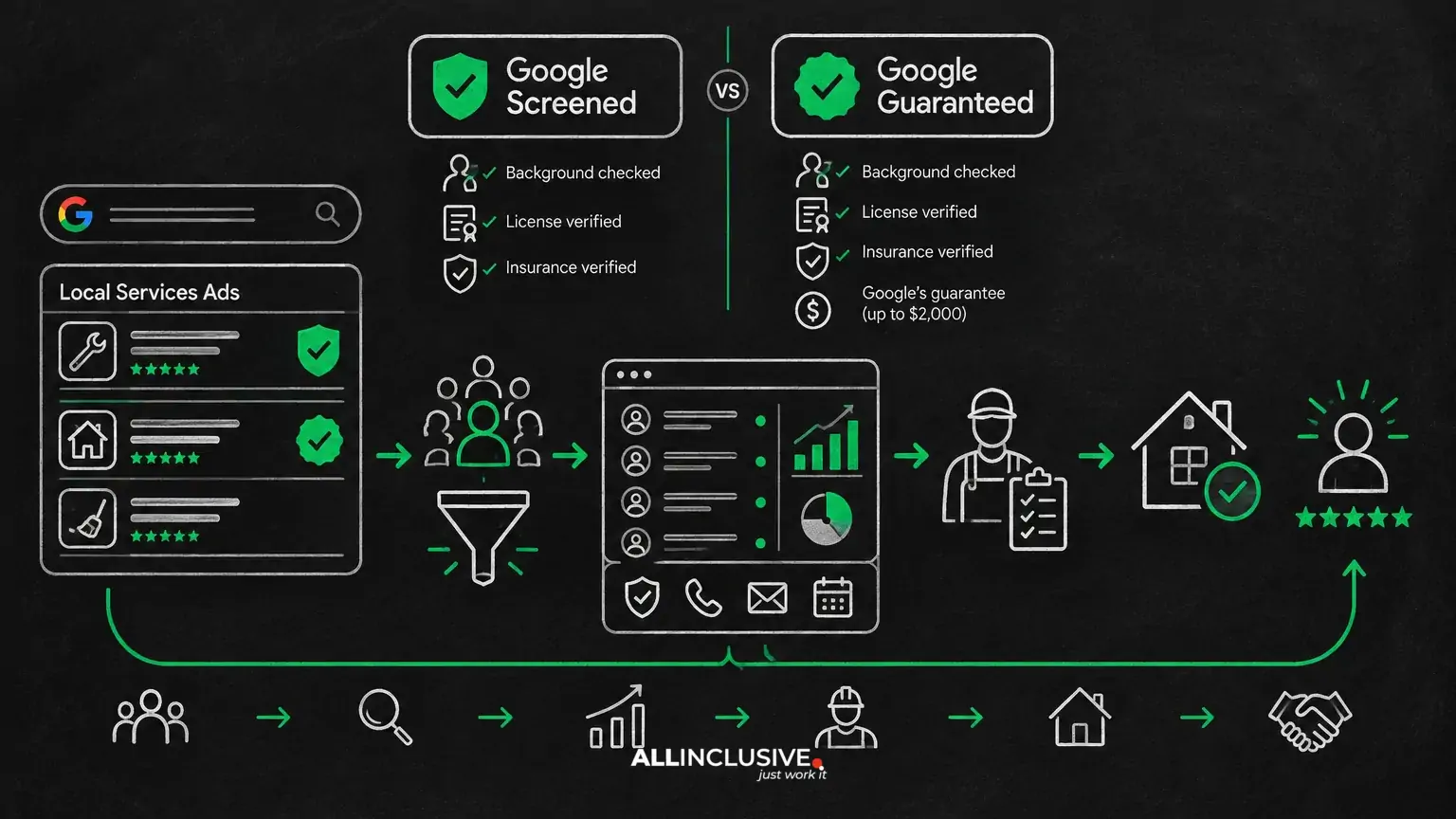
A local service ads audit should answer two commercial questions: are you paying for the right opportunities, and does your business convert those opportunities into profitable work? Reviewing only spend, impressions, or lead volume is not enough. An account can generate calls while attracting the wrong locations, services, job sizes, or customers.
Use the checklist below to inspect account configuration, eligibility, visibility, lead quality, economics, measurement, and follow-up. Platform labels and available controls can change by market and business category, so verify current details in the account and applicable Google documentation rather than treating any checklist as a substitute for platform guidance.
How to use this Local Services Ads audit
Start with a defined review period long enough to expose patterns, then separate confirmed leads from inquiries that were missed, unqualified, duplicated, or never answered. Compare the account to business records where possible: call logs, booked jobs, estimates, revenue, service areas, and customer records.
For every issue, record four items:
- Evidence: what the account, call record, or CRM shows.
- Impact: how the issue affects cost, lead quality, coverage, or reporting.
- Action: the change required and who owns it.
- Validation: the metric or observation that will confirm improvement.
For broader channel planning, see the paid media resource. For the channel’s role, use the Local Services Ads guide.
Account, profile, and eligibility checks
1. Confirm the business identity
Check that the account represents the correct legal or trading business, phone number, website, address, and operating entity. Inconsistent details can create trust, verification, and lead-routing problems.
2. Review verification status
Document the status of relevant business, license, insurance, background, or screening requirements for the category and market. Separate completed requirements from items that are pending, expired, or limited to particular locations or services. The Local Services Ads verification guide covers this area in more detail.
3. Audit service categories
List every selected category and compare it with the work the business actually wants. Remove categories that attract inquiries outside capability, licensing, geography, or minimum job value.
4. Check services and job types
Review service descriptions, job types, and any selectable offerings for accuracy. Specific, operationally meaningful services help the team distinguish a valuable inquiry from a poor fit during lead review.
5. Validate business hours and availability
Compare published hours and response availability with actual staffing. If calls arrive when nobody can answer or dispatch, the problem is operational as much as media-related.
Location and coverage checks
6. Reconcile service areas with actual capacity
Map the selected areas against dispatch limits, technician coverage, travel time, and commercial priorities. A broad service area may increase inquiry volume while reducing close rate and raising acquisition cost.
7. Check location-level lead quality
Group leads by city, postal area, radius, or other available geographic detail. Identify areas producing missed calls, poor-fit jobs, excessive travel, or low booking rates. Avoid expanding coverage solely because an area generates impressions.
8. Identify boundary and address issues
Inspect leads near service-area boundaries and verify whether customers are actually eligible. Ask the sales or dispatch team to flag locations that appear acceptable in the account but are impractical to serve.
9. Compare location economics
Estimate the value of a booked job by area after travel, labor, subcontracting, and other variable costs. Prioritize locations that support profitable fulfillment, not just the lowest apparent lead cost.
Visibility and profile checks
10. Review profile completeness and accuracy
Audit business information, services, photos, reviews, credentials, and other profile elements available in the account. Remove outdated claims and ensure the profile reflects the experience customers will receive.
11. Examine review quality and recency
Do not reduce reviews to a single count. Review themes, response patterns, recency, and complaints related to punctuality, pricing, communication, or workmanship. These signals affect customer confidence even when the advertising setup is sound.
12. Compare visibility with business priorities
Look at when and where the business is visible, then compare that exposure with staffing and profitable demand. Higher visibility is not automatically better if the team cannot answer, quote, or fulfill the resulting work.
13. Check competitive context carefully
Record meaningful changes in local competition, category demand, seasonality, and review strength. Avoid claiming that one ranking factor explains performance without evidence. A visibility change may reflect several conditions at once.
For a structured discussion of visibility inputs, read Local Services Ads ranking factors.
Budget and cost checks
14. Compare budget with qualified demand
Review spend against qualified leads, booked jobs, and capacity. If the team cannot handle additional work, increasing budget may only increase response failures or low-quality inquiries.
15. Calculate cost at multiple stages
Track at least cost per lead, cost per qualified lead, cost per estimate, cost per booked job, and customer acquisition cost where data allows. Each metric answers a different question; cost per lead alone can conceal waste.
16. Investigate cost changes by period
Compare performance across consistent time windows and annotate seasonality, staffing changes, service changes, review events, and budget changes. Do not infer causation from a single week or isolated lead.
17. Set economic guardrails
Define acceptable acquisition cost using contribution margin, average job value, repeat potential, cancellation risk, and close rate. A lead can be inexpensive and still unprofitable; a more expensive lead can be valuable if it produces suitable work.
18. Review lead disputes and credits
Maintain a log of invalid, duplicate, spam, wrong-number, outside-area, and unrelated inquiries. Follow the current platform process for disputing eligible leads, but treat credits as recovery—not as a replacement for quality analysis.
Lead quality and operations checks
19. Create a consistent lead classification
Use a shared taxonomy such as valid inquiry, qualified opportunity, estimate, booked job, completed job, canceled job, and unqualified lead. Define each status so marketing, sales, and operations report the same way.
20. Listen to a representative sample of calls
Review calls across locations, services, times, and outcomes. Look for wrong intent, price-only inquiries, poor fit, unanswered calls, long waits, unclear qualification, and missed opportunities. Protect personal information and follow applicable recording and privacy requirements.
21. Check response speed and answer rate
Measure whether calls are answered and whether messages receive timely follow-up. Separate media failure from operational failure: a relevant lead that is never answered should not automatically be classified as poor advertising.
22. Audit intake questions
Ensure the team captures service needed, location, urgency, property type, budget or scope where appropriate, and next step. Keep the intake practical; excessive questioning can damage the customer experience.
23. Compare lead source with CRM records
Match platform leads to call tracking, contact records, estimates, bookings, and revenue. Investigate duplicates and missing records. If matching is manual, document the method and limitations so decisions are not presented with false precision.
24. Measure downstream outcomes
Review conversion by service, geography, device or contact type where available, and team member. The most useful audit finding may be that one service produces many leads but few completed jobs, while another produces fewer but better opportunities.
25. Audit follow-up and close-loop reporting
Confirm that every lead receives a disposition and, when appropriate, a revenue outcome. Set a review cadence—weekly for operational exceptions and monthly for strategic decisions—while allowing enough time for estimates and jobs to mature.
How to prioritize audit findings
Not every issue deserves immediate structural change. Rank findings by likely financial impact, confidence in the evidence, speed to implement, and operational dependency.
- Fix measurement gaps first. You cannot judge optimization if qualified leads and booked work are not recorded consistently.
- Remove obvious mismatch. Correct inaccurate services, locations, hours, and eligibility issues before changing budget.
- Address response failures. Improve answer rate, routing, scheduling, and follow-up when relevant leads are being lost.
- Reallocate around business economics. Use qualified and booked outcomes to guide service and location priorities.
- Test one meaningful change at a time. Record the hypothesis, date, expected effect, and review window.
What a useful audit deliverable includes
A practical audit should end with an action register, not a long list of observations. Include the current state, evidence, recommended action, owner, priority, expected business effect, and validation date. Add a simple funnel showing leads, qualified opportunities, estimates, booked jobs, completed jobs, revenue, and acquisition cost where available.
Keep platform mechanics separate from business strategy. Account settings and eligibility determine what can be configured; service mix, geography, staffing, margins, and customer experience determine what should be pursued. That distinction prevents a common error: treating every performance problem as an advertising-setting problem.
Local Services Ads Audit: What to Prioritize
The purpose of a Local Services Ads audit is not to maximize activity. It is to establish whether visibility reaches the right customers, whether the business responds effectively, and whether resulting work supports its economics. Repeating the 25 checks after meaningful changes creates a clearer decision process than reacting to lead volume alone.