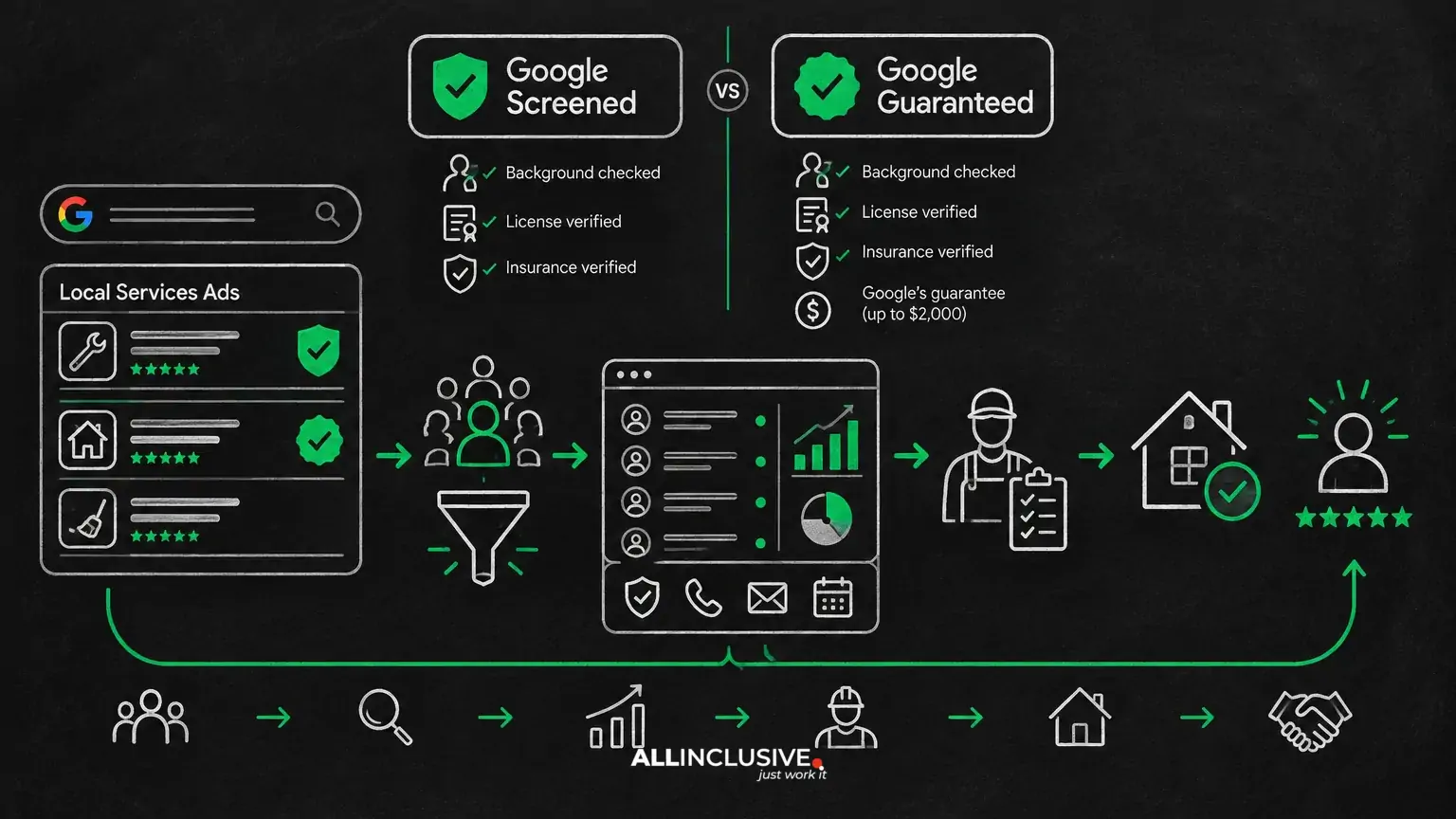
Local Services Ads visibility is shaped by more than budget. Google’s system can consider factors such as a provider’s relevance to the search, proximity to the customer, profile quality, reviews, responsiveness, business eligibility and bidding or budget settings. The exact weighting is not fully public and can vary by market, service category and search context.
That means there is no reliable “ranking trick.” The practical objective is to remove eligibility issues, improve the quality and relevance of your profile, respond consistently, and use budget and bidding settings that support the volume you can actually handle.
This guide explains the main local service ads ranking factors marketers and operators should monitor, how to separate visibility problems from lead-quality problems, and what to test first.
How Local Services Ads visibility works
Local Services Ads are designed to connect customers with nearby service providers. Unlike conventional search campaigns, the ad format and lead flow depend heavily on business verification, service eligibility, location coverage, customer trust signals and the provider’s ability to respond to enquiries.
Visibility is also contextual. A business may appear prominently for one service and area but have limited exposure for another. Results can change as competitors enter or leave the market, customer demand shifts, profiles are updated, or account settings change.
For that reason, treat visibility as an outcome of several interacting signals rather than a fixed position that can be checked once and permanently improved.
Key Local Services Ads ranking factors
1. Relevance to the customer’s search
The closer your selected services, business category and profile information match the customer’s request, the more likely your listing is to be considered relevant. Relevance can be weakened by selecting broad or inaccurate services, using vague descriptions, or advertising work your business does not actually provide.
Review your service list against real enquiries and completed jobs. If a category attracts requests outside your capabilities, refine the profile and coverage rather than accepting every possible service. Better alignment can improve both visibility quality and downstream lead quality.
2. Proximity and service-area fit
Local intent matters. Google may consider the relationship between the customer’s location, your business location and the areas you serve. A business that is highly relevant but far from the customer may not be competitive in the same way as a nearby provider.
Keep service areas accurate and operationally realistic. Expanding coverage can increase potential demand, but it can also create longer travel times, weaker response capacity and less suitable leads. Use location-level reporting where available to identify areas that produce qualified opportunities rather than assuming every additional area is valuable.
3. Business verification and eligibility
Verification is foundational. Incomplete business information, unresolved documentation requests, licensing issues or category restrictions can limit delivery or prevent an account from participating. Verification itself is not a shortcut to prominent placement, but a profile that is not eligible cannot compete consistently.
Maintain current business details and submit requested documentation carefully. For a deeper operational checklist, see Local Services Ads Verification.
4. Reviews and reputation signals
Customer reviews can influence trust and the likelihood that a prospect chooses your business. The important considerations are not only the visible rating, but also review volume, recency, authenticity and how your business responds to feedback.
Build review generation into the post-job process without offering incentives that could undermine authenticity or violate applicable policies. Ask customers for honest feedback after a completed service, monitor new reviews, and resolve legitimate issues through a consistent customer-service process.
5. Responsiveness and lead handling
When customers contact a service provider, the quality and speed of the response affect the commercial value of the lead. Missed calls, delayed replies and unclear qualification processes can waste paid demand even when visibility is strong.
Audit call coverage, voicemail handling, after-hours routing and message response workflows. A useful operational standard is to define who owns new leads, what information must be captured, and when a lead is escalated. Do not assume that increasing exposure will solve a follow-up problem.
6. Bid, budget and lead-volume settings
Account controls that influence desired lead volume, bidding or budget can affect how aggressively the system seeks opportunities. These settings should be interpreted as delivery controls, not guaranteed ranking levers.
Before increasing spend, confirm that your business can answer and fulfil more enquiries. Then evaluate changes over an appropriate period using qualified leads, booked jobs and cost per accepted opportunity—not impressions alone. The mechanics and trade-offs deserve separate treatment; see Local Services Ads Bidding.
7. Profile completeness and accuracy
A complete profile helps prospective customers understand who you are, what you do and where you operate. Accurate business names, phone details, service descriptions, hours, photos and other available profile fields can reduce uncertainty and support conversion.
Completeness is not a substitute for relevance or operational quality. Avoid adding claims, services or coverage that cannot be substantiated. Inaccurate information may create poor-fit leads and damage trust.
8. Business history and customer experience
Performance signals associated with lead outcomes and customer experience may influence future delivery, although Google does not publish a complete formula or fixed weighting for every market. Consistent lead handling, accurate service information and legitimate customer feedback are therefore safer priorities than attempting to manipulate individual metrics.
Track outcomes beyond the platform where possible. A lead that appears inexpensive may be commercially weak if it is outside your service area, unrelated to your category or never answered.
What is not a dependable ranking strategy
- Raising budget without fixing relevance: More budget cannot make an unsuitable service profile suitable.
- Adding every possible category: Broader targeting may increase mismatched enquiries and operational waste.
- Using artificial reviews: Inauthentic feedback creates compliance and reputation risk.
- Expanding service areas indiscriminately: Larger coverage can reduce fulfilment quality and profitability.
- Checking one search manually: A single result does not represent delivery across locations, devices, times or service types.
- Optimizing for leads alone: Volume without qualification and follow-up can make performance look better while business results worsen.
A practical diagnostic framework
Start by separating three questions: Can the business participate? Is it being shown to the right customers? Does it convert and fulfil the resulting demand?
Step 1: Confirm eligibility and delivery status
Check verification, licences or other required documentation, account notifications, business information and selected services. Resolve administrative blockers before making performance changes.
Step 2: Review coverage and relevance
Compare advertised services and locations with the jobs the business accepts. Look for areas that produce poor-fit requests, services that are rarely fulfilled and gaps between the profile promise and the sales team’s qualification process.
Step 3: Audit trust and conversion assets
Review the profile from a customer’s perspective. Is the business information clear? Are reviews current and credible? Do photos and descriptions support the service being requested? Is it obvious how to contact the business?
Step 4: Test response operations
Call the published number during business hours and review missed-call handling. Test message routing, voicemail instructions and lead ownership. Record response time and outcome, not merely whether a contact was received.
Step 5: Evaluate settings against capacity
Compare desired lead volume and spend with staffing, geography, average job value and close rate. If capacity is limited, a lower volume of better-qualified opportunities may be more valuable than maximum exposure.
Step 6: Measure by outcome
Build a simple report containing impressions or exposure indicators where available, leads, valid leads, qualified leads, booked jobs, revenue and cost per qualified or booked opportunity. Segment by service and area to avoid hiding weak pockets inside account averages.
How to improve visibility responsibly
- Fix blockers first. Resolve verification, licensing and account-status issues before changing budgets.
- Tighten the service offering. Keep selected services aligned with actual capabilities and profitable work.
- Make location coverage operational. Remove areas the team cannot serve reliably and prioritize locations with viable economics.
- Strengthen the customer experience. Ask for genuine reviews, respond professionally and correct recurring service problems.
- Improve lead response. Assign ownership, establish call-back procedures and monitor missed opportunities.
- Use controlled changes. Change one major variable at a time where practical, then assess quality and volume together.
- Connect advertising to sales data. Feed booked-job and revenue information into decision-making rather than optimizing only to platform leads.
How to interpret common visibility problems
Low visibility with no leads: Check eligibility, service relevance, location coverage, budget or bid controls and local competition. Do not conclude that one setting is responsible without reviewing the full account context.
High visibility but poor lead quality: Examine category selection, service descriptions, location boundaries and customer qualification. More exposure is unlikely to solve a targeting mismatch.
Good leads but weak close rate: Review response time, pricing communication, sales qualification and fulfilment capacity. This may be a sales-process problem rather than a ranking problem.
Performance changes after an edit: Record what changed and compare trends over a meaningful period. Demand, competitors, seasonality and customer mix can move at the same time, so avoid assigning causation too quickly.
Build the work into a broader paid-media process
Local Services Ads should be assessed alongside other demand-capture activity, not in isolation. Search campaigns, local landing pages, call tracking, CRM stages and offline conversion data can reveal whether the platform is creating incremental demand or simply shifting existing enquiries between channels.
Use a consistent definition of a qualified lead across channels. Then decide where Local Services Ads fit in the customer journey, how much capacity they should consume and which outcomes justify continued investment. For broader channel planning, visit Allinclusive’s paid media resource.
For an end-to-end review of account structure, lead quality and operational controls, use the Local Services Ads audit checklist. It complements this article by turning ranking-factor concepts into a repeatable account review.
Local Services Ads Ranking Factors: What to Prioritize
Local Services Ads visibility is best approached as a systems problem. Relevance, proximity, eligibility, reputation, responsiveness, profile accuracy and delivery settings can all matter, but none should be treated as a guaranteed ranking formula.
The most durable approach is to keep the profile accurate, serve only realistic locations and services, respond quickly, maintain genuine customer trust and measure qualified business outcomes. That improves the conditions for visibility while protecting the economics of the leads you receive.
For broader strategic context, see our Local Services Ads resource.