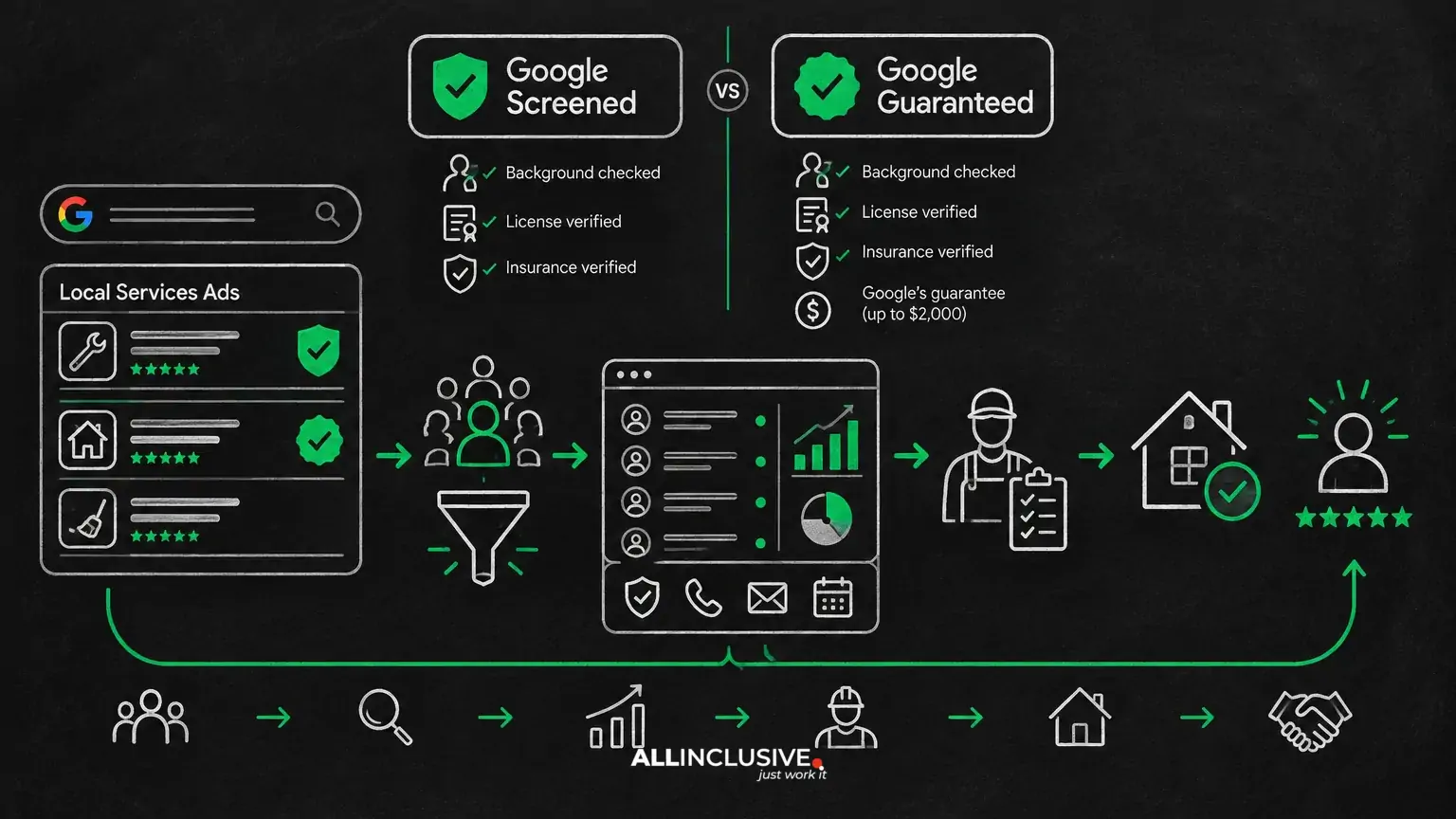
Local Services Ads bidding is not simply a choice between spending more and spending less. The more useful question is whether your business currently needs to maximize qualified opportunities, control acquisition cost, or build enough reliable data to make that decision with confidence.
For many advertisers, the central comparison is between a strategy designed to maximize leads and one that sets a maximum amount the business is willing to pay for an individual lead. The right option depends on demand, service-area economics, lead quality, response capacity, and how consistently your team records outcomes after the inquiry arrives.
What the two bidding approaches are designed to do
Platform labels and available controls can change, so confirm the current options in your account before implementation. Strategically, however, the distinction is straightforward:
- Maximize Leads: prioritizes generating as many eligible opportunities as the campaign can pursue within its available budget and market conditions. It generally gives the platform more discretion to vary effective lead costs in pursuit of volume.
- Max Per Lead: introduces a stronger cost-control constraint by setting the maximum amount you are prepared to pay for an individual lead, subject to eligibility, competition, demand, and the platform’s current mechanics.
Neither approach guarantees a particular number of leads, a fixed cost, or a specific level of lead quality. Bidding is only one part of Local Services Ads performance. Eligibility, verification, reviews, responsiveness, proximity, service coverage, category fit, budget, and customer experience can all affect delivery and results.
When maximizing leads can make sense
A lead-volume-oriented approach is often worth testing when the business has the operational capacity to answer more inquiries and the economics support variable acquisition costs.
Use it when capacity is the primary constraint
If technicians, sales staff, or appointment slots are available, additional qualified inquiries may be more valuable than strict control over the cost of every lead. A business with unused capacity can often learn faster by allowing the campaign to pursue available demand rather than narrowing delivery too aggressively.
Use it when conversion data is limited
Early campaigns frequently lack enough reliable information about which inquiries become booked jobs, completed jobs, or profitable customers. A volume-oriented strategy can help produce a larger sample, but only if the business reviews lead quality and does not treat every inquiry as equally valuable.
Use it when demand is uneven
Local demand can vary by season, day, service type, and geography. A restrictive ceiling may reduce visibility when eligible demand is already limited. If the campaign is underdelivering and the business can profitably handle more work, pursuing volume may be the more useful diagnostic step.
The trade-off is less predictable cost control. A high inquiry count can conceal weak economics if calls are unanswered, requests fall outside the service area, or the team accepts low-value jobs that do not cover acquisition and fulfillment costs.
When setting a maximum per lead can make sense
A maximum per lead is generally more appropriate when acquisition economics are well understood and the business needs a clearer guardrail.
Use it when job values vary substantially
A lead for a high-value replacement project should not necessarily be evaluated the same way as a lead for a small repair. If service mix is uneven, set the ceiling with the actual contribution margin and close rate of the targeted work in mind—not with a generic industry expectation.
Use it when budget predictability matters
Businesses with limited monthly budgets, strict cash-flow requirements, or narrow operating margins may prefer a stronger cost constraint. This can reduce exposure to lead costs that the business cannot comfortably absorb, although it may also limit delivery.
Use it after establishing baseline performance
Cost controls work better when based on first-party evidence. Review historical data by service, location, lead source, and outcome before choosing a ceiling. Without that context, a maximum may be set so low that the campaign cannot compete for enough opportunities—or so high that it offers little practical protection.
The trade-off is reduced volume and potentially less flexibility. If the ceiling is below what is required to participate in available demand, impressions and leads may decline. A lower cost per lead is not automatically a better result if profitable opportunities disappear.
How to choose the right approach
Use the following decision criteria before changing a Local Services Ads bidding strategy.
- Calculate allowable acquisition cost. Start with average revenue, gross margin or contribution margin, close rate, fulfillment costs, and customer lifetime value where relevant. Define the maximum cost that still supports a healthy business outcome.
- Separate inquiries from qualified leads. Count spam, wrong numbers, out-of-area requests, duplicate contacts, employment inquiries, and unrelated service requests separately. A platform-reported lead is not always a sales-qualified opportunity.
- Measure downstream outcomes. Track answered calls, booked appointments, estimates, sold jobs, completed work, revenue, and margin. Bidding decisions based only on lead count or cost per lead can optimize the wrong outcome.
- Assess operational capacity. Confirm that the business can answer promptly, schedule demand, cover the advertised area, and deliver the promoted services. More leads are not useful if response or fulfillment capacity is already constrained.
- Review service and location mix. A campaign can appear efficient overall while producing poor economics in one service or territory. Use available reporting and internal records to identify where the actual value is coming from.
- Choose a testing window. Avoid reacting to one expensive lead or one quiet day. Make changes deliberately, document the date, and allow enough time for delivery and sales outcomes to become interpretable.
A practical bidding framework
Businesses can use a staged approach rather than treating the choice as permanent.
Stage one: establish eligibility and measurement
Before changing bids, confirm that the profile, business information, service categories, service areas, licenses, and required verification are accurate. Review Local Services Ads verification requirements and resolve any issues that could affect eligibility or trust.
Then create a basic lead-quality process. Assign every inquiry a status such as invalid, qualified, booked, sold, completed, or lost. Record the service requested, location, estimated value, and reason for loss where practical.
Stage two: use volume to learn—if the economics allow it
If the business has capacity and can tolerate variation in lead costs, a maximize-leads approach may provide useful information about demand and service mix. Set a total budget that reflects what the business can actually service, and monitor quality daily enough to catch obvious waste.
This is not permission to ignore cost. Establish a stop-loss rule based on business economics, such as pausing expansion when qualified acquisition cost exceeds the approved threshold for a sustained period.
Stage three: introduce a cost ceiling
Once the business has enough outcome data, test a maximum per lead based on allowable acquisition cost. Begin with a defensible ceiling rather than an arbitrary low number. Monitor both cost and delivery: a successful test should be evaluated on profitable outcomes, not merely whether the average lead price decreased.
Stage four: adjust with evidence
If volume falls sharply, examine whether the ceiling is too restrictive, the service area is too narrow, demand is seasonal, or the profile has another eligibility or quality issue. If costs rise without better outcomes, review lead quality, response time, service mix, and competition before assuming the bid alone is responsible.
Example: two businesses, two different choices
Consider two hypothetical businesses. A plumbing company has open technician capacity, strong margins on emergency work, and limited historical data. It may initially prioritize qualified lead volume while building a reliable process for classifying calls and measuring booked jobs.
A residential cleaning company has a fixed crew, narrow margins, and clear data showing which recurring services are profitable. It may prefer a maximum per lead that protects contribution margin, accepting lower volume when the cost of acquisition exceeds its approved threshold.
The examples illustrate an important point: the best bid strategy is determined by the relationship between lead economics and operational capacity—not by the lowest advertised cost per lead.
Common mistakes in Local Services Ads bidding
Setting the maximum from a competitor’s claim
Competitor pricing, online estimates, and informal benchmarks rarely reflect your close rate, job value, staffing, or geographic coverage. Use your own financial model as the starting point.
Optimizing only for lead count
More inquiries can be a positive signal, but not if they are unanswered, unqualified, or unprofitable. Connect platform reporting to a CRM, call-tracking workflow, spreadsheet, or other dependable internal process.
Changing several variables at once
Changing bids, budget, service categories, hours, and service areas simultaneously makes it difficult to identify what caused the result. Isolate major changes where possible.
Ignoring response speed
Paid lead generation cannot compensate for missed calls and slow follow-up. Audit call-answer rates, voicemail handling, text response, appointment availability, and the handoff from marketing to operations.
Treating lead disputes as a bidding solution
Invalid or inappropriate inquiries should be reviewed through the platform’s available process, but disputes do not replace better targeting, qualification, and follow-up. See Local Services Ads lead disputes and credits for a separate discussion of that workflow.
How ranking and reputation affect bidding decisions
Bidding does not operate in isolation. Visibility and lead potential can also be influenced by business relevance, proximity, reviews, responsiveness, eligibility, and other platform signals. A higher bid or more permissive strategy cannot guarantee prominent placement if the profile is incomplete or the business is not a strong match for the search.
Review Local Services Ads ranking factors before concluding that bid settings are the only problem. Reputation is particularly important because poor review quality can affect trust even when delivery is available. Reviews should be earned through consistent customer experience, not manufactured or manipulated.
Measurement checklist for ongoing management
- Spend and platform-reported leads
- Valid versus invalid inquiries
- Answered-call rate and response time
- Qualified leads by service and location
- Booked appointments and estimates
- Won jobs, revenue, and contribution margin
- Cost per qualified lead and cost per sold job
- Lead disputes, recurring failure reasons, and operational capacity
Review these metrics on a cadence that matches lead volume. Small campaigns may need longer evaluation periods, while high-volume campaigns can identify obvious quality problems quickly. Keep a change log so bid decisions are tied to evidence rather than memory.
Local Services Ads Bidding: Decision Summary
Choose a maximize-leads approach when the business has capacity, can tolerate variable acquisition costs, and needs to learn more about available demand. Choose a maximum-per-lead approach when unit economics are established and cost control is more important than pursuing every available opportunity.
In both cases, treat bidding as an operating decision—not a standalone media setting. The most reliable strategy connects platform delivery to lead quality, sales outcomes, service capacity, and profitability. For broader context, explore our Local Services Ads guide and the paid media resource hub.