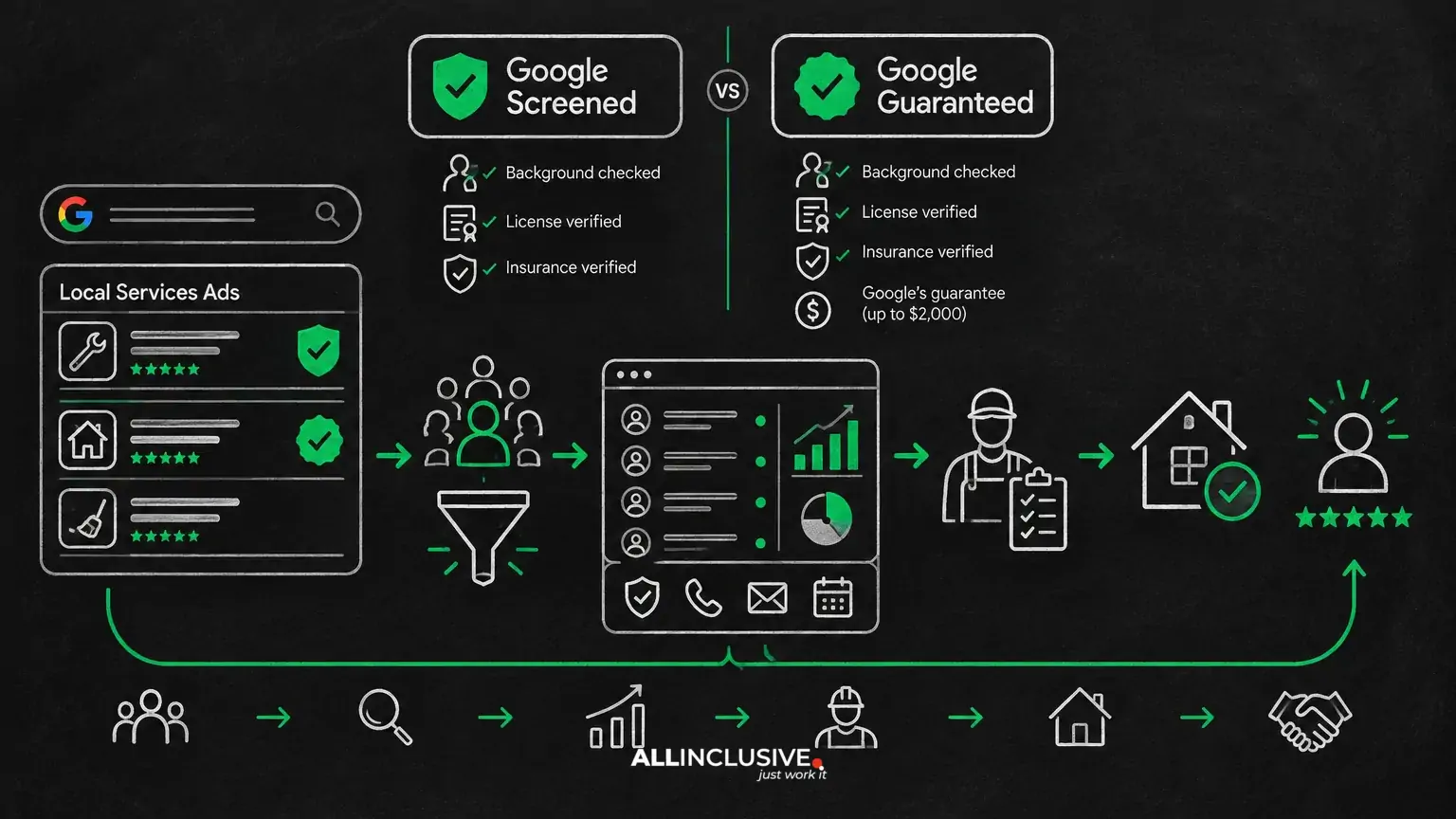
Home services local service ads can put eligible contractors in front of customers who are actively looking for help with a nearby job. But visibility alone does not create a profitable channel. Results depend on category eligibility, service coverage, profile quality, response speed, lead qualification and the economics of each job.
This guide explains how to evaluate Local Services Ads for a home-services business, what can influence ad visibility, how to protect lead quality and how to decide whether the channel belongs in your acquisition mix.
What Local Services Ads are for home-service businesses
Local Services Ads are a Google lead-generation format designed to connect people searching for local services with eligible providers. Depending on the market and service category, the experience may support calls, messages or other lead actions. The exact availability, verification process and features can vary by location and category, so treat Google’s current requirements as the source of truth before launch.
For a home-services company, the key difference from conventional search advertising is the emphasis on provider trust and direct lead actions. A customer may be comparing several plumbers, electricians, roofers, HVAC companies or other providers while facing an urgent problem. The business therefore needs more than an attractive profile: it needs a dependable operating process after the lead arrives.
Local Services Ads sit within a broader paid media strategy. They may complement search campaigns, local SEO, referral programs and remarketing, but they should be measured as a distinct lead source because lead intent, costs and conversion stages can differ.
Which home-service categories may be eligible?
Eligibility is category- and location-dependent. Common home-service groupings can include:
- Plumbing and drain services
- Heating, ventilation and air-conditioning services
- Electrical work
- Roofing, gutters and exterior repairs
- Garage door services
- Appliance repair
- Locksmith services
- Cleaning and maintenance services
- Handyman, remodeling or other property-improvement services
This list is illustrative, not a guarantee of availability. Google may distinguish between closely related services, restrict certain categories, or apply different verification requirements by market. Before building a budget, confirm three things:
- The exact category: Your primary service may not map neatly to the label customers use.
- Your service area: Coverage can depend on the locations you serve and how the profile is configured.
- Your business model: Eligibility and verification may differ for storefront businesses, service-area businesses, franchises and multi-location operators.
If your company offers several services, avoid selecting a broad category merely to increase reach. A category that generates irrelevant calls can reduce efficiency, burden your dispatch team and make performance analysis less useful.
How ranking and visibility should be understood
Google does not provide a simple public formula that lets advertisers calculate Local Services Ads position. It is more useful to think in terms of eligibility, relevance, trust and market conditions than to search for a single ranking lever.
Relevance to the customer’s request
The closer the selected category, service type and coverage are to the customer’s need, the more likely the profile is to be considered relevant. Keep service descriptions accurate and avoid presenting capabilities your team cannot consistently deliver.
Profile completeness and trust signals
Accurate business information, suitable service details, reviews, photos and verification materials can help customers understand and compare providers. These elements are not substitutes for operational quality, but incomplete or inconsistent information can create friction before a customer contacts you.
Location and proximity
Local intent is inherently geographic. The customer’s location, your stated service area and the practical distance to the job can all affect which providers are considered. Do not assume that expanding coverage automatically creates profitable reach; it can also increase travel time and produce leads outside your preferred operating zone.
Responsiveness and lead handling
Fast, reliable responses matter commercially even when a platform’s internal treatment of responsiveness is not fully transparent. Missed calls, delayed callbacks and unworked messages turn paid demand into wasted opportunity. Set ownership for every lead and define what happens when the first contact attempt fails.
Competition and budget conditions
Visibility can change as competitors enter or increase activity, demand shifts seasonally and available lead volume changes. Treat any observed placement as a market outcome, not a permanent entitlement. Monitor performance over enough time to distinguish normal variation from a structural problem.
Build the profile around profitable work
The best profile is not necessarily the one that lists every service. It is the one that attracts jobs your business can serve well and sell profitably.
Start by grouping services into practical business lines:
- Emergency work: urgent calls where response capacity and dispatch speed are critical.
- Routine repairs: defined jobs that can be screened efficiently over the phone.
- Replacement or installation: higher-value work that may require qualification, photos or an in-home estimate.
- Maintenance plans: recurring services that should be assessed on customer lifetime value, not only first-job revenue.
For each group, document the locations served, minimum job requirements, scheduling constraints, exclusions and target customer. Use that information to decide which services belong in the profile and which should be handled through other channels.
Lead economics: measure the job, not just the contact
A Local Services Ads lead is an opportunity, not revenue. A useful measurement model separates the following stages:
- Lead received
- Lead contacted
- Lead qualified
- Appointment or estimate booked
- Job completed
- Revenue collected
- Gross profit or contribution margin
At minimum, calculate:
- Cost per lead: total platform spend divided by received leads.
- Cost per qualified lead: spend divided by leads matching your service, location and job criteria.
- Cost per booked job: spend divided by appointments or jobs booked from the channel.
- Acquisition cost per completed job: spend divided by completed jobs.
Compare those figures with the margin available from the work. A low cost per lead can be misleading if calls are outside the service area, requests work you do not offer or fail to convert because the team cannot respond promptly.
Example: A contractor may accept a high volume of calls, but if many are low-value inquiries or cannot be scheduled within the customer’s timeframe, the channel may look active while producing weak contribution margin. The corrective action may be tighter service targeting and better intake—not simply more budget.
Lead quality controls for home services
Define a qualified lead before launch
Write down the criteria your team will use. A qualified lead might require a supported service, an address within the operating area, a viable job type and a realistic scheduling window. This definition should be consistent enough for staff to apply and specific enough for reporting.
Use a structured intake script
Ask the questions that affect dispatch and value: service needed, symptoms or project scope, property type, location, urgency, access constraints and preferred timing. The script should help the customer rather than create unnecessary friction, especially for emergencies.
Assign ownership and escalation
Determine who answers during business hours, who handles missed calls and how after-hours inquiries are routed. If a lead cannot be answered immediately, define the callback standard and record whether it was met.
Reconcile platform and CRM data
Use consistent source labels and statuses across the ad platform, phone system, CRM and scheduling tool. Review duplicate leads, spam, wrong numbers, existing customers and unbookable requests separately rather than mixing them into one conversion rate.
How to improve performance without chasing volume
- Refine service coverage: Remove services or locations that repeatedly produce poor-fit demand.
- Improve proof: Keep reviews, business details and project imagery accurate and current.
- Protect response capacity: Align active coverage with the hours your team can actually answer and dispatch.
- Review call quality: Listen to a representative sample of calls where permitted and identify recurring qualification failures.
- Close the reporting loop: Import booked and completed outcomes into your operating reports instead of judging the channel by lead count alone.
- Test operational changes first: Before increasing spend, address missed calls, slow callbacks, unclear pricing expectations or weak scheduling availability.
Platform settings can support these improvements, but strategy and operations remain distinct. A profile cannot compensate for insufficient technician capacity, an unclear service offer or a broken follow-up process.
Local Services Ads for Home Services: Mistakes to Watch For
Assuming every inquiry is valuable
Home-service demand can include urgent requests, price shoppers, warranty questions and work outside your capability. Tag these outcomes so the team can improve targeting without dismissing the entire channel.
Expanding geography before validating unit economics
Additional territory may increase lead volume while reducing route efficiency and technician utilization. Evaluate travel time, job density and margin by area.
Managing only to lead volume
High volume can conceal low booking rates or poor job quality. Make qualified and completed outcomes the primary decision points.
Ignoring seasonality
Demand for services such as HVAC, roofing and snow-related work can change with weather and season. Compare like periods where possible and explain unusual demand before changing strategy.
Overpromising services
Inaccurate listings can generate complaints, wasted calls and customer distrust. Market only the services your business is equipped and authorized to provide.
When Local Services Ads may fit your business
The channel is worth investigating when you have a clearly defined service offer, verifiable business information, sufficient response capacity and a way to connect leads to booked and completed jobs. It is less suitable as a standalone solution when the business cannot answer inquiries, has highly irregular coverage or lacks the margin to absorb paid acquisition costs.
Use a staged evaluation:
- Confirm category and market eligibility.
- Define target services, locations and qualified-lead rules.
- Prepare the profile and intake process.
- Set a test budget tied to acceptable acquisition cost.
- Track lead quality, bookings, completed jobs and margin.
- Scale only after operational bottlenecks are addressed.
For a broader financial framework, see how Local Services Ads costs, budgets and lead economics work. If you are still assessing the channel, this ROI framework for deciding whether Local Services Ads are worth it can help structure the decision.
Local Services Ads for Home Services: What to Prioritize
Local Services Ads can be a practical acquisition channel for eligible home-service companies, but ranking is only one part of performance. The stronger approach combines accurate category selection, credible profile information, disciplined geographic targeting, rapid lead handling and outcome-based measurement.
Review the wider Local Services Ads strategy hub for related guidance, then validate current platform requirements for your category and market before committing budget.