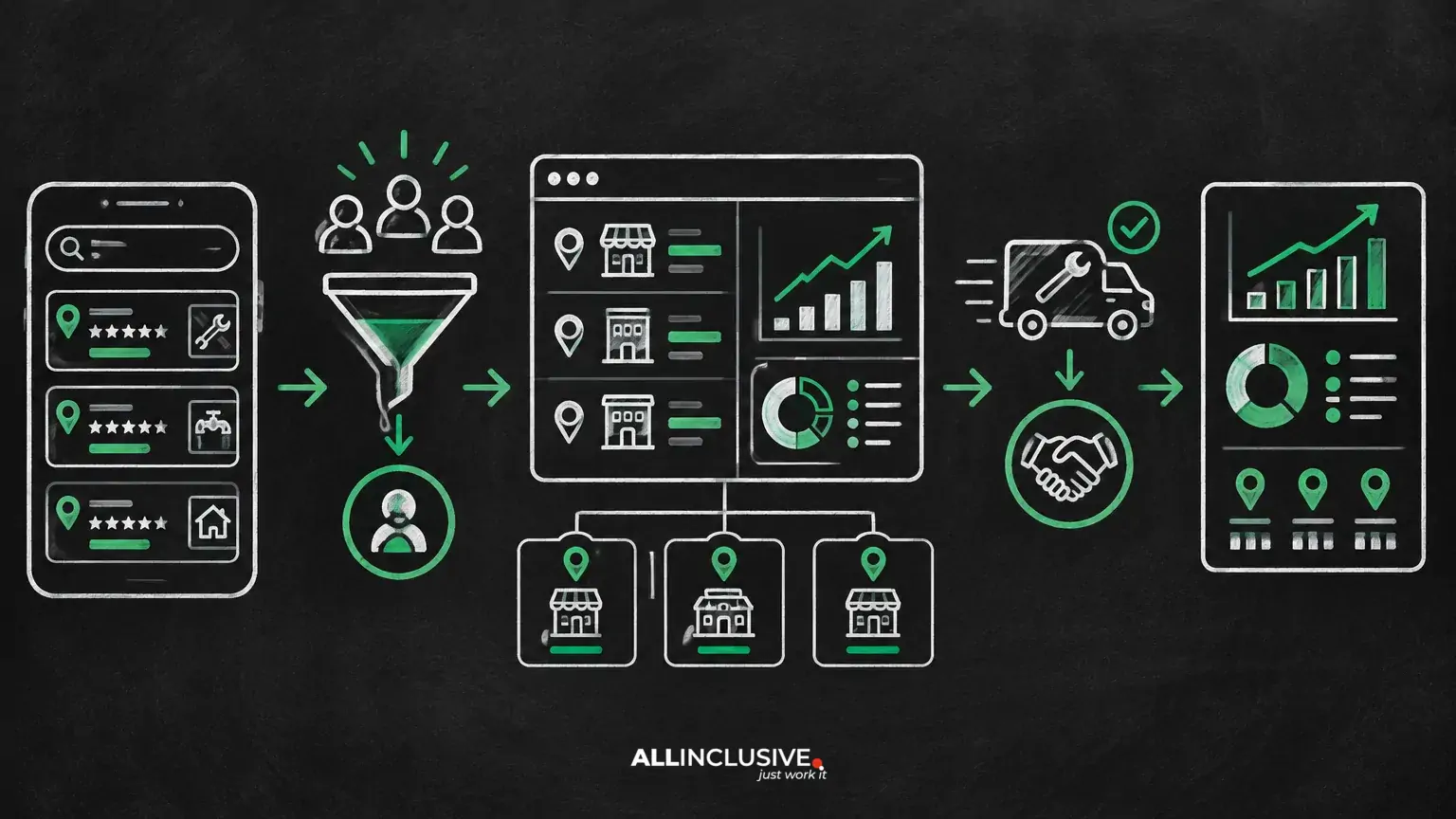
Managing local service ads multi location campaigns requires more than duplicating one account setup across several markets. Each location needs enough local control to protect lead quality, response times, and budget accountability, while leadership still needs a consistent view of total demand and efficiency.
The most reliable approach is to separate three decisions: how locations are represented in the platform, how operating responsibility is assigned, and how performance is reported. The exact account and profile mechanics can vary by market, category, and current platform configuration, so treat the framework below as a governance model rather than a claim about a fixed interface.
What a multi-location structure must accomplish
A sound structure should make it possible to answer five questions without manual reconstruction:
- Which location received the lead?
- Which service or market generated demand?
- Who owns follow-up and scheduling?
- How much budget and lead volume does each location control?
- Which locations are producing qualified opportunities, not merely inquiries?
These questions expose the main trade-off. Excessive centralization makes management simpler but can hide local differences. Excessive fragmentation may improve local visibility while creating inconsistent settings, duplicated work, and weak executive reporting.
Start with operational reality. A location should generally have distinct governance when it has its own service area, phone handling, availability, licensing or eligibility considerations, budget owner, or sales process. If several branches share the same intake team and fulfillment capacity, a more centralized model may be workable, provided the reporting still preserves location-level attribution.
Choose the right operating model
Centralized management
In a centralized model, a corporate or agency team controls strategy, monitoring, budget decisions, and reporting. Local teams provide availability, service information, and lead-quality feedback.
This model suits organizations with a shared contact center, uniform service standards, and centralized finance. Its risk is that local issues can remain hidden. A location may appear efficient at network level while missed calls, capacity constraints, or poor routing reduce its actual value.
Local ownership with central governance
Here, local teams own day-to-day lead handling and market context, while a central team defines naming, measurement, approval, and optimization standards. This is often effective for distributed operators because local managers can respond to real capacity conditions without creating separate measurement systems.
Use written rules for who may change budgets, service coverage, business details, operating hours, or lead-response workflows. Without these controls, local autonomy can produce reporting breaks and inconsistent customer experiences.
Hybrid ownership
A hybrid model assigns strategic decisions centrally and operational decisions locally. For example, central leadership may set target economics and minimum quality standards, while local teams manage availability and escalation handling.
The model is viable only when decision rights are explicit. Document the owner, approver, deadline, and escalation path for each recurring task.
Design the account and location structure
Do not begin by copying campaigns, profiles, or settings. Begin with a location inventory. For every branch or service area, record the business identity, physical presence where relevant, service coverage, phone destination, operating hours, core services, capacity constraints, local owner, and reporting identifier.
Then group locations by operational similarity rather than geography alone. Useful grouping dimensions include:
- Service category and customer need
- Lead-handling process
- Budget ownership
- Availability and capacity
- Regulatory or verification requirements
- Sales pipeline and CRM treatment
Locations that look similar on a map may require different structures if one uses a centralized call center and another relies on a local receptionist. Conversely, locations in different cities may be governed together when they share the same intake and fulfillment model.
Use a naming convention that supports reporting
Names should help operators identify market, location, service category, and status at a glance. A practical convention might include a stable location ID followed by the market and service group. Avoid names based only on street addresses or informal branch nicknames; those often change and make historical reporting harder.
Maintain a separate reference table that maps every platform entity to a durable business identifier. This is especially important when locations open, close, relocate, or change ownership.
Separate structure from targeting assumptions
A location’s administrative representation does not automatically determine the right service coverage or budget. Define service areas from actual fulfillment capability, not from an ambition to capture every nearby inquiry. Review overlap between adjacent locations carefully. If multiple branches can serve the same customer, establish a lead-routing rule before increasing coverage.
Build a local lead-routing and ownership system
Structure alone does not create accountability. Every lead should have a defined destination and a fallback path. At minimum, document:
- Primary receiving team or location
- Backup recipient when the primary team is unavailable
- Expected response process
- Rules for shared or overlapping service areas
- Method for marking spam, duplicates, out-of-area requests, and unqualified inquiries
- Escalation path for missed calls or delayed follow-up
Keep the routing design separate from performance evaluation. A location may receive lower lead volume because its service area is narrower, not because the campaign is underperforming. Similarly, a high lead count may reflect broad coverage rather than strong commercial value.
For organizations with centralized intake, create a location attribution field that survives transfer to the sales team. For organizations with local intake, require a consistent outcome taxonomy so that results can be aggregated later.
Report at three levels
Multi-location reporting should support different decisions at different levels. Combining everything into one total can hide underperformance; reporting only by branch can prevent leadership from seeing network economics.
Network level
Leadership reporting should summarize total spend, lead volume, qualified lead volume, booked opportunities, and downstream revenue when available. Include major changes in coverage, budget, operating hours, and lead-handling policy so that period comparisons have context.
Location level
Branch or market reporting should show delivery, lead quality, response performance, and capacity. Recommended fields include:
- Spend or budget allocation
- Leads by source and type
- Qualified, duplicate, spam, and out-of-area classifications
- Booked appointments or opportunities
- Contact rate and response-time indicators, where reliably captured
- Conversion or revenue outcomes, where available
- Operational notes such as closures, staffing gaps, or service restrictions
Service and cohort level
When locations offer multiple services, aggregate by service category as well as branch. This helps distinguish a location problem from a service-mix problem. Cohort views can also compare newly launched locations with mature locations, but avoid treating early data as a definitive efficiency benchmark.
For a broader measurement framework, review the paid media strategy resources and align Local Services Ads reporting with other acquisition channels rather than evaluating it in isolation.
Define the metric hierarchy before optimizing
Use a metric hierarchy that moves from delivery to business value:
- Delivery: visibility, spend, and lead volume.
- Lead quality: valid, relevant, serviceable, and contactable inquiries.
- Sales progression: appointments, estimates, opportunities, or completed jobs.
- Economic value: revenue, margin, customer value, or another approved commercial measure.
This hierarchy prevents a common mistake: reallocating budget solely toward locations with the lowest apparent cost per lead. A cheaper inquiry is not necessarily a better opportunity. Compare like with like, and record when a location has materially different services, coverage, capacity, or close rates.
If the sales system cannot yet pass revenue data back into reporting, use a carefully defined interim quality status. State what the status means and who is responsible for updating it. Do not present proxy metrics as revenue performance.
Set allocation and pacing rules
Budget should reflect both demand opportunity and fulfillment capacity. Establish a base operating level for locations that must remain visible, then define conditions for increasing or reducing allocation. Possible decision inputs include qualified lead volume, appointment capacity, response performance, close rate, service margin, and current backlog.
Use guardrails to prevent a strong-performing location from absorbing budget it cannot serve. Likewise, avoid starving a newer location before it has enough valid data to assess. Any test should specify its objective, duration or review point, success criteria, and rollback condition.
Budget changes should be logged with the reason, date, owner, and expected effect. This simple discipline makes later analysis more reliable and helps explain apparent performance changes.
Audit data quality and lead quality together
A multi-location dashboard can look precise while still being operationally wrong. Schedule regular checks for:
- Location identifiers and naming consistency
- Phone numbers, intake destinations, and call tracking continuity
- Duplicate or misclassified leads
- Service-area overlap and out-of-area inquiries
- Closed, relocated, or temporarily unavailable locations
- Missing downstream statuses
- Differences between platform totals, CRM records, and finance reporting
Use a shared definition of a qualified lead. If each branch applies its own standard, location comparisons become unreliable. A useful audit should examine both the platform setup and the business process that follows the lead. The Local Services Ads audit guide provides a complementary checklist for reviewing cost, lead quality, and operational controls.
Use local optimization without losing network control
Local optimization should focus on factors the location can influence: availability, service accuracy, response handling, customer feedback processes, and lead disposition quality. Central teams should look for repeated patterns across locations and turn them into shared operating improvements.
For a broader set of improvement ideas, see Local Services Ads optimization guidance. Keep this multi-location framework distinct: its purpose is not to list every platform optimization, but to connect local execution with governance and reporting.
When a location underperforms, diagnose before changing budget. Ask whether the issue is demand, eligibility, coverage, lead handling, service fit, capacity, tracking, or sales conversion. A campaign adjustment cannot repair a broken routing process or an unresponsive phone queue.
Local Services Ads for Multi-Location Businesses: Implementation Checklist
- Create a complete location and service inventory.
- Assign a durable identifier to every location.
- Choose centralized, local, or hybrid ownership.
- Document routing, fallback handling, and service-area overlap rules.
- Apply consistent naming and status conventions.
- Define network, location, and service-level reporting views.
- Agree on lead-quality and downstream outcome definitions.
- Set budget guardrails based on both economics and capacity.
- Log material changes and operational exceptions.
- Review data quality, lead quality, and follow-up performance on a recurring schedule.
Local Services Ads for Multi-Location Businesses: Strategic Perspective
The best structure for Local Services Ads across multiple locations is the one that preserves local accountability without sacrificing comparability. Platform setup matters, but governance matters just as much: stable identifiers, clear decision rights, consistent lead definitions, and reporting that connects inquiries to commercial outcomes.
Before expanding coverage or reallocating budget, make sure the organization can explain where every lead went, how it was handled, and what happened next. That foundation makes optimization more credible and gives leadership a clearer basis for investment decisions.
For the broader channel context, explore the Local Services Ads pillar alongside the wider paid-media framework.