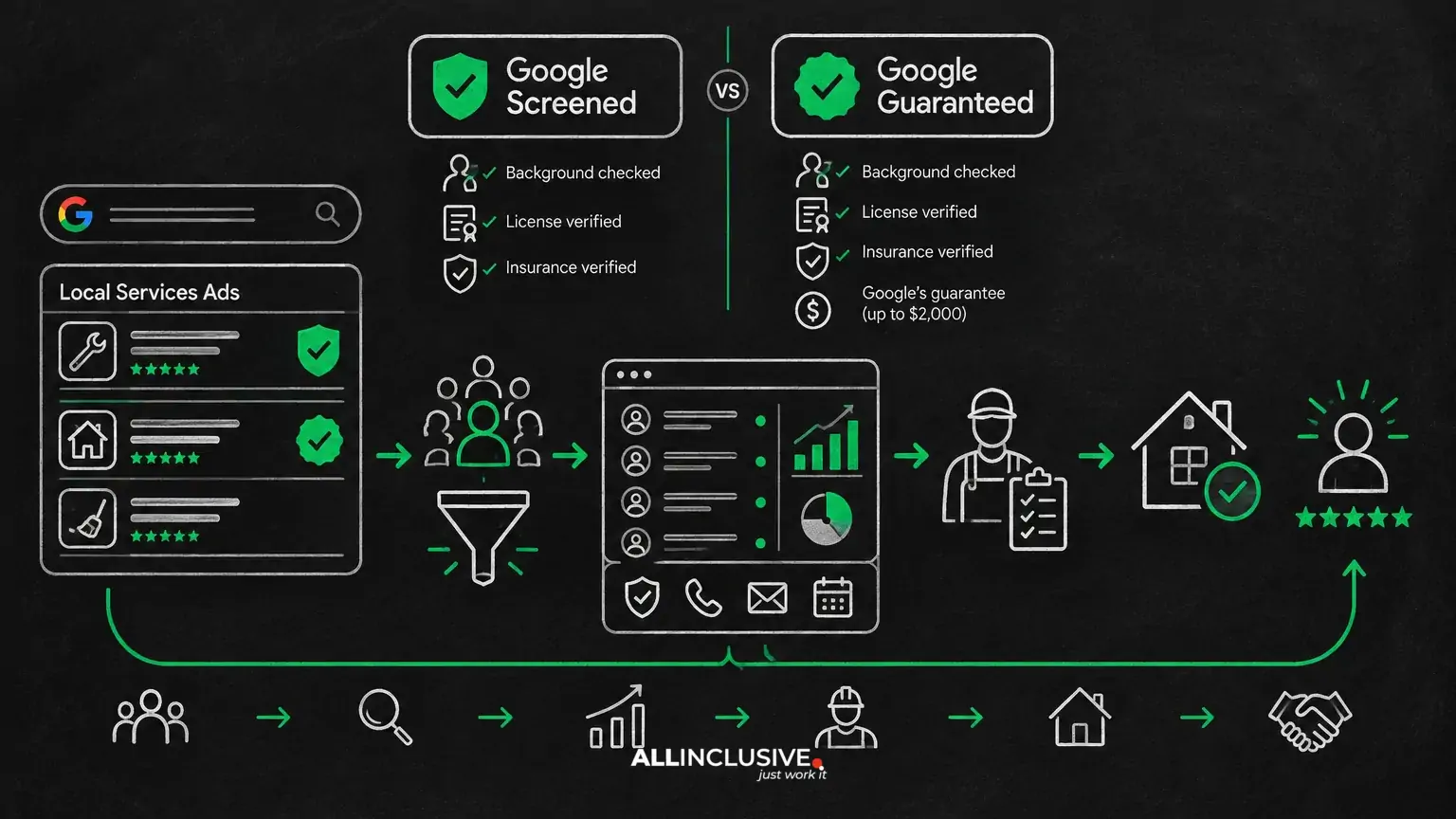
Choosing a local service ads marketing agency is less about finding someone who can launch a profile and more about evaluating how the partner manages lead quality, budget control, business operations and accountability over time. Local Services Ads can place eligible businesses in a high-intent search environment, but performance depends on more than visibility.
This guide explains what an agency should manage, how common fee structures work, what reporting should include and when outsourcing is likely to be worthwhile. It is intended for businesses comparing providers—not as a replacement for a platform eligibility review or a tailored acquisition strategy.
What a Local Services Ads marketing agency should actually manage
Agency scopes vary significantly. A credible proposal should separate setup work from recurring management and identify which tasks remain with the client.
Account and profile setup
Initial work may include reviewing service areas, business information, service categories, hours, photos, licenses or other required documentation, and the profile’s connection to the operating business. The agency should explain which information it needs from you and how it will verify that the setup reflects the services you genuinely provide.
Setup should also include tracking decisions. Before leads arrive, agree on how calls, messages, booked appointments and qualified opportunities will be recorded. Without that foundation, an agency may optimize for lead volume while the business experiences little commercial value.
Budget and lead management
Recurring management should cover spend pacing, lead flow and changes to targeting or service coverage where the platform allows them. An agency should not promise a fixed number of leads without understanding market demand, eligibility, geography, competition, seasonality and the client’s capacity to respond.
A useful operating plan defines:
- the approved weekly or monthly spend range;
- the desired lead types and services;
- acceptable service areas and scheduling constraints;
- who reviews disputed or irrelevant leads;
- what conditions trigger budget changes.
Lead-quality review
Lead handling is one of the most important differences between basic administration and serious management. The agency should establish a classification system such as valid inquiry, wrong service, outside area, duplicate, spam, existing customer or qualified opportunity.
Reviewing call recordings or message details may help identify patterns, subject to applicable privacy, consent and access requirements. The goal is not simply to count contacts. It is to determine whether the campaign is producing opportunities the business can serve profitably.
Conversion and operations support
Marketing performance can be limited by slow response times, missed calls, unclear availability or inconsistent intake questions. An agency may not operate your phones or CRM, but it should identify operational issues that affect lead outcomes and recommend practical changes.
For example, a business could receive relevant inquiries but lose bookings because calls route to an unattended line. In that case, changing media settings alone is unlikely to solve the problem.
What does a Local Services Ads agency cost?
There is no universal agency fee for Local Services Ads management. Pricing depends on the account’s complexity, the number of service areas, reporting requirements, lead volume, integration needs and whether the agency supports related paid-media activity.
Common commercial models include:
- Fixed monthly fee: A recurring amount for an agreed scope of setup, optimization and reporting. This is usually straightforward to budget for, but the scope should state how much ongoing analysis and client support is included.
- Percentage of media spend: The management fee rises or falls with advertising spend. Ask whether there is a minimum fee and whether the percentage applies only to platform spend or also to other services.
- Lead-based pricing: The client pays according to a defined lead volume or lead event. The contract must clarify what counts as a lead, how invalid contacts are handled and whether the agency controls the underlying spend.
- Hybrid pricing: A fixed base fee combined with a variable component for spend, lead volume or additional services.
The cheapest proposal is not necessarily the lowest-cost option. Compare the total commercial model with the value of qualified opportunities, internal time required, reporting quality and contract flexibility. A low fee with limited lead review may be more expensive than a higher fee that helps reduce wasted spend and exposes operational problems.
Questions to ask before hiring an agency
Use the sales process to test how the agency thinks. Strong providers should be willing to discuss uncertainty, measurement limitations and client responsibilities.
- What exactly is included each month? Request a written list covering optimization, lead review, reporting, meetings, testing and support.
- How do you define a qualified lead? The answer should reflect your services, geography and commercial process rather than a generic contact count.
- How will you handle irrelevant or disputed leads? Ask who documents them, what evidence is retained and how the information informs future management.
- What access will we have? Confirm that the business can review the relevant account, lead records and reporting rather than relying only on screenshots or summary claims.
- How do you handle changes in budget or demand? Look for a clear approval process and realistic discussion of capacity, seasonality and market conditions.
- What does the client need to do? Clarify responsibility for calls, booking, licenses, business information, service-area decisions and feedback on lead quality.
- What is the cancellation and handover process? Make sure you understand notice periods, ownership of data and what happens to access when the relationship ends.
Reporting standards for Local Services Ads management
A monthly report should help a decision-maker answer three questions: what happened, why it happened and what will change next. A list of impressions or contacts alone is not enough.
Core delivery metrics
Depending on available account data and the agreed measurement setup, reporting may include spend, lead volume, lead type, service category, geography, missed calls, response status and appointment outcomes. Agencies should identify the source of each metric and distinguish platform-reported figures from CRM or sales data.
Quality and commercial metrics
Where the client can provide reliable downstream data, reporting should connect leads to useful business outcomes such as contacted leads, booked estimates, completed jobs, revenue or pipeline value. These measures can be incomplete when sales cycles are long, attribution is shared across channels or CRM processes are inconsistent, so the limitations should be documented.
Action-oriented commentary
Every report should include interpretation. Examples of useful commentary include:
- lead volume increased after a service-area change, but outside-area inquiries also rose;
- call volume was stable while booked appointments declined, suggesting a response or qualification issue;
- one service category generated more inquiries but fewer commercially relevant opportunities;
- spend pacing requires review because capacity is temporarily limited.
The report should finish with specific next actions, owners and timing. This creates an operating record instead of a retrospective dashboard.
How agency strategy differs from platform mechanics
An agency can make strategic decisions about positioning, budget allocation, lead qualification, business processes and measurement. It cannot guarantee that a platform will deliver a particular placement, lead volume or cost per opportunity.
Platform mechanics and eligibility requirements can change. Treat claims about verification, service coverage, lead handling, bidding, ranking or dispute processes as items to confirm against current official documentation and the account’s actual options. A responsible agency should avoid presenting platform behavior as fully controllable.
For broader context on how this channel fits into a full acquisition program, see Allinclusive’s paid media resources. For channel-specific planning, review the Local Services Ads guide.
When should you hire an agency?
Outsourcing is most defensible when the business has enough lead volume or geographic complexity to justify structured management, but not enough internal time or expertise to perform it consistently. It may also make sense when lead quality is unclear, reporting is fragmented or multiple locations require coordinated oversight.
In-house management can be practical when one accountable operator can monitor leads frequently, maintain accurate business information, analyze outcomes and communicate changes quickly. The decision should be based on operating requirements, not the assumption that an agency automatically improves performance.
Before signing, compare the agency’s proposed scope with the management work your team can realistically complete. The relevant question is not simply whether the provider can generate contacts. It is whether the partnership creates a repeatable process for attracting, evaluating and converting service inquiries.
How this article differs from other Local Services Ads resources
If you are evaluating the day-to-day work after selecting a provider, see Local Services Ads Management: Weekly Operating Checklist. If you need a broader comparison of what agency management should include, read Local Services Ads Agency: What Management Should Actually Include.
Those resources address operating cadence and management scope in greater detail. This article is focused on the commercial decision: comparing agency services, fee structures and reporting before you engage a partner.
Final evaluation checklist
- Is the scope specific about setup, recurring management and reporting?
- Does the agency define qualified leads for your business?
- Can it connect platform activity to sales or booking outcomes where data permits?
- Are client responsibilities and response expectations documented?
- Is the fee model transparent, including minimums and additional charges?
- Does the contract address access, data ownership, cancellation and handover?
- Does the proposal acknowledge platform and market uncertainty rather than promising fixed results?
The strongest agency relationship is built on shared visibility and clear decisions. Choose a provider that can explain not only how it will manage the channel, but also how both sides will determine whether the investment is producing useful business opportunities.