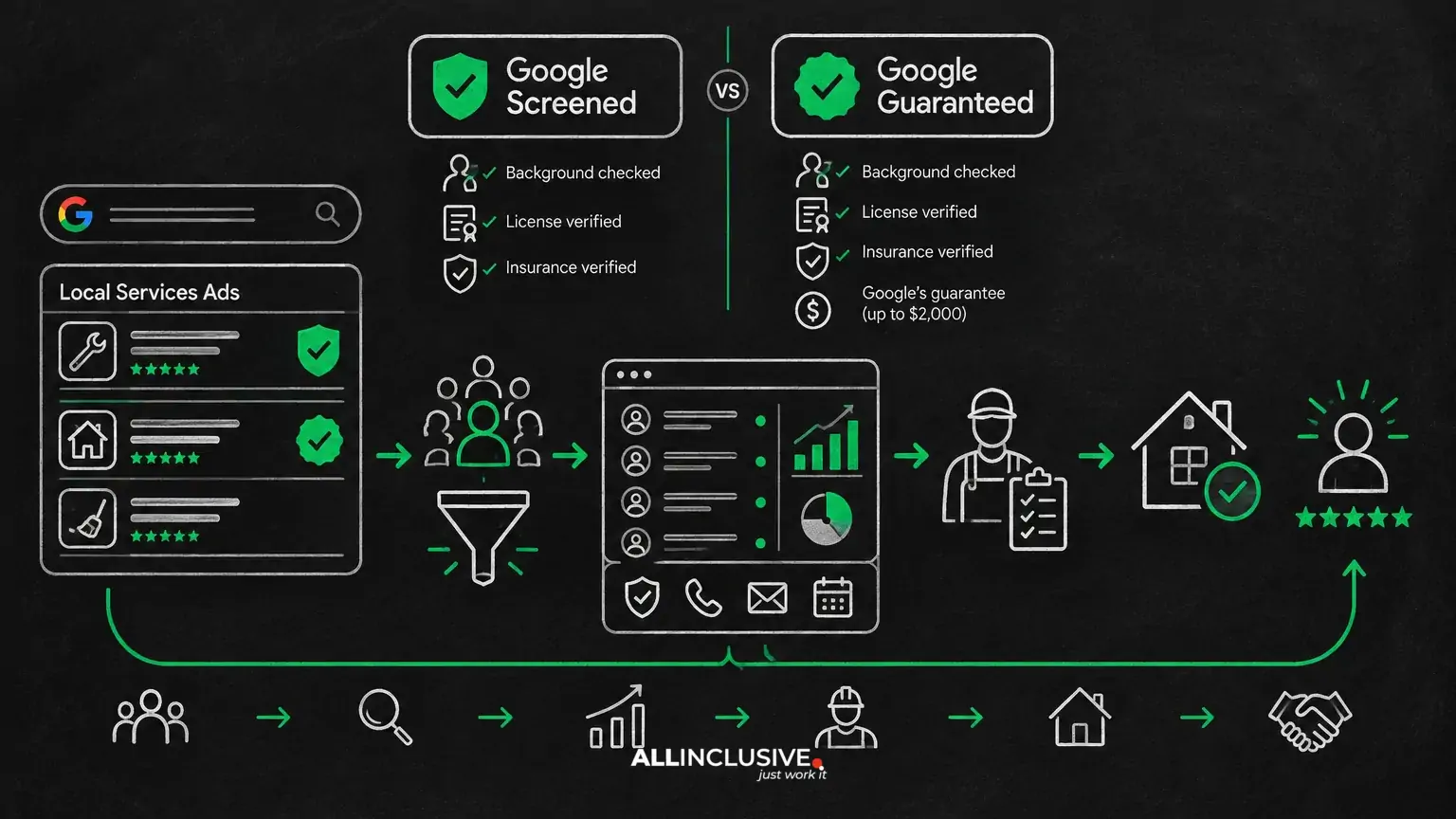
A local service ads agency should do more than turn on a campaign and forward lead notifications. Effective management connects eligibility, profile quality, budget decisions, lead qualification, response speed, and business outcomes.
That distinction matters because Local Services Ads sit close to the customer’s decision point. A lead may arrive as a phone call or message, but the advertising result is not complete until the business can assess the opportunity, respond promptly, schedule the work, and understand whether the lead became revenue.
This guide explains what professional management should include and how to compare agencies without confusing platform administration with a complete acquisition process.
What a Local Services Ads agency should actually manage
Agency scopes vary, but a credible engagement should cover five connected areas:
- Account and profile readiness: service areas, business information, category choices, photos, credentials, and other available profile elements.
- Lead generation controls: budget planning, job types, locations, and operating hours aligned with actual capacity.
- Lead quality operations: call and message handling, qualification, dispute processes where applicable, and feedback collection.
- Measurement: lead volume, lead source, response activity, booked work, revenue, and unresolved data gaps.
- Commercial improvement: recommendations based on capacity, close rates, margins, seasonality, and service priorities.
The strongest programs treat Local Services Ads as one part of a wider paid media operating system, not as an isolated listing.
1. Initial audit and eligibility review
Before making budget recommendations, an agency should establish whether the account and business are prepared to participate effectively. The review should be specific to the company’s services, locations, operating model, and ability to respond.
Key audit questions
- Is the business information consistent across customer touchpoints?
- Are the selected services and locations commercially relevant?
- Can the business answer calls or respond to messages during advertised hours?
- Are required credentials, licenses, insurance details, or verification materials current where applicable?
- Does the profile accurately describe the work the business wants to sell?
- Are there operational limits, such as technician availability or restricted service zones?
Platform eligibility and verification requirements can change by market, category, and account status. An agency should confirm current requirements through the applicable platform workflow rather than promise approval or imply that every business qualifies.
2. Profile and service positioning
Profile management is not simply a copywriting exercise. The goal is to make the business easy to understand and credible to a potential customer while keeping the information accurate.
An agency may help organize service descriptions, business details, images, service areas, and trust signals. It should also identify mismatches between the profile and the actual operation. For example, a company that advertises emergency availability but cannot reliably answer after hours may generate demand it cannot convert.
Good positioning answers practical customer questions:
- What type of work does the business perform?
- Which customers or properties does it serve?
- Where does it operate?
- When can it respond?
- What should a customer expect after making contact?
Agencies should not encourage unsupported claims, misleading guarantees, or service descriptions that attract inquiries outside the company’s capabilities.
3. Budget and lead-volume planning
A management partner should translate business capacity into a controlled testing and scaling plan. That does not require promising a fixed number of leads. Lead volume and cost can vary with geography, category, competition, demand, profile strength, operating hours, and customer response.
A useful planning conversation starts with business economics:
- Define the services and jobs the company wants to win.
- Estimate the value and gross margin of an acceptable customer.
- Document historical contact-to-booking and booking-to-completion rates, if available.
- Set a maximum tolerable acquisition cost based on those economics.
- Choose an initial spend level that the business can answer, sell, and fulfill.
- Review performance on a defined cadence before making material changes.
Budget management should include controls for periods when the company is fully booked, understaffed, closed, or unable to serve a location. Increasing spend while the sales team cannot respond is not optimization.
For a deeper planning framework, see Local Services Ads Budget: How to Set Weekly Spend and Lead Targets.
4. Lead quality and dispute processes
Lead count alone is an incomplete performance measure. A management team should help classify incoming contacts so the business can distinguish genuine opportunities from poor-fit, duplicate, irrelevant, or otherwise unusable inquiries.
A practical lead classification model
- Qualified: the customer needs a service the business provides in a serviceable location.
- Unqualified: the request is outside the company’s services, location, schedule, or customer type.
- Invalid: the contact is unusable, such as a clear spam inquiry or wrong-number call.
- Pending: the team has not yet determined the outcome.
- Booked or completed: the lead progressed into a scheduled or delivered job.
The exact definitions should match the business model. A residential plumber, legal practice, and commercial contractor will not evaluate lead quality in the same way.
Where the platform provides a process for reviewing or disputing certain leads, an agency can help document the issue and submit accurate feedback. It should not promise that every disputed contact will be credited or that platform decisions can be controlled.
5. Call and message handling coordination
Local Services Ads performance is heavily influenced by what happens after the contact arrives. An agency may not operate the client’s phones, but management should expose weaknesses in the handoff and recommend practical fixes.
At minimum, the operating process should define:
- Who owns incoming calls and messages during each operating period.
- How missed calls are returned and how quickly.
- What information staff should collect during qualification.
- Which jobs should be declined or routed elsewhere.
- How appointments, estimates, and follow-ups are recorded.
- How final outcomes are sent back into reporting.
For businesses with multiple locations or teams, ownership should be explicit. A lead that is technically generated but never assigned is not a successful acquisition event.
6. Reporting that supports decisions
A monthly screenshot of spend and leads is rarely enough for management. Reporting should answer what happened, why it happened, and what should change next.
Recommended reporting layers
- Delivery: spend, contacts, contact type, and relevant account status.
- Quality: qualified contacts, invalid or poor-fit inquiries, and recurring quality patterns.
- Sales: response status, appointments, estimates, booked jobs, and completed work where data is available.
- Economics: cost per qualified lead, cost per booked job, and revenue or margin indicators when reliably tracked.
- Action plan: budget, profile, service, location, staffing, or follow-up changes for the next period.
If revenue data is unavailable, the agency should say so clearly and identify the minimum tracking process needed to improve decision quality. It should not fill gaps with assumptions presented as facts.
7. Testing and optimization without random changes
Optimization should follow a hypothesis. Examples include testing whether a narrower service focus improves lead relevance, whether operating hours match response capacity, or whether a budget adjustment is appropriate during a known demand period.
Because several factors can change at once, the agency should document material changes and allow enough time or volume to interpret the result responsibly. A sudden increase or decrease in leads does not, by itself, prove that a single setting caused the outcome.
Useful optimization questions include:
- Are leads coming from the services the business values most?
- Are location settings aligned with actual service coverage?
- Is the business missing contacts because of staffing or routing issues?
- Are low-quality contacts concentrated in a specific service or area?
- Does the current budget fit available sales and fulfillment capacity?
How Local Services Ads management differs from broader paid search
Traditional search advertising often centers on keywords, ad groups, landing pages, bids, and conversion actions. Local Services Ads management includes some adjacent strategic concerns, but the operating model is different. The agency must account for profile trust, direct contact handling, service eligibility, geographic coverage, lead classification, and offline outcomes.
That does not make one channel universally better than the other. The appropriate mix depends on the service, customer journey, location, urgency, capacity, and measurement system. A local service ads agency should explain how the channel fits the wider acquisition plan rather than recommend it as a default.
Questions to ask before hiring an agency
Use the following questions to compare scope and accountability:
- What will you manage directly, and what remains the client’s responsibility?
- How will you assess whether our services, locations, and capacity are aligned?
- How do you classify qualified, unqualified, invalid, booked, and completed leads?
- What data do you need from our CRM, call tracking, or booking system?
- How do you handle poor-fit contacts and platform review processes?
- What will reporting include beyond spend and lead count?
- How often will we review performance and make changes?
- How do you prevent budget from exceeding our ability to respond or fulfill work?
- What assumptions would limit the accuracy of your recommendations?
Clear answers are more valuable than a long list of platform features. The agency should be able to connect its work to the client’s sales process and explain where measurement remains incomplete.
When an agency may not be the right next step
Management support may be premature if the business has no reliable way to answer leads, does not know which services it wants to prioritize, cannot serve the advertised area, or has no process for recording outcomes. In those cases, operational readiness may be the higher-leverage investment.
An agency can help create that structure, but advertising cannot compensate indefinitely for unavailable staff, unclear service boundaries, or weak follow-up.
Local Services Ads Agency: Decision Summary
The right Local Services Ads agency manages more than visibility. It builds a process connecting profile accuracy, budget discipline, lead quality, response operations, reporting, and commercial decisions.
When comparing providers, look for a documented operating model rather than a promise of guaranteed lead volume. The best fit is the partner that can explain what it controls, what it needs from your team, how it will measure quality, and how recommendations will change as the business learns.
For foundational context before comparing management approaches, visit the Local Services Ads guide. You can also review the practical Local Services Ads Management: Weekly Operating Checklist.