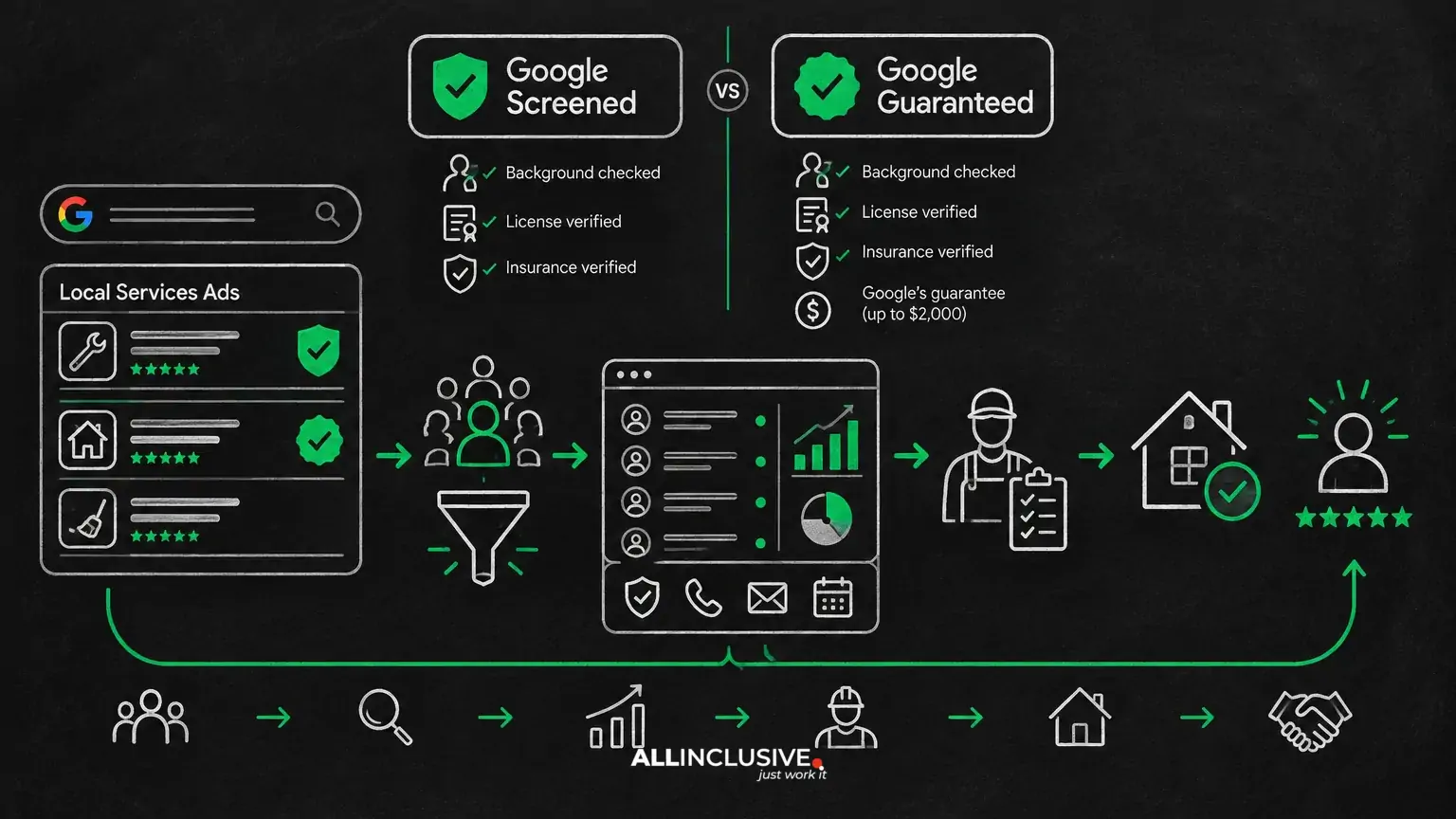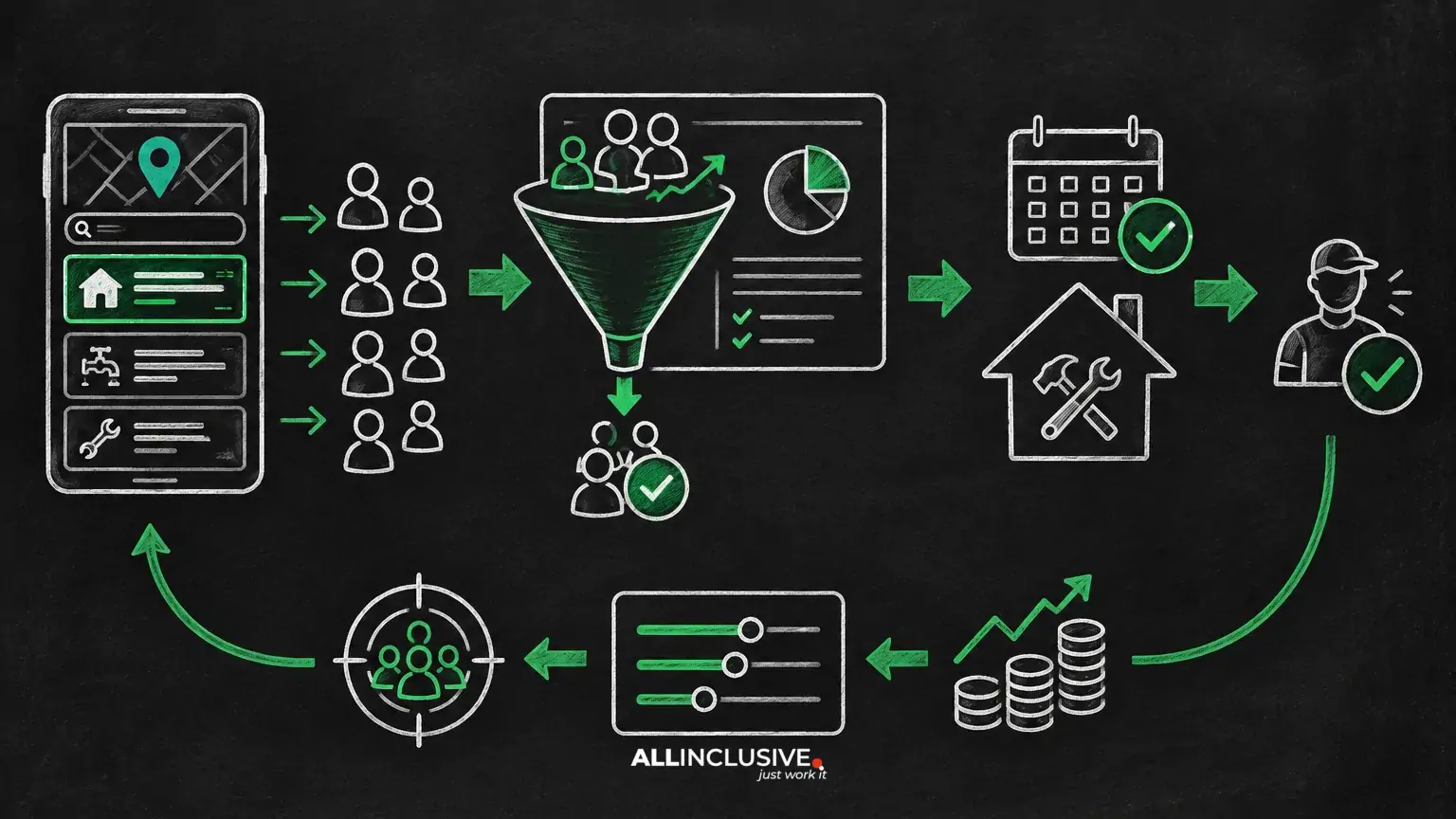
A workable local service ads budget starts with business capacity—not with an arbitrary daily limit. The right budget should connect three decisions: how many qualified leads your team can handle, what a qualified lead is worth, and how much demand the market can realistically provide.
Local Services Ads can support high-intent lead generation, but spend alone does not guarantee the right calls or messages. Your budget needs operating rules for lead quality, response speed, service area, scheduling capacity, and measurement. This guide shows how to build those rules and turn them into a practical weekly plan.
Start with capacity, not platform spend
Before choosing a number, estimate how many new opportunities your business can process without degrading the customer experience. Consider:
- Available appointment slots by week
- Technician, crew, or practitioner capacity
- Service areas you can reliably cover
- Maximum call and message volume your team can answer
- Seasonal constraints, staffing gaps, and existing demand sources
For example, a plumbing company with capacity for 20 additional booked jobs should not automatically fund enough advertising to generate 50 inquiries. The excess may produce missed calls, slower follow-up, weaker reviews, and wasted spend. A smaller budget that the team can actively work may create more value than a larger budget that overwhelms operations.
Define the lead target in business terms
“Leads” are not always the right planning unit. Separate the stages that matter to revenue:
- Raw inquiries: calls or messages attributed to the campaign.
- Qualified leads: inquiries that match the service, location, timing, and customer profile you want.
- Booked appointments: qualified opportunities that accept a scheduled next step.
- Completed jobs: appointments that turn into delivered work.
- Profitable customers: completed jobs after labor, materials, discounts, and acquisition costs.
Your weekly target should identify which stage you are optimizing. A target of 15 inquiries is not equivalent to a target of 15 booked jobs. If the business needs eight completed jobs, work backward through its own historical conversion rates rather than assuming every inquiry has equal value.
Use a simple budget model
A useful starting model is:
Weekly budget = target qualified leads × acceptable cost per qualified lead
If your planning target is based on booked jobs, expand the equation:
Weekly budget = target booked jobs ÷ lead-to-booking rate × acceptable cost per qualified lead
These are planning formulas, not guarantees. Your inputs should come from your own account and sales records whenever possible. If you do not yet have reliable data, use a controlled test budget and label the assumptions clearly.
For instance, suppose a business wants 10 qualified leads per week and is willing to pay $45 for each. The initial planning budget would be $450 per week. If 40% of qualified leads become booked appointments, the same plan implies roughly four booked appointments. The business can then compare actual results against capacity and profit requirements.
Do not confuse an acceptable cost per lead with a profitable acquisition cost. A lead may be inexpensive but commercially weak. The better question is whether the resulting jobs produce an acceptable contribution after fulfillment costs.
Calculate an economically defensible lead value
To set a rational ceiling, estimate the value of a new customer:
- Average revenue from the initial job
- Gross margin after direct delivery costs
- Expected repeat or referral value, if it can be supported by your records
- Close rate from qualified lead to completed job
- Maximum share of contribution you are willing to allocate to acquisition
For example, if a qualified lead produces a completed job at a known rate, you can estimate expected contribution per lead. That figure gives you a ceiling for acquisition cost. Keep the calculation conservative: projected lifetime value should not be used to justify current spend unless retention and repeat behavior are demonstrable.
Set a weekly budget with guardrails
Weekly planning is usually more useful than treating the account as an always-on faucet. Create a budget with explicit guardrails:
- Base budget: the amount approved for normal demand generation.
- Capacity ceiling: the maximum spend you can support without exceeding operational limits.
- Quality floor: the minimum acceptable share of qualified inquiries.
- Escalation rule: the evidence required before increasing spend.
- Reduction rule: the conditions that trigger a pause, adjustment, or investigation.
These rules prevent emotional decisions after one unusually strong or weak day. They also create a clear distinction between a budget problem and a conversion or service-quality problem.
Choose the right budget for your demand stage
New or unmeasured accounts
Start with a controlled amount that the team can answer and evaluate. The objective is not immediate scale; it is establishing a baseline for inquiry volume, qualification, response time, booked work, and cost. Keep service coverage focused enough that lead quality can be interpreted.
Stable accounts
Once you have a meaningful operating history, compare weekly spend with qualified leads, booked appointments, completed jobs, and revenue. Increase budget only when additional capacity exists and quality remains acceptable. A stable account benefits from consistent measurement more than frequent budget changes.
Capacity-constrained accounts
If the business is already near its appointment limit, the best budget may be flat or lower. Shift attention toward service mix, scheduling efficiency, lead screening, and higher-value jobs. More demand is not automatically better demand.
Separate budget decisions from lead-quality decisions
A high inquiry count can conceal poor targeting or weak fit. Review lead quality using a consistent classification:
- Correct service requested
- Customer located within the serviceable area
- Reasonable project or job fit
- Actionable contact information
- Appointment potential
- Duplicate, spam, vendor, employment, or irrelevant inquiry
Record the reason for disqualification rather than marking every weak lead as simply “bad.” Patterns can reveal whether the issue is geographic coverage, service positioning, customer expectations, call handling, or campaign settings. For broader optimization guidance, see Local Services Ads Optimization: 15 Ways to Improve Lead Quality.
Build a weekly reporting view
A budget review should connect media data to sales operations. At minimum, track:
- Spend and attributed inquiries
- Cost per inquiry
- Qualified-lead rate
- Cost per qualified lead
- Speed to answer and follow up
- Booked appointments
- Completed jobs
- Revenue or contribution where available
Review the same date range across sources and document changes to service areas, hours, staff availability, pricing, promotions, and tracking. Without this context, a budget increase may appear to fail when the actual cause was a staffing shortage or a change in qualification.
Know when to increase spend
Increase weekly spend when the following conditions are broadly true:
- The business can handle more qualified opportunities.
- Response and follow-up processes are functioning consistently.
- Lead quality meets the agreed threshold.
- Booked and completed-job economics remain acceptable.
- The added demand can be measured separately from unrelated changes.
Make increases in controlled steps rather than changing several variables at once. If you raise spend, expand coverage, alter services, and change the sales process simultaneously, you may not know what caused the result.
Know when to reduce or pause spend
Lower or pause spend when the account is producing demand the business cannot serve, when qualified-lead cost exceeds the economic ceiling for a sustained period, or when tracking and lead handling are unreliable. Also investigate recurring irrelevant inquiries before assuming more budget will solve the problem.
A temporary reduction is not necessarily a failure. It can protect profitability while the business corrects service coverage, staffing, response processes, or offer positioning.
Account for seasonality without overreacting
Many local services experience demand changes tied to weather, holidays, maintenance cycles, emergencies, and local events. Use prior business data where available, but avoid treating a single week as a seasonal law. Compare like periods, document operational conditions, and keep enough flexibility to respond to real capacity changes.
Seasonality can justify a different budget, but it does not remove the need for quality controls. A peak period may produce more inquiries while also creating slower response times and lower close rates.
Coordinate Local Services Ads with other channels
Budget should be evaluated across the full acquisition system, not in isolation. Local Services Ads may capture urgent, high-intent demand, while Google Ads can support additional search coverage and remarketing strategies where appropriate. The decision depends on service category, eligibility, competition, tracking, and operational capacity. See Local Services Ads vs. Google Ads: When to Use Each Channel for a channel-level comparison.
Local SEO may build durable visibility over a longer horizon, while paid lead channels can provide more immediate testing and demand capture. These channels should have distinct goals and measurement rather than being forced into one blended target. For context, compare Local Services Ads vs. Local SEO: Short-Term Leads vs. Long-Term Demand.
A practical weekly decision checklist
- Confirm the approved weekly budget and service capacity.
- Review spend, inquiries, qualified leads, bookings, and completed work.
- Classify lead-quality failures by cause.
- Check response speed, missed calls, and follow-up completion.
- Compare actual cost per qualified lead with the economic ceiling.
- Identify any changes in services, hours, geography, staffing, or pricing.
- Choose one action: maintain, increase, reduce, or pause.
- Document the decision and the evidence supporting it.
Final framework
The best local service ads budget is not the largest amount the platform can spend. It is the amount that creates enough qualified opportunities for the business to convert and fulfill profitably. Start with capacity, set a lead target, calculate an economically defensible cost ceiling, and review the complete path from inquiry to completed job.
For businesses building a broader acquisition plan, our Local Services Ads resource provides additional strategic context. You can also explore our wider paid media guidance for channel planning, measurement, and optimization.