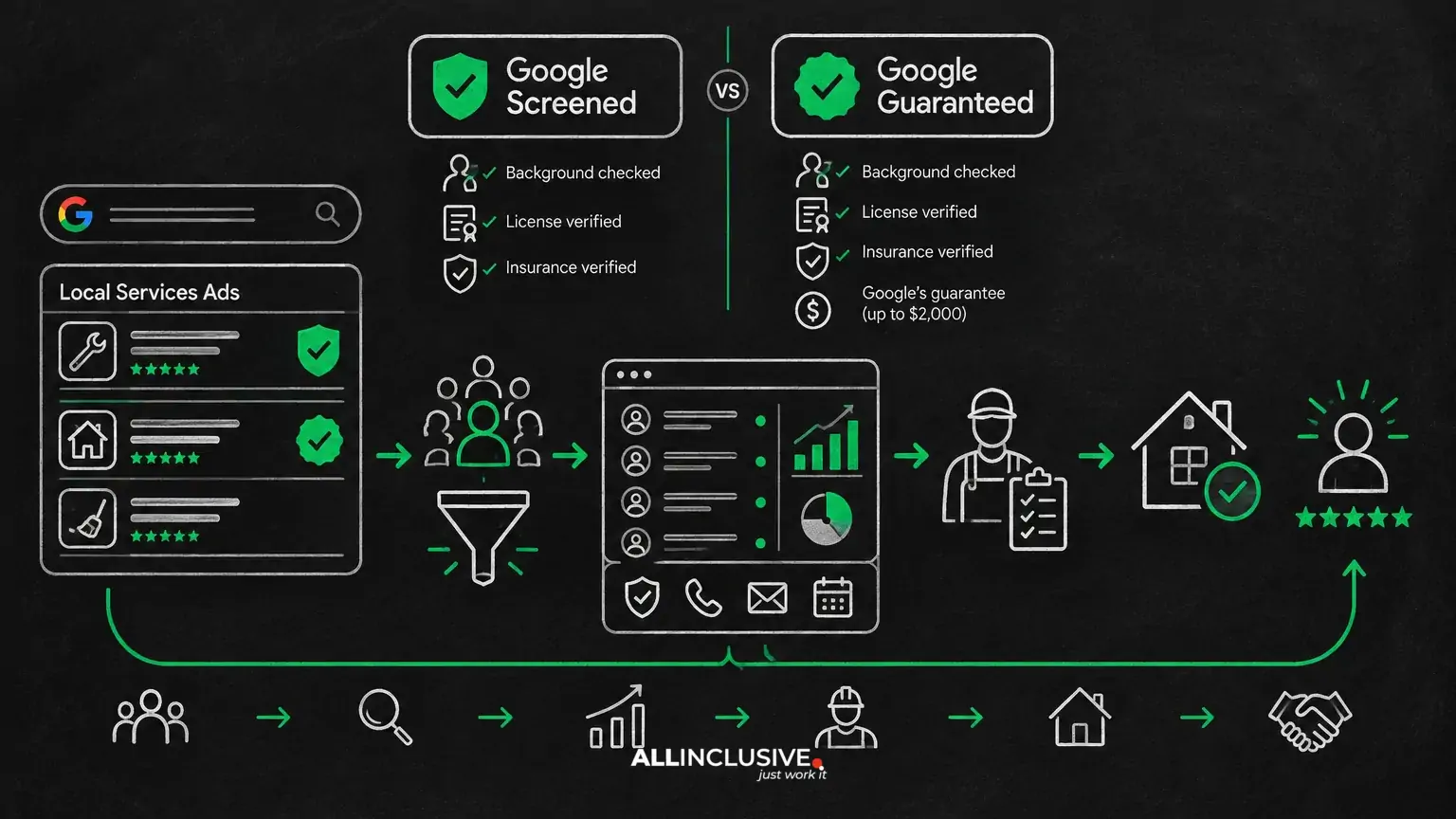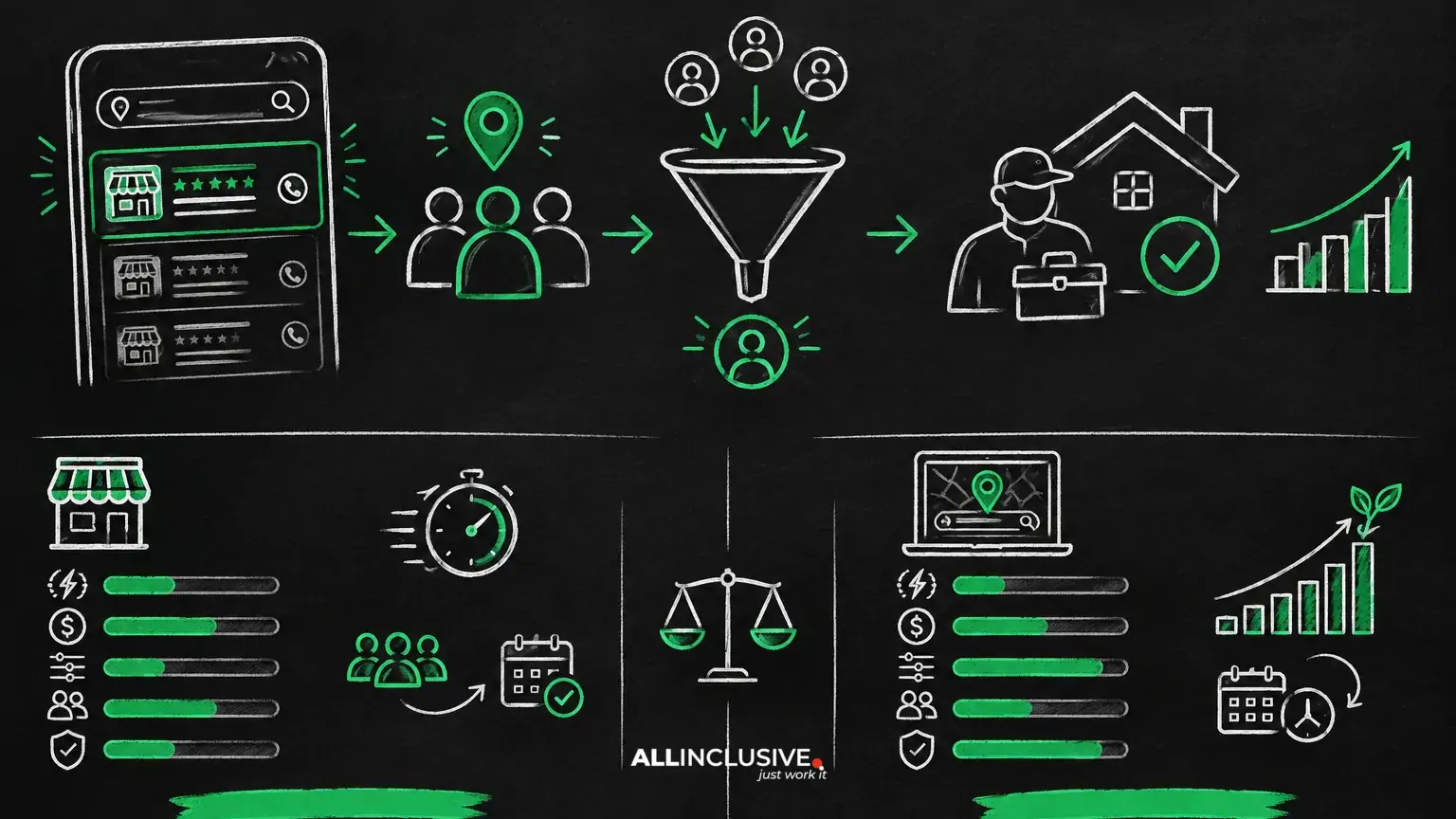
Local service ads vs seo is not a choice between “paid” and “free” traffic. It is a decision about how your business acquires demand, how quickly it needs leads, and how much operational capacity it can support. Local Services Ads can create visibility and inquiries relatively quickly when a business is eligible and its profile is competitive. Local SEO typically takes longer to build, but strong organic visibility can become a durable source of qualified demand.
For many local service businesses, the best answer is a portfolio: use Local Services Ads to capture near-term opportunities while building the website, reputation, and local relevance that support organic growth. The right balance depends on lead economics, service area, sales capacity, competition, and time horizon.
Local Services Ads vs. Local SEO at a Glance
Local Services Ads and local SEO can appear near the top of a search results page, but they work differently.
- Local Services Ads: a paid acquisition channel designed to connect eligible local businesses with people actively seeking specific services. Visibility depends on eligibility, profile quality, market conditions, budget or lead settings, and other platform factors that may change.
- Local SEO: the ongoing process of improving a business’s website, local business information, content, reputation signals, and technical foundation so it can earn organic visibility.
Local Services Ads are usually better suited to immediate demand capture and controlled testing. Local SEO is better suited to building an owned digital asset and reducing dependence on any single paid placement over time. Neither channel guarantees a particular ranking, lead volume, cost, or conversion rate.
When Local Services Ads Are the Better First Move
You need leads before organic visibility matures
Local SEO often requires sustained work before a business sees meaningful gains for competitive searches. A new location, recently redesigned website, or business entering a crowded market may not have enough authority or local relevance to compete immediately. Local Services Ads can provide a faster way to test whether search demand exists and whether the business can convert it.
This does not mean every inquiry will be high quality. Paid visibility creates opportunities; it does not replace accurate service descriptions, fast response, credible reviews, or disciplined follow-up.
You want a controlled demand-capture test
Local Services Ads can help answer practical questions: Which services generate inquiries? Which service areas are commercially viable? What types of requests can the team actually serve? A structured test should track more than leads. Measure valid leads, booked appointments, qualified opportunities, revenue, response time, and missed-call rates.
Your business has strong operational readiness
Paid lead generation exposes weaknesses in intake and sales operations. If calls go unanswered, staff cannot qualify requests, or the business does not serve the advertised area, additional visibility can increase waste rather than growth. Local Services Ads make more sense when the business can respond promptly, explain its offer clearly, and record outcomes consistently.
When Local SEO Deserves Greater Priority
You want durable visibility across the buying journey
Local SEO can support more than one transactional query. A well-structured site may help prospective customers discover services, compare options, understand pricing factors, review service areas, and validate expertise. That broader coverage can reduce reliance on a single lead source.
Your economics cannot support indefinite paid acquisition
Paid channels require ongoing spend to maintain paid exposure. Local SEO also requires investment—content, technical work, local information management, reputation development, and measurement—but the work can continue producing value after the initial effort. The financial comparison should therefore include contribution margin, customer lifetime value, repeat business, and the cost of maintaining each channel, not just the visible media charge.
You have a differentiated offer worth documenting
Organic content is more useful when a business has genuine expertise to communicate. Detailed service pages, helpful pre-purchase guidance, clear qualifications, service-area information, and answers to common customer concerns can support both search visibility and conversion. Avoid creating thin pages that merely repeat a service name and location.
Key Differences Between the Two Channels
Speed
Local Services Ads can begin generating exposure soon after setup and approval processes are complete, subject to market availability and account conditions. Local SEO is cumulative. Technical improvements may produce early gains, but competitive organic visibility commonly requires sustained execution and evidence of relevance and trust.
Cost model
Local Services Ads use a paid acquisition model, with costs connected to the platform’s current billing and lead-handling mechanics. Verify current details before forecasting. Local SEO costs come from strategy, content, technical implementation, local profile management, reputation work, and internal time or agency fees. “Free clicks” are not free if the business lacks the resources to create and maintain quality assets.
Control and predictability
Paid campaigns generally offer more direct control over budget, service selection, scheduling, and market tests, although delivery and lead volume still vary. Organic visibility is less directly controllable. Competitors, algorithm changes, search behavior, technical issues, and reputation signals can affect performance.
Lead intent and quality
Both channels can capture high-intent searches, but placement does not determine lead quality by itself. The offer, query context, service fit, location, timing, and intake process matter. A business should define a qualified lead before comparing channels. For example, an inquiry may need to match a target service, fall inside the service area, have a viable project scope, and reach a decision-maker.
Durability
Local Services Ads can stop producing paid visibility when campaigns are paused or conditions change. Local SEO assets can continue attracting and converting visitors, but rankings are not permanent and require maintenance. Durability is a reason to invest in SEO, not a reason to ignore ongoing optimization.
A Practical Decision Framework
Use the following questions to determine the appropriate channel mix.
- How urgent is lead generation? If the business needs demand now, begin with a controlled paid test while SEO work starts in parallel.
- Can the team handle additional demand? Consider opening hours, call coverage, appointment availability, geographic capacity, and follow-up ownership.
- What is an acceptable customer acquisition cost? Set this from contribution margin and expected customer value, not from competitor claims or broad industry averages.
- How competitive are the target searches? Review the strength of established local businesses, review profiles, organic results, and the quality of existing search assets.
- Which services have the best economics? Prioritize services with strong margins, reliable fulfillment, and clear qualification criteria.
- What can be measured? Connect inquiries to booked work and revenue wherever possible. Without outcome data, the business may optimize for inexpensive but unprofitable leads.
How to Use Local Services Ads and Local SEO Together
1. Start with a shared service and market map
List the services, locations, customer types, exclusions, capacity limits, and commercial priorities that both channels should reflect. This prevents paid profiles from promising services the website does not explain and prevents SEO content from attracting work the business cannot fulfill.
2. Build the conversion foundation first
Use consistent business information, clear calls to action, accurate service descriptions, trust evidence, and a simple intake path. Track calls and forms, but also record qualification and sales outcomes. If measurement is incomplete, establish a manual process before treating channel data as precise.
3. Use paid demand to identify commercial patterns
Review which services and request types produce qualified opportunities. Those insights can inform SEO priorities, frequently asked questions, page structure, and internal sales guidance. Do not copy every paid query into content; filter for relevance, profitability, and genuine customer value.
4. Develop SEO assets around real customer questions
Create or improve core service pages before expanding into supporting content. Explain who the service is for, what the process involves, what affects scope or cost, where the business operates, and when a different solution may be appropriate. This helps users make decisions and gives search engines clearer context.
5. Adjust investment by evidence
Increase paid activity when qualified demand is available, capacity exists, and customer acquisition economics are healthy. Increase SEO investment when organic opportunities are strategically important and the business can sustain the work. Reduce or refine either channel when it produces poor-fit inquiries, weak conversion, or unmeasured activity.
Local Services Ads vs. Local SEO: Mistakes to Watch For
- Comparing lead cost without lead quality: A lower inquiry cost is not better if the requests rarely become customers.
- Pausing SEO after launching paid ads: Paid visibility can solve an immediate gap while leaving the business exposed to future cost increases or platform changes.
- Expecting SEO to deliver instantly: Organic growth needs a realistic time horizon and consistent execution.
- Using one landing page for every service: Mismatched messaging can reduce relevance and attract poorly qualified requests.
- Ignoring operational data: Missed calls, delayed responses, and incomplete CRM records can make a good channel appear ineffective.
- Treating reviews as a shortcut: Reputation matters, but reviews should reflect genuine customer experiences and cannot substitute for service quality.
Measurement: What to Compare
Build a channel comparison that follows the customer journey:
- Impressions or visibility opportunities
- Calls, messages, and form submissions
- Valid and qualified leads
- Booked appointments or estimates
- Show rate and close rate
- Revenue and contribution margin
- Time to first response
- Repeat business and customer value where relevant
For paid activity, include media and management costs. For SEO, include content, technical, local, and maintenance costs. Compare results over a period long enough to account for sales cycles, seasonal demand, and the maturation of organic work. If attribution is imperfect, state the limitation rather than presenting false precision.
Related Planning Resources
If Local Services Ads are part of the immediate plan, review our guide to setting a Local Services Ads budget and lead targets before launching. For broader paid acquisition strategy, explore paid media planning and performance marketing. Businesses comparing Google’s broader search inventory with Local Services Ads may also benefit from Local Services Ads vs. Google Ads.
Local Services Ads vs. Local SEO: Decision Summary
Local Services Ads are generally the stronger tool for capturing urgent, high-intent demand and testing service-market fit. Local SEO is the stronger long-term investment for building discoverability, trust, and a less platform-dependent acquisition base. Most service businesses should not frame the decision as either-or. Use paid visibility where speed and control matter, build organic assets where durability and coverage matter, and judge both channels by qualified customers and profitable growth rather than traffic or lead volume alone.
For broader strategic context, see our Local Services Ads resource.