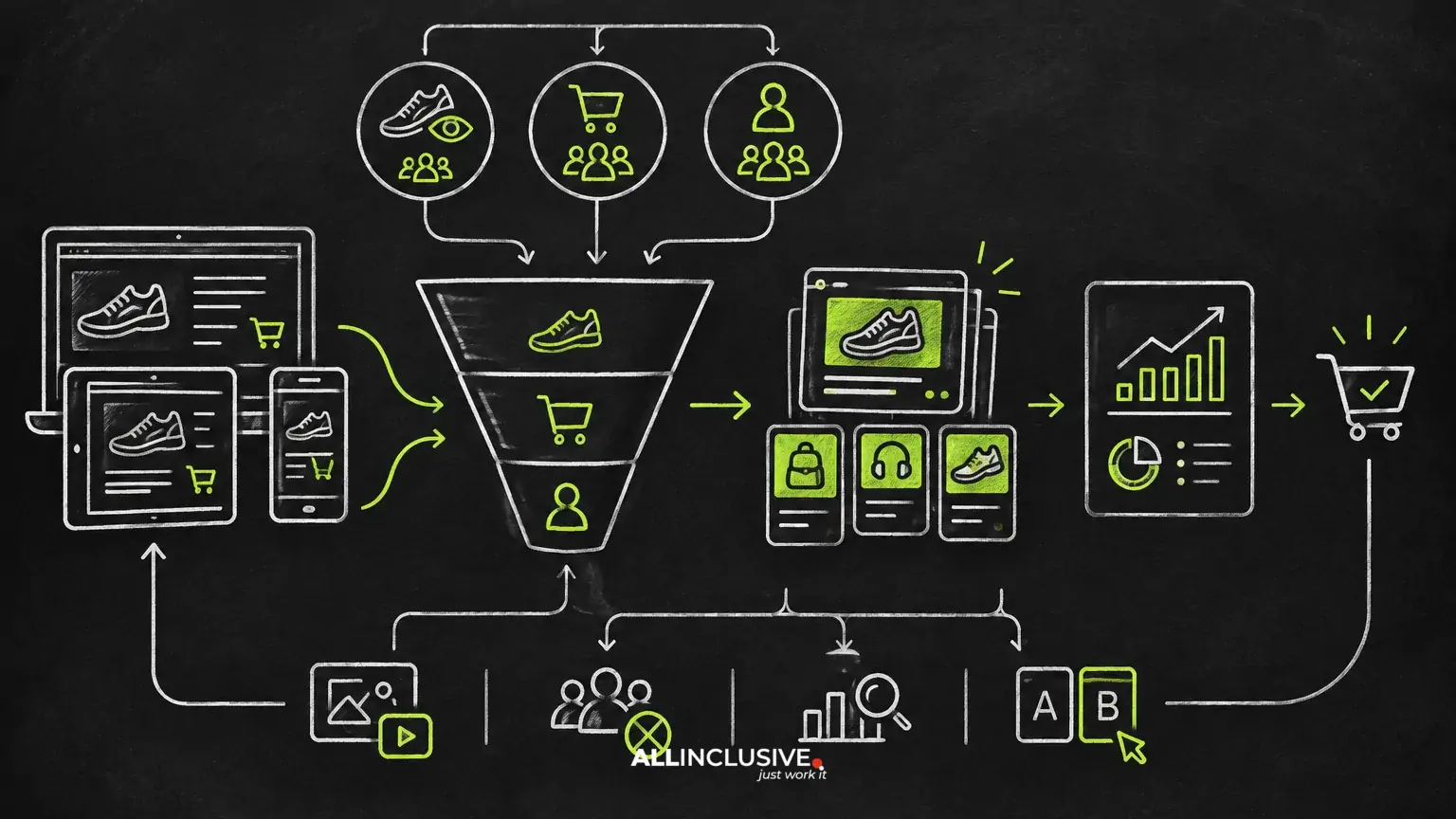
Remarketing for ecommerce works best when it reflects what a shopper actually did. A product viewer, a cart abandoner, and a recent customer should not receive the same ad, offer, or landing-page experience. Treating them as one audience can waste spend, create repetitive exposure, and make performance difficult to interpret.
This guide presents a practical segmentation framework for ecommerce remarketing: product-view audiences, cart audiences, and customer segments. It also covers creative decisions, exclusions, measurement, and implementation checks that apply across paid social, display, search, and other addressable media environments.
Start with behavior, not channel
The strategic question is not whether to use one advertising platform or another. It is what the shopper has already demonstrated and what action should come next. Channel mechanics change over time, but the underlying decision framework remains useful:
- Product viewers showed interest but may still be comparing options, researching fit, or waiting for a reason to return.
- Cart abandoners expressed stronger purchase intent, but something interrupted checkout or created uncertainty.
- Customers have already purchased and should be managed according to retention, replenishment, cross-sell, or suppression goals.
Before building campaigns, define the business objective for each group. A product-view audience may need education or proof. A cart audience may need friction reduction. A customer audience may need a complementary product, a replenishment reminder, or no paid exposure at all.
Build the core ecommerce remarketing segments
1. Product-view visitors
Product viewers are valuable because they have shown specific interest, but they are not all equally close to purchase. Someone who viewed one product briefly is different from someone who returned several times, viewed reviews, or visited shipping and returns information.
Where data quality permits, consider separating product-view audiences by:
- Product category, collection, or margin group
- Number of product views or repeat visits
- Recent versus older visits
- New visitors versus known customers
- Product availability, price range, or promotional eligibility
Creative should continue the shopper’s evaluation rather than simply repeat the product image. Useful messages may include product benefits, comparison guidance, customer proof, sizing or compatibility information, and clear delivery or returns details. If the product has meaningful technical considerations, send the shopper to a page that answers those questions instead of assuming another product ad will resolve them.
For higher-consideration purchases, create a progression. Early product viewers can receive education or category-level content; repeat viewers can receive a more direct product message; visitors who engage with high-intent content can move into a stronger conversion audience.
2. Cart and checkout abandoners
Cart abandoners are usually a higher-priority segment, but their behavior still needs context. A shopper may abandon because of shipping cost, payment friction, uncertainty about returns, a technical issue, or simple interruption. The right response is not automatically a discount.
Structure the audience around the last meaningful event available:
- Added to cart but did not begin checkout: reinforce product value, availability, and the path back to the cart.
- Began checkout but did not purchase: reduce uncertainty around payment, delivery, returns, or support.
- Repeated checkout activity: investigate tracking accuracy and site friction before increasing media pressure.
Use short, controlled eligibility windows for high-intent audiences when the product decision is time-sensitive. For products with longer consideration cycles, a longer window may be appropriate, but creative and bidding should reflect declining recency.
Avoid leading with a promotion unless margin, inventory, and promotion rules support it. Discounting every abandoned cart can train customers to delay purchase and can obscure whether the underlying experience is working. Test reassurance, convenience, and product proof separately from price incentives.
3. Existing customers
Customers should not be treated as a single remarketing pool. Their value and likely next action depend on product type, purchase frequency, order value, and time since purchase.
Useful customer segments may include:
- Recent purchasers who should be excluded from acquisition or immediate conversion messaging
- Customers eligible for complementary products
- Customers approaching a likely replenishment point
- High-value or repeat customers who warrant retention investment
- Past customers who have not returned within an expected buying cycle
Cross-sell creative should explain why the recommended product belongs with the previous purchase. Replenishment messaging should be based on a plausible product-use cycle, not an arbitrary schedule. Retention campaigns can also emphasize service, new use cases, loyalty benefits, or product education rather than constant discounts.
In some cases, the best customer strategy is exclusion. If a customer has just purchased a durable product with no near-term follow-up need, continuing to show the same conversion ad can reduce efficiency and harm the experience. The remarketing exclusions guide covers additional suppression decisions.
Match creative to the segment’s next question
Strong ecommerce remarketing answers the question most likely to block the next step. Segment-level creative does not need to be complex, but it should be intentional.
| Audience | Likely question | Creative direction |
|---|---|---|
| Product viewer | Is this right for me? | Benefits, proof, comparisons, fit, use cases |
| Cart abandoner | Should I finish this purchase? | Reassurance, delivery, returns, support, checkout recovery |
| Recent customer | What happens next? | Setup, education, complementary products, service |
| Past customer | Why return now? | Replenishment, new products, changed needs, relevant offers |
Product feeds can support dynamic personalization, but a feed alone is not a strategy. Review product titles, images, availability, variants, landing-page destinations, and promotional consistency. For catalog-heavy programs, organize products into commercially meaningful groups rather than relying only on default categories.
Also establish frequency and creative-rotation rules. Repetition may be acceptable for a short cart-recovery window, but it can become wasteful for older product viewers. Review performance by audience, recency, placement, creative, and conversion event rather than judging the entire remarketing campaign as one unit.
Choose the right destination
Sending every shopper to the homepage introduces unnecessary friction. Product viewers generally need the relevant product or category page. Cart abandoners should return to a recoverable cart or checkout path when technically and operationally appropriate. Customers may need a complementary product page, replenishment destination, account area, or educational content.
Before launching, verify that:
- The destination preserves product, variant, and availability context.
- Mobile users can complete the intended action without avoidable friction.
- Promotional claims in the ad match the landing page and checkout.
- Out-of-stock products are removed or redirected appropriately.
- Tracking records the intended event after any redirect, login, or consent step.
For more detail on destination decisions, see remarketing landing pages.
Set exclusions before scaling spend
Exclusions protect both efficiency and customer experience. At minimum, decide how to handle purchasers, recent purchasers, refunded orders, employees, internal traffic, and users who have completed the campaign objective.
Do not assume that a purchase exclusion is universally correct. Suppressing all customers may be appropriate for a one-time purchase campaign but harmful for replenishment or cross-sell activity. Instead, define exclusions in relation to the campaign’s objective and product economics.
Audience overlap also matters. A person can qualify as a product viewer, cart abandoner, and customer across different events or time windows. Establish prioritization rules so the highest-intent or most relevant message wins. Without those rules, reporting may be difficult to interpret and delivery may favor the largest audience rather than the most valuable one.
Measure incremental business value
Remarketing often receives credit from people who were already likely to purchase. That makes platform-reported conversions useful for operational monitoring but insufficient for judging true business impact.
Track performance by segment and consider:
- Revenue and profit contribution, not only conversion volume
- New versus returning customer outcomes
- Average order value and discount usage
- Conversion rate by recency window
- Frequency, reach, and cost by audience
- Post-purchase value where retention is part of the objective
Use controlled tests or carefully designed comparisons when the decision requires an incrementality estimate. Keep the conversion definition consistent, document attribution settings, and account for overlap with email, direct traffic, organic search, affiliates, and other paid activity. The remarketing attribution article explains why last-touch or platform-reported ROAS can overstate the effect of remarketing.
Implementation sequence for a reliable launch
- Map events: confirm product view, cart, checkout, purchase, refund, and customer-status signals.
- Define business segments: set recency windows, exclusions, and priority rules for each objective.
- Audit data quality: check product identifiers, prices, availability, consent handling, deduplication, and event timing.
- Assign creative roles: create messages for evaluation, reassurance, replenishment, cross-sell, and suppression.
- Choose destinations: match each segment to the most direct, functional next step.
- Set guardrails: establish frequency, budget, bid, margin, promotion, and inventory controls.
- Launch with readable reporting: separate audience, recency, creative, and objective dimensions.
- Review incrementality: use tests or comparison methods before treating attributed revenue as causal.
Use the broader remarketing strategy framework to connect these audience decisions with planning, measurement, and optimization. For context on how remarketing fits within the wider acquisition and retention mix, explore paid media strategy.
Final decision framework
A strong ecommerce remarketing program answers four questions for every audience: what did the shopper do, what is stopping the next action, what message can address that barrier, and when should paid exposure stop?
Product viewers usually need relevance and confidence. Cart abandoners need a clear, low-friction path to completion. Customers need a reason to return—or a deliberate exclusion when another ad would add no value. When segmentation, creative, destinations, exclusions, and measurement work together, remarketing becomes more than repeated product exposure: it becomes a controlled system for moving distinct customer groups toward the next commercially useful action.