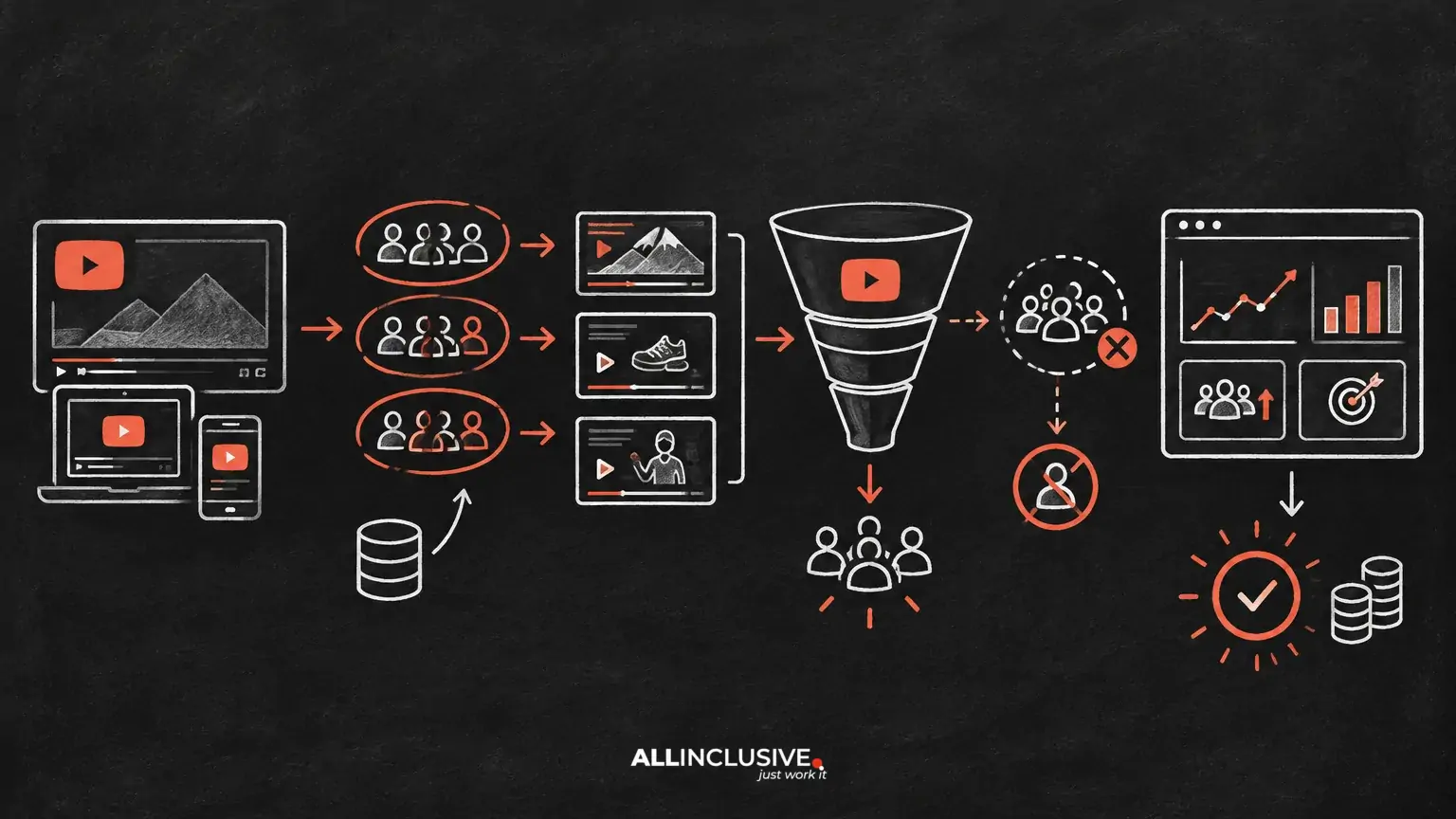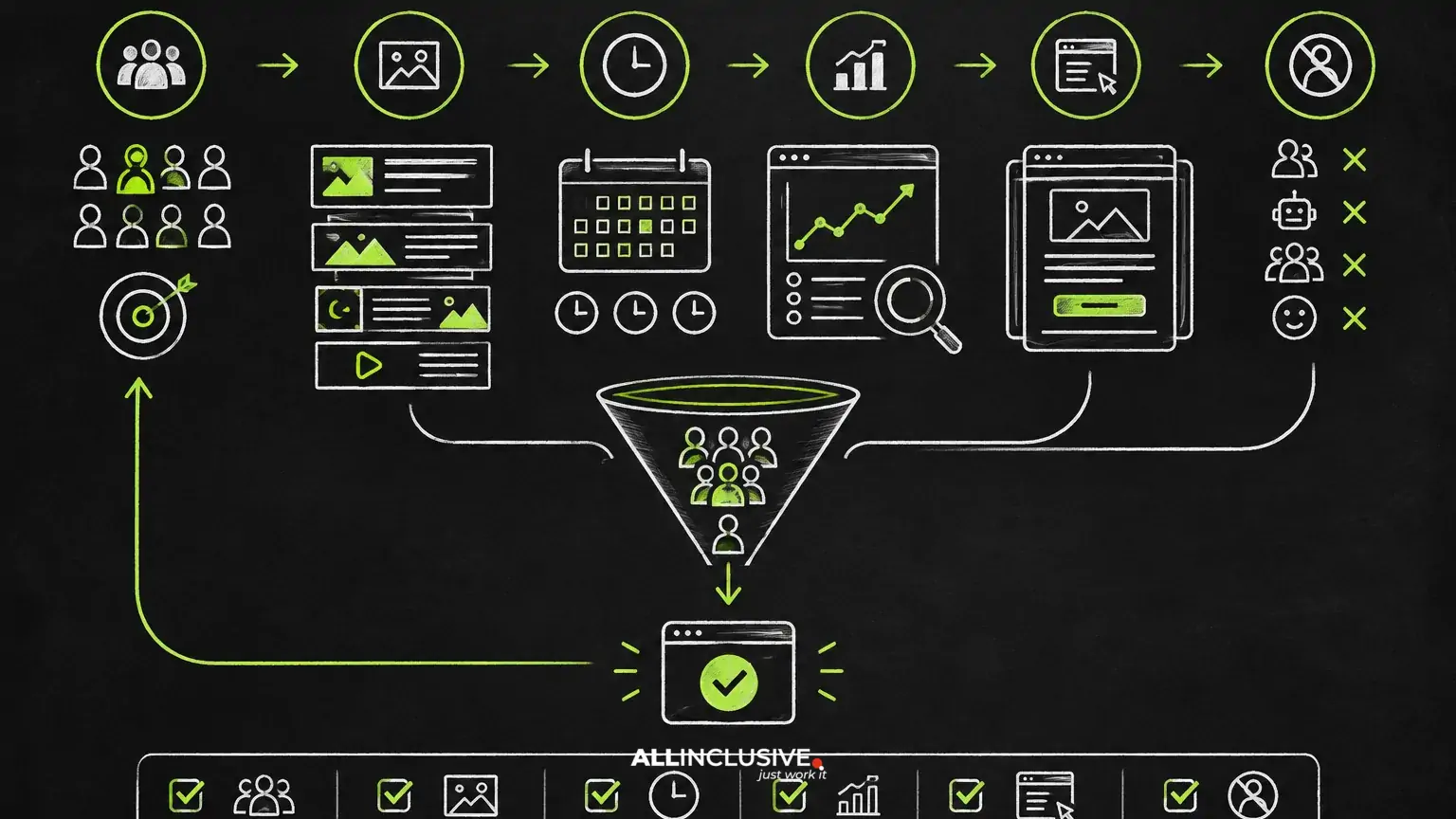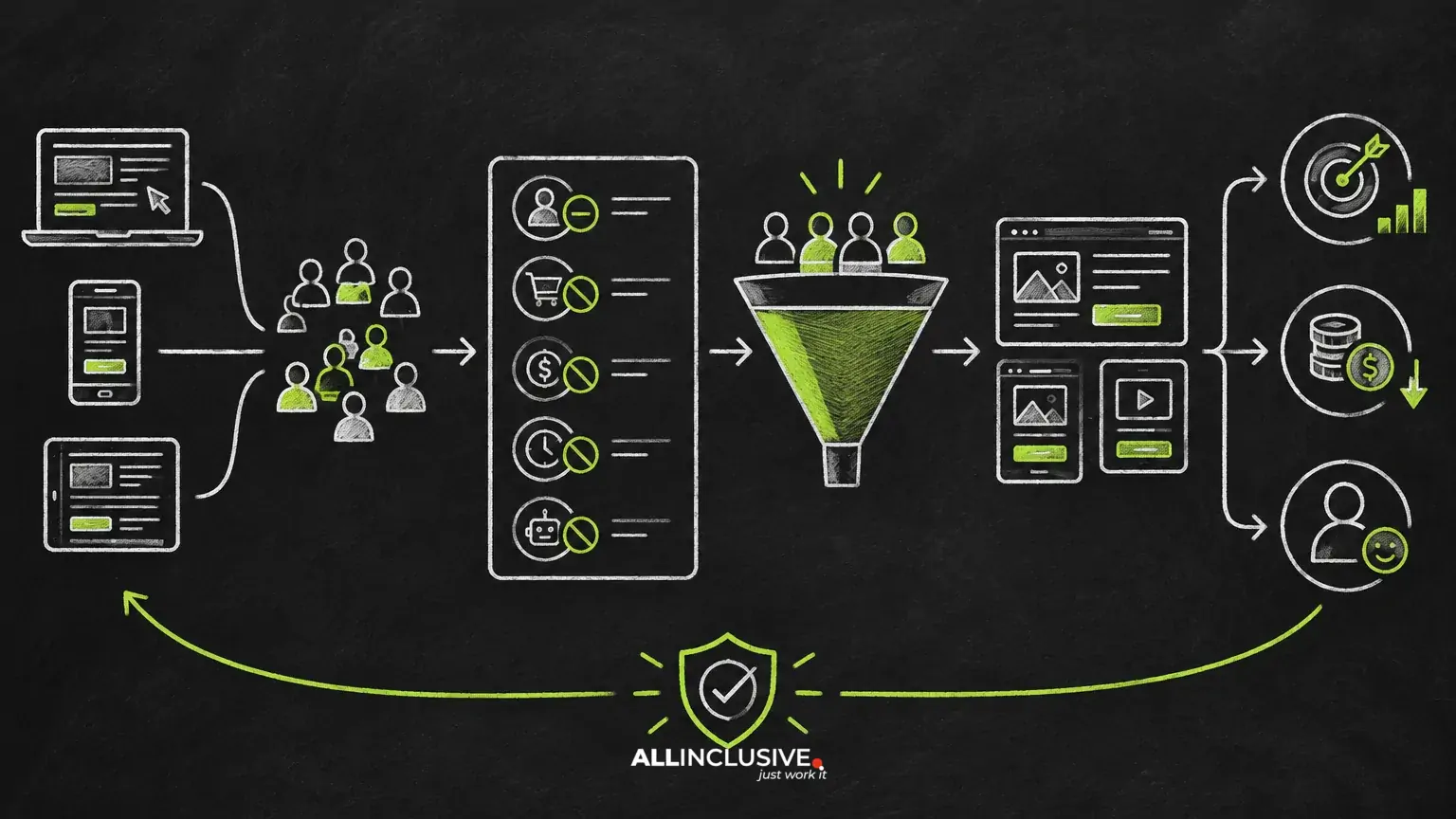
Remarketing exclusions determine who should stop seeing your ads. The goal is not to make audiences as large as possible; it is to keep campaigns relevant by suppressing people who have converted, opted out, entered an unsuitable buying stage, or are unlikely to produce incremental value.
Common exclusions include recent purchasers, completed lead forms, existing customers in acquisition campaigns, employees, internal traffic, competitors, unqualified users, and people who have received too many impressions. The right rule depends on the campaign objective, sales cycle, customer value, and the action you want the audience to take next.
This makes exclusions a strategic part of remarketing strategy, not merely a platform setup task. A carefully designed suppression framework can reduce wasted spend, prevent conflicting messages, and make performance data easier to interpret.
What are remarketing exclusions?
Remarketing exclusions are audience, event, placement, geographic, or behavioral rules that prevent selected users from entering or remaining in a remarketing campaign. In practice, an exclusion may be applied when someone:
- Completes the conversion the campaign was designed to generate
- Becomes an existing customer who should receive a retention message instead
- Is outside the campaign's eligibility or service area
- Has already seen the message often enough
- Shows signals that make the offer irrelevant or unsuitable
- Should be handled by sales, customer success, or another campaign
Exclusions are different from simply ending an audience after a fixed period. A window controls how long a user remains eligible based on time. An exclusion removes a user because their status, behavior, or relationship with the business has changed.
Why exclusions matter in remarketing
They protect budget from low-value impressions
Past visitors are not automatically good prospects. Some visited by mistake, completed the intended action, were researching for someone else, or have shown no meaningful engagement since their first visit. Continuing to bid on every eligible visitor can shift budget toward people who are no longer commercially useful.
They prevent message conflicts
A prospect who has just submitted a form should not continue receiving an acquisition ad that says “request a consultation.” They may need a confirmation, nurture, or sales follow-up instead. Exclusions help coordinate the next message with the user's current stage.
They improve interpretation of performance
When converters remain in acquisition remarketing, reported conversions and revenue may reflect people who were already close to converting or who have already converted elsewhere. Suppressing completed actions does not solve attribution on its own, but it can make campaign intent and audience membership easier to understand.
They support a better customer experience
Repeatedly showing an outdated offer after a purchase or application can make a brand appear disconnected. In B2B campaigns, it can also create friction when an account has moved from marketing to sales or customer success.
Who should you stop advertising to?
1. People who completed the primary conversion
The first exclusion should usually be users who completed the action the campaign was designed to drive. Depending on the business, this may include a purchase, qualified form submission, booked meeting, application, demo request, or trial activation.
The exclusion should be tied to a reliable conversion event rather than a weak proxy. For example, a thank-you page visit may be useful if tracking is dependable, but it can be less robust than a confirmed backend event. Validate how the conversion is recorded before using it as a suppression signal.
Do not assume every converter should disappear from all remarketing. A converted lead may be eligible for customer education, cross-sell, or account-based messaging. The key is to exclude it from the campaign whose original objective has been completed.
2. Existing customers in acquisition campaigns
Customer exclusions are especially important when the objective is new business. Existing customers may still browse the website and enter visitor pools, but they should not necessarily receive prospecting or first-purchase messaging.
Use a customer list, customer relationship management status, authenticated account event, purchase event, or another approved first-party signal where available. Keep the rule aligned with the offer. A current customer may be excluded from a new-customer promotion but retained for an upgrade or renewal campaign.
3. Users who have already entered a sales process
A completed form is not the only meaningful stage change. Users who have an open opportunity, scheduled meeting, active trial, or ongoing sales conversation may need a different experience from anonymous site visitors.
Suppressing these users from generic acquisition ads can reduce duplication between marketing and sales. In some cases, however, an account-based campaign may intentionally continue with content designed to support the active opportunity. The exclusion should therefore be based on campaign purpose, not a blanket rule that removes every sales-qualified user from every channel.
4. Unqualified or ineligible users
Not every visitor is a viable prospect. Depending on the offer, exclusions may include users outside the service area, organizations below a minimum fit threshold, students when the offer is for businesses, job seekers, vendors, or users seeking support rather than a new purchase.
Use these rules carefully. A single page view is rarely enough to determine that someone is unqualified. Prefer explicit signals such as form responses, account data, support status, product eligibility, or repeated behavior that clearly indicates a different intent.
5. Employees, agencies, and internal traffic
Internal users can inflate audience counts, create irrelevant impressions, and contaminate reporting. Excluding known office traffic, employees, testing accounts, and agency users can be useful when those audiences are identifiable and the exclusion does not remove legitimate prospects who share a network or location.
Do not treat every corporate IP address as internal by default. Distributed teams, shared offices, privacy controls, and changing network conditions can make IP-based rules incomplete. Combine signals where appropriate and document the limitations.
6. Competitors and research-only audiences
Some businesses choose to suppress known competitors, job candidates, students, or other research-heavy audiences when they consume budget without representing the target market. This is most defensible when the audience can be defined using reliable first-party or contextual signals.
Be cautious with assumptions based on a single content download or page visit. Research behavior can precede a legitimate buying process, particularly in complex B2B categories. Treat this as a testing and qualification question rather than an automatic exclusion.
7. People exposed too frequently
Frequency control and exclusions solve related but different problems. Frequency limits attempt to regulate how often ads are shown. An exclusion can remove users after they reach a defined exposure or engagement condition, if the platform and measurement setup support that logic.
Consider suppressing users who have received repeated impressions without visiting, engaging, or converting. The threshold should reflect the audience size, buying cycle, creative rotation, and available reach. A small, high-value account list may require more persistence than a broad consumer audience, so there is no universal cutoff.
8. Users who opted out or should not be targeted
Privacy and consent requirements should take priority over remarketing goals. Do not target people who have withdrawn the relevant consent or whose data cannot lawfully be used for the intended purpose. Coordinate audience controls with the organization's privacy, legal, and measurement processes.
Platform features and consent behavior can vary by market, account configuration, and implementation. Strategy should begin with the permitted data and documented consent state, not with a desire to maximize audience size.
Build exclusions around lifecycle transitions
A useful way to design exclusions is to map the user lifecycle and define what should happen when a person moves from one stage to another.
- Unknown visitor: eligible for education or initial consideration messaging when other conditions are met.
- Engaged prospect: eligible for content or offer-specific remarketing based on demonstrated interest.
- Lead: removed from generic lead-generation ads and routed to nurture or sales-support messaging.
- Opportunity: excluded from broad acquisition where sales owns the next step, unless a coordinated account campaign is intentional.
- Customer: excluded from new-customer offers and considered for onboarding, retention, expansion, or advocacy campaigns.
- Inactive or disqualified contact: suppressed from campaigns that no longer match the person's status.
This framework is more durable than building exclusions around isolated URLs. URLs change, forms are redesigned, and users may complete an action through multiple paths. Lifecycle events and status fields can provide a clearer basis for suppression when they are maintained accurately.
How to choose the right exclusion rule
Start with the campaign objective
Ask what the campaign is trying to accomplish. If the goal is a first purchase, exclude purchasers. If it is a demo request, exclude completed demo requests. If it is expansion, existing customers may belong in the audience rather than outside it.
Use the strongest available signal
Rank potential signals by reliability. A confirmed transaction or CRM status is generally more useful than a page view. A meaningful product event may be more useful than a generic session. Document the event owner, data source, update frequency, and expected delay.
Account for the sales cycle
Immediate suppression may be appropriate for a completed ecommerce order. A complex B2B purchase may require a short transition period while systems update or while coordinated messages are prepared. The correct approach depends on operational handoffs and customer expectations.
Separate exclusion from suppression duration
Some users should be excluded permanently from a particular campaign, such as customers from a first-purchase offer. Others should be suppressed temporarily, such as a new lead during a sales follow-up period. Define the duration explicitly rather than allowing an indefinite rule to accumulate.
Consider overlap across campaigns
A user can qualify for several audiences at once. Map priority between campaigns so that a lower-stage acquisition message does not compete with a more relevant onboarding, opportunity, or retention message. This is particularly important when different teams manage different campaigns.
Implementation and quality-assurance checklist
- Write the business rule in plain language before configuring a platform audience.
- Identify the source event or status that proves the rule is true.
- Confirm that the event is deduplicated and associated with the correct user or account.
- Define whether the exclusion is temporary, permanent, or tied to a lifecycle transition.
- Check whether conversion delays could cause users to keep seeing an ad after they act.
- Review audience overlap and campaign priority before launch.
- Test with approved internal or test accounts without compromising personal data.
- Monitor audience size, delivery, spend, frequency, and conversion quality after implementation.
- Record the rule, owner, data source, review date, and known limitations.
For a broader implementation view, use the remarketing checklist alongside your exclusion plan. If timing is the issue, the guide to remarketing windows can help you distinguish a time-based audience rule from a true lifecycle exclusion.
Remarketing Exclusions: Mistakes to Watch For
Excluding all converters from every campaign
A conversion ends one campaign's job, not necessarily the relationship. Customers may be valuable audiences for onboarding, renewals, cross-sell, or advocacy. Build exclusions at the campaign and offer level.
Using weak proxies as permanent exclusions
A pricing-page visit, long session, or content download can indicate interest, but it does not prove qualification or purchase intent. Use these signals to segment or test before turning them into hard exclusions.
Ignoring data latency
If customer or CRM data updates slowly, users may remain eligible after a status change. Understand the delay and decide whether a temporary buffer, alternate event, or coordinated messaging is needed.
Assuming exclusions fix attribution
Suppression can reduce redundant exposure, but it does not eliminate view-through effects, cross-channel overlap, conversion lag, or other attribution limitations. For measurement considerations, see remarketing attribution.
Letting exclusions become invisible technical debt
Audience rules often outlive the campaigns and systems that created them. Review them when forms, CRM stages, consent processes, offers, or measurement definitions change. An outdated exclusion can quietly shrink delivery or remove valuable users.
How to evaluate whether exclusions are working
Do not judge exclusions only by lower spend or lower reach. Review whether the remaining audience is more aligned with the intended objective and whether downstream outcomes improve. Useful checks include:
- Are completed converters removed within the expected timeframe?
- Are sales-owned users receiving a coordinated experience?
- Has irrelevant frequency decreased?
- Are qualified audiences still large enough to support delivery?
- Did lead quality, purchase quality, or sales progression change?
- Are reported conversions easier to interpret?
When possible, compare outcomes against a defined control or pre-change period, while accounting for seasonality, budget, creative, landing-page, and tracking changes. Avoid claiming causation from a simple before-and-after movement.
Remarketing Exclusions: What to Prioritize
Strong remarketing depends as much on who you remove as who you include. Exclude people when a conversion changes their lifecycle stage, when the offer no longer applies, when another team owns the next interaction, or when continued exposure is unlikely to add value. Keep the rule specific to the campaign, use reliable signals, document timing and ownership, and review the setup whenever business or measurement conditions change.
Done well, remarketing exclusions make campaigns more relevant, protect budget, and create cleaner transitions between acquisition, sales, onboarding, retention, and expansion.
For broader strategic context, see the broader paid media hub.