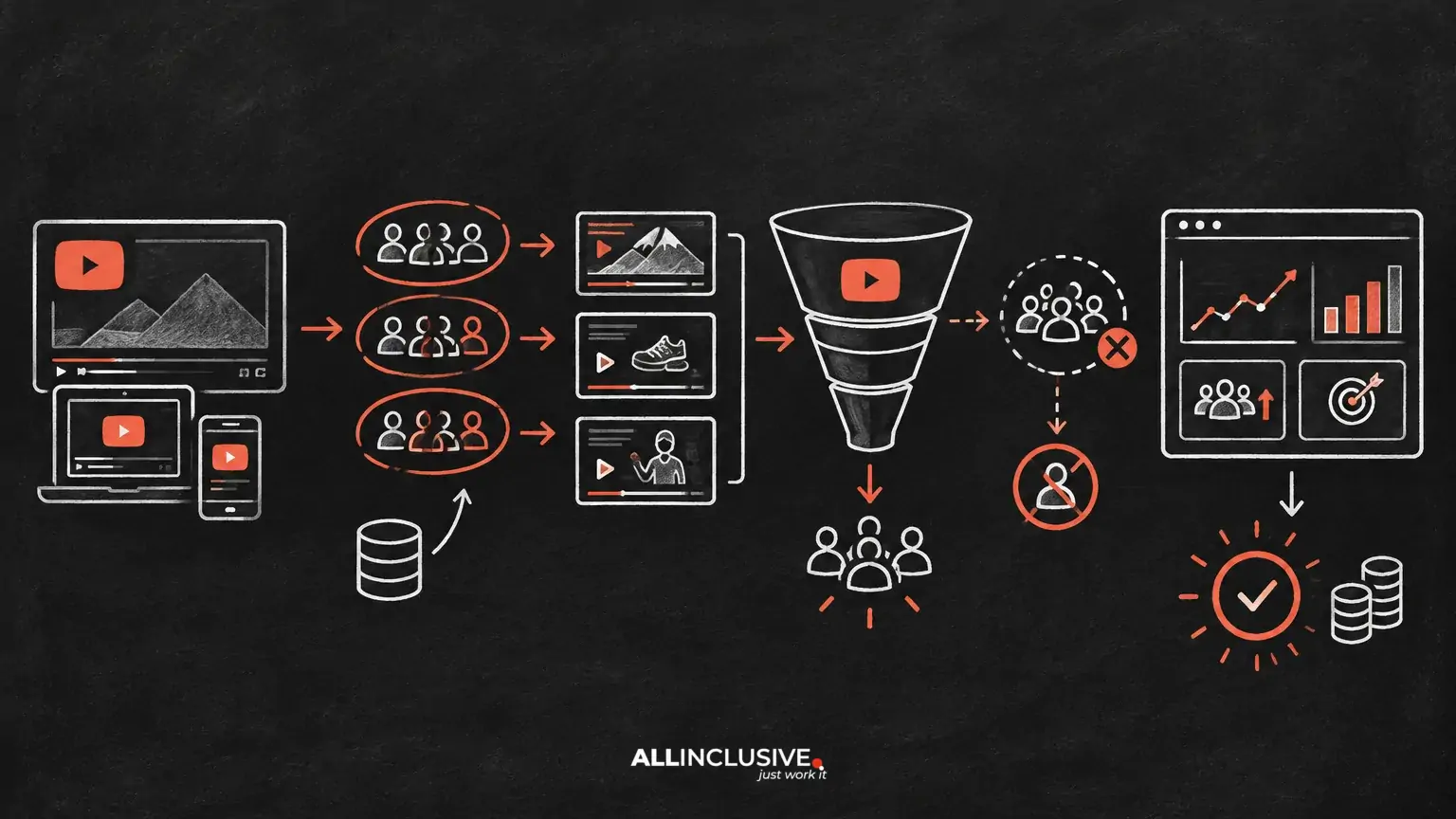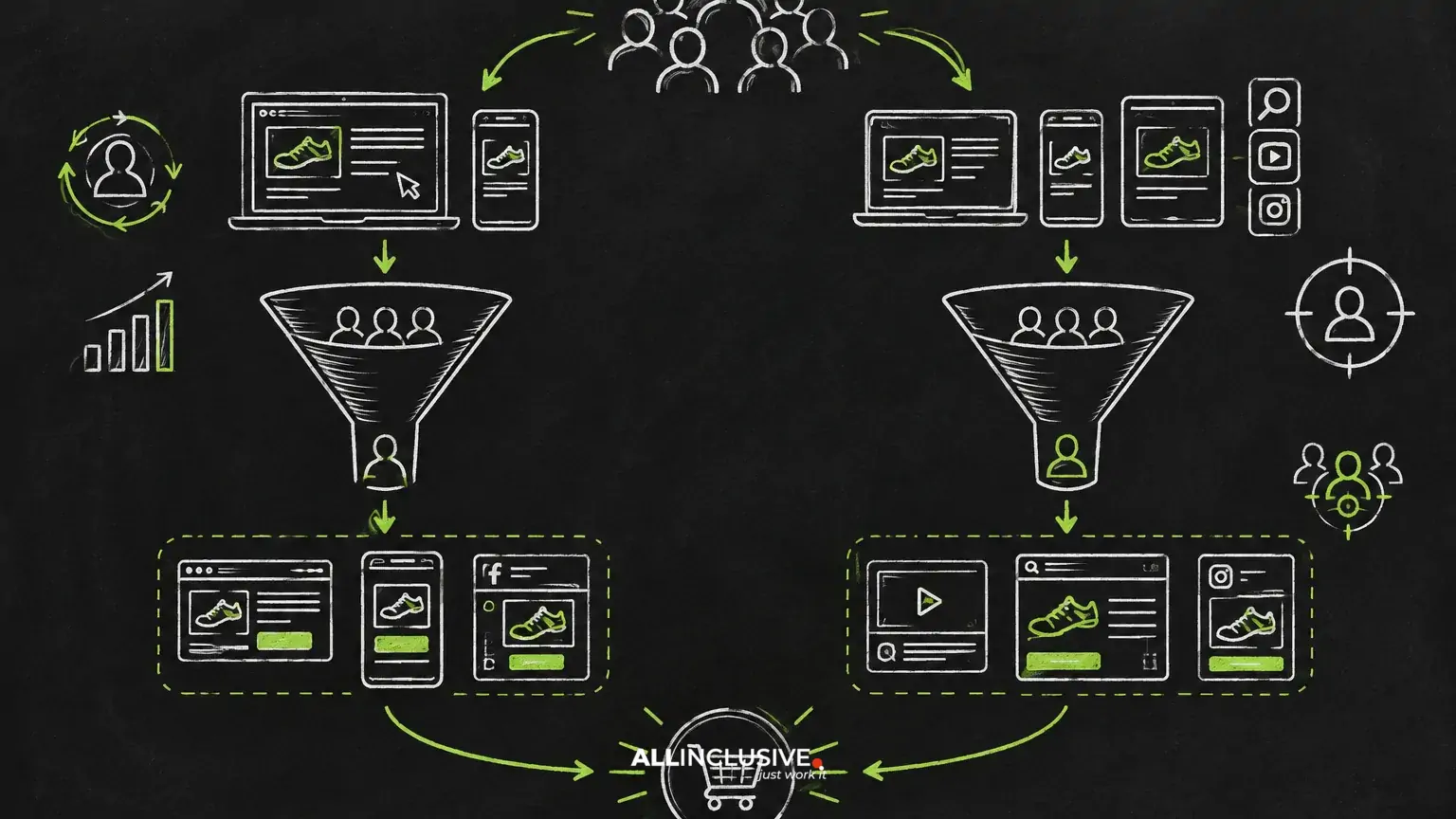
Custom remarketing strategies work best when they respond to what a visitor has already done—not simply when they target everyone who has visited a website. A product viewer, a pricing-page visitor and an existing customer have different questions, levels of intent and reasons for seeing an ad.
The practical approach is to divide audiences by funnel stage, then assign each group a distinct objective, message, offer, landing page and measurement plan. This creates a more relevant experience and helps prevent wasted spend, repetitive creative and premature sales pressure.
What makes a remarketing strategy custom?
A custom remarketing strategy uses behavioral and commercial context to determine what a person should see next. The relevant context may include:
- Engagement: whether someone viewed one page, read multiple pages, watched a video or interacted with an ad.
- Content interest: which product, service, category or educational topic attracted attention.
- Buying intent: whether the visitor viewed pricing, started a form, added an item to a cart or requested information.
- Customer status: whether the person is a prospect, open opportunity, purchaser or repeat customer.
- Time since interaction: how recently the qualifying action occurred.
Customization does not require an elaborate account structure. It requires clear decisions about audience eligibility, exclusion rules, sequencing and business outcomes. Platform mechanics vary, so the strategy should be defined first and then implemented within the capabilities and policies of the selected advertising channels.
Map remarketing to funnel stages
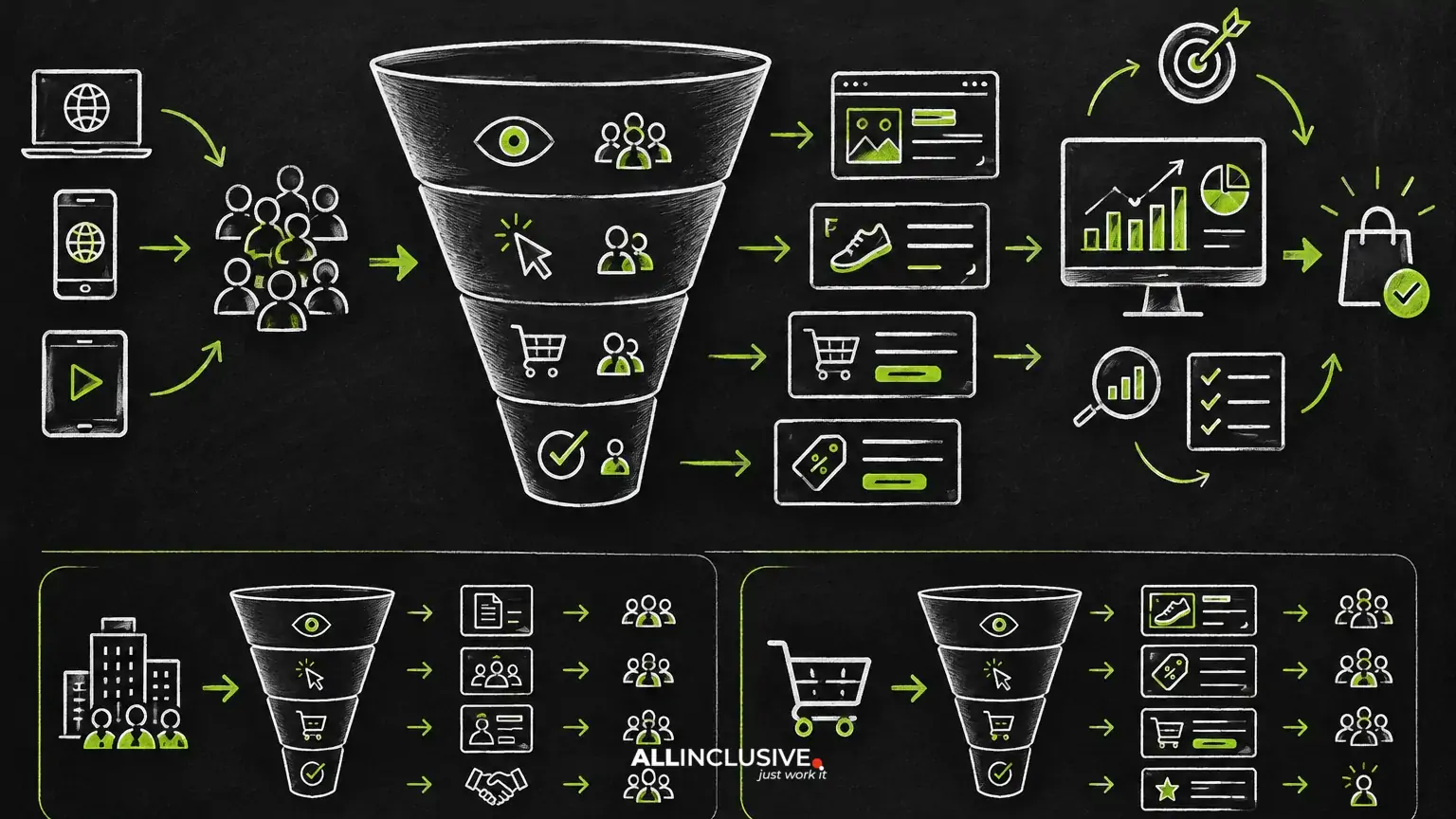
A useful framework is to organize audiences into four broad stages: awareness and engagement, consideration, conversion and post-conversion. These stages are not rigid labels. They are decision-making tools that help determine the next most useful message.
Stage one: engaged visitors who are not ready to buy
Early-stage visitors may have read an article, viewed a video, explored a category or visited the website without reaching a commercial page. Their immediate need is usually education or problem definition, not a hard conversion request.
Objective: build qualified familiarity and move the visitor toward a meaningful next action.
Message: address the problem, explain the category or show how the solution works. Use proof points that reduce uncertainty without overstating results.
Offer: a relevant guide, comparison, checklist, webinar, product education asset or deeper content experience.
Landing page: match the subject of the original interaction. Someone who engaged with a guide about paid search should not be sent to an unrelated general homepage.
Measurement: evaluate quality actions such as engaged sessions, content progression, qualified page views or assisted conversions alongside direct conversions. These users should not be judged by the same immediate standard as high-intent prospects.
Stage two: consideration audiences
Consideration audiences have demonstrated stronger interest. They may have reviewed service pages, compared products, returned to the site or consumed several pieces of related content. At this stage, the campaign should help the visitor evaluate fit.
Objective: turn interest into active evaluation.
Message: explain differentiators, implementation considerations, use cases, integrations, constraints and evidence. Avoid vague claims that could apply to every competitor.
Offer: a product walkthrough, comparison resource, consultation, sample plan, calculator or relevant demonstration.
Landing page: provide enough detail for evaluation and make the next step clear. For B2B campaigns, the page may need to address stakeholders beyond the original researcher.
Measurement: prioritize qualified form completions, demo requests, sales conversations, high-value product actions or other events that indicate commercial intent.
Consideration audiences benefit from tighter exclusions than broad site visitors. For example, a visitor who has already submitted a demo request should leave the prospecting sequence and enter an appropriate follow-up or customer journey.
Stage three: high-intent and conversion audiences
High-intent users have taken an action closely associated with a decision. Examples include visiting a pricing page, beginning checkout, configuring a product, submitting part of a form or returning repeatedly within a short period.
Objective: remove friction and make the desired conversion easier.
Message: answer the final objections. Clarify process, availability, delivery, implementation, support, contract considerations or what happens after submitting the form.
Offer: the most direct next step appropriate to the business, such as completing checkout, booking a consultation or requesting a proposal. An incentive may be appropriate in some models, but it should not be the default answer to every abandoned action.
Landing page: preserve continuity with the prior experience. If someone abandoned a specific product or form, return them to a page that retains the relevant selection where practical.
Measurement: optimize toward completed business outcomes, not merely clicks. Where a lead has multiple quality levels, connect reporting to downstream qualification or revenue data when available.
The closer an audience is to conversion, the more specific the message should become. High intent does not mean every person needs urgency; it means the campaign should address the actual remaining barrier.
Stage four: customers and converted leads
Conversion is not always the end of the relationship. Existing customers may be eligible for onboarding, cross-sell, replenishment, renewal or advocacy campaigns. However, they should not continue receiving acquisition ads that ask them to perform an action they have already completed.
Objective: support retention, expansion or advocacy, depending on the business model.
Message: provide useful next steps, complementary products, service education or account support.
Offer: onboarding content, related products, account reviews, renewal resources or referral programs where relevant.
Measurement: track repeat purchase, adoption, expansion, retention or other customer outcomes rather than acquisition metrics.
Build the audience architecture before writing ads
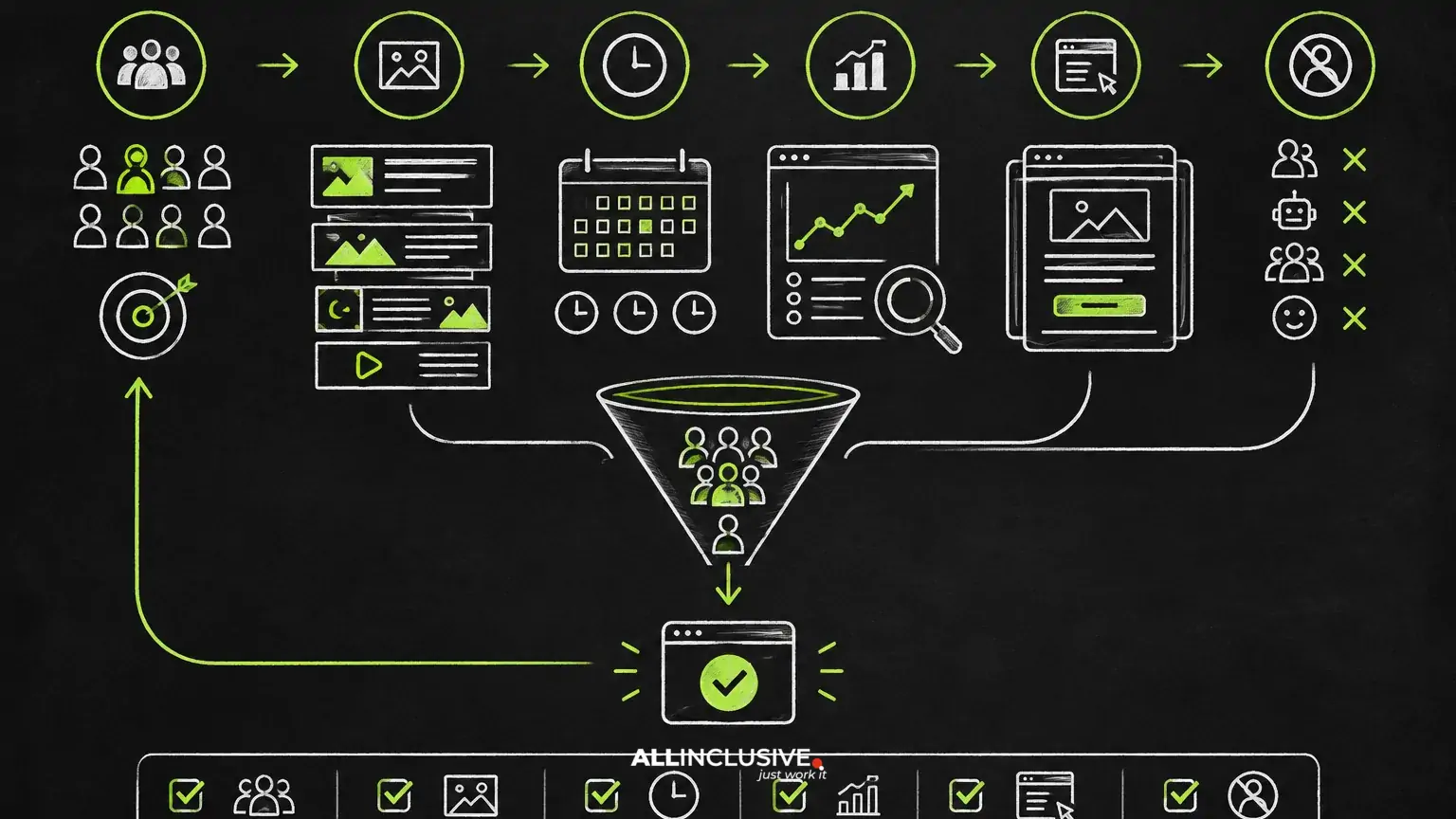
Start with a simple audience matrix. For each audience, document the qualifying signal, lookback period, exclusions, message, destination and success event. The exact lookback periods should reflect the buying cycle and data volume. A short-cycle ecommerce product and a complex B2B service should not use identical windows.
- Audience: pricing-page visitors, product viewers, form starters, content readers or purchasers.
- Intent signal: the action that qualifies the person.
- Recency: the period during which the action remains useful.
- Exclusions: converters, existing customers, employees, irrelevant locations or audiences already assigned to a later stage.
- Next step: the single action the campaign is designed to encourage.
Use the narrowest useful audience definition that still supports delivery and learning. Over-segmentation can create small, unstable groups and excessive operational complexity. Under-segmentation can produce generic ads and conflicting journeys.
Match creative to the visitor’s unanswered question
Creative should advance the conversation rather than repeat the first touchpoint. A practical progression might look like this:
- Recognition: name the problem or use case relevant to the visitor’s original interest.
- Understanding: show how the solution works and who it is designed for.
- Evaluation: provide proof, comparisons, process details or objections handling.
- Action: make the next step clear and set expectations about what follows.
- Expansion: help customers adopt, replenish or broaden their relationship with the business.
Creative variations should test meaningful differences: proposition, proof type, call to action, format, product angle or objection. Changing only minor design details may not reveal why performance changes. For additional guidance on message development, see remarketing creative strategy.
Use sequencing carefully
Sequencing can help a campaign move users from education to evaluation and then to conversion, but it should not become a rigid script. People may enter at different stages, interact with multiple assets or convert without seeing every step.
A practical sequence has three safeguards:
- Entry rules: define the action that places someone into the journey.
- Progression rules: move users forward when they complete a meaningful action, not simply after they have seen an ad.
- Exit rules: remove converters and redirect users whose behavior shows a different need.
For a deeper treatment of stage-based timing and transitions, review the remarketing funnel sequencing framework.
Connect remarketing to the broader paid-media plan
Remarketing should not be evaluated in isolation. It can capture demand created by search, social, video, content distribution, partnerships and organic activity. Campaign design should account for how users enter the audience, how prospecting and remarketing overlap, and whether the reported conversion would likely have occurred without the ad exposure.
Set channel roles before comparing results. One channel may introduce a new audience, another may support evaluation, and another may close an existing demand opportunity. Review the full paid media strategy when deciding how remarketing fits into budget allocation, attribution and measurement.
Measure quality, not just attributed conversions
Custom remarketing strategies need measurement that reflects both immediate response and business value. Useful reporting dimensions include:
- conversion rate by audience stage;
- cost per qualified lead or completed purchase;
- lead quality, opportunity creation or downstream revenue where available;
- assisted interactions and conversion-path position;
- incremental lift or holdout-based evidence when the organization can support a suitable test;
- frequency, reach and audience exhaustion signals;
- performance by creative proposition, landing page and recency group.
Be cautious when comparing audiences with different intent levels. A high-intent group may produce more conversions at a lower apparent cost because it already contains people close to a decision. That does not automatically mean it deserves unlimited budget. Compare results with the role each audience is meant to play.
Common strategy mistakes
Putting every visitor into one audience
This removes useful context and often leads to generic creative. Separate at least the most commercially meaningful actions, such as broad engagement, product or service evaluation, and conversion intent.
Continuing acquisition ads after conversion
Weak exclusion logic wastes impressions and can create a poor customer experience. Confirm that conversion events are received consistently and that customers are routed to the right journey.
Using discounts to solve every objection
Price is only one barrier. Trust, fit, timing, implementation and complexity may matter more. Address the actual objection before introducing an incentive.
Optimizing for clicks alone
A click can indicate curiosity without commercial value. Pair engagement metrics with qualified actions and downstream outcomes whenever possible.
Over-segmenting too early
Build the simplest structure that distinguishes meaningful intent. Add segments when the difference changes the message, offer, destination or business decision.
Custom Remarketing Strategies by Funnel Stage: Pre-Launch Checklist
- Define the business outcome for each funnel stage.
- List the behavioral signals that indicate stage progression.
- Set recency windows based on the buying cycle.
- Document exclusions for converters, customers and overlapping journeys.
- Assign one primary message and destination to each audience.
- Create creative variations that address different objections or use cases.
- Confirm consent, tracking, data-quality and platform-policy requirements.
- Set reporting for both immediate conversions and lead or customer quality.
- Review audience overlap, frequency and budget allocation after launch.
- Refresh the strategy when products, buying behavior or funnel stages change.
Custom Remarketing Strategies by Funnel Stage: Strategic Perspective
The strongest custom remarketing strategies are not defined by the number of audiences or ad variations. They are defined by whether each impression helps a person take the next appropriate step. Map behavior to funnel stage, align creative and landing pages to the visitor’s unanswered question, exclude people who have progressed, and measure outcomes according to business value. That approach makes remarketing more relevant, more controllable and easier to improve over time.
For broader strategic context, see our remarketing strategy resource.