
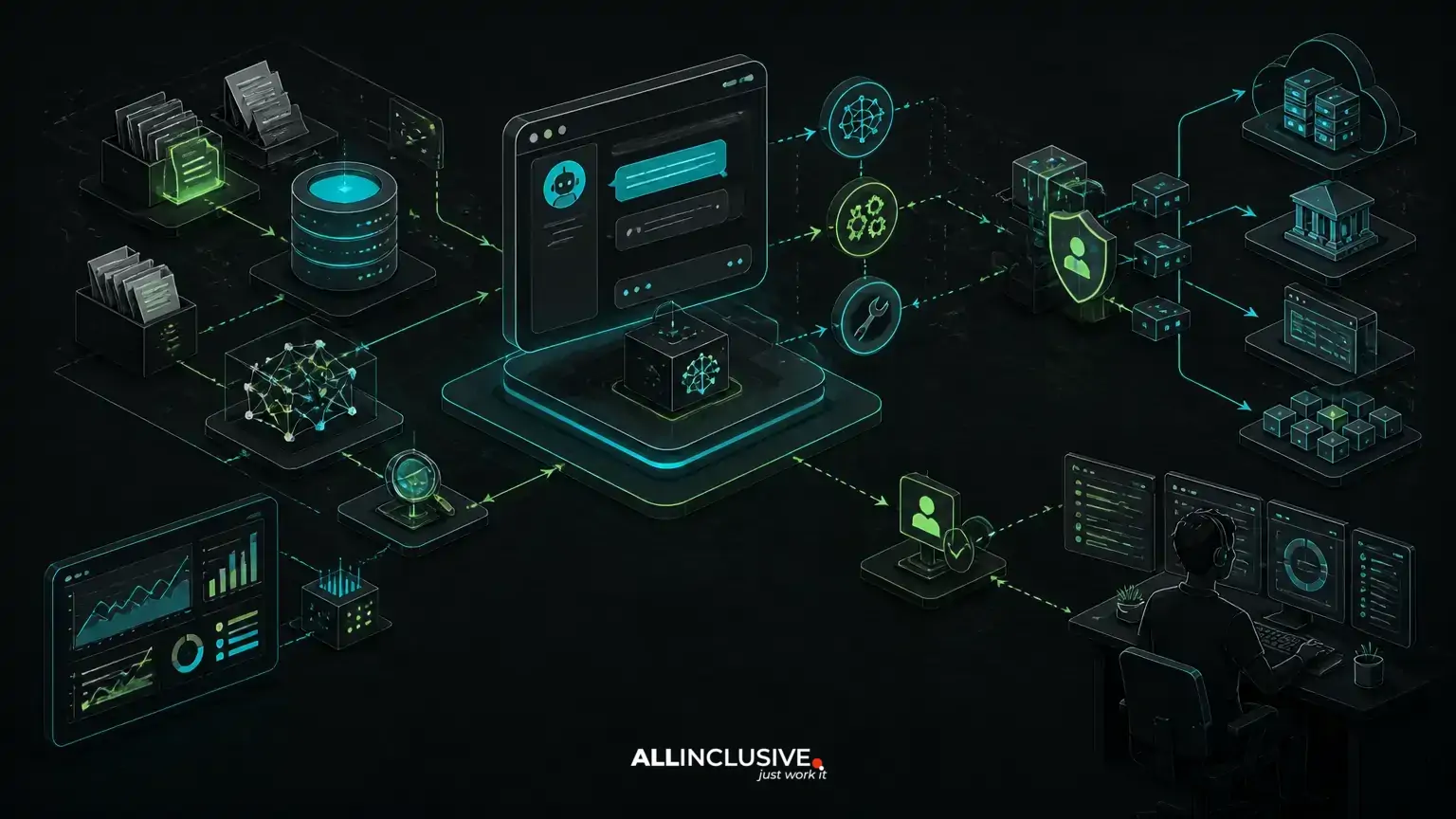
Custom AI chatbot development is the process of building a conversational system around a specific business workflow, knowledge base, user population, and operating model. It goes beyond connecting a chat interface to an LLM. A production chatbot must retrieve reliable information, respect permissions, call approved tools, handle uncertainty, protect sensitive data, and provide a path to human review.
An FAQ bot may be enough for a narrow public knowledge base. A connected business assistant requires a broader architecture: an application layer, model integration, retrieval services, business-system connectors, observability, evaluation, and operational controls. The right design depends less on choosing a particular model than on defining what the assistant is allowed to know and do.
What makes a custom AI chatbot different from a basic bot?
A basic bot usually follows scripted flows or returns answers from a limited collection of content. A custom AI chatbot can interpret varied requests, use business context, search approved sources, and support workflows such as ticket creation, account lookups, document analysis, or internal handoffs.
That flexibility introduces engineering responsibility. The chatbot needs explicit boundaries around:
- Knowledge: Which documents, records, and systems may inform an answer?
- Actions: Which operations can the assistant perform, and which require confirmation?
- Identity: How is the user authenticated and mapped to existing permissions?
- Uncertainty: When should the chatbot ask a clarifying question, decline, or escalate?
- Accountability: Which prompts, retrieved sources, tool calls, and outcomes should be logged?
This is why production chatbot work belongs within a broader AI development discipline rather than being treated as a front-end widget.
Core architecture for a production chatbot
A maintainable implementation commonly separates the conversational experience from orchestration, retrieval, business logic, and model access. The exact components can vary, but the separation helps teams replace models, change data sources, and improve controls without rewriting the entire product.
1. Conversation and application layer
The user interface may live in a web application, customer portal, support console, mobile product, or internal tool. This layer manages authentication, conversation history, streaming responses, attachments, rate limits, and user-facing error states.
For an existing Laravel or PHP product, the application layer can own user accounts, permissions, workflows, billing, notifications, and audit records. A Python service can own AI-specific workloads such as document processing, retrieval orchestration, model calls, and evaluation pipelines. This division is useful when the product already has a mature application layer but needs specialized AI services.
2. Model gateway and orchestration
A model gateway centralizes requests to one or more language models. It can apply standardized prompts, token limits, timeout policies, structured output requirements, redaction rules, and fallback behavior. Keeping this boundary explicit reduces vendor lock-in and makes model changes easier to test.
Orchestration determines what happens for each request. A simple assistant may use one model call followed by retrieval. A more capable assistant may classify the request, retrieve relevant information, select a tool, validate the result, and compose a response. Orchestration should remain bounded and observable; an open-ended loop of model-generated actions is difficult to secure and debug.
3. Retrieval and knowledge services
Retrieval-augmented generation, or RAG, gives a chatbot access to information that is not reliably contained in the model’s training data. Documents are typically parsed, split into meaningful passages, converted into embeddings, and stored in a vector-capable search system. At query time, the system retrieves candidate passages and may rerank them before providing selected context to the model.
Good retrieval is not just a database decision. Chunk size, metadata, document versions, access filters, query rewriting, hybrid keyword search, reranking, and citation behavior all affect answer quality. A chatbot that retrieves outdated or unauthorized content can produce a confident but unacceptable response.
For a deeper infrastructure comparison, see pgvector vs Pinecone. The choice should follow requirements such as existing database ownership, scale, filtering, operational preferences, and team expertise.
4. Tools and business integrations
Tools allow a chatbot to interact with systems instead of merely describing what a user could do. Examples include searching an order system, checking a subscription, creating a support ticket, drafting a response, or requesting approval.
Each tool should have a narrow contract, validated inputs, explicit authorization, and a defined failure response. Destructive or externally visible actions should generally require confirmation or human approval. The assistant should not receive unrestricted database access or broad credentials simply because a model can generate a query.
Choosing between FAQ, RAG, and agent behavior
Not every chatbot needs an agent. A useful decision sequence is:
- Use deterministic flows when the task has a small number of known states, such as collecting information for a form.
- Use retrieval when the main requirement is answering questions from changing or private content.
- Use tools when the assistant must read from or write to business systems.
- Use bounded agent behavior when the task requires selecting and sequencing several approved tools.
Agent behavior adds flexibility but also increases latency, token use, testing complexity, and the number of failure modes. A chatbot should not become an agent merely because the label sounds more advanced. Start with the narrowest architecture that supports the user workflow.
For a related discussion of autonomy and controls, read AI agent development: what makes an agent production-ready. If the product needs suggestions inside an existing workflow rather than a standalone conversation, AI copilot development may be the more relevant pattern.
Permissions, privacy, and data handling
Chatbot security cannot be delegated to the model. Authorization belongs in application code and the systems that own the data. Retrieval should apply user or tenant filters before context reaches the model, and tool calls should recheck permissions at execution time.
Teams should define how prompts, responses, uploaded files, retrieved passages, and tool results are stored. Sensitive fields may need redaction before model submission. Retention, deletion, access to logs, provider data handling, and regional processing requirements should be reviewed before production launch.
Multi-tenant systems require particular care. A shared index or cache can create cross-tenant exposure if tenant identifiers are not enforced at every retrieval and persistence boundary. Tests should deliberately attempt unauthorized access rather than relying only on happy-path checks.
Evaluation before launch
Manual demonstrations are not enough to validate a custom chatbot. Evaluation should use representative questions, expected behaviors, difficult edge cases, and adversarial inputs. The goal is not to prove that every answer is identical; it is to measure whether the system follows the required policy and produces useful outcomes.
A practical evaluation set may include:
- Questions whose answers are present in approved sources.
- Questions with incomplete, conflicting, or outdated information.
- Requests that require a clarifying question.
- Attempts to access another user’s or tenant’s data.
- Prompt-injection content embedded in documents.
- Tool calls with invalid, incomplete, or unauthorized inputs.
- Requests that should be escalated to a person.
Evaluation can combine automated checks, structured human review, retrieval inspection, and regression tests. Results should be versioned alongside prompts, retrieval settings, tool definitions, and model configurations so that changes can be compared rather than judged from isolated conversations.
Observability, latency, and cost controls
When a chatbot gives a poor answer, teams need to know why. Useful telemetry may include request identifiers, model and prompt versions, retrieval queries, selected sources, tool calls, validation failures, response times, token usage, escalation outcomes, and user feedback. Logs should be designed with privacy in mind and should not expose sensitive content unnecessarily.
Latency and cost are architectural concerns. Retrieval depth, reranking, multi-step orchestration, large conversation histories, and high-capability models can all increase resource use. Common controls include concise context construction, conversation summarization, model routing by task, caching where appropriate, bounded tool loops, streaming responses, timeouts, and graceful fallbacks.
A fallback should be useful rather than misleading. If retrieval fails, the chatbot may state that it cannot verify the answer and offer a support route. If a business system is unavailable, it should not claim that an action succeeded.
Human review and operational ownership
Human review is part of the product design, not merely a safety net added after launch. Define when a conversation must be handed off, what context the reviewer receives, how ownership is assigned, and whether the user is told that a person will respond.
Review is especially important for high-impact decisions, sensitive support cases, irreversible actions, complaints, and low-confidence answers. The handoff process should preserve relevant conversation history while limiting unnecessary exposure of personal data.
Ownership also needs to be explicit. Product teams should own the intended user outcomes and escalation policy. Engineering should own reliability, integrations, access control, and deployment. Domain experts should maintain source content and review evaluation cases. Without this operating model, a chatbot can remain technically functional while becoming stale or untrusted.
A practical custom chatbot development checklist
- Define the primary user groups and highest-value workflows.
- Separate informational answers from actions that change business records.
- Inventory approved data sources, owners, freshness requirements, and access rules.
- Choose deterministic flows, RAG, tools, or bounded agent behavior for each use case.
- Design authentication, tenant isolation, authorization, redaction, retention, and auditability.
- Create an evaluation set before optimizing prompts or models.
- Instrument retrieval, model calls, tool execution, latency, cost, failures, and escalation.
- Provide clear fallbacks when the model, retrieval layer, or connected system is unavailable.
- Launch with a limited workflow, monitor real interactions, and expand based on evidence.
When custom development is justified
A managed chatbot platform may be appropriate for a narrow, low-risk FAQ use case. Custom development becomes more valuable when the assistant must use private or frequently changing data, enforce complex permissions, integrate with existing workflows, support multiple tenants, meet specific privacy requirements, or provide measurable operational outcomes.
The central question is not whether a model can produce a convincing answer in a demonstration. It is whether the complete system can deliver a useful answer or action under real permissions, data quality, latency, failure, and review conditions. Teams planning the application architecture can also explore Python development for AI services and web development for the surrounding product experience.
For a broader distinction between an API experiment and an operational system, see AI proof of concept vs production system. A well-scoped chatbot is usually the result of disciplined product and software engineering: narrow permissions, traceable retrieval, tested tools, observable model behavior, and a human path for cases the system should not handle alone.
Explore the wider development practice when the chatbot must be integrated into an existing product rather than deployed as an isolated demo.


