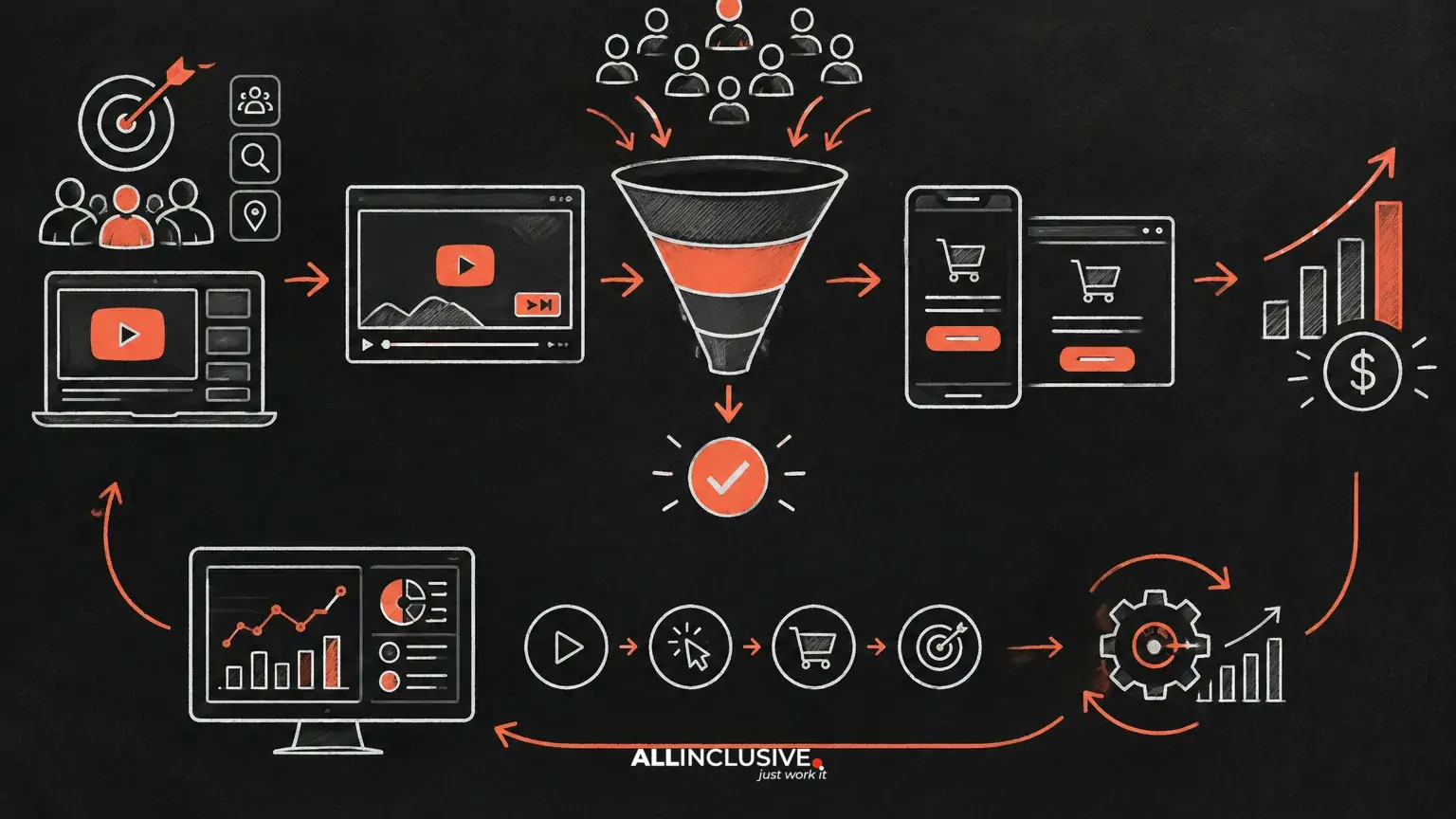
YouTube video action campaigns are designed for advertisers who want video to contribute directly to measurable actions—not only reach, views, or assisted awareness. The strongest setups connect a clear conversion objective to reliable measurement, audience signals, useful creative, and a testing plan that accounts for the delay between exposure and action.
This guide explains how to plan and launch a conversion-focused YouTube campaign, what to validate before spending, and how to interpret performance without confusing inexpensive engagement with business value.
What YouTube video action campaigns are built to do
A video action campaign uses video inventory and direct-response creative to encourage an action such as a purchase, lead submission, trial start, booking, or other valuable website event. The campaign type is only one part of the system. Results depend on the relationship between the offer, landing page, conversion tracking, audience inputs, creative, and bidding objective.
That distinction matters because a campaign can generate views, clicks, or low-cost traffic while producing few qualified outcomes. Before launch, define the business action that matters and make sure the account can record it consistently.
Start with the conversion architecture
Conversion architecture is the foundation of the campaign. It determines what the platform can optimize toward and what your team will use to judge success.
Choose one primary outcome
Select a primary conversion that represents meaningful progress for the business. Examples include:
- Completed purchase or subscription
- Qualified lead form submission
- Demo or consultation request
- Account creation or trial activation
- Completed booking or application
Supporting events can still be useful for analysis, but avoid asking an automated bidding system to optimize toward several actions with very different values unless there is a clear reason to do so.
Audit the measurement path
Verify that the conversion event fires after the intended action, is attributed to the correct account, and is not duplicated by multiple tags or integrations. Test the complete journey across devices and browsers where practical. Also document whether reported conversions are online actions, imported offline outcomes, or a combination.
For lead-generation campaigns, the form submission may be easy to track while lead quality is not. If possible, connect downstream qualification or revenue data to the marketing measurement process. Otherwise, optimize first for reliable lead capture and use CRM analysis to evaluate quality.
Set a realistic value framework
If different conversions have different commercial value, assign values using a defensible business model rather than arbitrary numbers. A qualified enterprise inquiry, for example, may be more valuable than a newsletter signup. If value data is not yet dependable, prioritize clean counting and a stable primary event before adding complexity.
Define the offer before selecting the audience
Conversion-focused video needs a clear reason to act. A broad promise such as “learn more” is often weaker than a specific next step tied to the viewer’s problem.
Clarify four elements:
- Problem: What costly, urgent, or frustrating situation does the viewer recognize?
- Proof: Why should the viewer believe the proposed solution is credible?
- Offer: What exactly is available now—such as a guide, assessment, trial, consultation, or product?
- Action: What should the viewer do next, and what will happen after the click?
Keep the landing page aligned with the promise in the video. A mismatch between the ad and page can produce clicks without meaningful progression.
Build the campaign around audience signals
Audience strategy should reflect both buying intent and the amount of conversion data available. Relevant options may include first-party audiences, customer lists where permitted, website or app activity, in-market or affinity-style audience categories, search-intent signals, and contextual or placement approaches.
Use audience inputs as a structured testing framework rather than assuming one segment will perform immediately. Separate audiences when you need to compare intent, message relevance, or lead quality. Avoid excessive fragmentation if the campaign lacks enough data to support meaningful comparisons.
For a new campaign, a practical sequence is:
- Identify the audience most likely to have the problem now.
- Use available first-party signals to re-engage known visitors or prospects when appropriate.
- Test a broader prospecting approach once the offer and conversion path are credible.
- Create a separate remarketing plan for viewers or site visitors who did not complete the action.
Remarketing should not simply repeat the first message. Use a different objection-handling angle, proof point, or offer where appropriate. See the YouTube remarketing guide for audience sequences and creative considerations.
Design video creative for action
Conversion video has to earn attention quickly and make the next step understandable. The production style can vary, but the structure should support the intended action.
A practical creative structure
- Opening: Introduce the problem, audience, or outcome early enough to establish relevance.
- Development: Explain the mechanism, demonstrate the product, or show how the solution addresses the problem.
- Proof: Use a credible demonstration, customer evidence, expert explanation, comparison, or specific detail.
- Call to action: State the next step and connect it to a clear benefit.
Build variations around the same offer so you can test different openings, demonstrations, lengths, tones, and calls to action without changing the entire strategy at once. Make the message understandable with sound off where practical, while preserving a strong spoken experience for viewers using audio.
Do not treat the call-to-action element as a substitute for persuasive creative. The video should establish relevance and confidence before asking for the click.
For a broader discussion of hooks, story structure, and calls to action, read YouTube ad creative strategy.
Configure the campaign with disciplined inputs
During setup, align the campaign objective, conversion action, budget, geography, language, inventory preferences, exclusions, and landing page. The exact interface and available options can change, so treat platform settings as implementation details to verify at launch rather than permanent assumptions.
Budget and bidding
Set a budget that allows the campaign to gather enough information to evaluate the selected conversion event. If the event is rare, a very constrained budget can make the learning period difficult to interpret. If the business has a strict efficiency threshold, define it before launch but avoid reacting to short-term volatility without checking conversion delay and volume.
Choose bidding around the business objective, not a proxy metric. A low cost per view may be useful for awareness, but it does not establish that the campaign is efficient for lead generation or sales.
Geography and language
Match targeting to where the offer can actually be delivered. For international campaigns, consider whether landing pages, sales coverage, pricing, legal terms, and follow-up processes are available in each market. Combining markets can obscure meaningful differences in conversion rate, lead quality, and sales-cycle length.
Inventory, exclusions, and brand suitability
Review available inventory controls and content exclusions with your brand requirements in mind. Balance reach with the environments in which your audience and brand are comfortable appearing. Document the choices so performance changes can be interpreted later.
Use a measurement plan that separates signals
Track the funnel in layers:
- Delivery: impressions, reach, frequency, and spend
- Engagement: views, view rate, watch behavior, and interaction
- Traffic: clicks, sessions, landing-page engagement, and bounce or abandonment patterns
- Conversion: leads, purchases, trials, bookings, or other primary actions
- Business quality: qualified leads, pipeline, revenue, retention, or contribution margin where available
These metrics answer different questions. Engagement can diagnose whether the creative is earning attention. Traffic can reveal landing-page or message alignment. Conversion and downstream quality determine whether the campaign is commercially useful.
Use consistent naming conventions for campaigns, audiences, creative versions, offers, and landing pages. Record launch dates, major changes, conversion definitions, and analysis windows. This turns optimization into a series of explainable decisions rather than a collection of isolated metric checks.
Optimize in the right order
When performance is weak, change the highest-leverage variable first.
- Validate tracking: Confirm that the conversion is firing, counted correctly, and assigned to the intended source.
- Check the offer and page: Review message match, page speed, form friction, trust signals, and mobile usability.
- Review creative: Look for a slow opening, unclear value, weak proof, or an indistinct call to action.
- Assess audience fit: Examine whether the targeting reflects actual demand and service availability.
- Evaluate bidding and budget: Make sure the campaign has enough flexibility and that the selected objective matches the available data.
Change one major variable at a time when possible. If you replace the creative, audience, offer, landing page, and bid approach together, you may improve performance without learning why—or make diagnosis impossible.
YouTube Video Action Campaigns: Mistakes to Watch For
- Optimizing for views when the goal is revenue: Use engagement as a diagnostic, not the final business judgment.
- Launching without a tested conversion event: A campaign cannot reliably optimize toward a signal it cannot record.
- Using one generic video for every audience: Adapt the problem framing and proof to the viewer’s awareness level.
- Over-segmenting early: Too many small ad groups can dilute data and make comparisons unreliable.
- Ignoring conversion lag: Recent traffic may not yet have had time to convert, particularly for considered purchases or B2B offers.
- Judging lead generation only by form volume: Connect campaign data to qualification and sales outcomes where possible.
When to use a separate remarketing layer
Prospecting and remarketing usually serve different jobs. Prospecting introduces the problem and offer to people who may not know the brand. Remarketing can address hesitation, provide proof, clarify the process, or present a more direct conversion path.
Build remarketing audiences around meaningful behavior where possible, such as site visits, video engagement, product views, or incomplete forms. Apply sensible exclusions so recent converters do not continue receiving acquisition messages. Audience duration and sequencing should reflect the buying cycle rather than an arbitrary default.
How this fits into a broader paid-media program
YouTube video action campaigns work best when they are connected to the rest of the acquisition system. Search can capture active intent, display or social can support discovery and retargeting, and CRM data can reveal whether leads become qualified opportunities. The right channel mix depends on the offer, buying journey, measurement quality, and operational capacity. For a broader framework, explore paid media strategy and execution.
Launch checklist
- Primary conversion and value logic are documented.
- Tracking has been tested through the complete conversion path.
- Landing page promise matches the video message.
- Creative includes a clear problem, proof, offer, and action.
- Audience structure reflects intent without unnecessary fragmentation.
- Geography, language, inventory, and exclusions match business requirements.
- Budget, bid objective, and evaluation window are defined in advance.
- Campaign naming and change logs are ready for analysis.
- Lead quality or downstream business outcomes have a review process.
The most reliable YouTube video action campaigns are not created by a single setting. They are built as measurement-led systems: a valuable offer, a credible message, a usable landing page, appropriate audience signals, and a disciplined optimization process. Start with the conversion path, then use video to make the next action feel relevant and worthwhile.
For broader strategic context, see our YouTube advertising resource.