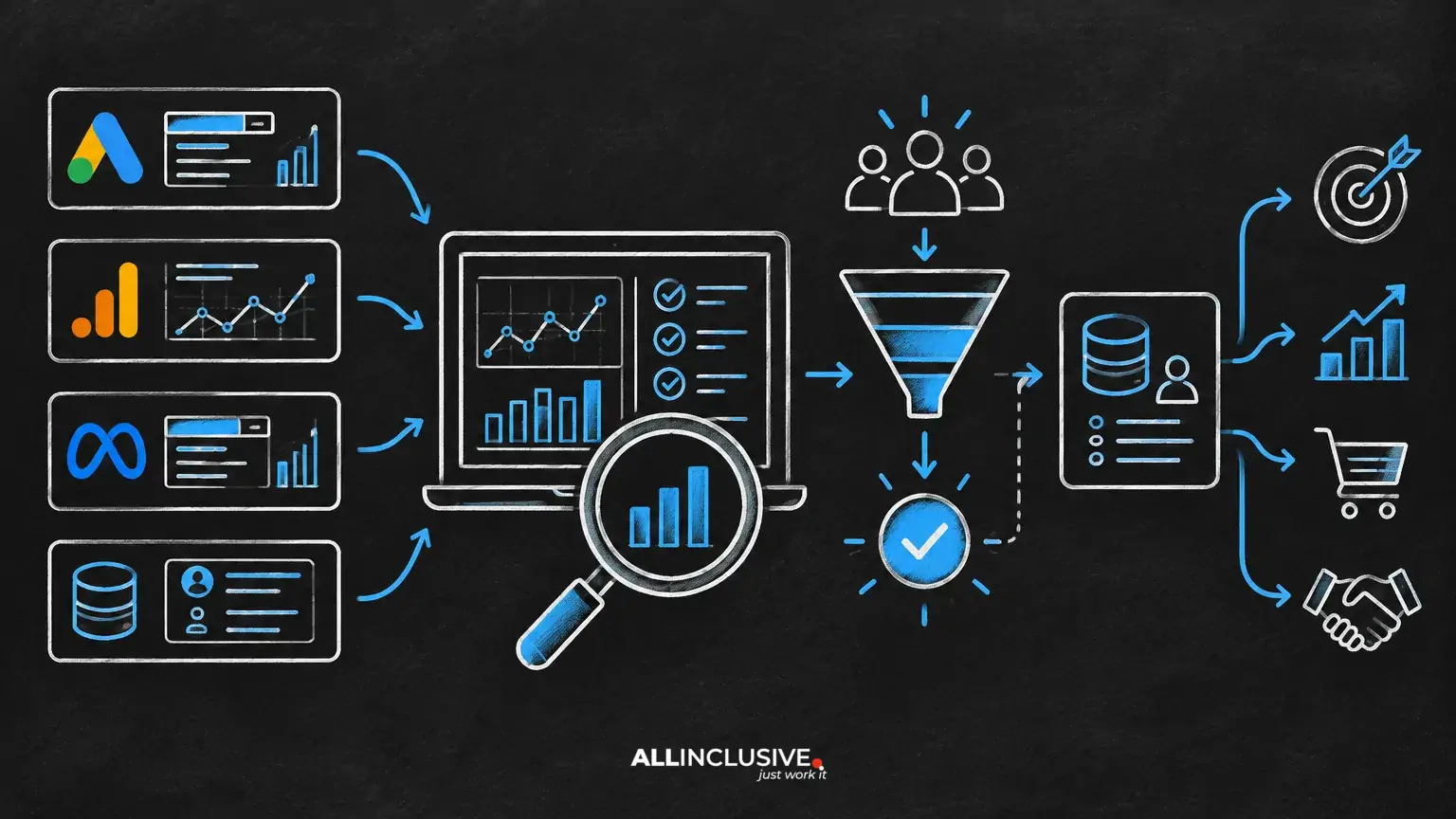
When comparing pmax vs search, the most useful question is not which campaign type is universally better. It is which job each campaign should perform in your account.
Search campaigns are usually the stronger control layer for capturing known intent. Performance Max can extend reach across eligible Google inventory using automated targeting, bidding and creative combinations. A durable structure often uses both: Search to protect and prioritize high-value demand, and Performance Max to find additional opportunities where the economics and measurement support expansion.
The right split depends on your conversion data, margins, brand strategy, creative assets, feed quality, geographic coverage and tolerance for limited placement-level control. This guide explains how to assign roles, allocate budget and decide whether a campaign is adding incremental value.
What is the difference between Performance Max and Search?
A Search campaign is built around keyword- and query-led demand capture. It gives advertisers more direct control over themes, ad messaging, landing pages, negatives, match behavior and budget priorities, although the exact mechanics depend on account settings and ongoing platform changes.
Performance Max is designed to use automation across multiple Google surfaces. Rather than treating it as a single placement, evaluate it as an automated campaign layer that may access several types of inventory. Its effectiveness depends heavily on the signals, assets, conversion goals, product or service data and constraints supplied by the advertiser.
These differences create distinct strategic roles:
- Search: deliberate demand capture, query governance, message control and high-intent segmentation.
- Performance Max: automated discovery, cross-surface reach and expansion when sufficient signals and conversion quality are available.
Neither role guarantees profitable growth. A Search campaign can scale inefficiently if it captures low-value queries, while PMax can appear efficient if conversion definitions, attribution or branded demand are not examined carefully.
When Search should lead
Search should generally receive priority when the business needs tighter control over intent, messaging or budget. This is particularly relevant when:
- Customers use clear, commercially meaningful queries.
- Different keyword themes require different landing pages, offers or qualification rules.
- Brand protection, competitor messaging or legal review requires explicit control.
- Lead quality varies materially by query, product, geography or audience.
- The account has limited conversion volume and cannot yet support broad automation confidently.
- Sales capacity or inventory constraints make selective demand capture more important than maximum reach.
Search is also useful as a diagnostic layer. Query analysis, search-term reviews and segmented conversion reporting can reveal whether the account is attracting the right demand before more automation is introduced.
Search campaign priorities
Organize Search around business intent rather than an unnecessarily complex keyword taxonomy. Common distinctions include brand, non-brand category, high-value product or service, competitor, and location or use-case themes. Give each group a clear purpose and a landing-page path.
Build ad messaging around the reason a prospect should choose the business, not simply around repeated keyword insertion. Review the search terms that generate conversions, qualified leads or revenue, and use those findings to refine negatives, landing pages and offer language. For ad asset guidance, see the Responsive Search Ads guide.
When Performance Max should play a larger role
Performance Max can be appropriate when the account has a dependable conversion framework, usable creative assets and a credible reason to expand beyond tightly controlled Search demand. It may be especially useful when:
- The business has sufficient conversion history for automated bidding to learn from.
- Products, services or offers can be represented clearly through feeds, assets or landing pages.
- There is meaningful demand outside the queries the team can identify in advance.
- The organization can evaluate incremental value rather than relying on reported conversions alone.
- Stakeholders accept less granular placement and query control in exchange for automated reach.
PMax is not a substitute for fixing weak fundamentals. If conversion tracking is unreliable, lead quality is unknown, margins are ignored or creative assets are poor, adding automation can make diagnosis harder rather than improve performance.
For a deeper operating framework, read Performance Max Strategy: When PMax Helps and When It Hides Problems.
How to split budget between PMax and Search
There is no universal percentage split. Start with business priorities and marginal economics, then use budget as a control mechanism for the role you want each campaign to play.
1. Fund non-negotiable Search coverage first
Estimate the budget required to cover the Search themes that are strategically important: high-value categories, core services, brand protection where relevant and markets with strong commercial intent. This does not mean funding every keyword at any price. It means protecting the demand that the business can define and evaluate with confidence.
2. Reserve a controlled expansion budget for PMax
Use the remaining budget, or a deliberately capped test allocation, to assess whether PMax can generate incremental qualified demand. The test should have a defined hypothesis, time window, conversion objective and decision rule. Avoid treating an automatically generated campaign as a blank check simply because its reported return initially looks attractive.
3. Reallocate by marginal value
Compare the next dollar invested in each role, not only the average account return. If Search is losing valuable impression share on high-priority themes while PMax is absorbing budget from less certain demand, the answer may be to restore Search coverage. If Search is saturated and PMax is producing additional qualified outcomes at an acceptable cost, expansion may be justified.
A practical planning table can include:
- Campaign role and business objective
- Primary conversion and qualification criteria
- Budget floor or test cap
- Target efficiency range based on contribution margin or customer value
- Known risks, such as brand concentration or weak lead validation
- Review date and reallocation rule
How to evaluate overlap and incremental value
Reported campaign conversions do not automatically show that one campaign created new demand. PMax and Search may participate in the same customer journey, and branded demand can make an automated campaign appear stronger than its true incremental contribution.
Use a layered evaluation process:
- Check conversion integrity. Confirm that primary conversions represent meaningful business outcomes and that duplicate, low-intent or unsuitable actions are not inflating results.
- Segment by business value. Separate revenue, qualified opportunities, booked meetings, purchases or other outcomes that matter commercially from weaker proxy events.
- Review brand and non-brand performance. A blended total can hide whether the campaign is discovering demand or harvesting existing demand.
- Compare marginal efficiency. Examine what happens as spend increases, rather than relying only on a single blended return.
- Use controlled tests where feasible. Geo, budget or campaign experiments may help estimate incrementality, but the method must fit the account and preserve statistical and operational validity.
Do not expect perfect channel isolation. The objective is a better decision about the next budget allocation, not a claim that every conversion belongs to one campaign.
A practical structure for common account types
Lead generation
Use Search to separate high-intent services, industries, use cases or locations when those distinctions affect qualification. Ensure offline outcomes, such as accepted opportunities or closed business, can inform optimization where the data quality and implementation support it. Test PMax only when lead quality feedback is available and the business can tolerate broader prospecting.
Ecommerce
Search can protect branded demand, priority categories and high-intent product themes. PMax may support broader product discovery when product data, pricing, availability, creative assets and purchase tracking are reliable. Analyze product and customer value, not just order volume, so automated delivery does not over-favor low-margin transactions.
Seasonal or promotion-led businesses
Use Search for clear promotional intent and critical terms that must be covered during a demand spike. Introduce or expand PMax when assets, feeds, inventory and landing pages are ready for the promotion. Set budget and measurement rules before demand accelerates; review the related Google Ads seasonality guide for planning considerations.
Common mistakes in a PMax vs Search decision
- Choosing by campaign label. “Automated” does not mean more profitable, and “keyword-based” does not mean sufficiently incremental.
- Comparing unlike conversion actions. A campaign optimized to a weak form fill should not be compared directly with one measured on qualified revenue.
- Underfunding Search and blaming demand. If priority Search themes cannot access enough budget, the account may be creating a self-inflicted coverage problem.
- Using PMax to compensate for poor assets or feeds. Automation cannot reliably repair unclear offers, incomplete product data or weak landing experiences.
- Ignoring brand concentration. Review branded contribution and other indicators of existing demand before interpreting efficiency.
- Changing too many variables at once. Budget, bidding, conversion actions, creative and structure changes should be documented so the team can identify what influenced results.
Performance Max vs. Search Campaigns: Implementation Checklist
- Define the business outcome and acceptable efficiency threshold.
- Audit conversion actions, lead quality, revenue values and attribution settings.
- Map Search campaigns to priority intent and landing pages.
- Document the role PMax is expected to play: coverage, discovery, product scale or another specific objective.
- Prepare relevant assets, feeds and audience or customer signals without assuming they guarantee performance.
- Set a budget floor for essential Search coverage and a controlled allocation for PMax testing or scale.
- Separate brand, non-brand and other meaningful segments in reporting.
- Establish a review cadence based on sufficient data and business decision cycles.
- Reallocate budget according to qualified marginal value, not platform-reported volume alone.
The bottom line
The best answer to PMax vs Search is usually a role-based portfolio rather than an either-or decision. Search provides a clearer control and intent-capture layer. Performance Max can provide automated expansion when the account has strong signals, assets, economics and measurement.
Start with the demand you understand, protect the campaigns that matter most, and test automation against an explicit incremental-growth hypothesis. For the broader operating context, explore our paid search resources and paid media hub.