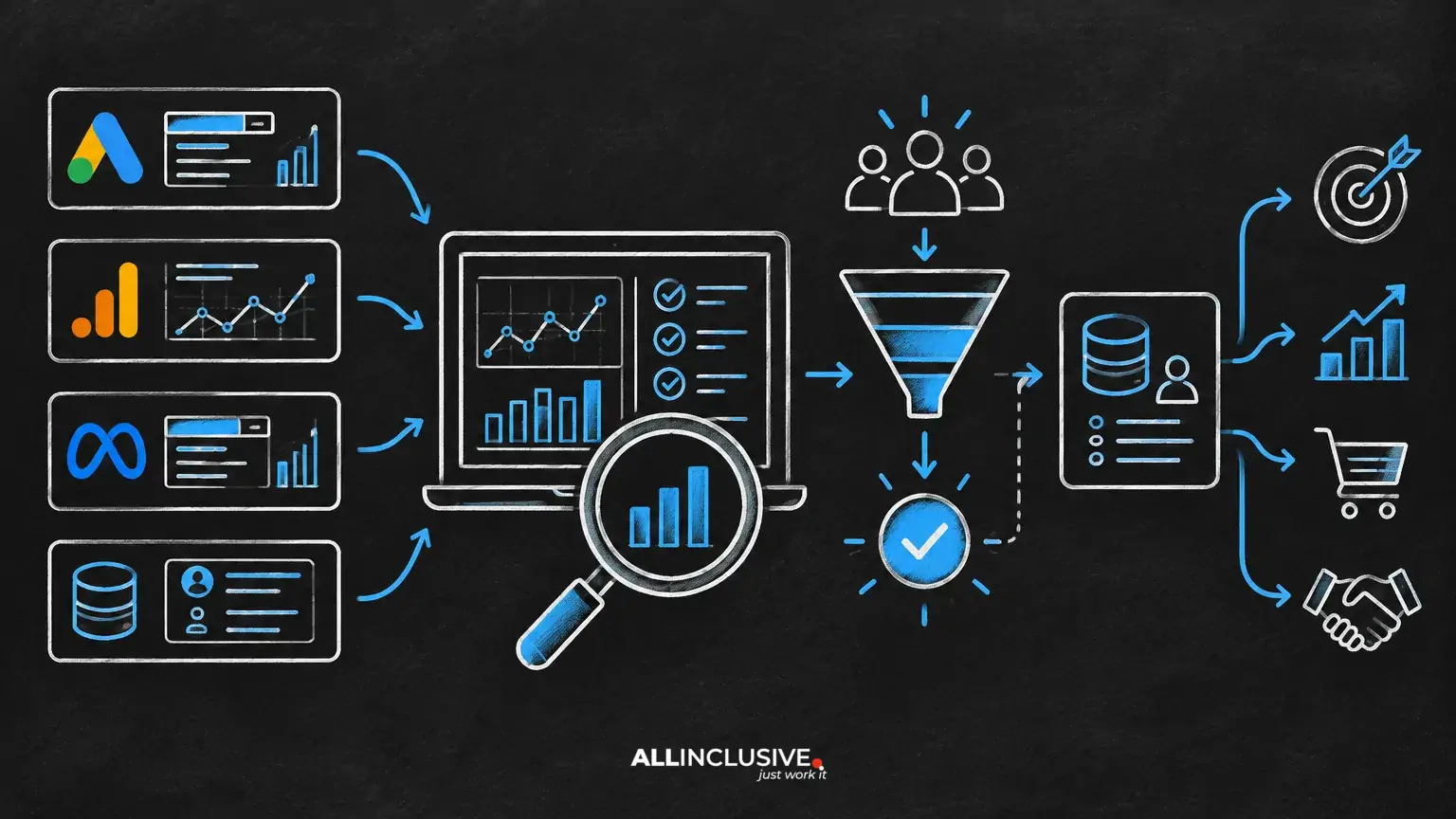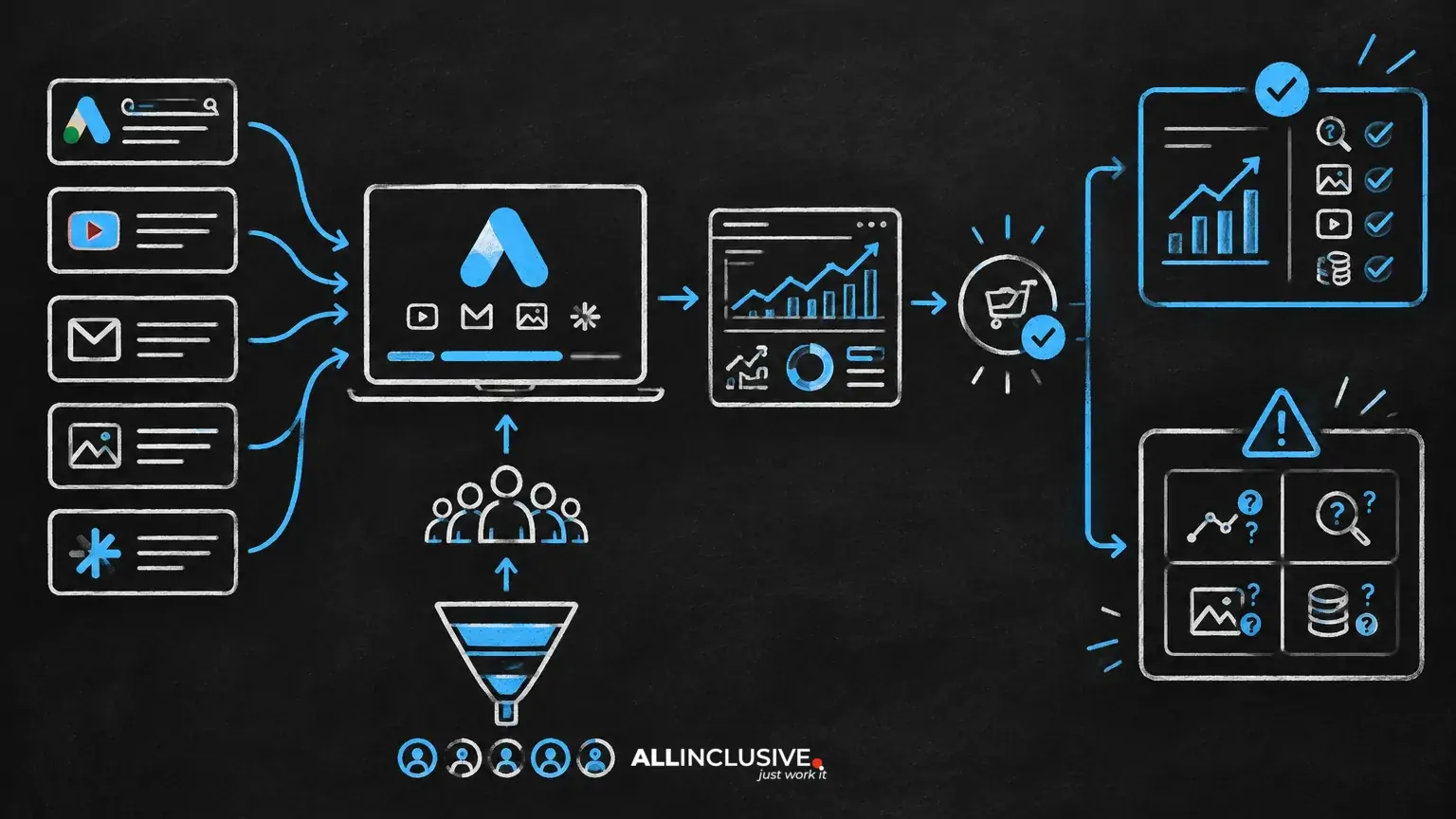
A sound performance max strategy starts with a decision that is often overlooked: whether Performance Max is solving a clearly defined growth problem or simply absorbing budget inside a complicated account.
Performance Max can help advertisers access multiple Google inventory types through one campaign and optimize toward selected conversion goals. It can be useful when measurement is reliable, creative assets are sufficient, product or service demand is broad enough, and the team has a disciplined way to evaluate incremental value.
It can also hide problems. Weak conversion tracking, poor landing pages, unclear search intent, limited creative, or excessive dependence on automated bidding may be obscured by blended reporting. If those foundations are not ready, adding PMax can make an account look more active without making it more profitable.
This guide explains when to use Performance Max, when to delay it, how to assign it a role alongside Search, and how to evaluate it without treating platform-reported efficiency as the whole business case.
What Performance Max is—and what it is not
Performance Max is a Google Ads campaign type designed to use automation across multiple Google surfaces. The advertiser supplies inputs such as conversion goals, audience signals, creative assets, budgets, feed information where relevant, and bidding preferences. The platform then determines where and when to show ads based on its predictions.
That makes PMax a distribution and optimization system, not a complete paid-search strategy. Strategy still has to answer:
- Which business outcomes matter?
- Which customers or accounts are worth pursuing?
- What role should brand, non-brand, competitor, prospecting, and remarketing activity play?
- How much control is required over query intent, message, placement, budget, and exclusions?
- What evidence would justify increasing or reducing investment?
The distinction matters because automation can optimize efficiently toward the inputs it receives, even when those inputs are commercially incomplete. A campaign can meet a target cost per acquisition while producing low-value leads, overstating assisted influence, or concentrating on demand that other campaigns would have captured.
When a Performance Max strategy can help
1. Your conversion data is trustworthy
PMax is most defensible when the account can distinguish meaningful business outcomes from low-value actions. For a lead-generation advertiser, that may require separating qualified inquiries, sales-accepted opportunities, and closed revenue from form starts or generic calls. For ecommerce, it may require accurate transaction values, returns treatment, and clear primary conversion settings.
If the campaign is trained on unreliable or duplicated actions, automation receives a distorted definition of success. Before launch, audit the conversion path, attribution settings, imported offline outcomes, duplicate events, and the relationship between account-level goals and campaign-level objectives.
2. The business can support broad inventory access
PMax may be useful when customers discover a business through more than one type of intent or when the advertiser has strong visual, video, product, and audience inputs. It can extend beyond the narrow set of queries a manually structured Search campaign can target.
This does not mean every business needs maximum reach. It means the campaign has a credible reason to explore additional demand and enough assets to communicate consistently across placements.
3. The offer and landing experience are already credible
Automation cannot repair a weak offer. If the landing page is slow, vague, poorly matched to the ad promise, or difficult to convert on, additional distribution can increase wasted exposure. PMax is more likely to contribute when the value proposition, proof, calls to action, and conversion path are already tested.
4. You have a clear measurement plan beyond platform efficiency
A useful evaluation plan combines platform metrics with business outcomes. Depending on the model, that can include qualified lead rate, sales acceptance, pipeline value, gross margin, new-customer rate, repeat purchase behavior, and assisted or incremental revenue indicators.
Return on ad spend and cost per conversion may remain useful diagnostics, but they should not be the only decision criteria—especially when PMax operates alongside branded Search, organic demand, direct traffic, or other paid campaigns.
When PMax can hide problems
Unclear conversion definitions
If every micro-action is treated as a primary conversion, automated bidding may pursue activity rather than commercial value. Common warning signs include sharp conversion volume with no corresponding improvement in qualified opportunities, inconsistent lead quality, or a high proportion of contacts that sales cannot use.
The response is not necessarily to lower the target or change the budget. First, validate the event hierarchy and connect advertising outcomes to downstream revenue.
Insufficient control over search intent
Advertisers with strict query requirements may need more visibility and control than PMax provides on its own. Regulated categories, highly specialized B2B products, narrow service areas, and accounts with sensitive brand or competitor policies often benefit from explicit Search structures and query analysis.
PMax can have a role in those accounts, but it should not be used to avoid understanding where demand comes from. Pair it with campaigns that make high-value intent easier to inspect and govern.
Budget is being shifted toward easy conversions
Automation tends to favor opportunities it predicts will meet the chosen objective. If branded demand, remarketing audiences, or existing high-intent users convert more easily, blended campaign results may look strong while incremental prospecting remains weak.
Ask whether PMax is creating additional demand, capturing demand that would have converted anyway, or simply reallocating credit. The answer requires controlled comparisons, consistent segmentation, and attention to total business performance—not just the campaign dashboard.
Creative coverage is too thin
Automated distribution does not remove the need for message strategy. Limited asset variety, weak proof points, generic headlines, or inconsistent calls to action can restrict the system’s ability to match different audiences and contexts.
Review creative by customer stage and objection. For B2B campaigns, that may mean separate messages for problem awareness, solution evaluation, implementation risk, compliance, integration, and commercial proof. Assets should support the landing-page experience rather than repeat disconnected claims.
The account is using automation to avoid structural work
Performance Max should not be the default answer to poor account architecture. If brand and non-brand demand are mixed, conversion goals are inconsistent, or budgets are shared across materially different business priorities, the campaign may make diagnosis harder.
Before expanding PMax, clarify campaign roles, naming, exclusions, budget ownership, reporting dimensions, and the relationship between paid search and the broader paid media plan.
How to assign PMax a useful role
Start with a role statement that can be tested. For example:
- Incremental prospecting: find qualified customers beyond existing high-intent demand.
- Product discovery: broaden reach for a catalog with reliable value data and strong creative.
- Demand capture support: complement Search where customers use multiple discovery paths.
- Re-engagement: reconnect with users who have demonstrated meaningful interest, subject to the account’s privacy and audience approach.
A role statement prevents vague objectives such as “scale PMax” from becoming the strategy. It also determines what should be compared. A prospecting role should not be judged only against branded Search efficiency. A product-discovery role may require attention to new-customer quality and margin, not just order volume.
For a broader account framework, see the paid search strategy guide. For campaign-role decisions specifically, compare the trade-offs in PMax vs. Search campaigns.
PMax and Search: complementary roles, not automatic substitutes
Search campaigns remain valuable when the advertiser needs explicit control over keyword themes, ad messaging, landing pages, budgets, or query-level analysis. They are particularly useful for high-intent commercial terms, brand protection, priority services, and tightly defined account segments.
PMax may complement those campaigns by exploring additional inventory and signals. The correct split depends on business economics, demand volume, creative readiness, and measurement quality. Avoid assuming that one campaign type should replace the other simply because one reports a lower platform-attributed cost.
A practical structure often separates:
- Brand demand, where protection and message control matter.
- High-value non-brand intent, where query relevance and landing-page alignment require close attention.
- Distinct products, services, or markets with different economics.
- PMax initiatives with their own role, conversion logic, budget, and evaluation criteria.
A pre-launch checklist
- Define the business outcome. Specify the action or revenue event the campaign should optimize toward.
- Audit measurement. Confirm event accuracy, deduplication, value treatment, and offline feedback where available.
- Clarify campaign boundaries. Document brand, non-brand, product, market, audience, and budget responsibilities.
- Prepare assets. Build message variations around customer needs, objections, proof, and calls to action.
- Check landing-page alignment. Match each important message to a relevant destination and a clear next step.
- Set evaluation windows. Allow enough time for meaningful data while defining review checkpoints and stop conditions.
- Establish quality reporting. Connect platform activity to qualified leads, revenue, margin, or another defensible commercial measure.
How to evaluate PMax without overreacting
Do not judge the campaign from a single day or one dashboard metric. Build a review cadence that separates diagnostics from decisions.
Review delivery and input quality
Check budget utilization, asset coverage, conversion volume, conversion-value consistency, audience and feed inputs where applicable, and any material changes in landing pages or business conditions. These observations explain what the system had available to work with.
Review commercial quality
Compare lead qualification, sales progression, order quality, new-customer contribution, margin, and cancellation or return behavior with the campaign’s stated role. If the campaign reports efficient conversions but downstream quality declines, the optimization target needs attention.
Review incrementality carefully
Platform attribution can help with within-account diagnostics, but it does not by itself prove incremental business impact. Consider geographic, audience, budget, or campaign experiments where practical, and interpret results alongside total conversions, total revenue, and channel interactions.
Review search and placement signals where available
Use available reporting and account-level analysis to identify whether activity aligns with the intended customer and offer. The goal is not to demand manual control over every auction; it is to detect mismatches that require better exclusions, creative, landing pages, segmentation, or campaign roles.
Common mistakes in PMax decision-making
- Launching before fixing tracking: automation magnifies the consequences of bad inputs.
- Using one blended target for different economics: products, markets, or lead types may require separate goals.
- Scaling on attributed volume alone: growth should be judged against business quality and incrementality.
- Replacing Search prematurely: less control is not automatically better efficiency.
- Changing too many variables at once: budget, goals, assets, landing pages, and bidding changes can make diagnosis impossible.
- Ignoring creative fatigue or offer weakness: campaign automation cannot substitute for a persuasive customer proposition.
Performance Max Strategy: Decision Summary
Performance Max is most useful when it has a defined job, reliable conversion signals, strong inputs, and a measurement plan that extends beyond platform-reported efficiency. It becomes risky when it is used to conceal weak tracking, unclear campaign roles, poor creative, or unresolved demand-quality problems.
The best approach is neither automatic adoption nor blanket avoidance. Assign PMax a specific role, protect the areas where control and intent visibility matter, and evaluate the campaign against qualified business outcomes. When the evidence supports expansion, scale deliberately. When the evidence does not, diagnose the foundation before adding more automation.
For broader strategic context, see our paid search resource.