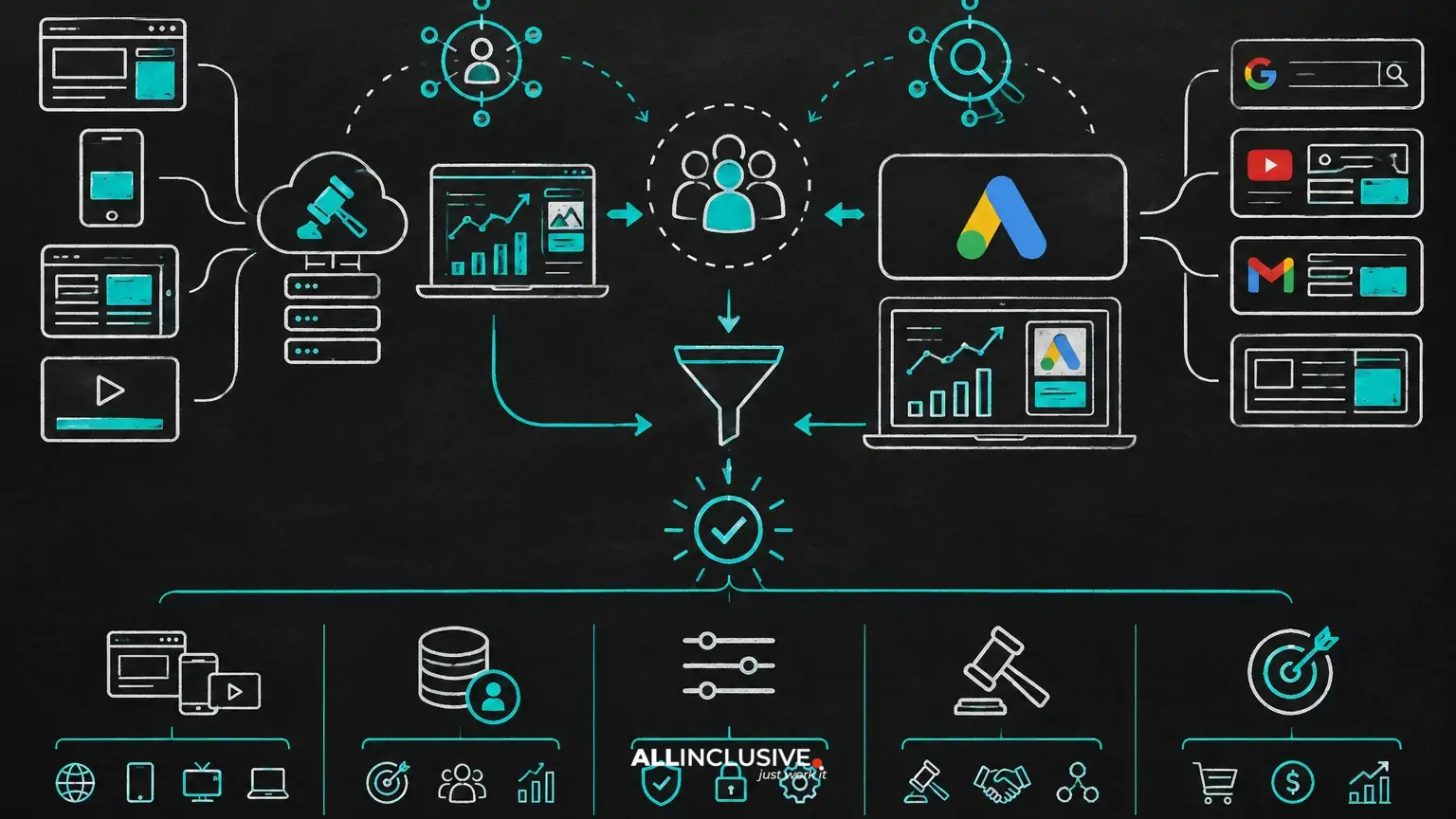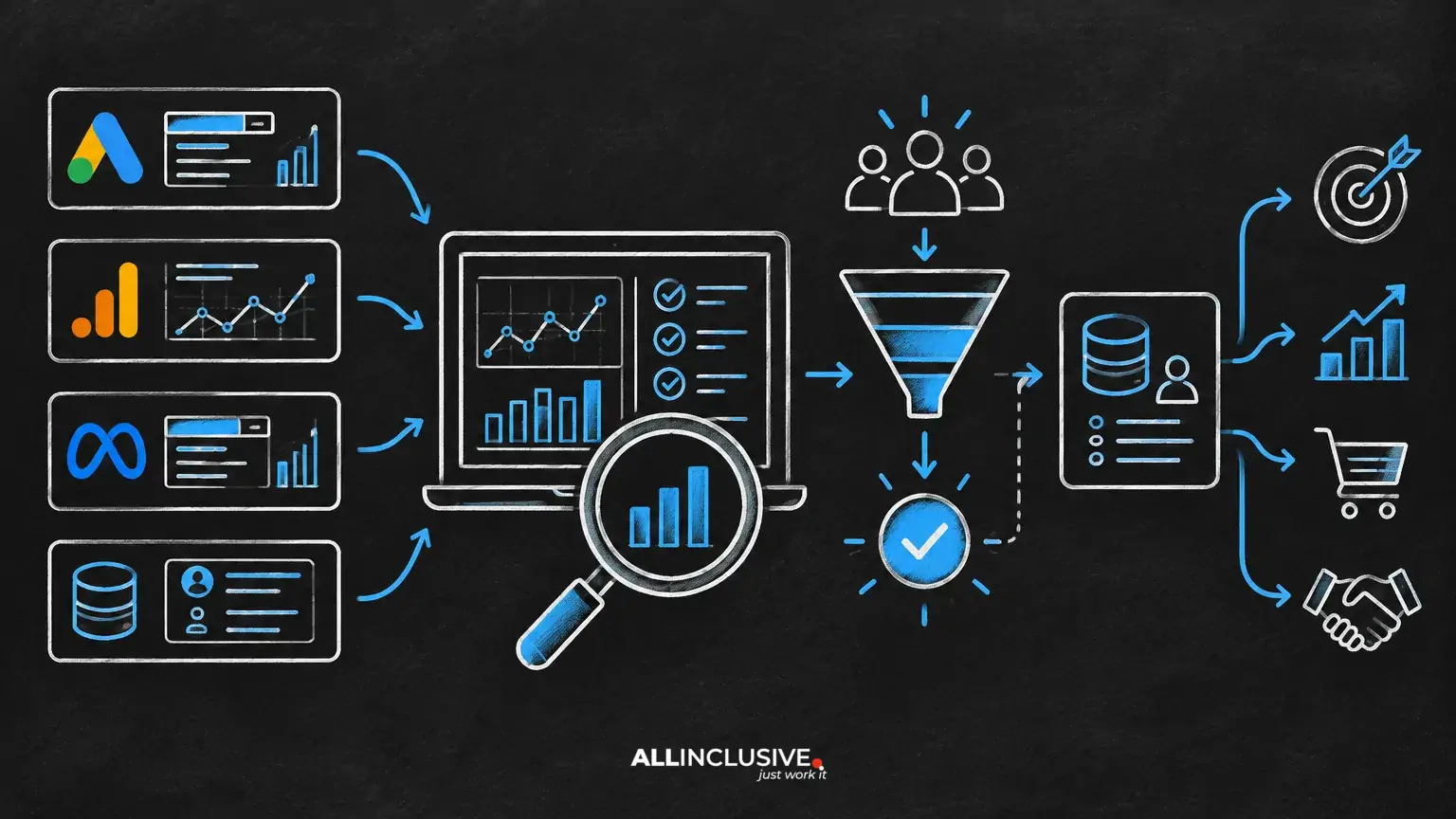
A conversion tracking audit checks whether paid-media platforms, analytics tools, websites and CRM systems record the right actions, with the right definitions, at the right stage of the customer journey. It is not simply a tag check. A campaign can show conversions while still misreporting duplicate leads, low-quality inquiries, revenue, or the source of each opportunity.
For that reason, audit the complete measurement chain before changing bids, budgets or creative. The objective is to establish which conversions are technically captured, which are strategically meaningful, and which can be connected to qualified pipeline or revenue.
What a conversion tracking audit should answer
A useful audit should produce clear answers to five questions:
- What happened? Which user actions are being recorded?
- Where was it recorded? Website, Google Ads, GA4, Meta, CRM or another system?
- Was it counted once? Can the same person or event enter reporting multiple times?
- Was it valuable? Does the action indicate genuine business intent?
- Can it be reconciled? Do the systems agree closely enough to support decisions?
The audit should also separate measurement problems from expected differences between platforms. Different systems may use different attribution settings, lookback periods, time zones, consent states and counting methods. A discrepancy is not automatically a tracking failure, but unexplained discrepancies deserve investigation.
Start with a conversion measurement map
Before inspecting tags, document the customer journey and the business meaning of each event. A simple measurement map can include:
- Landing-page visit or engaged session
- Form start and form submission
- Phone call or tracked chat
- Demo, consultation or quote request
- Account creation or trial activation
- Purchase, contract or subscription
- Qualified lead, opportunity and closed revenue
For every event, record its owner, source system, technical trigger, intended use, value, counting rule and destination platforms. Also note whether the event is a primary optimization signal, a secondary diagnostic event, or an offline status update.
This distinction matters. A form submission may be useful for troubleshooting but too weak to guide optimization if the form attracts spam or poor-fit inquiries. Conversely, a qualified opportunity may be strategically important but arrive too late or too sparsely for some bidding workflows. Measurement design should reflect both business value and usable signal volume.
Audit the website and tag implementation
Verify the trigger
Confirm that each conversion fires only when the intended action is complete. A form event should not fire merely because a visitor opens a form, clicks a button, or reaches a page that can be loaded without submission. For single-page applications, test route changes, validation errors, reloads and browser navigation carefully.
For purchases or transactions, verify that the event is tied to a confirmed success state and that transaction identifiers are available. For calls, distinguish clicks on a phone number from connected calls when the business needs the latter. For lead forms, determine whether a server response, thank-you state or CRM record is the most reliable completion signal.
Check duplicates and missed events
Common duplication sources include a browser event combined with a server event, repeated page loads, multiple tags listening to the same data-layer action, and thank-you pages that remain accessible after submission. Common gaps include consent blocking, ad blockers, cross-domain navigation, embedded forms and errors in dynamic forms.
Test at least one valid conversion, one invalid or incomplete attempt, a refresh, a back-button journey and a repeat submission. Where applicable, compare browser-side and server-side event identifiers so that intended deduplication can be validated rather than assumed.
Review event parameters
Check that events carry the fields needed for analysis and activation: transaction ID, value, currency, form type, product or service category, lead identifier, consent status, landing page and campaign parameters. Avoid sending unnecessary personal information. A lead identifier should be designed for controlled matching, not used as a reason to expose sensitive data in URLs or analytics reports.
Google Ads and GA4: audit each system for its role
Google Ads and GA4 can both report conversions, but they are not interchangeable reporting layers. Decide which system owns each conversion definition and why. If an event is imported from GA4 while a separate Google Ads tag records the same action, check whether both are being included in optimization or reporting.
In Google Ads, review conversion actions for:
- Primary versus secondary status
- Counting method appropriate to the action
- Assigned value and currency
- Included conversion goals and campaign-level goals
- Attribution setting and conversion windows
- Enhanced measurement or first-party data integrations, where implemented
In GA4, review:
- Event naming and parameter consistency
- Which events are marked as key events for analysis
- Internal traffic and developer-test exclusions
- Cross-domain measurement for relevant journeys
- Referral exclusions and unwanted self-referrals
- Data-driven or other attribution views used in reporting
Do not expect identical totals across Google Ads and GA4. Instead, document the reason for each system’s role and establish a reconciliation range based on the known differences. The most important question is whether the variance is stable, explainable and directionally useful.
Meta: validate event quality and business meaning
For Meta campaigns, inspect the browser and server event paths separately and together. Confirm that the events used for optimization correspond to meaningful actions rather than intermediate clicks. If both browser and server events are used, verify that event IDs or the platform’s supported deduplication method are consistently passed.
Review event parameters, domain and event configuration where relevant, consent behavior, and the relationship between lead events and actual CRM outcomes. A platform may receive an event successfully even when the underlying lead is incomplete, duplicated or outside the target market. Delivery status therefore does not prove measurement quality.
Compare Meta’s reported actions with website records and CRM-created leads using a defined date range and time zone. Investigate large changes after a tag release, form redesign, consent-management change or campaign-structure update.
Connect platform conversions to the CRM
The CRM is often the point at which a lead becomes commercially meaningful. Audit whether paid-media identifiers and campaign context survive the path from ad click to contact record. Depending on the implementation, this may include click IDs, UTMs, landing-page data, form metadata and a stable lead or opportunity ID.
Check the following:
- Are new records deduplicated consistently?
- Are lifecycle stages defined and timestamped?
- Can a lead be matched to its opportunity and revenue outcome?
- Are status changes sent back to advertising platforms when appropriate?
- Are imported values based on actual business outcomes rather than estimates?
- Are closed-lost, disqualified and test records excluded from quality reporting?
For complex or longer sales cycles, an offline conversion tracking design may be more useful than optimizing exclusively to an online form completion. The implementation should define which CRM stages are eligible for import, how duplicates are handled, and how late-arriving updates affect reporting.
Audit attribution and reconciliation
Attribution is part of tracking governance, not a substitute for it. First reconcile the event itself: how many valid leads or transactions existed, how many were recorded by the website, and how many were assigned to each platform. Only then interpret channel credit.
Use a reconciliation table with columns for date, system, event, count, value, time zone, attribution model, inclusion rules and known limitations. Compare:
- Website or backend transactions against platform-reported conversions
- CRM-created leads against form submissions
- Qualified opportunities against imported offline events
- Revenue in the CRM or finance system against reported conversion value
When systems disagree, test the most likely causes in order: date and time-zone settings, conversion windows, consent loss, duplicate events, attribution differences, delayed CRM updates, cross-domain breaks and filters. Avoid applying arbitrary correction factors unless the methodology is documented and validated over time.
For a broader framework on interpreting channel credit, see Paid Media Attribution: A Practical Guide Beyond Last Click. If the central question is whether campaigns produce commercially valuable contacts, pair the technical audit with a paid media lead quality review.
Use a risk-based testing plan
Not every issue deserves the same response. Prioritize findings by business impact and likelihood:
- Critical: revenue events are missing, duplicated, assigned incorrect values, or optimized toward the wrong action.
- High: lead sources cannot be matched to CRM records, lifecycle stages are unreliable, or platform and backend totals have unexplained changes.
- Moderate: parameters are incomplete, naming is inconsistent, or reporting requires manual workarounds.
- Low: documentation gaps that do not currently affect optimization or reporting.
For each finding, record the evidence, affected systems, business consequence, recommended fix, owner, deadline and validation test. Re-test after tag changes, website releases, consent updates, CRM migrations and major campaign restructuring. Tracking is an operating process, not a one-time installation.
Turn audit findings into better decisions
A completed audit should lead to a clear measurement policy. Define the conversions used for bidding, the events used for diagnosis, the CRM stages used for quality analysis, and the revenue source used for financial reporting. Assign ownership across marketing, analytics, engineering and sales operations.
Once the foundation is reliable, performance analysis becomes more credible. You can assess lead quality, compare optimization signals, evaluate value-based bidding, and decide when to use CRM feedback or controlled experiments. For broader paid-media planning and measurement context, visit the paid media hub.
The practical standard is not perfect agreement between every platform. It is a documented, testable measurement system in which important actions are captured once, tied to business outcomes where possible, and interpreted with known limitations.