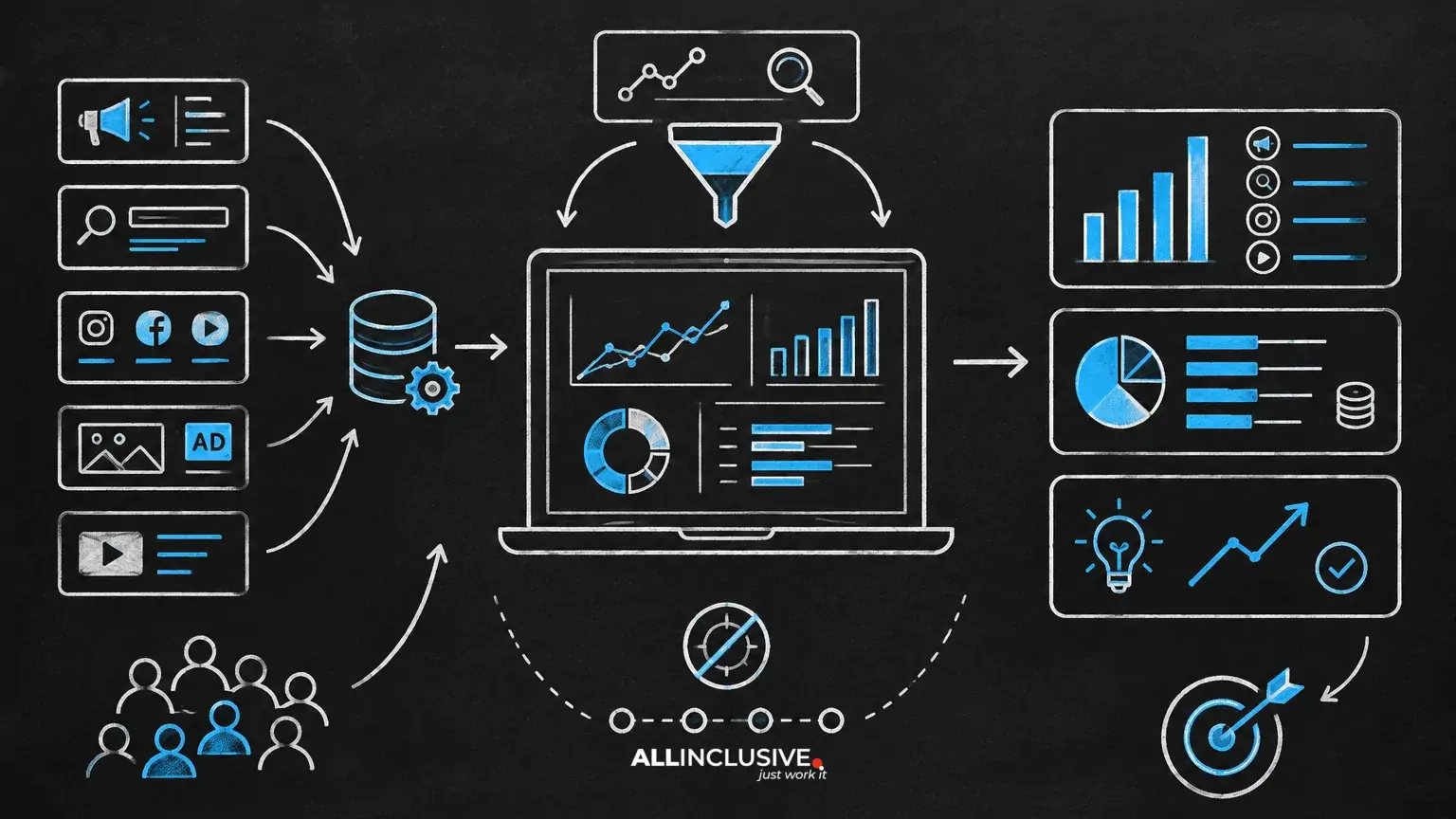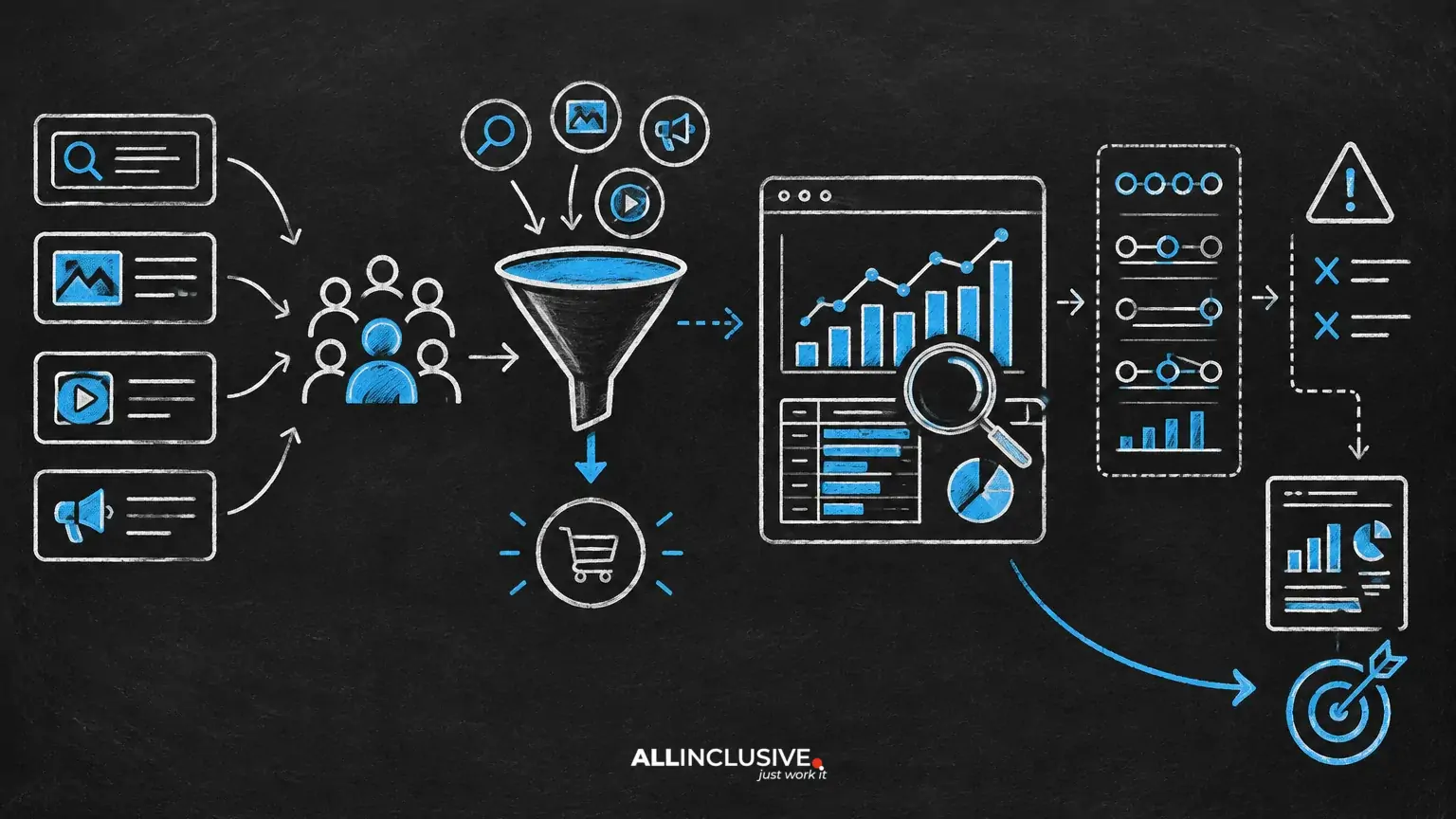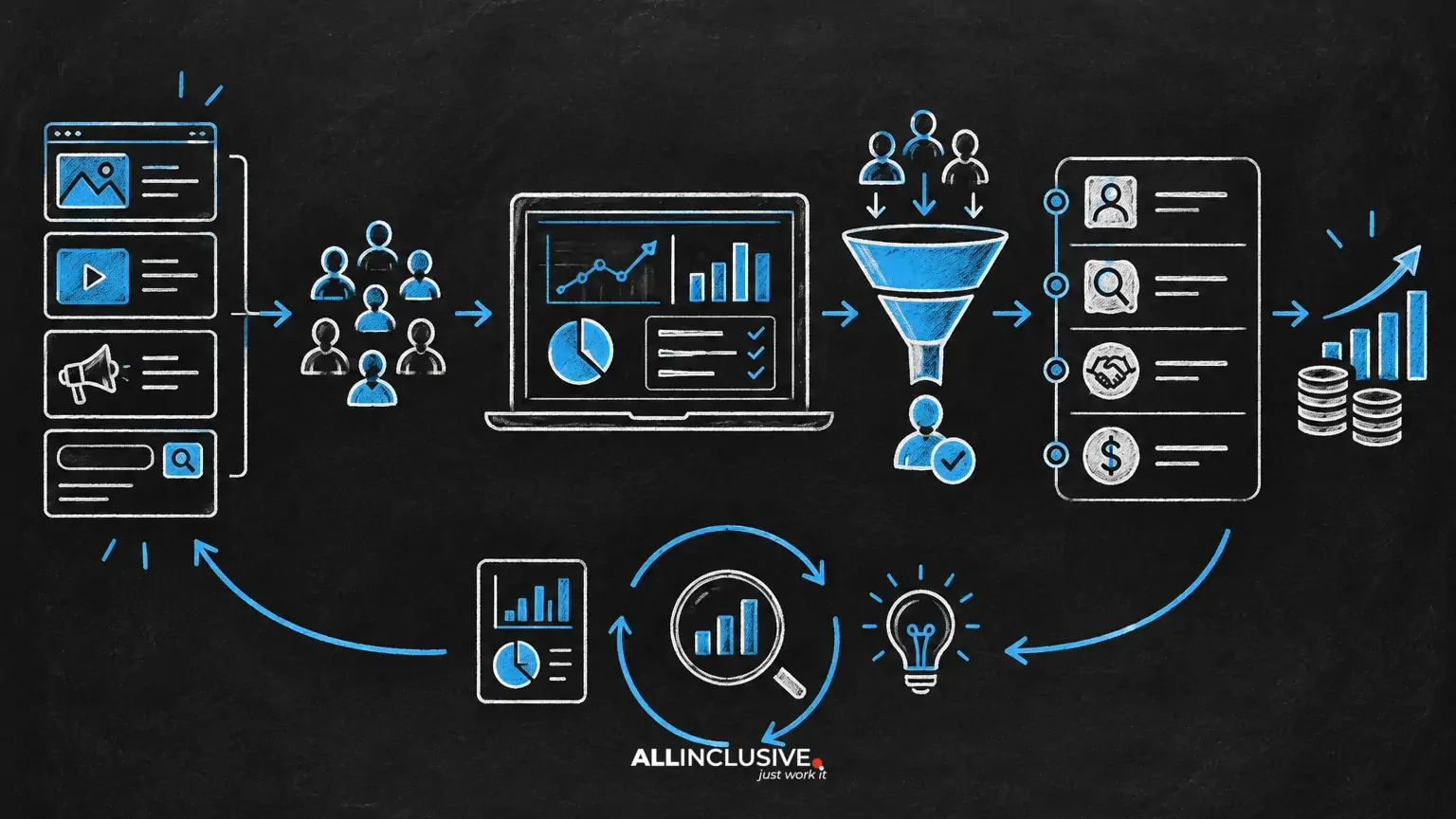
Lead volume is an incomplete measure of paid media performance. A campaign can generate a low cost per lead while producing few sales conversations, poor-fit accounts, or no meaningful pipeline. Lead quality measurement paid media programs need connects the original campaign and conversion event to downstream sales outcomes.
The goal is not to discard form fills, calls, or other early conversions. Those signals can help manage delivery and diagnose friction. The goal is to place them in a hierarchy that reflects commercial value: from initial response to qualification, opportunity creation, revenue, and—where measurement supports it—profit or customer value.
What paid media lead quality measurement should answer
A useful measurement system answers three questions:
- Which leads are becoming qualified? Define the sales or marketing criteria that separate actionable demand from unqualified inquiries.
- Which campaigns and audiences generate pipeline? Connect acquisition data to CRM stages without losing source, campaign, or conversion detail.
- What should the team change? Translate quality data into budget, bidding, targeting, creative, landing-page, and qualification decisions.
This makes lead quality a feedback loop rather than a reporting label. The measurement model should be specific enough to guide action, but not so complex that data arrives too late or cannot be trusted.
Define lead quality before choosing the metric
Lead quality is not a universal status. It depends on the business model, sales process, target customer, and available evidence. Start with an operational definition agreed by marketing, sales, and finance or revenue operations.
Common quality dimensions
- Fit: Does the company, person, or account match the intended market, geography, size, use case, and buying environment?
- Intent: Does the inquiry indicate a credible problem, evaluation, or buying need rather than general research or an unrelated request?
- Sales readiness: Can the team contact and meaningfully progress the lead?
- Progression: Does the lead reach an agreed stage, such as marketing-qualified, sales-accepted, opportunity, or proposal?
- Economic value: Does the resulting opportunity or customer represent commercially relevant revenue and margin?
Do not treat every CRM field as equally reliable. A self-reported company size may be useful for routing, while an opportunity stage controlled through a documented process may be more suitable for optimization. Record the source and confidence of each quality signal.
Build a lead-quality funnel tied to business stages
A practical framework maps paid media events to stages in the customer journey. The names will vary by organization, but the logic should remain consistent.
- Response: A visitor submits a form, calls, starts a chat, or completes another defined conversion.
- Validated lead: The record passes basic checks such as valid contact information, relevant geography, and duplicate or spam screening.
- Qualified lead: The lead meets documented fit and intent criteria.
- Sales-accepted lead: Sales confirms that the record is actionable and accepts responsibility for follow-up.
- Opportunity: A defined sales opportunity exists with a credible need, process, or commercial path.
- Revenue: The opportunity closes, ideally with value and status captured in the CRM.
These stages should not be confused with advertising-platform conversion events. A platform may optimize toward a web conversion, imported event, or modeled signal, but the organization still needs its own business definitions and governance.
Use a measurement hierarchy instead of one headline KPI
No single metric explains lead quality. Use a hierarchy that shows volume, progression, efficiency, and value together.
- Lead volume: Useful for monitoring reach and top-of-funnel delivery, but weak as a standalone success measure.
- Validation rate: The share of captured leads that pass basic quality checks.
- Qualification rate: Qualified leads divided by total leads or validated leads. State the denominator clearly.
- Sales acceptance rate: Accepted leads divided by leads routed to sales.
- Opportunity rate: Opportunities divided by leads or qualified leads.
- Cost per qualified lead: Spend divided by qualified leads, with the qualification definition documented.
- Cost per opportunity: Spend divided by opportunities, provided attribution and timing are sufficiently stable.
- Pipeline per dollar: Attributed pipeline value divided by media spend. Treat this as a directional efficiency measure when opportunities are early or values are estimated.
- Revenue efficiency: Closed revenue or contribution margin relative to spend, subject to sufficient volume and appropriate attribution.
For many B2B programs, the most useful operating view combines cost per lead, cost per qualified lead, cost per opportunity, and pipeline efficiency. Comparing only one of these can reward the wrong behavior. A low cost per lead may conceal weak qualification, while a high cost per opportunity may reflect a small but valuable segment.
Connect advertising data to CRM outcomes
Lead quality cannot be measured reliably if campaign data stops at the form submission. The required architecture depends on the business, but the core fields are consistent.
Capture acquisition context
Preserve source, medium, campaign, ad group or equivalent, creative, keyword or audience where available, landing page, device or placement context where appropriate, and the timestamp of the conversion. Use a documented naming convention and avoid overwriting original acquisition data when a lead has multiple interactions.
Define the identity path
Decide how a conversion is matched across the website, analytics environment, advertising platform, marketing automation system, and CRM. Matching can involve click identifiers, first-party identifiers, form data, or other approved methods. The important requirement is traceability: the team should be able to explain how a CRM outcome was associated with an originating paid-media interaction.
Return downstream outcomes where appropriate
When the data foundation supports it, send meaningful downstream events or statuses back to the relevant measurement and activation systems. Avoid importing every status change indiscriminately. A low-confidence or rapidly changing event can create noisy optimization signals.
For implementation detail, use the offline conversion tracking guide alongside a broader conversion tracking audit. These are related but distinct tasks: one addresses the flow of offline outcomes, while the other evaluates whether the wider measurement system is functioning as intended.
Choose optimization events carefully
The best reporting metric is not always the best bidding or optimization event. An event should be considered for optimization when it is:
- Clearly defined and consistently recorded;
- Close enough to business value to represent useful intent;
- Available with enough volume for the chosen platform or decision process;
- Resistant to obvious spam, duplicates, and operational artifacts;
- Available within a time frame that supports timely action.
If qualified opportunities are valuable but infrequent, optimize and report at multiple levels. Early events can support delivery while qualified-lead and opportunity outcomes guide budget allocation, audience evaluation, and creative decisions. Do not imply that an algorithm has learned business value merely because a downstream event exists in a report.
Account for lag, attribution, and incomplete outcomes
B2B lead quality often develops over weeks or months. A campaign may appear inefficient before leads have had enough time to progress, while a later report may credit pipeline to activity that did not create incremental demand.
Set a reporting window that reflects the sales cycle. Separate immature cohorts from mature cohorts, and label records whose final outcome is not yet known. Avoid comparing a recently launched campaign with a long-running campaign using only closed revenue.
Attribution also matters. Platform-reported conversions, analytics reporting, CRM-sourced attribution, and incrementality tests answer different questions. Use them for their intended purpose rather than forcing them into one number. The paid media attribution guide explains how to evaluate these perspectives beyond last click.
Turn quality findings into campaign decisions
Measurement is useful only when it changes decisions. Build explicit rules for interpreting common patterns.
High lead volume, low qualification
Check targeting, search intent, audience exclusions, offer language, form friction, and the definition of a lead. Review examples with sales rather than relying only on a dashboard. The issue may be traffic quality, unclear positioning, weak qualification, or inconsistent follow-up.
Low lead volume, high qualification
Assess whether the campaign can scale without diluting quality. Test adjacent queries, audiences, creative angles, or landing pages cautiously. If the segment has strong opportunity economics, a higher cost per lead may be acceptable.
Strong qualification, weak opportunity progression
Investigate sales acceptance, response time, routing, meeting availability, pricing fit, and the definition of “qualified.” Paid media may be generating credible interest while a downstream process limits progression.
Strong pipeline, weak closed revenue
Review opportunity quality, stage definitions, sales-cycle maturity, forecast accuracy, duplicate attribution, and deal loss reasons. Do not immediately conclude that acquisition failed if the cohort is not mature.
Create a lead-quality operating process
A durable program needs more than a dashboard. Assign ownership and establish a recurring review.
- Document definitions: Record stage criteria, exclusions, denominators, attribution rules, and data owners.
- Audit data quality: Check missing campaign fields, duplicate records, unmatched conversions, inconsistent stages, and delayed imports.
- Review cohorts: Compare campaigns by conversion month or another consistent cohort basis so lag is visible.
- Inspect lead samples: Read notes, disposition reasons, and opportunity records to validate what aggregate metrics suggest.
- Set decision thresholds: Define when to adjust spend, pause a tactic, request a tracking fix, or wait for more data.
- Close the feedback loop: Share quality findings with media, creative, landing-page, sales, and revenue-operations teams.
Keep a change log. If qualification criteria, CRM stages, routing rules, or attribution logic changes, record the date and expected measurement impact. Otherwise, trend comparisons can become misleading.
Questions to ask before trusting a lead-quality report
- What exactly counts as a lead, qualified lead, accepted lead, and opportunity?
- Are the stages defined by behavior and evidence, or by subjective labels?
- Can each downstream record be connected to a campaign interaction with documented logic?
- How are duplicates, spam, existing customers, partners, and unserviceable locations handled?
- What percentage of recent leads has had enough time to progress?
- Are platform, analytics, and CRM totals expected to differ—and is the reason documented?
- Which decisions will this report change?
Paid Media Lead Quality: Strategic Perspective
Effective lead quality measurement in paid media is a commercial measurement discipline, not simply a conversion-tracking feature. Start with agreed business definitions, preserve acquisition context, connect leads to CRM stages, account for lag and attribution, and use a metric hierarchy that reflects progression and value.
The result is a more defensible way to evaluate paid media: not by how many names entered the system, but by how consistently campaigns create qualified conversations, credible pipeline, and eventually revenue.
For broader planning and channel measurement, explore the paid media resource hub.