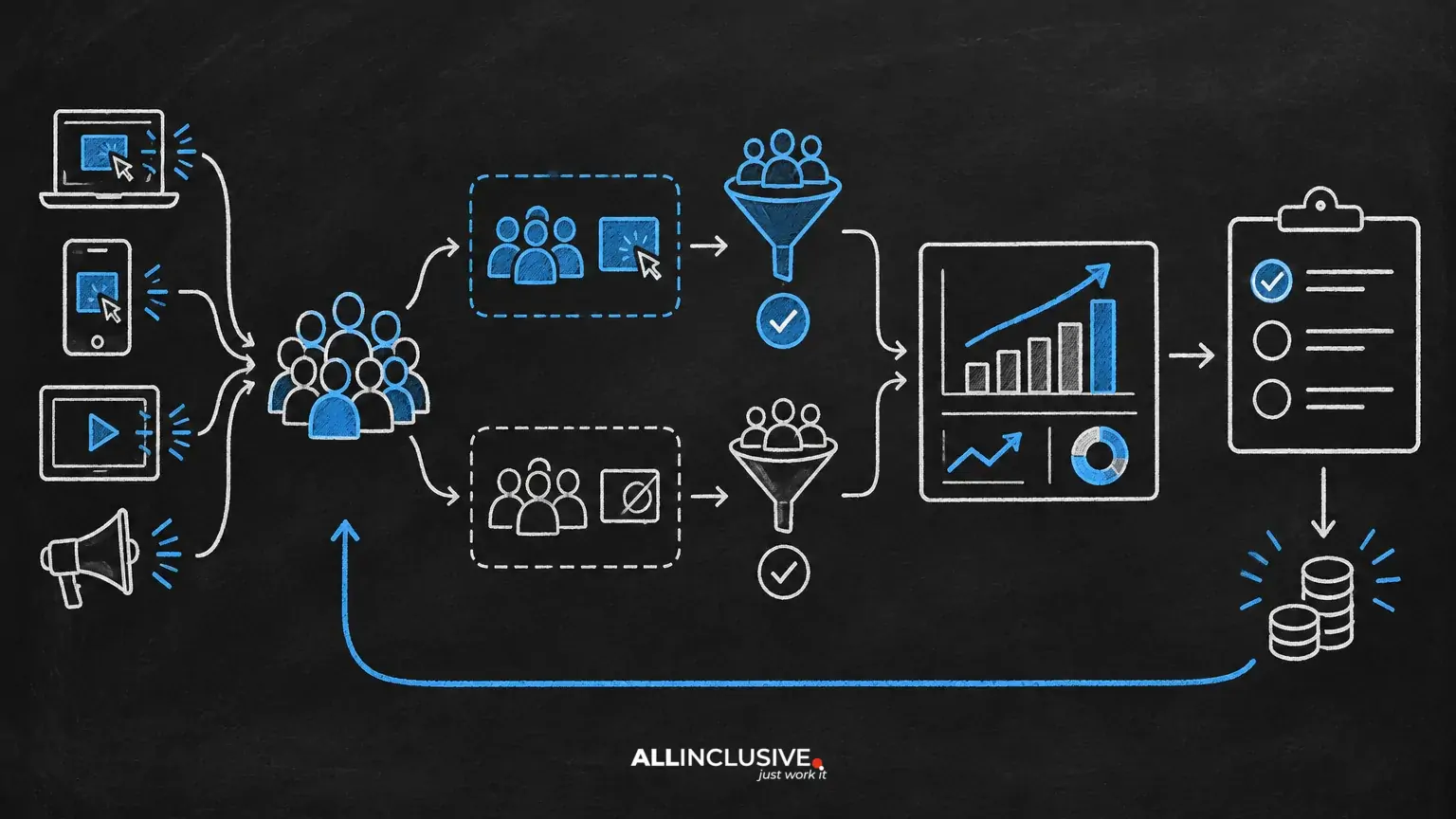
Paid media attribution is the process of connecting marketing interactions with business outcomes so teams can evaluate performance and allocate budget. The difficult part is that no single attribution model can fully explain how advertising influences a customer journey.
Last-click reporting is easy to understand, but it often overvalues the final interaction and undervalues earlier discovery, consideration, and retargeting activity. A more useful approach combines reliable conversion data, multiple analytical views, and business decisions that are tested against observed outcomes.
This guide explains how attribution works, where common models break down, and how to build a practical framework beyond last click.
What paid media attribution is—and what it is not
Attribution assigns some form of credit to marketing touchpoints associated with a conversion. Depending on the system, those touchpoints may include paid search clicks, paid social impressions or clicks, display interactions, video exposure, email, organic visits, direct traffic, and offline sales activity.
Attribution can help answer questions such as:
- Which campaigns are associated with qualified leads or revenue?
- How does reported performance change under different attribution rules?
- Where are conversion paths concentrated or fragmented?
- Which campaigns deserve deeper testing or budget protection?
Attribution does not prove that every credited touchpoint caused the outcome. A conversion may have happened without the interaction, another channel may have influenced the decision, or the available data may omit important activity. Attribution is therefore a decision-support system—not a direct measurement of causality.
Why last-click attribution is limited
Last-click attribution gives all reported credit to the final measurable interaction before conversion. Its simplicity makes it useful for basic reporting, but it creates predictable blind spots.
- It favors high-intent channels. Brand search, direct traffic, and remarketing often appear strong because they occur near the decision.
- It undervalues demand creation. Prospecting campaigns may introduce the brand without being the final recorded interaction.
- It depends on tracking completeness. Missing consented signals, cross-device activity, offline outcomes, or platform data can change the apparent last touch.
- It can encourage channel silos. Each platform may claim conversions using its own rules, producing totals that cannot be added together.
Last click is not always useless. It can be a consistent operational view for certain campaigns or funnel stages. The mistake is treating it as the complete truth about marketing contribution.
Common attribution models
First touch
First-touch attribution assigns credit to the first recorded marketing interaction. It is useful when the question is which channels introduce prospects to the brand. It can, however, ignore the substantial work required to educate, qualify, and convert that prospect.
Last touch
Last-touch attribution credits the final recorded interaction. It is simple and often available by default, but it tends to reward conversion capture more than demand creation.
Linear attribution
Linear attribution distributes equal credit across recorded touchpoints. This avoids selecting one interaction as the winner, but equal credit does not necessarily reflect equal influence. A brief interaction and a substantive sales conversation may receive the same share.
Time-decay attribution
Time-decay models assign more credit to interactions closer to conversion. They can reflect the intuition that recent activity is more relevant, but that assumption should be treated as a modeling choice rather than a fact.
Position-based attribution
Position-based models give greater weight to selected positions, commonly the first and last interactions, with the remaining credit distributed among intermediate touches. This can be useful for a simple funnel view, but the chosen weights are still subjective.
Data-driven or algorithmic attribution
Data-driven models use observed paths and statistical methods to estimate the relative contribution of touchpoints. Their quality depends on sufficient, accurate, and representative data. They may also be difficult to explain, especially when conversion volume is limited or the journey is highly fragmented.
No model eliminates the need for judgment. Model outputs should be compared, documented, and evaluated against business outcomes rather than accepted because they appear more sophisticated.
Separate attribution from incrementality
Attribution asks, “How should credit be distributed among observed interactions?” Incrementality asks, “What additional outcome occurred because of the marketing activity?” These are related but different questions.
A campaign can receive substantial attributed credit while producing limited incremental impact if it mostly reaches people who would have converted anyway. Conversely, a campaign may appear weak in last-click reporting while creating incremental demand that is captured later by another channel.
Use attribution for path analysis, optimization signals, and operational reporting. Use experiments such as holdouts or lift tests when the decision requires stronger evidence of causal impact. For a broader overview, see Incrementality Testing for Paid Media.
Build a reliable attribution foundation
Start with clear conversion definitions
Define the outcomes that matter before selecting a model. A form submission, booked meeting, qualified opportunity, closed-won deal, purchase, renewal, or profit contribution may each be valid—but they should not be treated as interchangeable.
Separate primary business outcomes from diagnostic events. For example, a pricing-page visit may help explain behavior, while revenue may be the outcome used for budget decisions.
Use a consistent conversion hierarchy
Create a documented hierarchy that connects early events to later outcomes. A B2B organization might distinguish:
- Lead or inquiry
- Marketing-qualified lead, where that definition is operationally meaningful
- Sales-accepted lead
- Qualified opportunity
- Closed-won revenue
The exact stages differ by business. The important point is to prevent media decisions from being based only on the easiest event to measure.
Connect online and offline outcomes
For businesses with sales teams, contracts, phone calls, or physical locations, the final outcome may not occur in the advertising platform or analytics tool. Passing reliable campaign identifiers and lead keys into the CRM can connect media exposure with later pipeline stages.
Data quality matters more than dashboard complexity. Review field consistency, duplicate records, stage definitions, revenue timing, and rejected or unmatched records. The guide to offline conversion tracking covers this connection in more detail.
Document identity and consent limitations
Users may interact across devices, browsers, sessions, and environments. Consent choices and platform privacy controls can also limit which interactions are observable. A responsible reporting system states what is measured, what is modeled, and what is missing.
Use stable naming conventions
Campaign, ad group, creative, audience, landing page, and geography fields should follow a consistent taxonomy. Without it, even a well-designed attribution model produces difficult-to-audit results.
A practical attribution framework for budget decisions
Rather than selecting one universal model, create several views that answer different questions.
View 1: Operational attribution
Use a consistent platform or analytics view to monitor pacing, conversion volume, and campaign-level changes. This view should be stable enough for routine optimization and clearly labeled with its rules.
View 2: Funnel or position analysis
Examine which channels appear early, middle, and late in the journey. This helps identify whether a channel primarily creates demand, assists consideration, captures existing demand, or performs multiple roles.
View 3: Revenue and quality analysis
Compare attributed interactions with downstream measures such as qualified opportunities, sales acceptance, revenue, retention, or margin. A low-cost lead is not necessarily a valuable acquisition, and a high-cost campaign may be justified if it produces stronger business outcomes.
View 4: Causal validation
Where the decision is material, validate attribution-based conclusions with controlled tests, geographic comparisons, budget changes, or other credible methods. The appropriate design depends on traffic volume, market structure, and operational constraints.
How to evaluate an attribution model
Ask the following questions before using a model to reallocate significant budget:
- Does it match the decision? A model for creative discovery may differ from one used for revenue forecasting.
- Are the inputs complete enough? Missing channels, offline outcomes, or conversion stages can distort the output.
- Is the logic understandable? Stakeholders should know how credit is assigned and what assumptions are involved.
- Does it avoid double counting? Platform-reported conversions should not be added together without reconciling overlapping definitions.
- Is it stable? Large unexplained swings may indicate tracking changes, delayed conversions, data loss, or model sensitivity.
- Can it be tested? Strong attribution claims should be compared with experiments or credible changes in exposure when possible.
Paid media attribution in GA4 and advertising platforms
Analytics systems and advertising platforms may use different scopes, lookback windows, identity methods, channel definitions, and conversion settings. As a result, discrepancies are normal. The goal is not to force every system to report the same number; it is to understand why numbers differ and assign each system a clear purpose.
Use a designated source for executive reporting, while retaining platform-native views for campaign operations. Document the reporting date range, conversion events, attribution setting, timezone, filters, and any modeled or imported data. For a focused discussion of analytics reporting, see GA4 Attribution for Paid Media.
Example: interpreting conflicting reports
Suppose paid social reports strong assisted conversion activity, paid search reports most final conversions, and the CRM shows that only a portion of those leads became qualified opportunities. A weak response would declare one channel the winner based on its preferred metric.
A stronger analysis would:
- Confirm that both channels use comparable conversion definitions.
- Review the customer journey by first, intermediate, and final recorded interactions.
- Compare lead quality and sales progression by campaign.
- Check for duplicate leads, missing identifiers, and delayed revenue updates.
- Test whether reducing or changing exposure affects qualified outcomes.
The result may be that paid social creates valuable demand, paid search captures existing intent, or one channel receives credit for outcomes it did not materially influence. Attribution helps frame the investigation; it does not remove the need for one.
Paid Media Attribution: Mistakes to Watch For
- Choosing the model that produces the preferred result. Set the decision rule before reviewing the outcome.
- Optimizing to volume instead of value. Connect media data to quality and revenue stages.
- Mixing incompatible reports. Do not total platform conversions without accounting for overlap.
- Changing definitions without a historical note. A conversion-setting change can look like a performance change.
- Ignoring latency. Recent leads may not yet have progressed through the sales cycle.
- Treating modeled data as observed data. Label estimates and assumptions clearly.
- Using attribution to make causal claims. Credit allocation and incremental impact require different evidence.
A practical implementation sequence
- Define the business question. Decide whether the goal is campaign optimization, channel planning, revenue reporting, or causal validation.
- Inventory data sources. List ad platforms, analytics, CRM, ecommerce, call tracking, and offline systems.
- Standardize conversion definitions. Identify primary outcomes, supporting events, and excluded actions.
- Audit tracking and data quality. Check identifiers, deduplication, timestamps, consent handling, and revenue imports.
- Choose a baseline view. Establish one consistent operational report rather than switching models opportunistically.
- Add diagnostic views. Compare first touch, last touch, path position, quality, and revenue where data supports it.
- Validate important decisions. Use experiments or credible quasi-experimental analyses for major budget shifts.
- Document and review. Record assumptions, model settings, known limitations, and changes over time.
Paid Media Attribution: Key Decision Point
Effective paid media attribution is not about finding a perfect model. It is about building a measurement system that makes assumptions visible, connects advertising to meaningful business outcomes, and distinguishes correlation from causation.
Use last click as one operational lens—not the final verdict. Combine clean conversion definitions, offline outcome data, multiple attribution views, and incrementality testing when the decision warrants it. With that foundation, attribution becomes more useful for planning and less likely to reward the easiest interaction to measure.
For broader guidance on channel strategy, measurement, and optimization, explore Allinclusive’s paid media resources.
Related: ChatGPT Ads strategy.