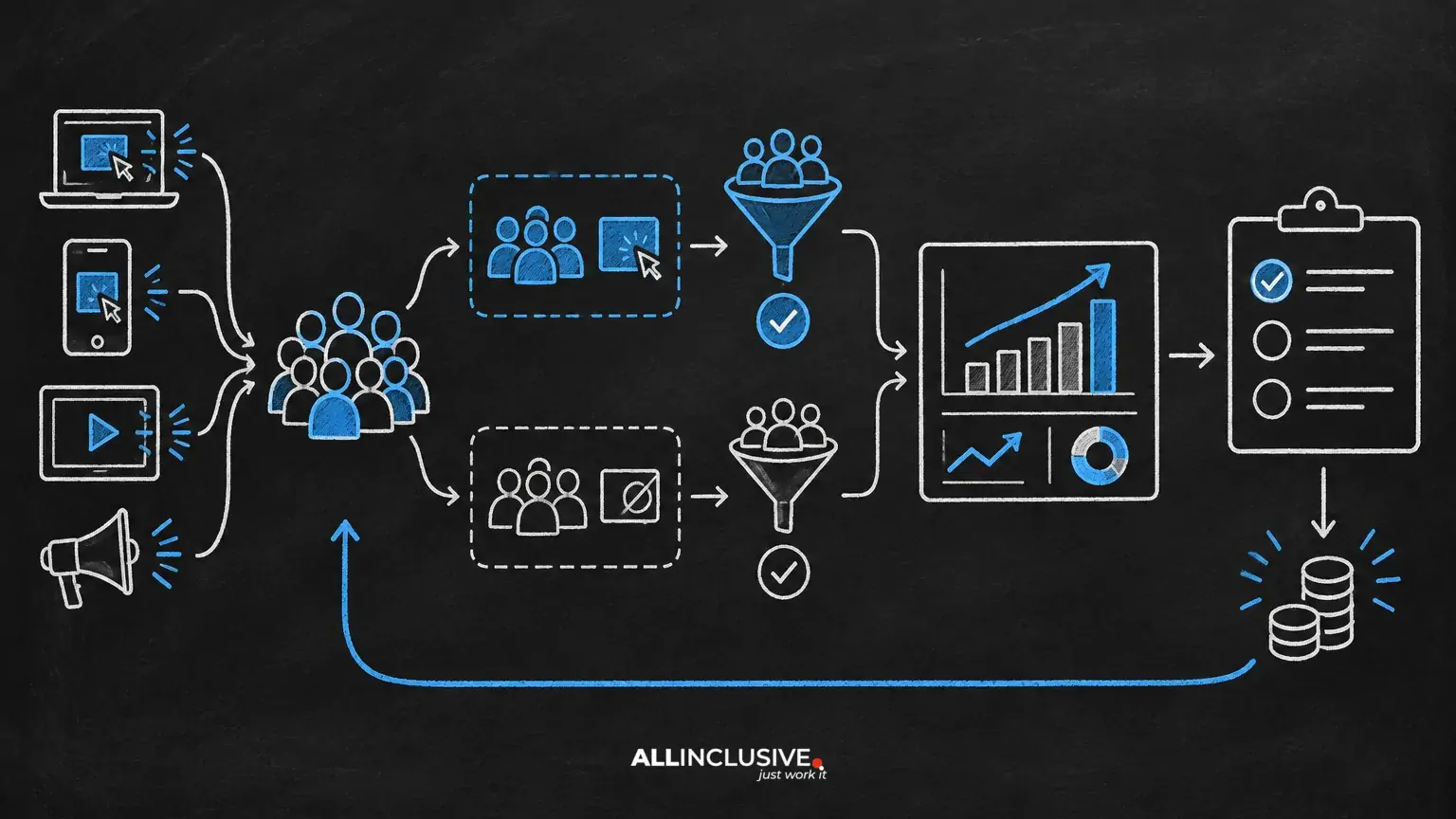
Programmatic attribution is the process of assigning credit for conversions or other outcomes to programmatic ad exposures. The difficult part is not collecting impressions, clicks and conversion events. It is deciding whether an exposure caused, assisted or merely preceded an outcome.
For most advertisers, the strongest measurement approach uses attribution models for operational reporting and incrementality testing for causal validation. Click-through and view-through attribution can help optimize delivery, but neither should be treated as definitive proof that a campaign created demand.
What programmatic attribution is designed to answer
Programmatic measurement usually supports three different questions:
- What happened? Which users or accounts were exposed, clicked, visited, converted or generated revenue?
- How should credit be allocated? Should a conversion be assigned to the last click, several touchpoints or a qualifying impression?
- What would have happened without the advertising? Did the campaign produce incremental conversions, revenue or other business outcomes?
The first question is descriptive. The second is attribution. The third is causal measurement. Confusing these categories is a common source of inflated programmatic ROI.
Programmatic advertising operates across display, online video, connected TV, audio, native and other formats. A useful measurement plan therefore defines the conversion event, identity approach, reporting windows, exposure rules and optimization goal before media launches. The broader context is covered in this programmatic advertising guide.
Click-through attribution
Click-through attribution assigns credit to an ad interaction when a user clicks and later completes a defined conversion. A last-click model gives all credit to the most recent eligible click. A position-based or multi-touch model may distribute credit among several interactions.
Where click-through attribution helps
- It provides a clear signal for direct-response campaigns.
- It is relatively easy to explain to stakeholders.
- It can support landing-page, creative and audience optimization.
- It generally reflects a stronger declared action than an impression alone.
Where it can mislead
Clicks are not automatically causal. Users who click ads may already be more interested, more familiar with the brand or closer to purchase than users who do not. A click can also occur after the user has independently decided to visit the site.
Last-click reporting can undervalue upper-funnel video, display and audio while over-crediting channels that capture demand near the point of conversion. It can also encourage teams to optimize toward inexpensive clicks rather than profitable outcomes.
View-through attribution
View-through attribution, sometimes called impression-through attribution, assigns credit when a user is exposed to an ad, does not click, and later converts within a defined lookback window. This model recognizes that an impression can influence behavior without generating an immediate click.
View-through measurement can be useful for formats where clicking is not the primary behavior, including video, connected TV, audio and awareness-oriented display. It can also make post-exposure behavior visible when click volume is small.
Why view-through credit requires caution
- Exposure is not attention. An ad may have been served without being meaningfully seen.
- Exposure is not influence. The user may have converted because of another channel or existing intent.
- Lookback windows change the result. A longer window creates more opportunities to associate later conversions with an impression.
- Reach and identity are imperfect. Cross-device matching and household-level exposure can create uncertainty.
- Frequency can create false confidence. A heavily exposed audience may also be the audience most likely to convert anyway.
View-through conversions should therefore be reported separately from click-through conversions. Combining them into one total can obscure the difference between an observed post-exposure conversion and a demonstrated incremental conversion.
Attribution windows and event definitions
An attribution window is the period during which a conversion may be associated with an ad interaction or exposure. The appropriate window depends on the buying cycle, conversion type and time between marketing exposure and action. A short window may miss legitimate delayed effects; a long window may claim conversions that are only loosely related to the campaign.
Define these elements in advance:
- The primary conversion and any secondary events.
- The eligible click and impression lookback periods.
- Whether post-view and post-click conversions are reported separately.
- How repeated conversions are counted.
- Whether conversions are deduplicated across platforms and analytics systems.
- Which revenue, margin or pipeline value is used for optimization.
Do not compare programmatic results across campaigns when the conversion definition, window or counting method has changed without documenting the change.
Multi-touch attribution and attribution models
Multi-touch attribution assigns credit across multiple recorded touchpoints. Common approaches include linear allocation, time decay, position-based rules and algorithmic models. Each approach encodes assumptions about how exposure contributes to a conversion.
Rule-based models are transparent but arbitrary. Algorithmic models may identify patterns in historical paths, but they still depend on data quality, identity resolution, conversion volume and model design. A sophisticated model does not automatically establish causality.
Use multi-touch attribution to understand the paths present in your data, not to assume that every recorded touchpoint added equal business value. In particular, exposure logs may be more complete for some channels, publishers or devices than for others. Apparent channel performance can reflect measurement coverage rather than actual effectiveness.
Why incrementality is different
Incrementality asks whether outcomes occurred because of advertising. The central comparison is between a treatment group that receives advertising and a comparable control group that does not, or receives a deliberately different level of exposure.
A well-designed incrementality test estimates the lift attributable to the campaign rather than simply counting conversions after exposure. It can be used to evaluate a channel, audience, creative strategy, frequency policy or broader media plan.
Common testing approaches
- Randomized holdouts: eligible users, households, regions or accounts are randomly assigned to treatment and control.
- Geo experiments: geographic areas receive different media conditions, with outcomes compared over a planned period.
- Conversion lift studies: exposed and control populations are compared using a platform or measurement partner methodology.
- Pre-post or matched-market analysis: useful when randomization is unavailable, but more vulnerable to confounding factors.
Randomization is generally preferable when feasible. Where it is not possible, document the assumptions, comparison method and factors that could explain differences between groups.
How to build a practical programmatic measurement framework
1. Start with the business outcome
Choose an outcome that reflects business value: qualified leads, completed applications, purchases, retained customers, revenue or contribution margin. A media platform conversion may be useful for optimization, but it should not replace the business outcome.
2. Separate reporting layers
Maintain distinct views for delivery, engagement, attributed conversions and incremental results. Delivery metrics explain whether the campaign reached its intended audience. Attribution metrics explain recorded paths. Incrementality explains causal lift.
3. Establish a source of truth
Reconcile ad-server, DSP, analytics, CRM and finance data. Differences are expected because systems may use different timestamps, identity rules, conversion definitions and counting methods. The goal is not to force every system to match; it is to document which system answers which question.
4. Protect test validity
Before launching a test, define the population, randomization or matching method, test duration, primary KPI, minimum detectable effect if available, and rules for excluding invalid traffic or contaminated users. Avoid changing targeting, budget, creative or conversion tracking mid-test unless the change is part of the design.
5. Use attribution for optimization, tests for budget decisions
Click and view-through signals can help identify promising creative, audiences and placements. Incrementality results are more appropriate for decisions such as whether to expand a channel, change its role in the funnel or reallocate a substantial budget.
Example: interpreting a display campaign
Imagine a campaign with a modest number of clicks and a larger number of conversions recorded after impressions. A platform report may show strong view-through performance. That is an observation worth investigating, not a conclusion that every post-view conversion was caused by the campaign.
A stronger analysis would compare a randomly held-out eligible audience with the exposed audience. If the exposed group produces a meaningfully higher conversion rate under a valid test design, the difference provides evidence of incremental lift. If the groups perform similarly, the campaign may have been reaching people who were already likely to convert, even if view-through attribution claimed credit.
Data quality and privacy considerations
Attribution depends on event quality, consent choices, identity availability and consistent tagging. Missing events, duplicate conversions, blocked identifiers, modeled outcomes and cross-device uncertainty can all affect reported performance.
Measurement should be designed around the data that can be collected lawfully and reliably. Avoid treating a loss of addressability as a reason to return to overly broad assumptions. Instead, combine first-party conversion data, clean event governance, aggregate reporting and controlled experiments where appropriate.
Frequency, supply quality and placement context also affect interpretation. A campaign that reaches users repeatedly in low-quality environments may generate exposure records without meaningful attention. For related planning considerations, see the guide to programmatic frequency capping and the overview of programmatic brand safety.
Questions to ask before accepting an attribution result
- Was the conversion preceded by a click, an impression, or both?
- What attribution window and counting rules were used?
- Were conversions deduplicated across systems?
- Could users have been exposed through another campaign or channel?
- How complete is cross-device and cross-environment identity matching?
- Is the result based on attribution or on a controlled incrementality test?
- Does the reported outcome reflect revenue, profit, qualified pipeline or only a proxy event?
- Did frequency, supply quality or viewability change during the period?
Programmatic Attribution: Decision Summary
Effective programmatic attribution is not about choosing one model and declaring it true. Click-through attribution is useful for direct interactions, view-through attribution can describe post-exposure behavior, and multi-touch models can organize observed paths. None of these methods alone proves incremental impact.
Use consistent definitions, separate click-through and view-through reporting, document limitations and validate important budget decisions with incrementality testing. That combination produces a more credible view of programmatic ROI and a better basis for optimization.
For broader measurement planning across channels, explore the paid media resources.