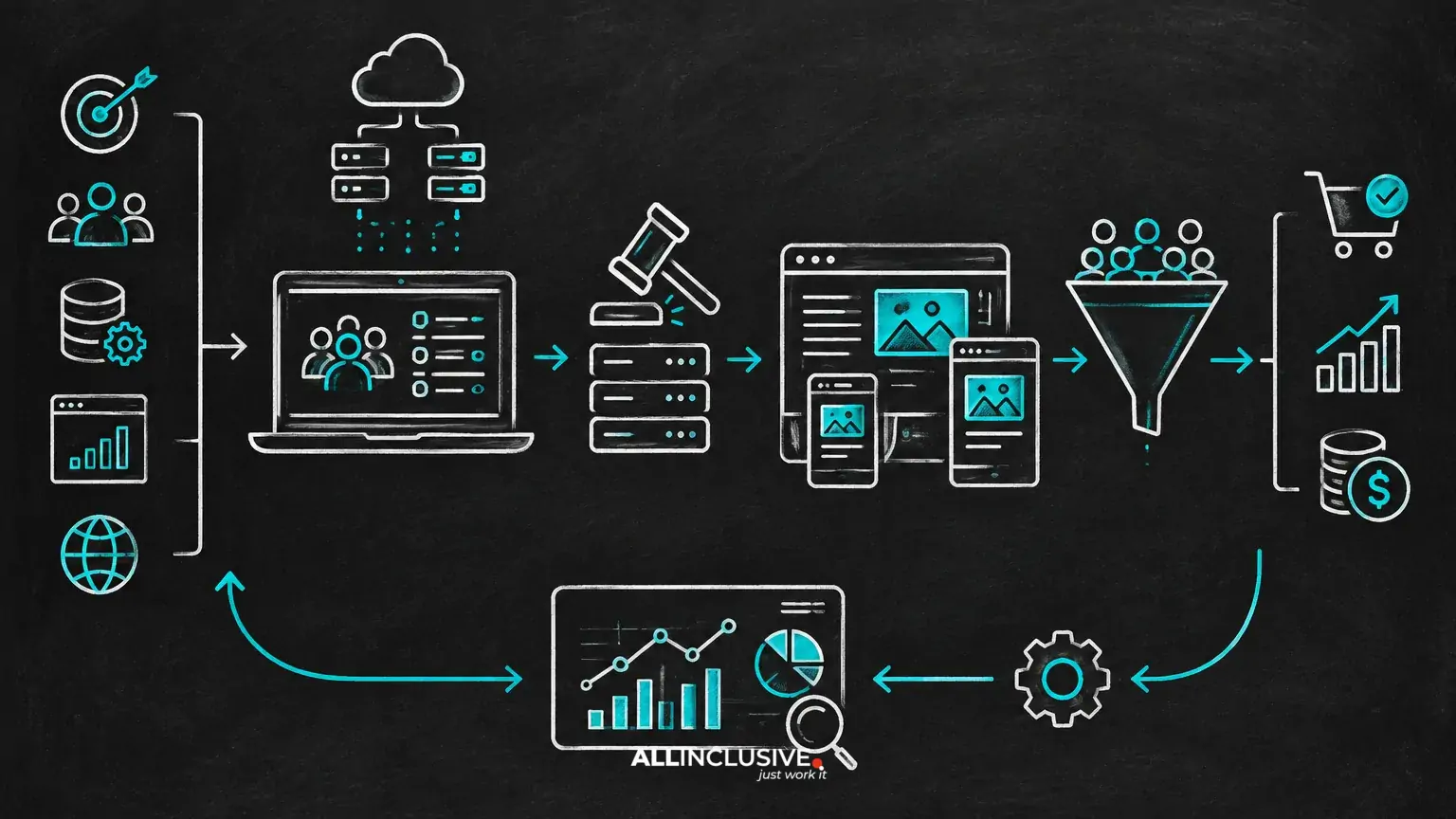
Programmatic brand safety is the practice of preventing paid media from appearing alongside content, environments, or experiences that could create unacceptable reputational, legal, or commercial risk. It combines pre-bid controls, inventory selection, supply-path decisions, verification, exclusion workflows, and human governance.
Brand safety is not the same as maximizing reach or blocking every potentially sensitive page. Overly broad exclusions can reduce scale, limit useful contextual environments, and make performance harder to evaluate. The goal is a documented risk framework that reflects the brand, audience, market, creative, and campaign objective.
What programmatic brand safety should control
A useful programmatic safety policy separates three related concepts:
- Brand safety: avoiding clearly unacceptable environments, such as illegal content, hate speech, extremist material, or content that conflicts with applicable law or company policy.
- Brand suitability: deciding which sensitive or ambiguous environments may be acceptable at different risk levels, with different treatments by brand or campaign.
- Media quality: evaluating whether impressions are viewable, measurable, human-generated, fraud-resistant, and delivered through a transparent path.
These categories overlap, but they should not be collapsed into one score. An impression can be safe but low quality, measurable but unsuitable, or contextually relevant while requiring a stricter adjacency rule for a particular advertiser.
Build a risk framework before activating controls
Start with business decisions rather than platform settings. A written framework makes exclusions more consistent across agencies, DSPs, regions, and campaigns.
Define prohibited environments
List environments that are unacceptable regardless of expected performance. Depending on the advertiser, this may include content involving illegal activity, graphic violence, explicit sexual material, hate or harassment, terrorism or extremism, misinformation categories, dangerous products, or content that violates regulatory requirements.
Definitions should be specific enough to operationalize. “Controversial content” is too broad to guide a buying team. A policy might distinguish between reporting about a violent event and graphic depictions of violence, or between a regulated topic and content that promotes unlawful behavior.
Define sensitive environments
Some categories require a decision rather than an automatic block. News, politics, health, finance, tragedy, user-generated content, and controversial social issues may be appropriate for one campaign and unsuitable for another. Create risk tiers such as avoid, review, and permitted with conditions.
Conditions can include contextual relevance, approved creative, geographic restrictions, publisher-level review, or a requirement for independent verification. This approach preserves strategic flexibility without treating every sensitive environment as equivalent.
Assign ownership and escalation rules
Brand safety requires an accountable owner. Define who approves category decisions, who investigates incidents, how quickly questionable placements are reviewed, and who can pause a campaign. Include marketing, legal, communications, procurement, and agency stakeholders where their input is material.
Core programmatic brand safety controls
Pre-bid inventory controls
Pre-bid controls attempt to prevent bids from entering inventory that matches selected risk criteria. They can be efficient because unsuitable opportunities are filtered before spend is committed. However, coverage and classification depend on the technology, data available in the auction, and the environments being evaluated.
Use pre-bid controls as a first layer, not as proof that every delivered impression is safe. Document which categories are enabled, whether controls apply across formats and devices, and what happens when inventory cannot be classified confidently.
Blocklists and allowlists
Blocklists exclude specified domains, apps, channels, content categories, or other inventory identifiers. Allowlists restrict buying to an approved set of properties or supply sources. Allowlists can provide stronger control, but they may reduce reach and require ongoing maintenance as publishers, apps, and inventory paths change.
A practical policy may use broad category exclusions for open-web scale, then apply allowlists to high-risk campaigns, premium launches, regulated products, or placements requiring tighter editorial control.
Keyword and contextual controls
Keyword exclusions can help identify pages associated with specific subjects, but individual words are often ambiguous. A term may be harmless in one context and risky in another. Contextual classification, page-level signals, semantic analysis, and content categories can provide a more useful basis for decisions than isolated keywords.
Contextual targeting should be evaluated separately from safety blocking. The same contextual signals that identify relevant content can support exclusion, inclusion, or tiered bidding. For a deeper look at that distinction, see contextual targeting in programmatic.
App, site, and placement controls
Review the environments where impressions can appear, including websites, mobile applications, connected-TV inventory, games, video platforms, and other emerging channels. App and placement controls may require attention to developer information, content descriptions, audience composition, ad experience, and the transparency of the inventory source.
Do not assume that a channel-level label answers every placement question. A campaign can meet a broad channel policy while still producing unsuitable adjacency at the individual app, site, video, or content level.
Verification: measure what actually happened
Independent verification can help assess whether impressions were delivered in acceptable environments and whether other quality conditions were met. Depending on the solution and campaign setup, reporting may include brand-safety classifications, viewability, invalid traffic indicators, geography, contextual signals, and placement details.
Verification is most valuable when its role is defined before launch. Decide which findings trigger an exclusion, a bid adjustment, an investigation, or no action. Also confirm measurement coverage by format, device, geography, publisher type, and buying method. A report that covers only part of the campaign should not be presented as a complete safety assessment.
Use verification as a feedback loop
- Review pre-launch settings and the intended risk tiers.
- Monitor delivered placements and classification results during the flight.
- Compare observed findings with the policy and investigate discrepancies.
- Update exclusions, supply decisions, or controls where the evidence supports a change.
- Record the decision, owner, date, and expected effect for later review.
Verification data can reveal false positives as well as misses. If a legitimate environment is repeatedly excluded, the policy or classification threshold may be too broad. If questionable placements recur, the team may need stronger supply restrictions or a different control layer.
Supply paths are part of brand safety
Brand safety is affected not only by the final publisher but also by how inventory reaches the buyer. Multiple intermediaries can reduce transparency, create duplicated auction access, complicate reporting, or make it harder to identify where an impression originated.
Review supply-path signals such as seller authorization, inventory ownership, reseller disclosure, domain or app transparency, auction mechanics, fee visibility, and the consistency of placement reporting. These checks do not guarantee safety, but they improve the buyer’s ability to investigate and control risk.
Supply-path optimization is therefore related to, but distinct from, brand safety. A cleaner path may improve transparency and media quality without solving contextual suitability on its own. For a broader framework, read supply path optimization.
Questions to ask about a supply source
- Can the buyer identify the publisher, app, channel, and placement with sufficient precision?
- Is the seller authorized to represent the inventory?
- Are resellers disclosed clearly enough to support investigation?
- Does the source provide meaningful reporting on content, fraud, viewability, and geography?
- Can unsuitable inventory be removed without disrupting the entire campaign?
- Are there duplicate or competing paths to the same inventory that create unnecessary complexity?
Implementation by campaign stage
Planning
Translate business risk into operational requirements. Set prohibited and sensitive categories, geographic rules, approved channels, measurement expectations, escalation contacts, and documentation standards. Decide whether the campaign needs broad scale, curated supply, or different rules by audience and market.
Activation
Apply platform-level inventory controls, contextual settings, blocklists or allowlists, supply-source requirements, and verification tags or integrations where available. Keep a record of the exact settings and exclusions. Naming conventions should make it possible to connect campaign results with the policy version used.
In-flight monitoring
Review placement reports and verification findings at a cadence appropriate to campaign risk and spend. Look for repeated domains, apps, content categories, unusual spikes, missing data, and discrepancies between platform delivery and independent measurement. A single incident may require investigation; a pattern may justify structural changes.
Post-campaign review
Evaluate both incidents and opportunity cost. Identify exclusions that removed valuable inventory, categories that produced recurring issues, supply paths with weak transparency, and reporting gaps that limited confidence. Update the policy and retain a decision log for future campaigns.
How safety decisions affect programmatic ROI
Brand safety controls can influence reach, CPM, delivery speed, audience composition, viewability, conversion volume, and measurement coverage. That does not mean the least restrictive setup is the most efficient. An inexpensive impression that creates reputational exposure or cannot be verified may have poor business value.
Evaluate trade-offs using a consistent scorecard. Consider effective cost, qualified reach, measurable delivery, attention or viewability indicators where relevant, conversion quality, suitability findings, invalid-traffic signals, and the operational cost of managing the campaign. Keep safety outcomes visible alongside performance metrics rather than treating them as a separate compliance report.
For related cost analysis, see programmatic rate cards, fees, and hidden costs. The objective is not to eliminate all variation in inventory cost, but to understand what the media price includes and what controls are required to make the impression usable.
Programmatic Brand Safety: Mistakes to Watch For
- Relying on one filter: No single keyword list, category setting, or verification report provides complete protection.
- Using vague policy language: Ambiguous definitions produce inconsistent buying and escalation decisions.
- Blocking entire channels without analysis: Broad exclusions may remove useful inventory without addressing the actual risk.
- Ignoring supply transparency: A safe-looking placement is harder to validate when the path and seller are unclear.
- Measuring only delivery: Spend and impressions do not show whether the campaign met safety, quality, or suitability requirements.
- Failing to review exceptions: Sensitive environments should have documented approvals, not informal one-off decisions.
A practical governance checklist
Before launch, confirm that the team can answer these questions:
- What environments are prohibited, sensitive, or permitted?
- Which controls operate before the bid, and which verify delivery afterward?
- Which channels, formats, markets, and supply sources are covered?
- Who owns incident response, and what triggers a pause or escalation?
- How will exclusions and exceptions be documented?
- How will safety findings be evaluated alongside reach, cost, and business outcomes?
- When will the policy and supply paths be reviewed again?
Programmatic brand safety works best as a layered operating system rather than a single platform checkbox. Clear policy definitions, appropriate inventory controls, independent verification, transparent supply paths, and disciplined review give buyers a more defensible way to manage risk while preserving useful scale.
To place these decisions within the wider channel strategy, explore programmatic advertising and the broader paid media framework.