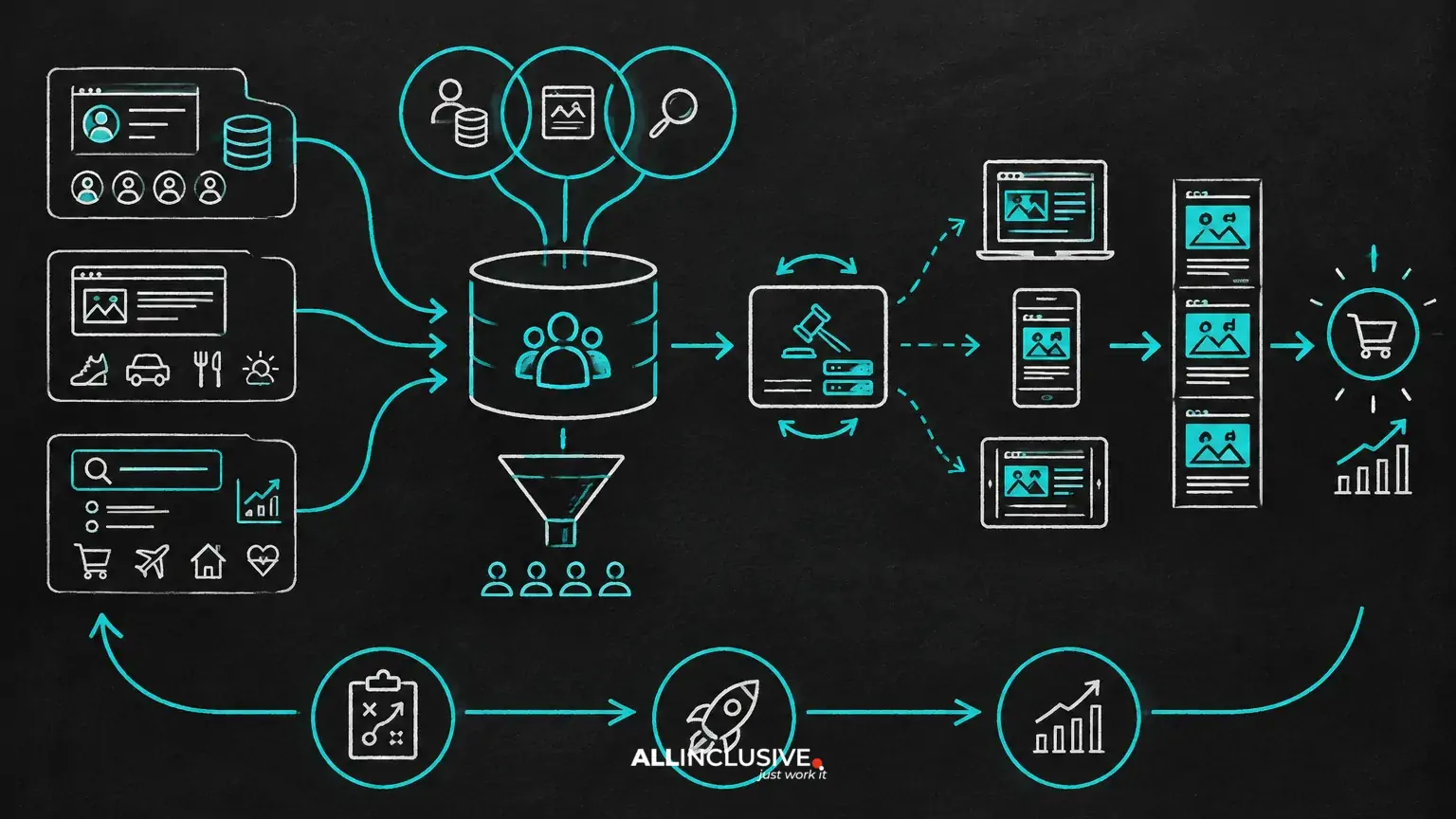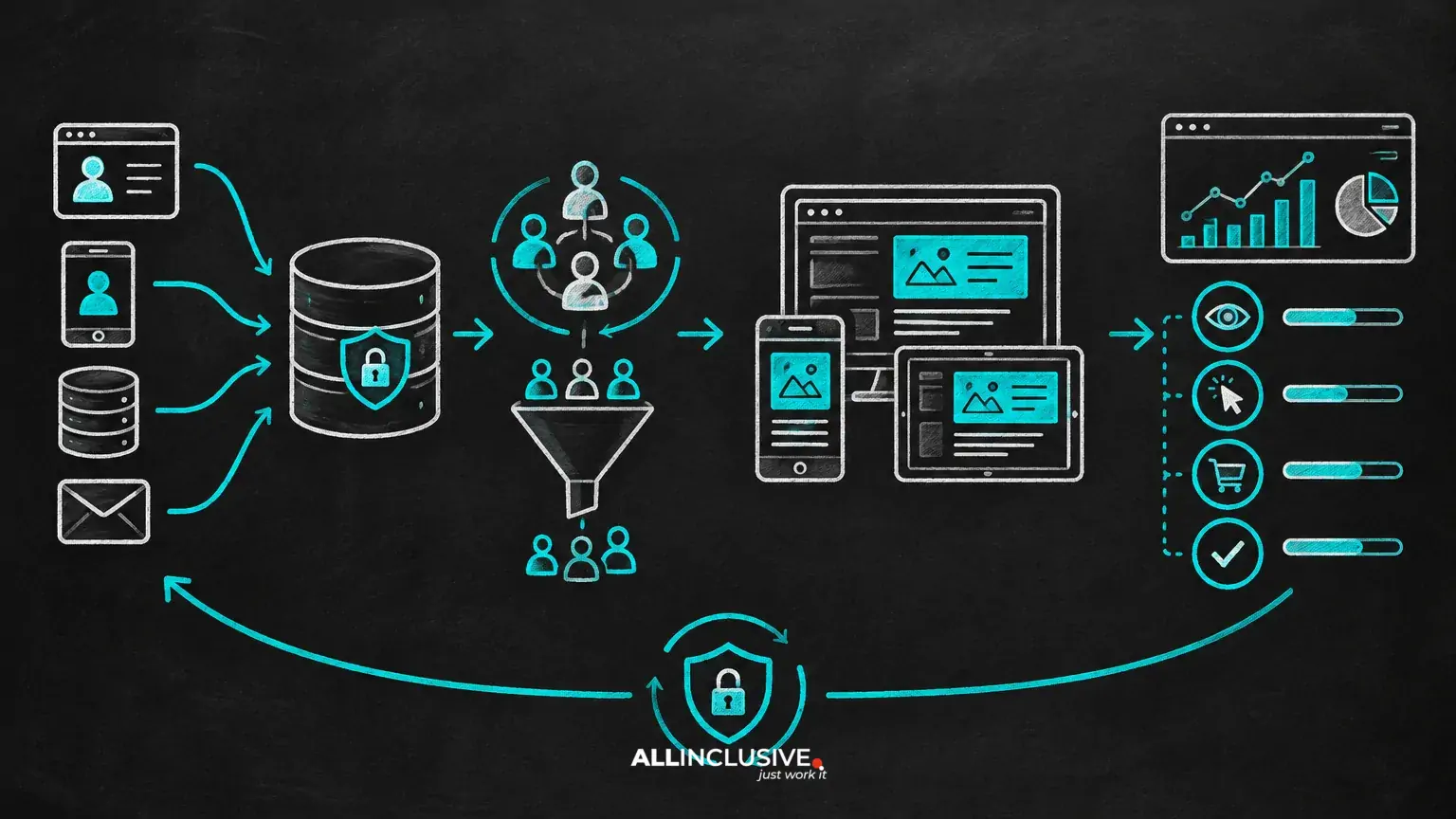
Programmatic first-party data is information a company collects directly from its customers, prospects, users, or owned digital properties. Used well, it can make media buying more relevant and measurable without relying entirely on broad third-party audience assumptions.
The value is not simply having a customer list. The real work is turning permissioned, well-governed business data into usable audience signals, applying those signals to appropriate inventory, and measuring whether media influenced meaningful outcomes. This requires coordination among marketing, analytics, legal, data engineering, and media teams.
What first-party data means in programmatic advertising
First-party data is collected through a company’s direct interactions with people or organizations. Common sources include:
- Website and app interactions
- CRM and customer relationship records
- Purchase, subscription, or lead history
- Authenticated account activity
- Content downloads and event registrations
- Customer service or product engagement signals
- Offline transactions that can be matched through an approved process
In programmatic advertising, these inputs may support audience creation, suppression, modeling, personalization, frequency management, or measurement. The exact activation method depends on the buying platform, data environment, consent framework, identity approach, and inventory available.
First-party data should not be treated as automatically superior to every other signal. It can be incomplete, outdated, biased toward existing customers, or difficult to match at scale. Its advantage is usually its relationship to the advertiser’s business and customer lifecycle—not guaranteed reach or performance.
Why advertisers use first-party data
First-party data can help connect media decisions to known business conditions. For example, an advertiser may want to:
- Reach high-value customer segments with relevant offers
- Exclude recent purchasers from acquisition campaigns
- Re-engage users who started but did not complete a process
- Separate prospects from existing customers
- Adjust messaging by product interest or lifecycle stage
- Measure exposure and conversion against approved business audiences
These applications are especially useful when broad demographic or interest targeting does not capture the advertiser’s commercial reality. A B2B company, for instance, may have more useful segmentation in its account and opportunity data than in generic interest categories.
However, activation should begin with a decision, not with a data export. Define the media objective first, then determine which fields are necessary, whether they are permitted for the intended use, and whether they are reliable enough to inform the decision.
Common programmatic first-party data use cases
Customer acquisition
Advertisers can use existing customer or qualified-lead data to identify patterns associated with valuable outcomes, where the platform and privacy framework support an approved modeling or expansion approach. This can help move beyond simple reach toward audiences that resemble commercially relevant users.
Modeling should be evaluated carefully. A model trained on incomplete or overly narrow data may reproduce the weaknesses of the source audience. Monitor lead quality, downstream conversion, and exclusion logic rather than judging success only by impressions or early clicks.
Retention and cross-sell
Customer segments can inform campaigns for renewals, product education, upgrades, or complementary services. Lifecycle segmentation is often more useful than treating all customers as one audience. A recent purchaser may need a different message from a customer approaching renewal.
Suppression and waste reduction
Suppression is one of the most practical applications. Removing recent converters, current customers, employees, invalid records, or ineligible users can reduce overlapping messages and protect the customer experience. Suppression rules should include refresh timing and an owner responsible for monitoring data quality.
Remarketing
Site or app interaction data can support campaigns for users who viewed a product, completed a form, or abandoned a defined journey. Set sensible recency windows and exclusions. A user who visited once several months ago should not necessarily receive the same treatment as someone who recently requested information.
Account-based media
For B2B campaigns, account lists can support coordinated media around named organizations or account tiers. Match rates and available inventory vary, so account-based activation should be paired with account-level measurement and sales-process context where possible. Media exposure alone does not establish account influence or pipeline causality.
From raw data to an activation-ready audience
A reliable workflow usually contains six stages.
- Define the business use case. Specify the audience, action, exclusions, geography, timing, and success metric.
- Inventory the source data. Document where records originate, what they represent, how often they change, and who may access them.
- Apply governance. Confirm consent, notice, contractual permissions, retention rules, regional requirements, and approved purposes.
- Normalize and validate. Resolve duplicate records, standardize fields, remove invalid entries, and establish freshness rules.
- Activate through an approved environment. Transfer only the fields required by the workflow and follow the relevant platform and partner controls.
- Test before scaling. Validate match behavior, audience size, exclusions, frequency, delivery, and conversion reporting before expanding spend.
The output should be an audience specification, not merely a file. That specification should state the source, eligibility logic, refresh schedule, suppression rules, intended use, owner, and expiration or review date.
Privacy and data governance considerations
Privacy compliance is not a final checklist item. It affects whether an audience can be collected, used, matched, modeled, measured, and retained.
At minimum, teams should clarify:
- What notice was provided when the data was collected
- Whether the intended advertising use is permitted
- Whether consent or another legal basis is required in relevant markets
- How opt-outs and deletion requests are propagated
- Which vendors or platforms receive the data
- How long audience records and activation logs are retained
- Whether sensitive or restricted categories are excluded
Do not assume that pseudonymized or hashed identifiers eliminate privacy obligations. Hashing can support a technical matching process, but it does not automatically change the nature of the underlying data or authorize its use. Legal and privacy teams should determine the applicable requirements for each market and workflow.
Data minimization is also a performance practice. Smaller, cleaner, purpose-built audiences are easier to audit and often easier to interpret than large exports containing unnecessary fields.
How first-party data affects bidding and delivery
Audience data can influence which impressions are eligible, how bids are adjusted, which creative is selected, or whether a user is excluded. The mechanics differ across demand-side platforms, supply paths, identity environments, and campaign types.
Keep the strategic question separate from the platform mechanic. The strategy might be to prioritize high-intent prospects while controlling exposure. The mechanic could involve an audience segment, a bid modifier, a campaign split, a frequency rule, or a modeled expansion. Those are not interchangeable, and the platform may not expose every control in every buying context.
First-party segments can also create delivery constraints. A narrow audience may produce limited scale, uneven geography, higher costs, or concentration in a small number of publishers. Review reach, win rate, frequency, inventory quality, and conversion volume together instead of assuming that tighter targeting always improves efficiency.
For broader context on audience design, see programmatic audience targeting. For the auction environment in which many programmatic decisions occur, see the real-time bidding guide.
Measurement: what to track
Measurement should reflect the role of the audience in the customer journey. A prospecting segment, a suppression list, and a retention audience should not be judged by identical metrics.
Data quality and delivery
- Audience size and eligible reach
- Match or addressability rate, where reported consistently
- Refresh timing and record age
- Delivery, win rate, and frequency
- Geographic and device distribution
- Suppression accuracy and overlap
Media response
- Viewability or other inventory-quality measures
- Click-through rate, interpreted cautiously
- Landing-page engagement
- Cost per qualified visit or action
- Incremental reach and frequency across channels
Business outcomes
- Qualified leads rather than raw form submissions
- Purchases, renewals, or activation events
- Revenue or margin, when reliable values are available
- Pipeline progression for B2B programs
- Customer retention or product adoption
Attribution reports can help describe delivery and recorded conversions, but they do not by themselves prove that first-party data caused the outcome. Use holdouts, geo experiments, audience splits, or other suitable testing methods when the decision warrants stronger evidence. The design must account for sample size, contamination, time lag, and other channels influencing the same users.
Building a practical test plan
A controlled test is usually more informative than launching every available customer segment at once. Start with one business question, such as whether a qualified-prospect audience improves downstream lead quality compared with a broader prospecting strategy.
Document:
- The control and treatment definitions
- Audience eligibility and exclusions
- Budget, timing, geography, and inventory
- Primary and guardrail metrics
- Conversion windows and reporting sources
- Rules for pausing, scaling, or ending the test
Use a primary outcome that is close enough to the business objective to be meaningful, while allowing for realistic conversion lag. Guardrail metrics can include frequency, cost, reach, delivery quality, and customer complaints. A test that improves a platform-reported conversion metric while increasing low-quality leads may not be a success.
Operational mistakes to avoid
- Using stale segments: Refresh frequency should match the business process. A daily-changing lifecycle segment should not be treated as a static list.
- Over-targeting: Combining multiple narrow constraints can make delivery too limited to evaluate.
- Ignoring overlap: The same user may qualify for several campaigns, creating excess frequency and unclear reporting.
- Measuring only clicks: Click behavior can be useful diagnostically but may not represent qualified demand or revenue.
- Skipping suppression QA: Test exclusions with known sample records and campaign-level checks before launch.
- Changing too many variables: If audience, creative, bid strategy, landing page, and geography all change together, learning becomes difficult.
- Confusing match with quality: A large matched audience is not necessarily accurate, current, or commercially valuable.
How to evaluate an activation partner or DSP
When selecting a platform or partner, ask specific questions rather than relying on broad claims about data access:
- Which first-party identifiers and audience workflows are supported?
- What documentation explains data use, retention, permissions, and deletion?
- How are consent signals and opt-outs handled?
- Can audiences be refreshed and expired automatically?
- What overlap, reach, frequency, and conversion reporting is available?
- Can the platform separate observed, modeled, and contextual audiences?
- What testing and incrementality options are supported?
- How portable are audiences, logs, and reporting if the relationship changes?
Platform capabilities change, and availability may depend on region, account configuration, inventory, and contract terms. Validate current functionality directly with the platform or partner before building a process around a specific feature.
For broader buying-platform evaluation, review how to choose a DSP. Programmatic audience activation is one part of a wider programmatic advertising strategy, which should also cover inventory, bidding, creative, measurement, and governance.
Key takeaways
First-party data can make programmatic advertising more connected to real customer and business signals, but it is not a shortcut around strategy, privacy, or measurement. The strongest programs begin with a defined use case, use only necessary and authorized data, maintain clear refresh and suppression rules, and evaluate outcomes beyond platform-reported clicks or conversions.
Start with a narrow, auditable test. Establish a control where practical, inspect data quality and delivery, and connect media results to qualified business outcomes. That approach turns first-party data from a static customer file into a governed input for better decisions.
For broader strategic context, see the broader paid media hub.