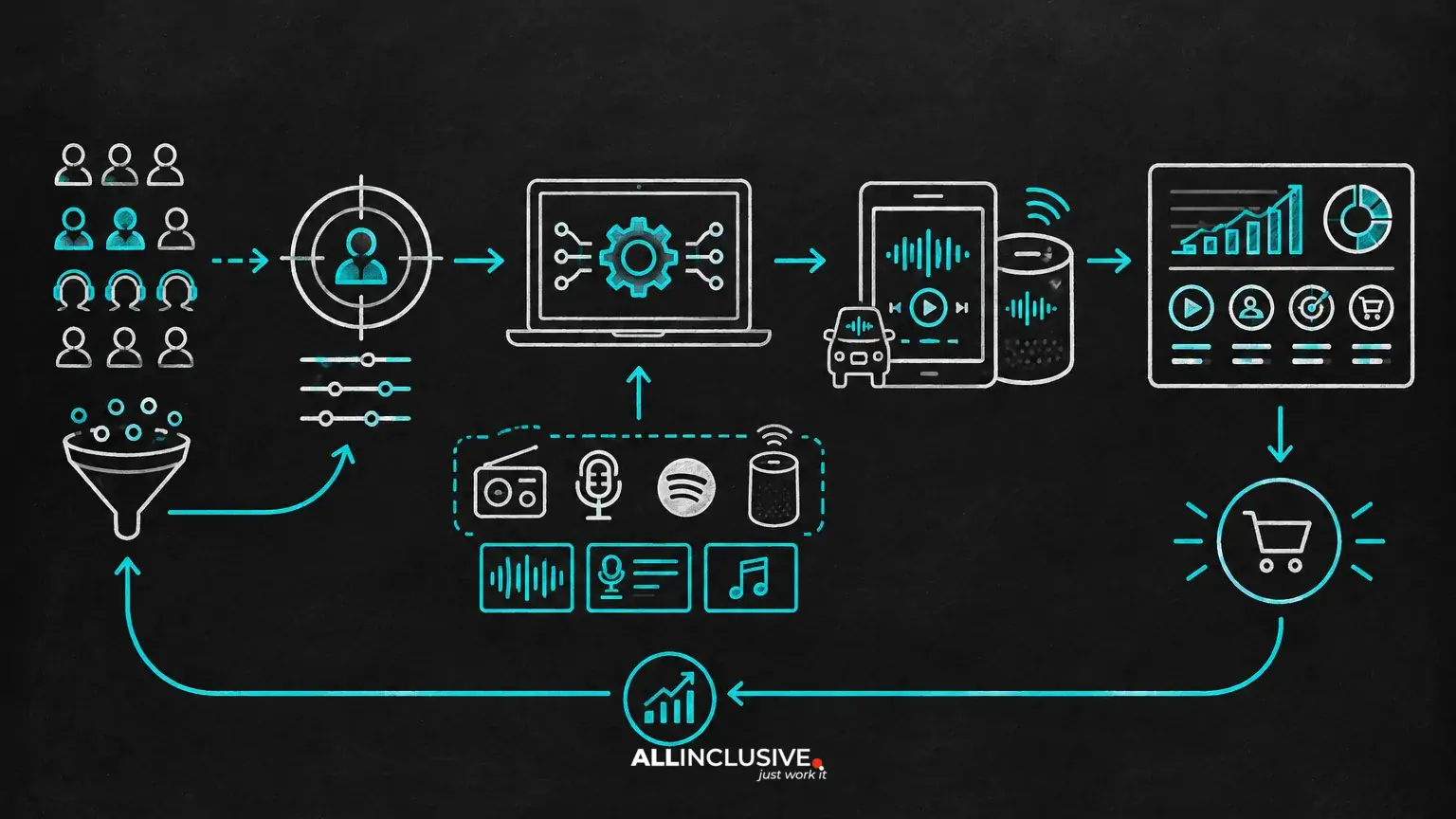
Programmatic audio is the automated buying of audio ad inventory across environments such as music streaming, digital radio, podcasts, and other internet-connected listening experiences. It can help advertisers reach audiences during attentive, screen-light moments, but performance depends on more than selecting an audio format. Inventory quality, audience definition, creative fit, frequency, attribution, and supply-path controls all influence the outcome.
For commercial teams evaluating the channel, the central question is not simply whether audio can generate reach. It is whether the campaign can connect a defined audience to a measurable business action at an acceptable cost. This guide explains the main inventory types, targeting approaches, buying considerations, and KPIs to establish before launch.
What is programmatic audio advertising?
Programmatic audio advertising uses automated technology to buy eligible audio impressions according to campaign parameters. Depending on the buying setup, those parameters may include audience characteristics, context, geography, device, time of day, frequency, inventory source, and bid or budget controls.
The ad is commonly a prerecorded audio spot, although some environments can support companion display, video, or interactive elements. The listener may hear the ad through a music service, podcast app, digital radio stream, publisher property, gaming environment, or another audio-enabled experience.
Programmatic buying does not make every audio impression interchangeable. A podcast download, a live digital radio stream, and an on-demand music session can differ in audience signals, insertion method, reporting detail, creative context, and measurement options. Planning should therefore begin with the business objective and inventory role rather than with a single channel label.
Where programmatic audio inventory comes from
Streaming music and digital radio
Streaming environments can provide broad, repeated reach and useful contextual signals. Listeners may be grouped by declared or inferred interests, listening behavior, geography, device, or session context, subject to the capabilities and privacy controls of the buying ecosystem.
These environments are often suitable for awareness and consideration campaigns, especially when the brand has a clear audience definition and a message that works without visual explanation.
Podcast inventory
Podcast advertising can appear in host-read, producer-read, dynamically inserted, or other publisher-defined formats. Programmatic access is most associated with dynamically served inventory, but available controls and reporting can vary considerably by show, network, supply source, and buying platform.
Podcast audiences may offer strong contextual alignment, yet scale and measurement need careful review. Ask whether delivery is reported by episode, show, network, audience segment, or broader inventory category, and clarify how impressions, downloads, completion, and conversions are defined.
Digital radio and live streams
Digital radio can combine scheduled programming with audience and geographic targeting. Its value may be strongest when the campaign needs repeated reach around commuting, workday, or other listening occasions. Validate how ad breaks are assembled, whether inventory is exclusive or shared, and how frequency is managed across streams and devices.
Audio in connected and emerging environments
Additional inventory may exist in gaming, retail media, smart-device, or other connected experiences. These placements should not be treated as equivalent to standard music or podcast inventory. Evaluate the listening context, user experience, consent framework, brand suitability controls, and available measurement before expanding supply.
How to choose inventory for the campaign
Match inventory to the job the campaign must perform:
- Reach: prioritize scalable environments with consistent delivery and transparent reporting.
- Context: prioritize shows, genres, content categories, or listening moments aligned with the audience’s mindset.
- Consideration: use stronger sequential messaging, companion elements, landing-page alignment, or retargeting where available and appropriate.
- Action: confirm that the buying and analytics setup can connect exposure to site visits, leads, purchases, store activity, or another defined conversion.
- Brand development: give greater weight to attention, completion, reach quality, and lift design rather than forcing every impression into a last-click framework.
Inventory selection should also account for supply quality. Review the seller or exchange, publisher and show transparency, invalid-traffic controls, ad-placement information, frequency capability, and reporting granularity. A lower apparent media cost is not necessarily efficient if the campaign produces weak attention, limited verification, or poor conversion observability.
Targeting options in programmatic audio
Geographic and demographic targeting
Geography is often useful for regional launches, retail catchments, service areas, and market-level testing. Demographic targeting may be available through platform or publisher signals, but definitions and modeled coverage differ. Treat audience labels as planning inputs, not guarantees of individual identity.
Behavioral and interest targeting
Behavioral and interest segments can help reach users associated with categories such as travel, finance, fitness, technology, or entertainment. Before activation, examine segment provenance, recency, scale, overlap, and whether the audience is directly observed, modeled, or supplied by a third party.
Contextual targeting
Contextual targeting uses the content or listening environment rather than relying exclusively on a user profile. It can be valuable when privacy requirements, addressability limits, or brand relevance make context a stronger signal. A financial-services advertiser, for example, might test business and economics programming alongside broader intent audiences.
First-party and account-based audiences
Where consent and platform capabilities allow, advertisers may use first-party customer or prospect data for activation, suppression, sequencing, or measurement. B2B campaigns can also explore account-based approaches, but account matching should be validated and evaluated against reachable scale. Avoid assuming that an account list translates directly into identifiable individual listeners.
Time, device, and listening-moment controls
Daypart, device, operating environment, and location can provide useful tests. For example, a productivity service may compare workday listening with evening inventory, while a retailer may test audio around store operating hours. These controls should support a clear hypothesis; excessive segmentation can fragment delivery and make results harder to interpret.
Creative requirements and message design
Audio creative must communicate without depending on a screen. The opening seconds should establish relevance, the core proposition should be easy to understand when heard once, and the call to action should be memorable enough to act on later. Brand name, category, benefit, and next step should receive deliberate attention.
Use a voice and sound design appropriate to the environment. A podcast spot may benefit from a conversational tone, while a broad streaming campaign may require a more direct structure. Music, effects, silence, pacing, and pronunciation all affect comprehension. Test creative for clarity on ordinary headphones and mobile speakers, not only in a studio setting.
If the placement supports a companion banner or other visual element, use it to reinforce rather than contradict the spoken message. Build destination pages that reflect the ad’s promise, use campaign-specific tracking parameters, and ensure that the page performs well on mobile devices.
Measurement: KPIs that support programmatic ROI
Measurement should be designed before buying begins. A useful framework separates delivery, engagement, business outcomes, and incrementality.
Delivery and media-quality KPIs
- Impressions or served opportunities, with the platform’s definition documented.
- Reach and frequency, ideally deduplicated as far as the available measurement allows.
- Completion or listen-through rate, interpreted in light of the inventory and player behavior.
- Cost per thousand impressions and effective cost by inventory type.
- Invalid traffic, supply quality, and brand-suitability outcomes where verification is available.
- Geographic, audience, device, and placement delivery against the plan.
Engagement and response KPIs
- Site visits and engaged sessions from trackable traffic.
- Promo-code, vanity-URL, QR, or other response signals when appropriate to the audience.
- Landing-page engagement, lead starts, completed forms, or product interactions.
- Search behavior or branded demand trends, used carefully and not treated as proof of causation on their own.
Conversion and efficiency KPIs
- Cost per qualified lead, application, booking, purchase, or other agreed business event.
- Revenue, margin, customer value, or pipeline contribution where the data connection is reliable.
- Return on ad spend or another efficiency measure with attribution assumptions documented.
- Assisted conversions and time-to-conversion, especially when audio supports a longer consideration journey.
Incrementality and brand KPIs
When direct attribution is incomplete, use a structured test where feasible. Holdout, geographic, audience, or time-based designs can help estimate incremental lift, provided exposure, contamination, sample size, and external demand factors are considered. Brand-lift research may also be useful for awareness, recall, consideration, or intent objectives. The method should match the decision the business needs to make.
A practical launch framework
- Define the commercial outcome. Specify whether the campaign is intended to create reach, qualified demand, transactions, pipeline, or a measurable lift in brand indicators.
- Map the audience and journey. Identify who should hear the message, what they already know, and what action should follow exposure.
- Choose an inventory mix. Compare music, radio, podcast, and contextual options by relevance, scale, transparency, and measurement—not by format name alone.
- Build the measurement plan. Confirm tracking, conversion definitions, attribution windows, exclusions, brand-safety controls, and the reporting cadence before launch.
- Prepare and test creative. Produce variants tied to a defined hypothesis, such as message angle, offer, voice, context, or call to action.
- Set decision rules. Establish what would trigger budget movement, creative replacement, audience expansion, supply restriction, or a pause. Avoid optimizing solely toward the cheapest delivery metric.
- Review results by meaningful cuts. Analyze inventory source, audience, geography, frequency, device, daypart, creative, and conversion lag while watching for small-sample overinterpretation.
Common risks and how to manage them
Overreliance on completion rate
A completed audio impression indicates delivery through the player’s measurement method; it does not automatically indicate comprehension, intent, or business impact. Pair completion with reach quality, response, and outcome measures.
Unclear supply and reporting
Ask exactly where the ad ran, how inventory was classified, what was modeled, and which metrics are deduplicated. Require a level of transparency appropriate to the budget and risk of the campaign.
Frequency without incremental reach
Audio can generate repeated exposure quickly among a narrow audience. Monitor frequency and marginal reach together. If additional impressions mostly reach existing exposed users, test broader audiences, new inventory, or a different sequencing strategy.
Attribution gaps
Listeners may remember a brand and convert later through search, direct navigation, or another device. Use multiple response signals and, where practical, an incrementality design. Do not present a platform-reported conversion number as a complete account of causal impact.
How programmatic audio fits a broader paid-media plan
Audio is usually strongest as part of a coordinated media system rather than as an isolated tactic. It can introduce a problem, reinforce a proposition, or support retargeting and conversion channels. Coordinate audience definitions, exclusions, frequency logic, creative sequencing, and measurement across channels.
For a wider planning view, review paid media strategy and channel planning. If the campaign also uses visual programmatic formats, compare the role of audio with programmatic display advertising and programmatic video advertising. These channels may share buying infrastructure while requiring different creative and measurement assumptions.
Questions to ask a programmatic audio partner
- Which inventory sources and content environments are included?
- How are impressions, completions, reach, and frequency defined?
- What audience signals are used, and how are they sourced or modeled?
- Can supply, placement, brand-safety, and invalid-traffic reporting be reviewed at a useful level?
- How will exposure connect to site activity, leads, revenue, or lift measurement?
- What controls exist for frequency, exclusions, pacing, geography, and creative rotation?
- Which optimization decisions will be automated, and which require human review?
Programmatic audio is worth investigating when the audience listens in environments that can be reached responsibly and when the business can define a credible measurement path. The strongest plans connect inventory choice, audience logic, sound-first creative, supply quality, and outcome measurement from the beginning. That discipline is more important than any individual platform setting or format label.
For broader strategic context, see our programmatic advertising resource.