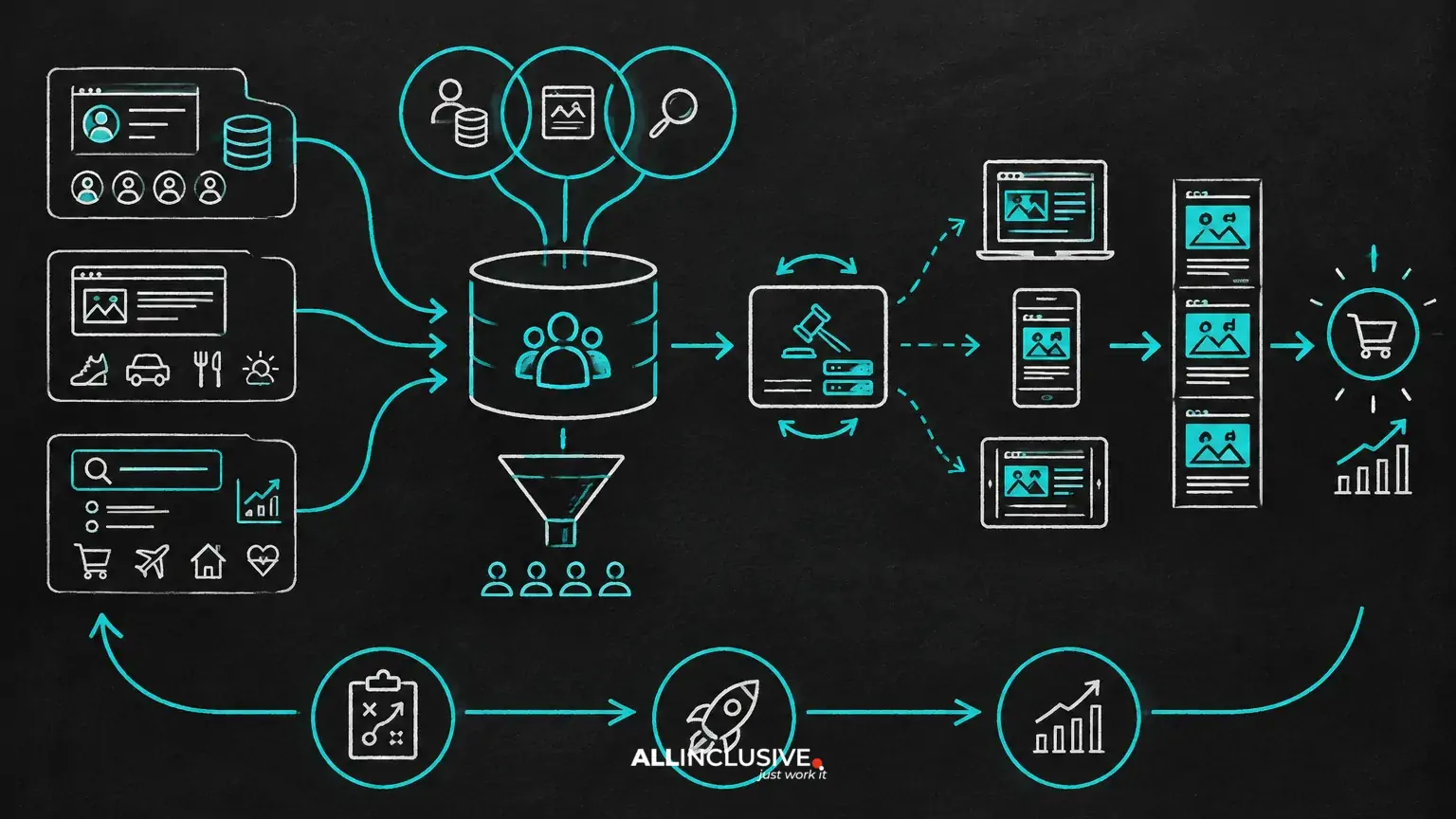
Real-time bidding (RTB) is the automated process used to buy and sell many digital advertising impressions through auctions that take place in milliseconds. When a user opens a page or app, an available ad impression can be offered to multiple buyers. Eligible advertisers evaluate the opportunity, submit bids through their demand-side platforms, and the winning ad is selected before the page or content finishes loading.
RTB is not the same as buying every impression on an open exchange, and it is not a complete synonym for programmatic advertising. Programmatic buying also includes automated direct deals, private marketplaces, and other transaction types that may not use an open auction. RTB specifically describes auction-based impression trading, usually with automated eligibility and pricing decisions.
This guide explains the auction sequence, the roles of the main participants, the factors that shape bids, and the controls advertisers need for reliable performance.
How a real-time bidding auction works
An RTB transaction involves several systems working in a short window. The exact sequence varies by auction design and technology stack, but the core process usually looks like this:
- An ad opportunity becomes available. A publisher, app, or connected-device environment identifies an impression that can be sold.
- An ad request is sent. The request may include information such as placement type, content context, device category, geography, consent signals, and available audience identifiers, subject to applicable privacy requirements.
- Supply-side technology offers the impression. A supply-side platform or exchange makes the opportunity available to eligible demand partners.
- Demand-side platforms evaluate it. Each DSP applies campaign rules, audience logic, inventory controls, predicted value, and bid constraints.
- Buyers submit bids and creative details. A bid represents what an advertiser is willing to pay under the applicable pricing and auction conditions.
- The auction determines the selected buyer. The exchange or supply-side system applies its auction rules, including eligibility and pricing mechanics.
- The winning creative is served. The selected ad is returned to the publisher or app, where it is rendered for the user.
- Events are recorded. Delivery, viewability, clicks, conversions, and other signals can be captured for reporting and future optimization, depending on measurement access and implementation.
The important distinction is that the advertiser is not manually choosing each impression. It defines a strategy and constraints; automated systems then make many individual decisions as opportunities appear.
The main participants in RTB
Advertisers and agencies
Advertisers define the business objective, audience, budget, creative requirements, geographic scope, and acceptable inventory. Agencies may manage these decisions on the advertiser’s behalf, including planning, activation, optimization, and reporting.
Demand-side platforms
A DSP gives buyers access to auction-based inventory and provides tools for campaign setup, audience activation, bidding, pacing, frequency management, creative selection, and measurement. DSP capabilities differ, so buyers should evaluate not only inventory reach but also transparency, data controls, brand-safety settings, and optimization options. For a broader evaluation framework, see how to choose a demand-side platform.
Publishers and supply-side platforms
Publishers own or operate digital properties where advertising is displayed. A supply-side platform helps manage and monetize that inventory by connecting it with demand sources, applying supply controls, and facilitating auction participation.
Ad exchanges and intermediaries
An exchange can connect buyers and sellers and support the auction process. In practice, the buying path may include multiple technology providers. Each additional intermediary can affect transparency, fees, latency, reporting, and the advertiser’s ability to verify supply.
Verification and measurement providers
Independent or platform-integrated tools may support fraud detection, viewability measurement, contextual classification, brand suitability, conversion reporting, or identity resolution. Their coverage depends on the environment, technical implementation, and available signals.
What determines an RTB bid?
A bid should reflect the expected value of an impression, not simply the fact that the impression is available. Common inputs include:
- Campaign objective: A conversion-focused campaign may value an impression differently from an awareness campaign.
- Audience relevance: First-party audiences, contextual signals, modeled segments, or intent indicators can influence expected value.
- Placement quality: Position, format, screen size, viewability potential, and the surrounding experience may affect the bid.
- Context and suitability: Page content, app category, language, and exclusion rules can determine whether an impression is eligible.
- Historical performance: The platform may use prior delivery and outcome signals, while recognizing that historical performance does not guarantee future results.
- Frequency and recency: A user who has already seen the ad several times may be worth less, or may be excluded altogether.
- Budget and pacing: The bid must fit daily, campaign, and overall spend controls.
- Competition and auction conditions: The value needed to win varies by inventory, demand, auction rules, and timing.
- Creative and landing-page readiness: An impression may be excluded if the creative does not meet format, policy, or technical requirements.
These inputs are combined through platform bidding logic. Some systems use rules, machine-learning models, or a combination of both. The practical question for marketers is not whether an algorithm exists, but whether it is receiving reliable signals and whether its decisions align with the business objective.
RTB pricing and auction mechanics
In a simplified auction, the highest eligible bid is selected. However, the amount paid and the conditions of the transaction depend on the auction design, supply path, and commercial terms. Advertisers should avoid assuming that every RTB environment uses one universal pricing model.
Several mechanics can affect outcomes:
- Floor prices: A publisher or supply partner may set a minimum acceptable price.
- Eligibility rules: Creative format, category restrictions, geography, consent, and quality requirements can remove bids before selection.
- Deal terms: Private marketplace or programmatic guaranteed arrangements may use negotiated terms rather than a standard open-auction dynamic.
- Supply-path differences: The same or similar inventory can appear through different routes, with different fees, duplication, and reporting quality.
- Currency and billing conventions: Buyers must understand the currency, pricing unit, and reporting basis used by the relevant platform.
For this reason, a lower bid is not automatically more efficient, and a higher win rate is not automatically better. The commercial result depends on the quality of the impressions won and the outcomes they produce.
RTB compared with other programmatic buying methods
RTB is one part of the broader programmatic ecosystem. Open-auction buying offers automated access to a wide range of impressions, but it can involve more variable supply quality and less predictable placement availability. Private marketplaces may provide a more controlled group of publishers or inventory packages. Programmatic direct deals can provide greater predictability around access, pricing, or volume, depending on the agreement.
The right approach depends on the objective. An advertiser seeking broad prospecting reach may use auction-based buying with strict supply controls. A brand prioritizing premium environments or a defined publisher group may use private or direct arrangements. Many mature programs combine methods rather than treating one as universally superior.
RTB also differs from search advertising. Search auctions respond to an active query and often use keyword or query-level intent. RTB can reach users across display, video, audio, connected television, mobile applications, and other addressable environments, depending on the platform and inventory access. For a fuller comparison of buying environments, see programmatic vs. Google Ads.
How advertisers improve RTB performance
Start with a measurable objective
Define whether the campaign is intended to generate qualified visits, leads, sales, completed views, reach, or another business outcome. The objective should determine the conversion event, optimization signal, bid constraints, and reporting structure.
Separate prospecting from retargeting
New-user acquisition and re-engagement often have different economics and frequency needs. Combining them can obscure performance and make budget decisions harder. Use clear audience definitions and reporting dimensions so each strategy can be evaluated on its own terms.
Use disciplined supply controls
Review domain and app inclusion or exclusion options, content categories, placement-level reporting, fraud indicators, viewability data, and supply-path information where available. Avoid optimizing only toward the cheapest inventory; low cost can reflect limited attention or weak business value.
Match creative to the environment
Build assets for the formats and screens being purchased. Test meaningful variations in message, offer, design, and call to action, while keeping landing pages consistent with the promise in the ad. Creative fatigue can also reduce the value of otherwise eligible impressions.
Protect frequency and pacing
Set practical frequency controls, monitor delivery against the campaign schedule, and watch for concentration in a narrow audience or placement set. Pacing problems can cause early overspending, late delivery, or unnecessary pressure to buy lower-quality inventory.
Make conversion measurement credible
Confirm that tags, events, consent handling, attribution windows, and deduplication rules are documented. Compare platform reporting with an agreed source of truth, but do not assume discrepancies mean one system is automatically wrong. Different systems may count events at different stages and under different rules.
Common RTB risks and how to manage them
- Invalid traffic: Use available verification, exclusion, and supply-quality controls, then review unusual patterns rather than relying on one aggregate metric.
- Brand-safety exposure: Establish suitability categories, sensitive-topic rules, keyword logic where appropriate, and escalation procedures before launch.
- Opaque supply paths: Request placement, fee, and supply-path reporting where available. Consolidating unnecessary routes can improve operational clarity.
- Audience overreach: Treat modeled or third-party audience labels as signals, not guarantees. Validate quality against business outcomes.
- Privacy and consent gaps: Use only data and activation methods permitted for the relevant jurisdiction, consent state, contract, and platform environment.
- Algorithmic drift: Monitor changes in spend distribution, inventory mix, frequency, conversion quality, and marginal performance after major strategy or signal changes.
A practical RTB implementation checklist
- Document the business goal, primary KPI, secondary safeguards, budget, and flight dates.
- Define audience, geography, devices, environments, frequency, and exclusion requirements.
- Select inventory types and decide whether open auction, private marketplace, direct, or a blended approach is appropriate.
- Prepare approved creative in the required formats and verify landing-page functionality.
- Configure conversion events, consent handling, attribution settings, and reporting dimensions.
- Set supply, brand-safety, fraud, viewability, and placement controls before activation.
- Launch with enough structure to compare audiences, creative, inventory, and bidding strategies without creating unnecessary fragmentation.
- Review delivery and quality early, then optimize toward the agreed business outcome rather than a single auction metric.
- Record changes so performance movement can be interpreted in context.
The role of bidding algorithms
Real-time bidding depends on algorithms because the volume and speed of impression opportunities make manual decisions impractical. Algorithms can estimate the probability of an outcome, assign value to an impression, adjust bids, manage pacing, and allocate spend across eligible opportunities.
Algorithmic optimization is only as useful as its inputs. Weak conversion tracking, inconsistent audience definitions, insufficient creative variation, poor supply controls, or premature changes can lead the system toward the wrong outcome. For a focused explanation of algorithmic approaches and optimization logic, read programmatic bidding algorithms.
Marketers should therefore treat automation as a managed operating system, not a substitute for strategy. The human role remains essential in setting objectives, defining acceptable risk, validating measurement, interpreting trade-offs, and deciding when a platform’s behavior no longer matches the business need.
Real-Time Bidding Explained: Key Decision Point
Real-time bidding is a fast, automated auction process that evaluates individual ad impressions against campaign rules, audience signals, predicted value, and supply conditions. Successful RTB programs combine appropriate inventory access with clear objectives, reliable measurement, disciplined quality controls, relevant creative, and ongoing review of marginal performance.
RTB works best when it is treated as one component of a broader programmatic advertising strategy. For planning across channels, measurement, and buying methods, explore the wider paid media discipline.