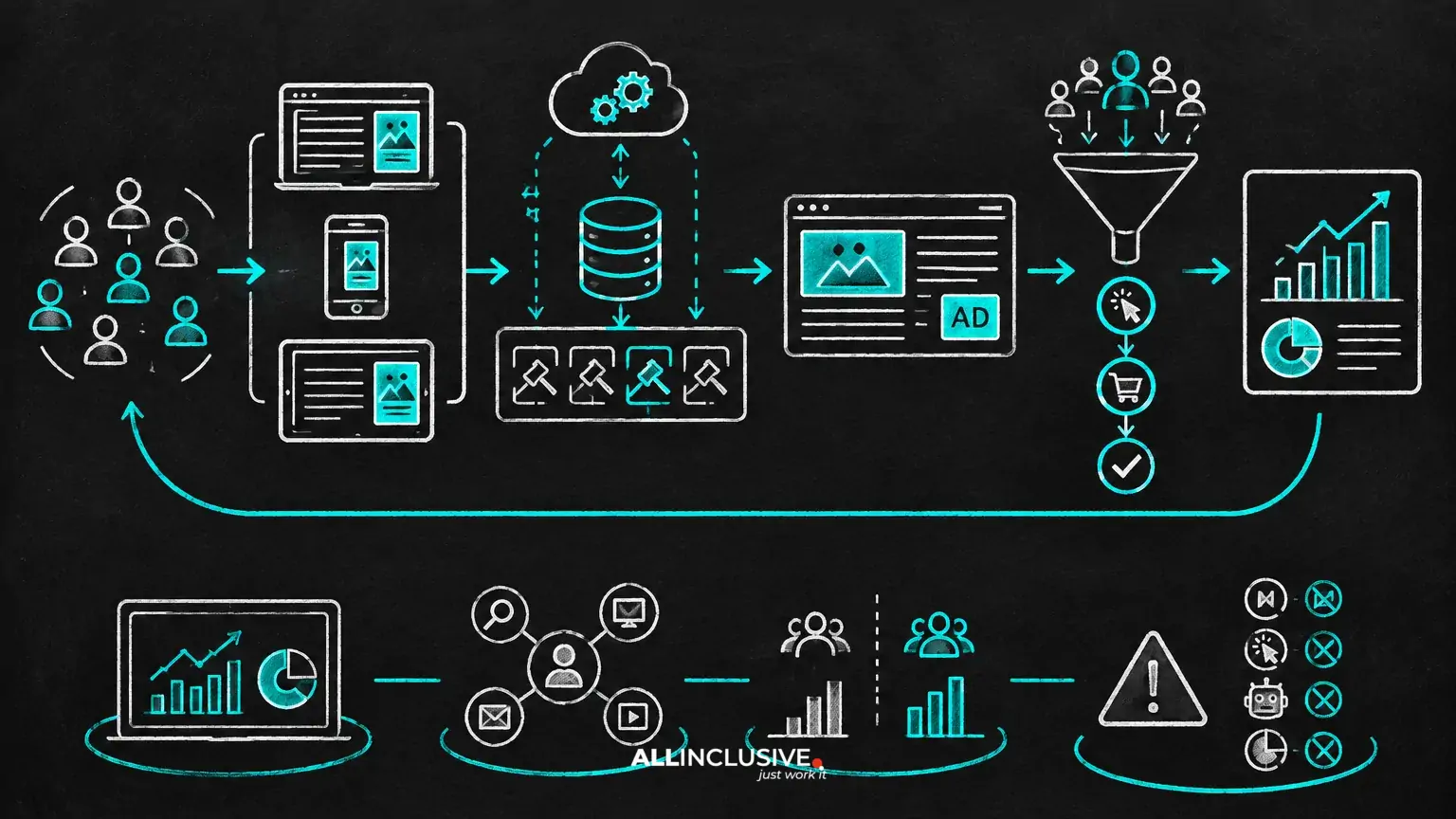
Programmatic advertising ROI is not defined by a low CPM, a high click-through rate or even a strong platform-reported ROAS in isolation. It is the relationship between the incremental business value generated by programmatic media and the total cost required to produce that value.
A reliable measurement approach connects four layers: media delivery, user actions, business outcomes and the cost of the complete programmatic operation. It also recognizes that attribution models can overstate the contribution of display, video, audio or connected TV when several channels influence the same conversion.
This guide explains which metrics matter, how to choose an attribution method, where measurement commonly fails and how to turn the findings into better buying decisions.
What programmatic advertising ROI actually measures
At its simplest, ROI can be expressed as:
ROI = (incremental revenue or profit generated − total investment) ÷ total investment
Many teams use ROAS instead:
ROAS = attributed revenue ÷ media spend
These measures answer different questions. ROAS describes the revenue assigned to advertising under a particular attribution model. ROI asks whether the investment created enough economic value to justify its full cost. A campaign can report attractive ROAS while producing limited incremental demand, especially when it retargets people who were already likely to convert.
For lead generation, revenue may not be available immediately. In that case, use a validated value for qualified pipeline, opportunities or closed business rather than treating every form fill as equal. The valuation method should be documented, reviewed against actual sales outcomes and updated when the sales cycle produces new evidence.
The metrics that support an ROI view
1. Delivery and media-efficiency metrics
These metrics describe whether the campaign reached the intended audience and bought media efficiently:
- Reach and frequency: how many people or households were exposed and how often, subject to the limitations of the available identity and measurement method.
- CPM or cost per completed view: useful for comparing delivery costs, but not proof of business impact.
- Viewability and completion rate: quality indicators that should be interpreted alongside placement, format and audience context.
- Invalid traffic and brand-safety outcomes: essential controls for determining whether delivered impressions were suitable and potentially valuable.
- Audience delivery: whether impressions reached the intended geography, account set, customer segment or prospecting audience.
Efficiency metrics are diagnostic. They help identify waste, but they do not establish that the media caused revenue.
2. Engagement metrics
Clicks, landing-page visits, video completions, engaged sessions and onsite actions can help explain user behavior. They are most useful when tied to a defined funnel stage. For example, an engaged visit may be a reasonable diagnostic for an awareness campaign but a weak primary KPI for a pipeline campaign.
Be cautious with metrics that are easy to inflate through accidental clicks, repeated exposure or low-quality inventory. Compare engagement quality across placements, devices, creative variants and audience groups instead of optimizing toward a single blended average.
3. Conversion and business metrics
Business metrics should sit closest to the decision the campaign is meant to influence. Depending on the objective, these may include:
- Completed purchases and contribution margin
- Qualified leads and accepted opportunities
- Pipeline created and pipeline progression
- Customer acquisition cost and payback period
- Repeat purchase, retention or customer lifetime value
- Store visits or offline sales when they can be measured responsibly
Use conversion quality rules wherever possible. A campaign that generates inexpensive leads with poor sales acceptance may have weaker economics than one with a higher cost per lead but stronger downstream performance.
4. Total-cost metrics
Programmatic ROI should account for more than the media invoice. Depending on the operating model, the investment may include data costs, ad-serving or verification fees, creative production, agency or platform fees, measurement costs and internal resources. If these costs are excluded, the analysis may be useful for media optimization but should not be labeled a complete ROI calculation.
Choose the measurement method before launch
Measurement should be designed around the campaign objective, conversion volume, sales cycle and available first-party data. No single method is best for every program.
Platform-reported attribution
Platform reporting is useful for operational decisions such as pacing, delivery and audience comparisons. It is less reliable as a standalone estimate of incremental business impact because the platform controls parts of the exposure, conversion and attribution environment.
Use platform data as one input, not as the final source of truth. Keep attribution windows, conversion definitions and reporting dates consistent when comparing periods.
Analytics and multi-touch attribution
Web analytics can provide a cross-channel view of sessions and conversions. Rule-based models, such as last-click or position-based attribution, are simple to operate but encode assumptions about credit. Data-driven approaches may be more sophisticated, yet they still depend on data quality, identity coverage and model design.
Multi-touch attribution is best treated as a directional allocation system. It can help prioritize campaigns and journeys, but it should not be confused with a controlled estimate of incremental lift.
Geo or market-based testing
Geo-based testing compares exposed and control markets or regions while attempting to keep other factors reasonably balanced. It can be practical for businesses with sufficient geographic scale and stable market conditions. The design should account for seasonality, local promotions, distribution differences and spillover between markets.
Holdout and conversion-lift testing
Holdout testing withholds advertising from a defined control group or market and compares outcomes with the exposed group. Conversion-lift studies can provide a stronger causal signal than click-based attribution, but they require an eligible population, an adequate sample and carefully defined success events.
For upper-funnel channels such as video, audio and CTV, a conversion may be too infrequent or delayed to capture the whole effect. Brand-lift surveys, search behavior, direct traffic, qualified site engagement and longer-term business outcomes may be appropriate supporting measures, provided their limitations are clear.
Marketing mix modeling
Marketing mix modeling can estimate the relationship between media investment and business outcomes over time, particularly for organizations with sufficient historical data and variation in spend. It is useful for budget allocation across channels, but it generally operates at an aggregate level and may not answer granular questions about individual audiences or creative executions.
Common traps that distort programmatic advertising ROI
Counting every conversion as incremental
A view-through or post-click conversion shows that a conversion followed an exposure. It does not prove that the exposure caused the outcome. Retargeting and high-intent audiences are especially vulnerable to over-crediting because they already contain people close to conversion.
Optimizing to the cheapest conversion
Low-cost conversions may reflect weak qualification, duplicate submissions, poor geographic fit or users who would have converted without advertising. Connect optimization events to downstream quality and revenue wherever the data allows.
Comparing channels with incompatible attribution rules
One channel may report view-through conversions while another reports only click-through conversions. Their totals are not directly comparable. Standardize conversion definitions, attribution windows and reporting logic before evaluating channel efficiency.
Treating media quality as proof of performance
High viewability, premium inventory and strong completion rates are valuable safeguards, but they do not establish economic return. Quality controls reduce waste and risk; they must still be connected to outcomes.
Ignoring frequency and saturation
Additional impressions may have diminishing value after an audience has received enough exposure. Review performance by frequency bands where measurement permits, and watch for rising costs, falling engagement quality or conversion rates that remain flat as spend increases.
Mixing new and returning customers
Acquisition and retention often have different economics. A campaign may appear efficient because it receives credit for existing customers, repeat purchases or users already active in the brand ecosystem. Report new-customer and existing-customer outcomes separately when the business objective is acquisition.
Changing too many variables at once
If audience, bid strategy, creative, inventory, budget and landing page all change simultaneously, the team may see a performance movement without knowing its cause. Establish a testing hierarchy and maintain a record of material changes.
A practical framework for improving ROI
- Define the business outcome. Specify whether success means profitable sales, qualified pipeline, customer acquisition, retention or another measurable result.
- Set the economic value. Use margin, expected revenue, qualified-pipeline value or another documented valuation rather than an arbitrary conversion value.
- Separate reporting layers. Keep delivery, engagement, attributed conversions and incremental outcomes distinct.
- Audit tracking and data quality. Check conversion deduplication, consent handling, event timing, CRM matching, offline imports and landing-page analytics.
- Establish a baseline. Compare against a prior period, matched market, control group or pre-campaign trend where appropriate.
- Test incrementality. Use a holdout, geo experiment, lift study or aggregate model suited to the campaign’s scale and objective.
- Optimize within guardrails. Improve audience, creative, inventory and frequency while protecting reach and learning. Do not optimize solely toward the easiest event to generate.
- Reconcile costs and outcomes. Compare the same time period and include the relevant operational costs before making budget recommendations.
How to use ROI findings in planning
ROI analysis should lead to a decision, not merely a dashboard update. If a campaign produces efficient attributed conversions but no measurable lift, reduce confidence in the attribution and investigate audience overlap, retargeting pressure and organic demand. If incremental lift is positive but the overall return is weak, examine creative, landing-page conversion, pricing, margin and total operating cost before assuming the media is the sole problem.
For campaigns that cannot yet support robust causal testing, use a measurement maturity ladder. Start with consistent event tracking and conversion-quality reporting. Add cross-channel analysis and cost reconciliation. Then introduce experiments or modeling as spend, volume and organizational readiness increase.
A structured programmatic advertising strategy should connect inventory selection, audience design, creative sequencing and measurement from the outset. For broader channel planning and budget governance, see paid media.
Before launch, a programmatic campaign audit can help identify tracking, inventory and measurement weaknesses. If the program spans display, video, audio and CTV, review the principles in omnichannel programmatic advertising to avoid evaluating each channel in isolation.
Programmatic Advertising ROI: What to Prioritize
Programmatic advertising ROI is strongest when it is treated as a business measurement problem rather than a platform-reporting exercise. Use delivery metrics to find waste, conversion metrics to understand the funnel and incrementality methods to estimate what the advertising actually changed. Document assumptions, separate attribution from causality and connect media decisions to profitable business outcomes.