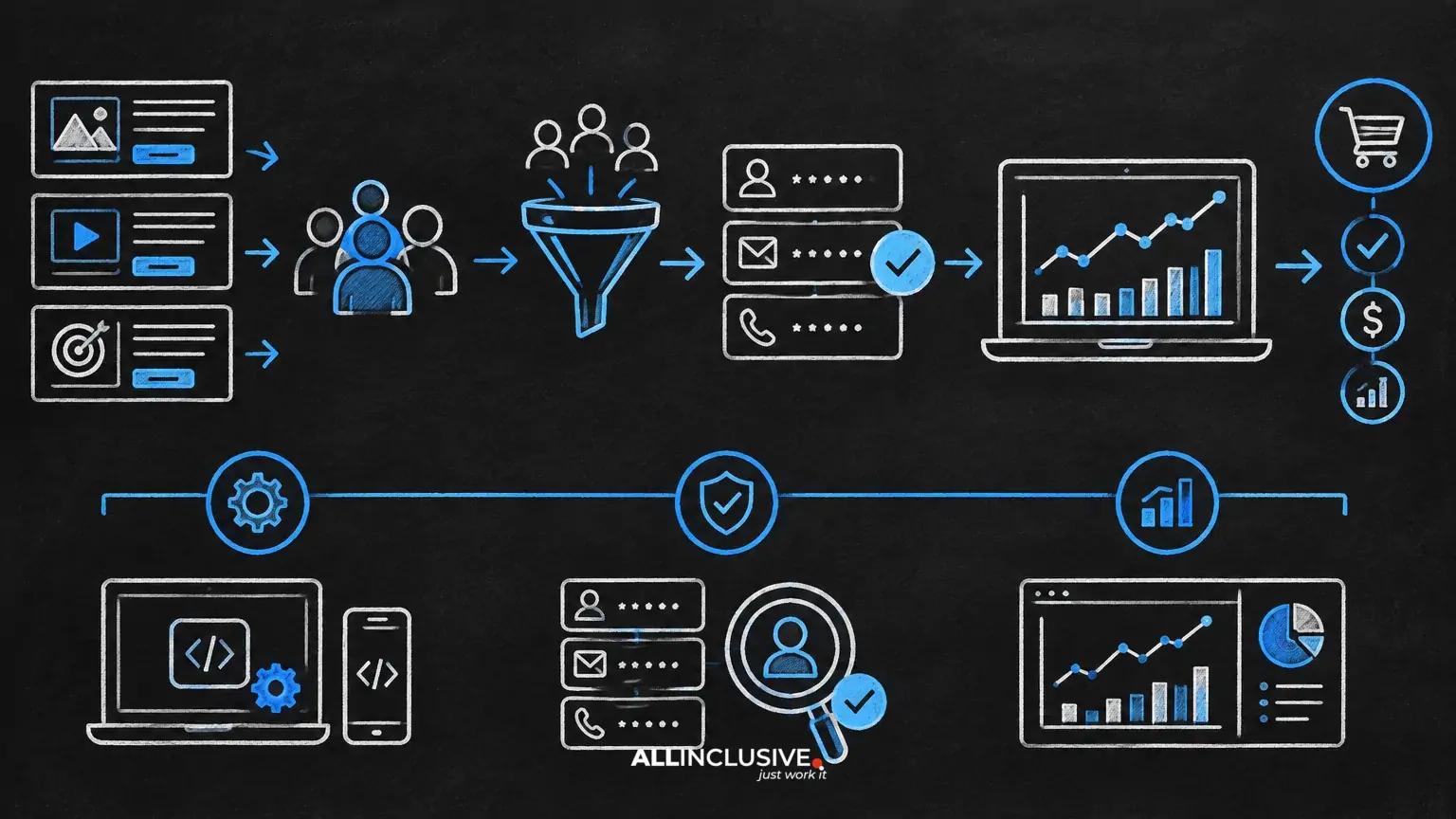
Enhanced conversions are a measurement feature that uses consented, first-party customer information—such as an email address, phone number or name and address—to improve the ability of an advertising platform to associate a conversion with an ad interaction. The information is typically normalized and protected before being matched, depending on the platform and implementation method.
The strategic point is more important than the feature name: enhanced conversions can help recover signal lost through browser restrictions, device changes and limited third-party identifiers, but they do not turn incomplete data into perfect attribution. They work best when implemented with clear consent controls, accurate conversion definitions and an independent measurement framework.
What enhanced conversions do
Standard conversion tracking usually relies on a browser identifier, click identifier, cookie or similar mechanism being available when the conversion occurs. That connection can fail when users move between devices, restrict storage, delete cookies or complete a transaction in a different environment.
Enhanced conversions add consented first-party data to the matching process. For example, a user may click an ad on one device, submit an email address on a landing page and later complete a purchase. If the platform can securely process the permitted data and match it to an eligible ad interaction, the conversion may become more measurable than it would have been through browser signals alone.
Enhanced conversions are not the same as:
- Offline conversion imports: sending qualified leads, opportunities or revenue events back to an advertising platform after the initial lead event.
- Modeled conversions: statistical estimates used when direct observation is incomplete.
- Identity resolution: a broader data-management process that may connect users across systems, with different governance and privacy requirements.
- Attribution: the process of assigning credit across marketing touchpoints. Enhanced conversions may improve input data, but they do not settle attribution on their own.
For a broader view of how conversion credit should be interpreted, see our guide to paid media attribution.
Why advertisers use them
The main benefit is improved observability of conversions that would otherwise be difficult to associate with paid media. Better signal can support bidding, budget allocation and reporting, provided that the underlying conversion event represents a meaningful business outcome.
Potential benefits include:
- More complete measurement when browser-based identifiers are unavailable.
- Better alignment between a platform’s optimization data and the conversions recorded in a CRM or ecommerce system.
- Improved visibility into conversion paths involving multiple devices or sessions.
- More useful diagnostic information when comparing platform-reported conversions with internal records.
These benefits are conditional. A platform can only match what it receives, and more matched conversions do not automatically mean more incremental customers. If the event is duplicated, poorly defined or sent without valid consent, the apparent improvement may be misleading or noncompliant.
Before implementation: define the measurement problem
Start with the business question, not the tag or API configuration. Ask which conversion is undercounted, where the customer information becomes available and what decision the additional data will inform.
Choose the conversion event
Prioritize events that are both valuable and reliably recorded. Common examples include a completed purchase, a submitted lead form, a booked consultation or a qualified sales milestone. Avoid optimizing primarily toward low-intent events simply because they occur more often.
For lead-generation businesses, a staged measurement design is often more useful than relying on a single form submission. You might measure the initial lead, then import qualified or revenue-generating outcomes through a separate process. Enhanced conversions can support the first-party matching layer, while CRM feedback addresses lead quality. Our guide to offline conversion tracking covers that downstream connection.
Map where first-party data appears
Document the customer journey and identify where permitted customer information is collected:
- Ad interaction or referral.
- Landing page visit.
- Form submission, checkout or account creation.
- Order confirmation or lead-management event.
- CRM qualification, sale or repeat purchase.
This map helps determine whether implementation belongs in a website tag, a server-side workflow, a platform-supported API, a customer-data platform or a combination of methods.
Confirm consent and data governance
Enhanced conversions involve customer information, even when the data is hashed or otherwise protected before matching. Hashing is not a substitute for a lawful basis, appropriate notice or consent controls. Work with legal, privacy and security stakeholders to confirm what data may be collected, for which purposes and in which regions.
At minimum, document:
- Which fields may be used.
- When they may be collected.
- How consent status is passed to measurement systems.
- Where data is processed and retained.
- How users can exercise applicable privacy choices.
- How deletion and correction requests affect downstream systems.
Implementation approaches
The right setup depends on technical control, data sensitivity, site architecture and the conversion path. Platform interfaces and requirements change, so treat the following as implementation patterns rather than permanent platform rules.
Browser-based tagging
A website tag can capture eligible first-party fields at or near the conversion event and send them through the platform’s supported enhanced-conversion configuration. This can be practical for straightforward forms and ecommerce checkouts.
Risks include firing before a submission is valid, capturing the wrong form field, sending data without the correct consent state or creating duplicate events alongside a server-side implementation. Test the actual user journey rather than assuming that a tag container preview proves production behavior.
Server-side or API-based transmission
Server-side methods can be more reliable when the conversion is confirmed by an order system, lead-management platform or backend application. They can also reduce dependence on browser execution. However, they require stronger data governance, event deduplication and operational monitoring.
Use stable event identifiers and define which system is authoritative for each conversion. If both browser and server systems send the same event, the platform must have a supported way to recognize and deduplicate it. Never assume that matching on timestamp, value or email alone will prevent duplicates.
Tag-management deployment
A tag-management system can centralize configuration and consent logic, but it does not automatically make an implementation correct. Establish naming conventions, environments, approval workflows and a record of each field being passed. Keep production changes traceable and review them when forms, checkout flows or consent tools change.
Match quality: what to evaluate
Match quality describes how effectively the submitted information can be associated with eligible platform records or ad interactions. It is a diagnostic signal, not a business outcome.
Evaluate match quality across several dimensions:
- Coverage: the proportion of eligible conversion events that include usable fields.
- Validity: whether the fields contain real, correctly formatted values rather than placeholders or malformed data.
- Consistency: whether values are normalized in a way the receiving system can process.
- Consent integrity: whether data is sent only under the permitted consent state.
- Event integrity: whether the conversion is deduplicated and associated with the correct transaction or lead.
- Business relevance: whether the matched event represents a meaningful customer outcome.
Common causes of weak match quality include missing form fields, inconsistent phone formats, capitalization differences, accidental whitespace, placeholder values, cross-domain checkout gaps and data being collected after the conversion event has already fired.
Do not respond to weak matching by collecting more data indiscriminately. First identify whether the issue is coverage, formatting, consent, timing or event design. More fields can increase privacy exposure without solving the underlying technical problem.
How to validate an implementation
Validation should combine technical testing, platform diagnostics and reconciliation against an independent source of truth.
1. Test controlled journeys
Use test submissions and purchases that represent the main paths through the site. Confirm that the conversion fires once, the intended value and currency are present, consent signals are respected and the enhanced data is attached to the correct event.
2. Inspect the source data
Check whether the information being collected is the user’s actual value, whether it is normalized consistently and whether placeholders or internal test data are excluded. Review both successful and failed form paths.
3. Check deduplication
Compare browser and server event logs using a stable transaction or event identifier. Repeated conversion counts are often caused by reloads, confirmation-page revisits, retries or parallel implementations.
4. Reconcile totals
Compare platform-reported conversions with the website, payment processor or CRM over a defined period. Differences are expected because systems use different counting rules, time zones, attribution windows and eligibility criteria. The goal is not necessarily identical totals; it is an explainable relationship between them.
5. Monitor after releases
Form redesigns, checkout migrations, consent-management updates and CRM changes can affect measurement without changing advertising campaigns. Add conversion monitoring to release checklists and investigate abrupt changes in event volume, value, match quality or qualification rate.
How enhanced conversions affect measurement and optimization
Improved conversion signal may change platform-reported performance and automated bidding behavior. That change should be interpreted carefully. A higher reported conversion count may reflect better recoverability, a counting change, delayed attribution or duplication—not necessarily a sudden improvement in campaign efficiency.
When activating or materially changing the implementation, establish a baseline and record:
- Conversion volume by event.
- Reported revenue or conversion value.
- Cost per conversion and return metrics.
- Match-quality diagnostics where available.
- CRM qualification, sales and revenue outcomes.
- Spend, campaign structure and bidding changes during the same period.
Allow enough time for normal reporting delays and compare like-for-like periods. Avoid changing tracking, bidding, budgets and landing pages simultaneously if you need to understand causality.
Enhanced conversions may make platform optimization more responsive, but they do not answer whether the ads caused the outcome. For that question, combine platform reporting with first-party analysis, attribution work and, where feasible, experiments. See our guide to incrementality testing for paid media for a framework focused on causal lift.
Common implementation mistakes
- Treating hashing as anonymization: protected data can still be sensitive and should be governed accordingly.
- Sending data before consent is known: consent logic must be part of the event design, not an afterthought.
- Optimizing to every available event: prioritize events that correspond to business value.
- Ignoring lead quality: more measured leads can be harmful if they are not qualified or revenue-producing.
- Running multiple implementations without ownership: define which system sends each event and who approves changes.
- Judging success by match rate alone: assess data quality, platform utility and business outcomes together.
- Comparing incompatible reports: align time zones, attribution windows, counting methods and conversion definitions before drawing conclusions.
A practical operating model
Assign ownership across marketing, analytics, engineering, privacy and sales operations. Marketing should define the decision the data supports; analytics should document definitions and reconciliation; engineering or implementation teams should control event delivery; privacy stakeholders should approve data use; and sales operations should validate downstream outcomes for lead-generation programs.
Maintain a measurement specification that lists each conversion name, business definition, source system, event trigger, value logic, consent requirement, deduplication key, destination and validation method. Review it whenever the site, CRM, checkout or advertising account changes.
Finally, keep enhanced conversions in perspective. They are a signal-recovery and matching capability within a broader measurement system. Sound decisions still depend on clear conversion definitions, reliable first-party records, appropriate attribution analysis and disciplined testing. For the wider strategic context, explore our paid media resources.