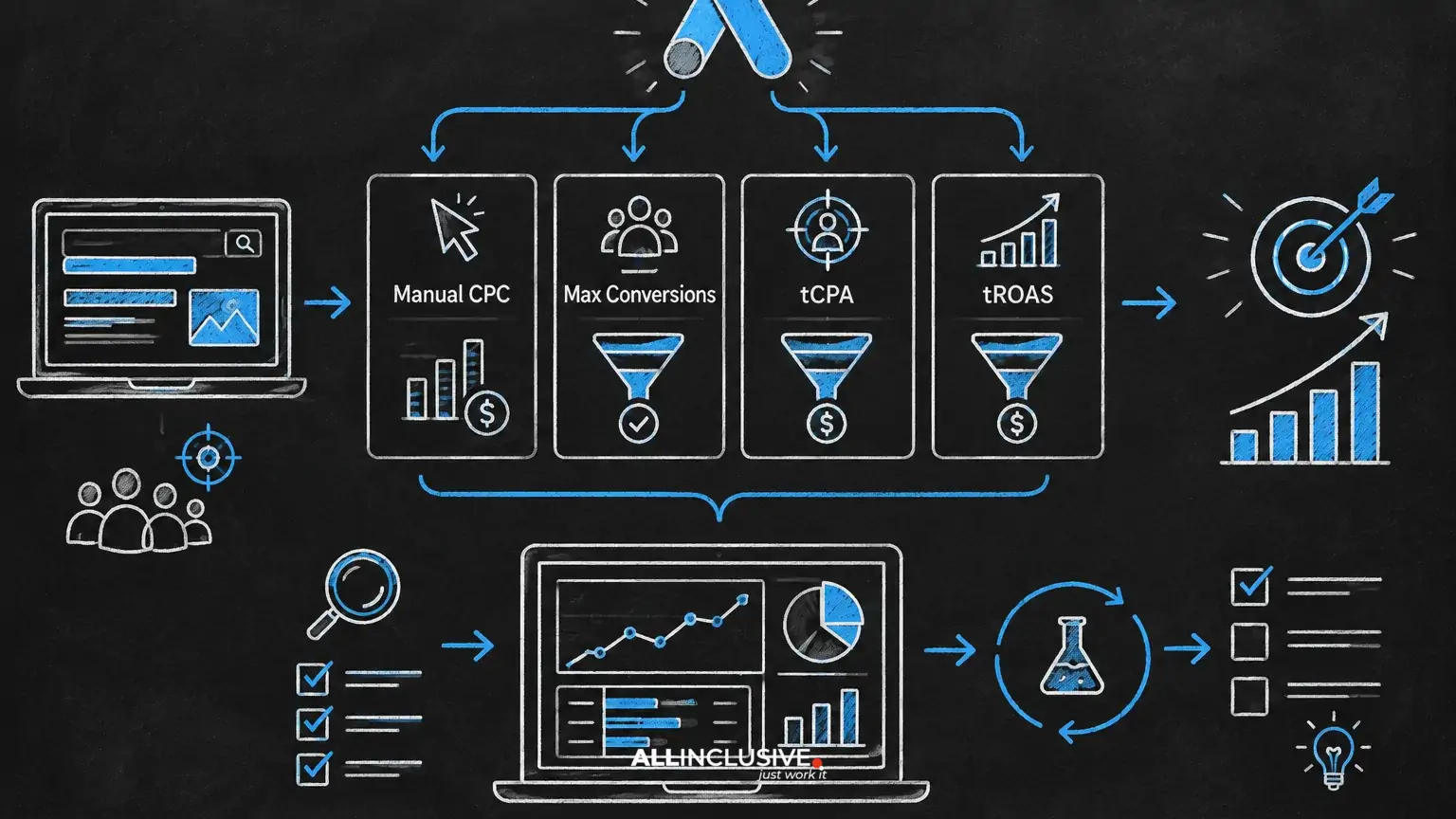
Google Ads bidding strategies determine how aggressively the platform enters auctions and what it tries to optimize. The right choice depends on your conversion data, business objective, tracking quality, budget constraints and tolerance for variation—not on a universal “best” setting.
In practical terms, Manual CPC gives you the most direct control over bids, while automated strategies such as Maximize Conversions, target CPA and target ROAS use auction-time signals to pursue a defined outcome. Automated bidding can reduce manual workload and respond to changing auction conditions, but it also depends heavily on reliable conversion measurement and sufficient signal quality.
This guide explains the major approaches, how to choose among them, and how to test changes without confusing bidding problems with issues in keywords, ads or landing pages.
What are Google Ads bidding strategies?
A bidding strategy is the rule set used to decide how much your campaign should bid for an eligible impression or click. Some strategies focus primarily on traffic and control; others use conversion or revenue signals to adjust bids toward a business outcome.
The strategy is only one part of account performance. Auction eligibility, keyword intent, ad relevance, landing-page experience, budget, conversion tracking and audience context all influence results. A bidding change cannot repair poor measurement or an offer that does not convert.
Manual CPC: control before automation
Manual CPC is designed for advertisers who want direct influence over keyword or ad-group bids. It can be useful when an account is new, conversion tracking is not yet dependable, or the team needs to understand traffic quality before handing more control to automation.
When Manual CPC makes sense
- Limited conversion history: There may not yet be enough trustworthy data for conversion-focused optimization.
- Strict traffic controls: You may need to prioritize certain keywords, match types or segments while learning which queries matter.
- Complex lead evaluation: A form submission may not represent a qualified opportunity, making raw conversion volume a weak optimization signal.
- Testing and diagnosis: Manual control can help isolate how bid changes affect impression coverage, clicks and cost.
Manual control has a cost: it requires ongoing review, and it may react more slowly than auction-time automation to signals such as device, location, query context and time. It can also create false precision if bids are adjusted frequently without enough data or without considering changes in demand.
Maximize Conversions: pursue conversion volume
Maximize Conversions is an automated strategy intended to obtain as many recorded conversions as possible within the campaign’s available budget and constraints. It is generally a stronger candidate once conversion tracking is reliable and the account has a meaningful history of the action being optimized for.
The key decision is not simply whether the campaign has conversions. It is whether those conversions represent the outcome you actually want. If the campaign counts low-value actions, duplicate events or unqualified leads, automation may efficiently pursue the wrong result.
Use Maximize Conversions when
- Your primary goal is conversion volume rather than maintaining a defined cost per conversion.
- The conversion action is clearly defined and consistently recorded.
- You can tolerate variation in cost per conversion while the system seeks more volume.
- Budget and targeting are broad enough to give the strategy opportunities to find additional converters.
Before adopting it, audit the conversion hierarchy. Separate primary optimization actions from secondary interactions such as page views, button clicks or early-stage engagement. For lead generation, consider whether qualified lead, opportunity or revenue data can eventually be fed back into the account.
Target CPA: control efficiency around a cost goal
Target CPA, often abbreviated tCPA, tells the bidding system to seek conversions around a chosen average cost per acquisition. It is useful when acquisition efficiency matters more than maximizing raw conversion volume.
A target is not a guaranteed price for every conversion. Actual costs can vary by auction, day, query and conversion lag. Setting the target below what the campaign can realistically achieve may restrict delivery or reduce volume. Setting it far above historical performance can remove useful efficiency discipline and change how aggressively the campaign spends.
How to set a responsible tCPA
- Start with reliable history: Review recent conversion volume, cost per conversion and conversion quality.
- Use a business-based threshold: Base the target on acceptable acquisition economics, not an arbitrary round number.
- Allow for variation: Evaluate the average over an appropriate period rather than judging individual days.
- Change gradually: Large target changes can alter delivery and make diagnosis harder.
- Watch volume and quality together: A lower CPA is not an improvement if qualified opportunities decline.
For lead-generation programs, tCPA should be evaluated against downstream outcomes where possible. A campaign that produces inexpensive but poorly qualified leads may look efficient in-platform while weakening sales productivity.
Target ROAS: optimize toward revenue or value
Target ROAS, or tROAS, is designed for campaigns that pass conversion values and want to optimize toward a return objective. Instead of treating every conversion as equal, it allows the system to distinguish between higher- and lower-value outcomes.
Value-based bidding is most useful when values are meaningful, consistently assigned and connected to business economics. For ecommerce, that may involve transaction value. For lead generation, it may require modeled or imported values based on lead quality, opportunity stage or expected revenue.
When tROAS is appropriate
- Different conversions have materially different business value.
- Conversion values are passed accurately and are not merely placeholders.
- The organization can explain how the target relates to margin, revenue or pipeline economics.
- The campaign has enough value data to support value-oriented optimization.
Do not use tROAS simply because revenue is available somewhere in a CRM. The value must be mapped into the advertising measurement process in a way that is timely and consistent enough to guide decisions. If all conversions receive the same nominal value, the strategy may not reflect real value differences.
How the main Google Ads bidding strategies compare
- Manual CPC: Highest direct bid control; useful for early learning, constrained testing or accounts without dependable conversion signals.
- Maximize Conversions: Prioritizes conversion volume; appropriate when the conversion action is reliable and efficiency can vary.
- Target CPA: Prioritizes conversions around an acquisition-cost goal; best when cost efficiency has a clear business threshold.
- Target ROAS: Prioritizes conversion value relative to ad spend; best when values are accurate, differentiated and strategically meaningful.
These categories should not be treated as permanent account identities. A campaign may begin with a control-oriented approach, move to volume optimization after measurement improves, and later adopt value-based bidding as the organization develops better revenue feedback.
Choose based on the signal, not the label
Use this decision sequence before changing a strategy:
- Define the real business objective. Is the priority qualified demand, total conversions, acquisition efficiency, revenue or profit?
- Audit measurement. Confirm that primary conversions fire once, reflect meaningful actions and are assigned to the correct campaigns.
- Assess data depth. Consider conversion volume, conversion lag, seasonality and whether recent performance is representative.
- Check economics. Establish the maximum acceptable CPA or minimum acceptable return before selecting a target.
- Review constraints. Budget, geographic limits, brand restrictions, inventory and audience size can limit what automation can achieve.
- Choose the simplest strategy that fits. More automation is not automatically more sophisticated if the input signal is weak.
If the goal is traffic exploration and tracking is immature, Manual CPC may be a reasonable temporary choice. If the goal is more recorded conversions and the signal is dependable, Maximize Conversions may fit. If the business has a defined acquisition threshold, consider tCPA. If values differ and are measured credibly, tROAS may be the better long-term direction.
Implementation: prepare before changing bids
1. Validate conversion tracking
Check the conversion action, counting method, attribution settings, deduplication, consent-related measurement behavior and import timing. Review whether reported conversions are duplicates, micro-actions or actions that sales does not recognize as valuable.
2. Separate diagnosis from bidding
Before changing strategy, examine search terms, match behavior, ad-to-query relevance and landing-page experience. A campaign can have an appropriate bid strategy and still waste budget on irrelevant intent. Use the Google Ads search terms guide to structure query review and negative-keyword decisions.
3. Establish a baseline
Record spend, impressions, clicks, conversion volume, cost per conversion, conversion rate, conversion value and lead quality where available. Include the date range and note major changes in budget, targeting, creative or landing pages.
4. Make one material change at a time
Changing bidding, budget, targeting and landing pages simultaneously makes the result difficult to interpret. Sequence changes where possible, and give performance enough time to reflect conversion lag before drawing conclusions.
5. Protect the post-click experience
Bidding can increase the likelihood of entering an auction, but it cannot make an unclear or slow landing page persuasive. Review message match, page speed, form friction and calls to action alongside campaign settings. For a deeper framework, see the guide to Google Ads landing pages.
Common bidding mistakes
- Optimizing to every available conversion: More tracked actions do not necessarily mean more business value.
- Setting targets from aspiration alone: A target must reflect observed performance and unit economics.
- Judging automation too quickly: Conversion lag and normal auction variation can make short windows misleading.
- Ignoring budget constraints: A strategy cannot find additional qualified demand when budget, targeting or inventory is severely limited.
- Changing targets repeatedly: Frequent adjustments make it difficult to determine whether the strategy is improving.
- Using bidding to solve relevance problems: Poor keyword intent, weak ads or an unsuitable landing page require separate fixes.
A practical testing framework
Start with a clearly defined hypothesis: for example, “A conversion-focused strategy will increase qualified lead volume without exceeding our acceptable acquisition cost.” Specify the campaign scope, primary conversion, evaluation period, guardrails and success measures before making the change.
Monitor both leading and business metrics. Leading indicators may include impressions, clicks, cost and conversion rate. Business indicators may include qualified leads, opportunities, revenue, margin or sales acceptance. If the platform metric improves while downstream quality declines, the strategy is not succeeding.
Use campaign segmentation carefully. Splitting data across too many small campaigns can weaken the signal available to automated bidding. Conversely, combining campaigns with materially different goals can make a shared strategy optimize toward an unhelpful average.
Where bidding fits in the larger paid-search system
Bidding is a lever, not a complete account strategy. Sustainable performance typically requires alignment among query intent, keyword coverage, ad relevance, landing-page experience, measurement and commercial follow-through. Quality Score can help diagnose relevance-related conditions, but it should not become the sole optimization objective; the Google Ads Quality Score guide explains how to use it appropriately.
For broader planning across search, social and other acquisition channels, explore Allinclusive’s paid media resources. For search-specific planning and execution, see the paid search pillar.
Google Ads Bidding Strategies: What to Prioritize
The best Google Ads bidding strategies are matched to the quality of the signal and the business objective. Manual CPC can provide useful control while an account learns. Maximize Conversions can pursue volume when tracking is dependable. tCPA adds an efficiency constraint, while tROAS is designed for credible value-based optimization.
Choose the strategy your measurement and economics can support, make changes deliberately, and judge performance using business outcomes rather than platform metrics alone.